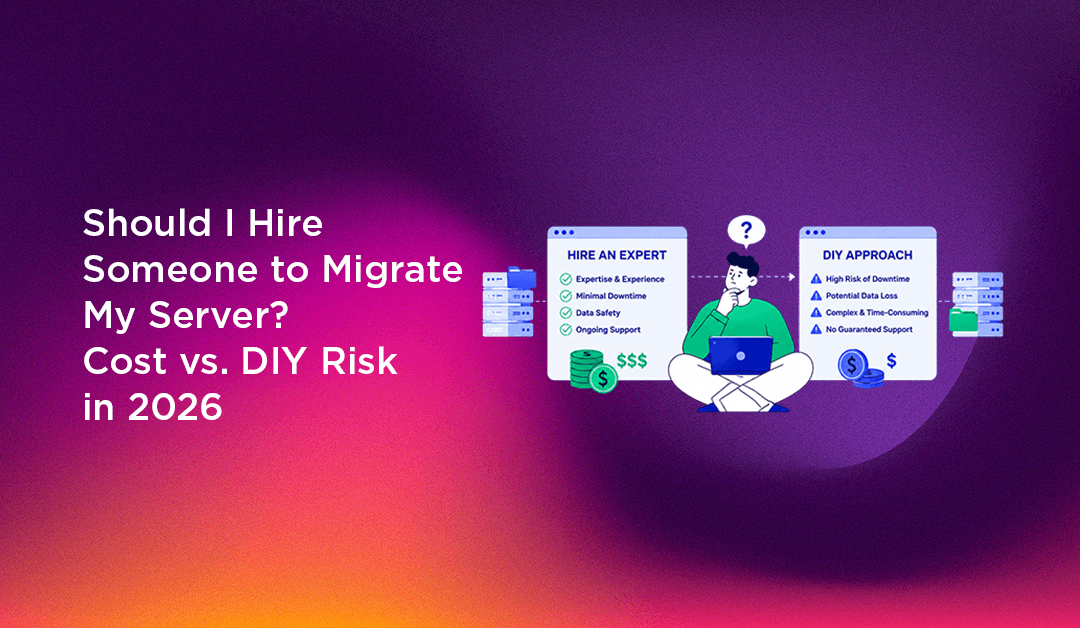
Planning a server migration and deciding whether to handle it in-house or outsource it? The data leans heavily toward outsourcing for most businesses — 70% of companies using external expertise report faster completion, and 62% see reduced downtime. Here's the real cost and risk comparison for 2026.
What Is Server Migration and Who Needs It?
Server migration means moving your applications, databases, and configurations from one server or hosting environment to another — whether that's a hardware refresh, a cloud move, or a provider switch. Any business outgrowing its current server, facing end-of-life hardware, or switching providers needs a migration plan that avoids downtime and data loss.
Outsourced vs In-House Server Migration: Which Is Right for You?
| In-House Migration | Outsourced Migration | |
|---|---|---|
| Speed | Slower — 41% of orgs report a shortage of in-house cloud/migration expertise | 70% faster completion reported by companies using external experts |
| Downtime risk | Higher — learning curve on unfamiliar migration tooling | 62% of businesses report reduced downtime with outsourced experts |
| Cost predictability | Open-ended — scope creep is common | Scoped/fixed-price contracts, easier to budget |
| Best for | Fewer than 30 workloads, simple compliance needs, teams wanting full control | 100+ workloads, tight deadlines (under 6-9 months), or complex compliance |
How Much Does Server Migration Cost?
Enterprise-scale cloud migrations can run into the hundreds of thousands to over a million dollars depending on scope, but for small-to-mid-size businesses, a scoped server migration (Linux or Windows, single-to-few servers) is typically $500–$5,000 as a one-time project, depending on data volume and downtime tolerance.
What to Look for in a Server Migration Provider
- Proven migration frameworks — automation tooling that reduces manual error
- Documented rollback plan — in case something breaks mid-migration
- Cross-platform experience — Linux and Windows, cPanel/Plesk/DirectAdmin
- Minimal-downtime approach — staged cutover rather than a single risky switch
- Post-migration verification — DNS propagation, SSL, file permissions, and database integrity checks
Why Businesses Choose CloudHouse for Server Migration
CloudHouse Technologies handles server migration for Linux and Windows environments with a documented rollback plan and post-migration verification — billed hourly, so migration cost stays scoped to your actual server count and data volume.
Frequently Asked Questions
Is it cheaper to migrate a server in-house or outsource it?
For businesses with fewer than 30 workloads, in-house can work, but outsourcing typically offers better cost predictability through scoped/fixed-price contracts and avoids the open-ended cost of a learning curve on unfamiliar tooling.
How long does a server migration take?
A single-to-few-server migration typically takes 1-3 days of elapsed time; larger multi-server or compliance-driven migrations can take weeks.
Will there be downtime during migration?
A properly staged migration minimizes downtime through a phased cutover — outsourced experts report 62% lower downtime incidence versus in-house-led migrations.
Do you offer a one-time migration without an ongoing contract?
Yes — CloudHouse bills server migration hourly as a scoped one-time project, with no requirement for an ongoing support contract afterward.
What happens if something breaks during migration?
A documented rollback plan should be in place before migration begins — this is one of the key things to confirm with any provider before hiring them.