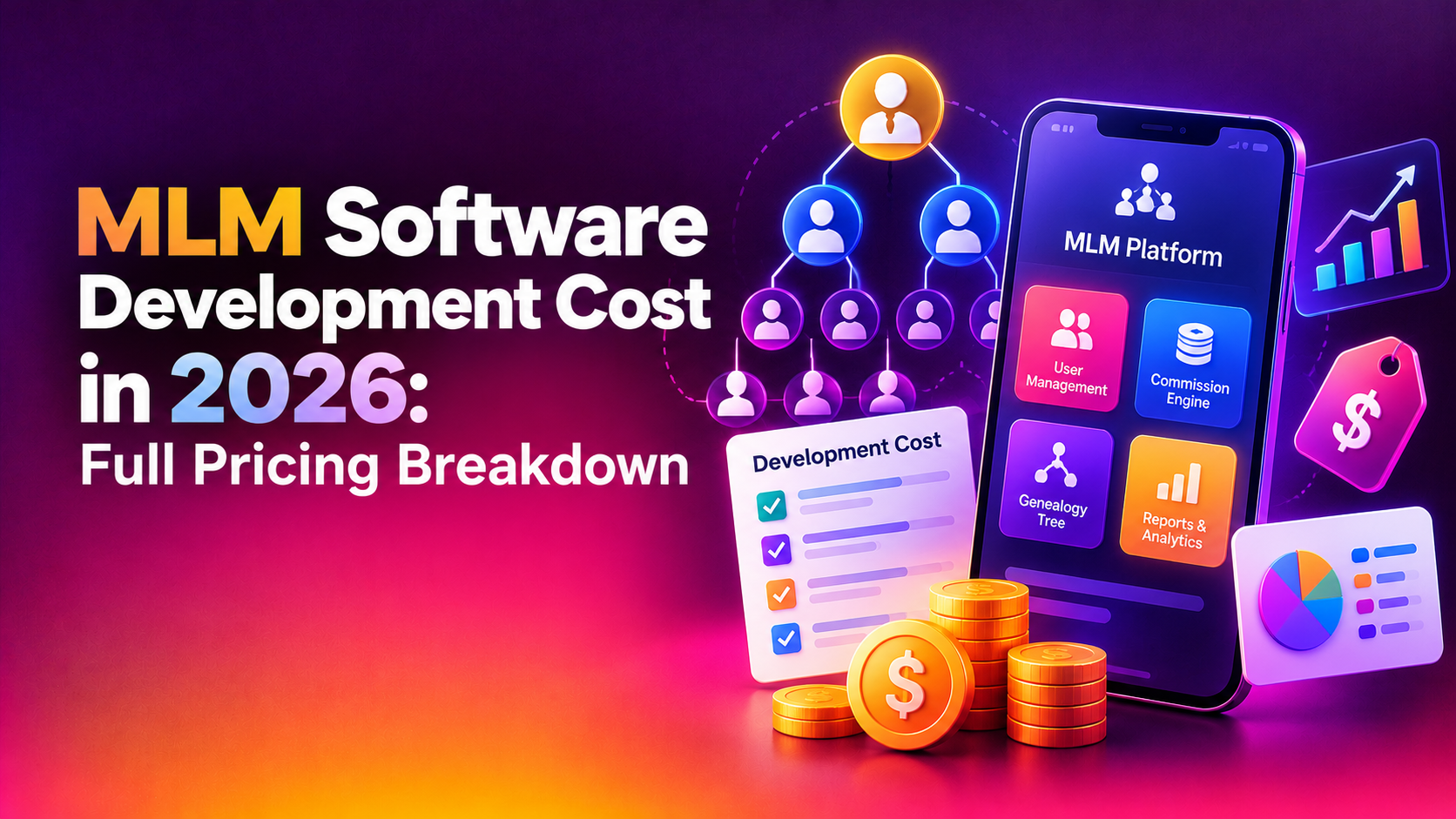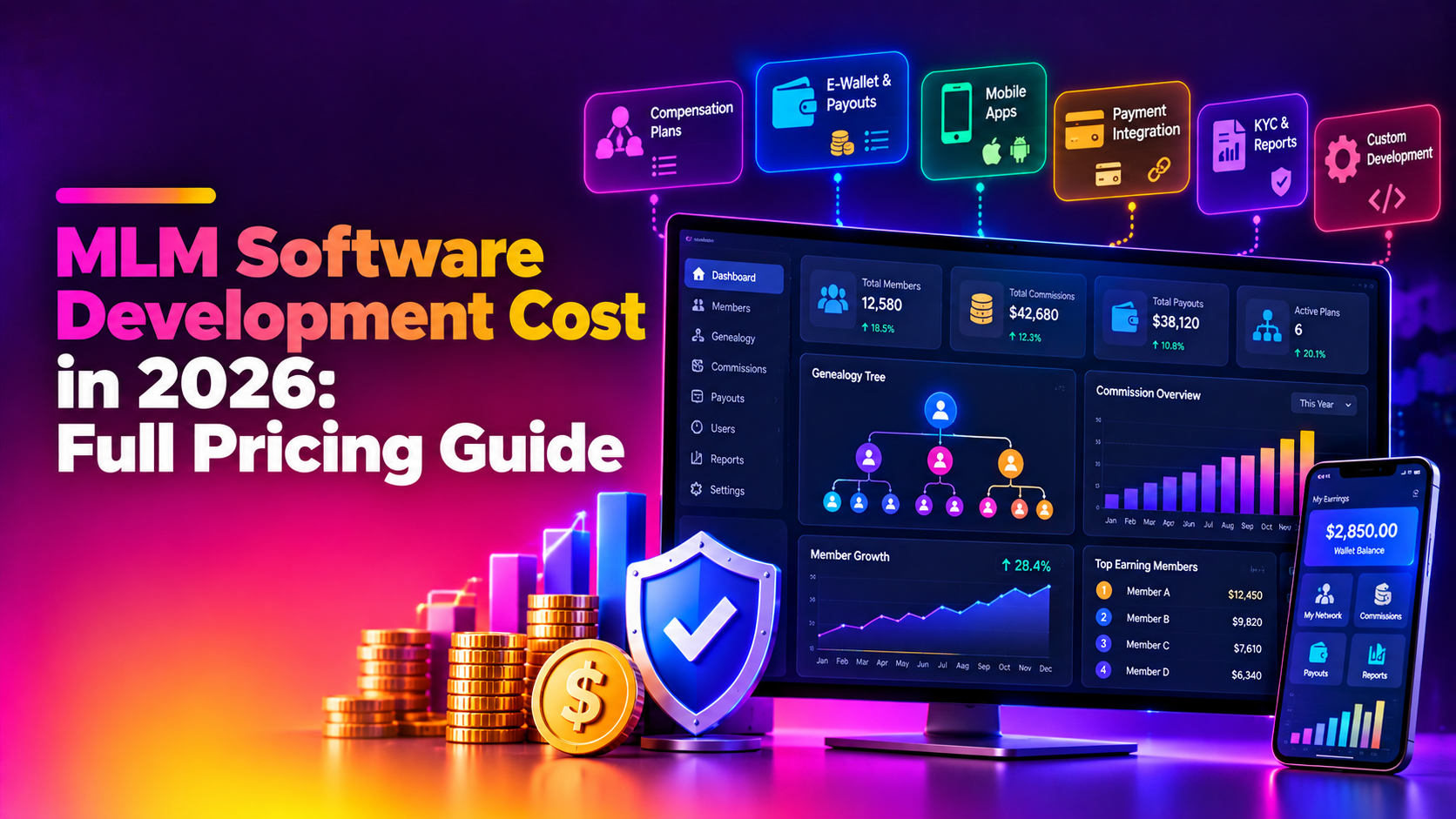
If you have spent the last few weeks collecting quotes for a custom MLM platform, you already know the problem: one vendor says $2,000, another says $35,000, and neither one explains why. MLM software development cost in 2026 depends almost entirely on your compensation plan structure, the features you bolt onto it, and whether you build in-house or outsource to a dedicated development partner. This guide breaks down real 2026 pricing by plan type, so you can sanity-check any quote you receive before signing a contract.
What Determines MLM Software Development Cost?
Before comparing numbers, it helps to understand what actually drives the price of a network marketing platform. Vendors rarely price a "generic MLM software" — they price a specific combination of the following factors, and understanding each one will make you a much sharper buyer:
- Compensation plan complexity — binary, matrix, unilevel, board, and hybrid plans each require different commission-calculation logic, and that logic is where most engineering hours go
- Genealogy tree depth and visualisation — real-time tree rendering for large downlines with thousands of active distributors is computationally heavier than a flat report or a simple list view
- Payment and payout integrations — e-wallets, bank payouts, crypto wallets, and multi-currency support all add development hours and testing overhead
- Mobile app requirement — a companion Android/iOS app for distributors typically adds 30-50% to the base cost, since it usually means building a parallel UI and API layer
- Third-party integrations — CRM, SMS/email gateways, KYC/AML verification, accounting software, and shipping/logistics connections for product-based MLMs
- Team size and location — an in-house senior developer in the US costs far more per hour than a dedicated offshore team with MLM-specific experience
- Security and compliance requirements — MLMs operating in regulated markets often need additional audit logging, data residency controls, and anti-pyramid-scheme compliance checks built in from day one
The single biggest variable, though, is the compensation plan itself. Plan logic is where most of the custom engineering hours go, which is why mlm software development price quotes swing so wildly between vendors quoting on the same feature list.
MLM Software Development Cost in 2026 (By Plan Type)
Below are realistic 2026 ballpark ranges for a genuinely custom build (not a reused white-label template) covering member management, a genealogy tree, an e-wallet, and standard reporting. Ranges widen at the top end once rank advancement, matching bonuses, or crypto payouts are added on top of the base plan.
| Compensation Plan | Basic Build | Advanced Build (bonuses, rank logic) | Typical Timeline |
|---|---|---|---|
| Binary Plan | $3,000 – $8,000 | $10,000 – $15,000 | 6 – 10 weeks |
| Matrix Plan | $5,000 – $10,000 | $12,000 – $18,000 | 7 – 11 weeks |
| Unilevel Plan | $4,000 – $8,000 | $10,000 – $15,000 | 6 – 10 weeks |
| Board / Cyclic Plan | $6,000 – $12,000 | $14,000 – $22,000 | 8 – 12 weeks |
| Hybrid Plan (2+ combined) | $10,000 – $18,000 | $20,000 – $35,000+ | 10 – 16 weeks |
These figures assume a web-based admin and back-office panel. If you also need a binary MLM software build with a full mobile companion app, or if you're comparing a matrix MLM software setup against a unilevel MLM software structure, expect the mobile app alone to add another $4,000–$10,000 depending on platform count and design complexity. For a board MLM software plan specifically, budget on the higher end of the range because cyclic re-entry logic and pool distribution rules require more thorough testing than a straightforward binary payout.
It's also worth noting that these numbers reflect development cost only. Hosting, SMS/email credits, payment gateway fees, and third-party KYC verification services are typically billed separately on a monthly or per-transaction basis, so don't mistake a development quote for your total first-year budget.
Features That Increase or Reduce the Price
Not every feature is worth paying for on day one. Here is what genuinely moves the needle on custom mlm software cost, based on what actually adds engineering hours versus what's marketing dressing:
Features that increase cost
- Cryptocurrency wallet or token integration ($5,000–$20,000+ depending on scope and blockchain choice)
- Real-time, zoomable genealogy tree with thousands of nodes and live commission preview
- Multi-currency and multi-language back office for global distributor networks
- Advanced fraud detection and KYC/AML compliance workflows for regulated markets
- Native iOS and Android apps rather than a responsive web app
- Custom rank-advancement engines with dozens of qualification rules and auto-recalculation
- Inventory and product-shipment tracking for product-based (as opposed to pure recruitment-based) MLMs
Features that reduce cost
- Starting with a single compensation plan instead of a hybrid model, with room to extend later without a full rebuild
- Using a proven modular framework instead of building every module — genealogy tree, wallet, reporting — entirely from scratch
- Launching with a responsive web app and adding native mobile apps in phase two, once you've validated the plan with real distributors
- Reusing standard payment gateways instead of building custom payout rails from the ground up
A well-scoped mlm compensation plan software pricing conversation with your development partner should walk through this list line by line — if a vendor quotes a flat number without asking about any of these, treat that quote with suspicion. The same applies to binary mlm software cost quotes specifically: ask whether matching bonuses, flush-out rules, and weak-leg carry-forward are included in the base price or billed as add-ons, since these three features alone can account for a third of total binary plan development time.
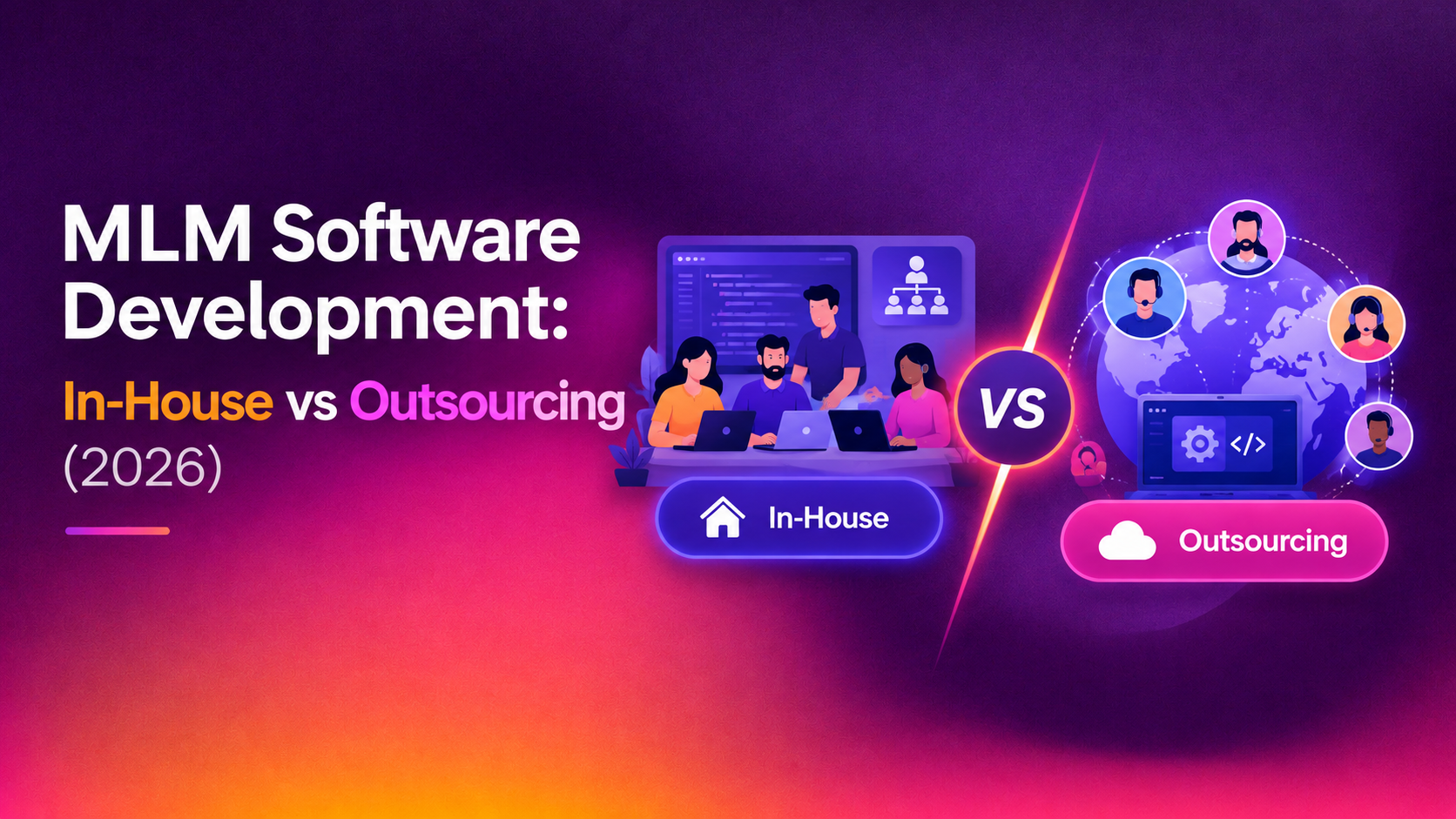
In-House vs Outsourced MLM Software Development
Founders often ask whether it's cheaper to hire an in-house team. In almost every case for a first build, it isn't.
- In-house team: A single mid-level developer costs $60,000–$100,000+ per year in salary alone in the US, before benefits, tooling, and management overhead — and MLM compensation logic is a niche skill most generalist developers have never touched, meaning the first few months are effectively a learning curve you're paying for.
- Outsourced/dedicated team: A specialised MLM development partner has already built binary, matrix, unilevel, and board engines multiple times, so the same feature set that would take an in-house generalist team 4-5 months typically ships in 6-12 weeks, with fewer commission-calculation bugs at launch.
- Ongoing cost: Yearly maintenance, hosting, and feature upgrades typically run 15-30% of the original build cost regardless of who built it — factor this into your first-year budget either way, since it's easy to overlook when comparing an in-house salary line against a one-time development quote.
- Risk profile: A commission-engine bug discovered after launch, once real payouts are flowing, is far more expensive and reputationally damaging to fix than the same bug caught during a structured QA phase with an experienced outsourced team.
For most direct-selling companies under 50,000 distributors, outsourcing to a team that specialises in MLM software development comes out cheaper on a like-for-like feature basis, and ships faster, without the overhead of building and managing an in-house engineering team from scratch.
Why MLM Companies Choose CloudHouse for Custom Software
CloudHouse builds binary, matrix, unilevel, and board MLM platforms from scratch rather than reselling a rebranded template, which means your compensation logic, branding, and integrations are genuinely yours — no vendor lock-in on future changes. Clients get transparent, itemised quotes broken down by plan complexity (not a single opaque number), plus ongoing hourly support after launch instead of being pushed into an expensive annual retainer. Every build includes a genealogy tree, e-wallet, and admin back office as standard, so you're never paying extra for the basics, and our team has already shipped and stress-tested every compensation model listed in the pricing table above.
How Development Cost Is Typically Structured
Most MLM software vendors and dedicated development teams break a project into three or four payment milestones rather than asking for the full amount upfront: an initial deposit (often 20-30%) to begin discovery and wireframing, a second payment tied to completion of the core compensation engine and genealogy tree, a third tied to payment gateway and wallet integration, and a final payment on delivery after user-acceptance testing. This milestone structure protects both sides — you are not paying for work that has not been demonstrated, and the development team has enough committed budget to properly staff the project. When comparing quotes, ask each vendor to lay out their milestone breakdown explicitly; a vendor that only offers 50% upfront and 50% on delivery, with nothing tied to specific deliverables in between, is a common source of scope disputes later in the project.
Frequently Asked Questions
How much does MLM software development cost in 2026?
A genuinely custom build ranges from roughly $3,000 for a basic binary or unilevel plan to $35,000+ for a hybrid plan with crypto integration and native mobile apps. Most mid-sized direct-selling companies land between $8,000 and $18,000 for a full-featured single-plan platform.
How long does it take to build custom MLM software?
A basic single-plan build typically takes 6-10 weeks. Adding rank advancement, matching bonuses, mobile apps, or crypto payouts extends the timeline to 10-16 weeks. Rushing this timeline usually means cutting corners on testing the commission engine, which is the one place you cannot afford bugs once distributors are being paid from it.
Which MLM compensation plan is cheapest to build?
Binary and unilevel plans are generally the cheapest to build in their basic form because the commission logic is more straightforward than board or hybrid plans. However, "cheapest to build" isn't the same as "best fit" — the right plan depends on your product margins and recruitment structure, not development cost alone.
Do MLM software vendors charge one-time fees or subscriptions?
Both models exist. Off-the-shelf and white-label MLM software is usually sold as a subscription starting around $500-$1,500/month. Custom-built software is typically a one-time development fee plus an optional annual maintenance contract (usually 15-30% of build cost), which gives you full ownership of the code rather than renting access to a shared platform.
What's the real difference between cheap $999 MLM software and a $10,000+ custom build?
Sub-$1,000 packages are almost always white-label templates shared across many clients, with limited ability to customise compensation logic or integrations, and you're typically one of hundreds of businesses running the same underlying codebase. A custom build gives you a compensation engine designed around your exact plan rules, your own codebase, and the ability to add features like crypto payouts or native apps without waiting on a third-party vendor's shared roadmap.