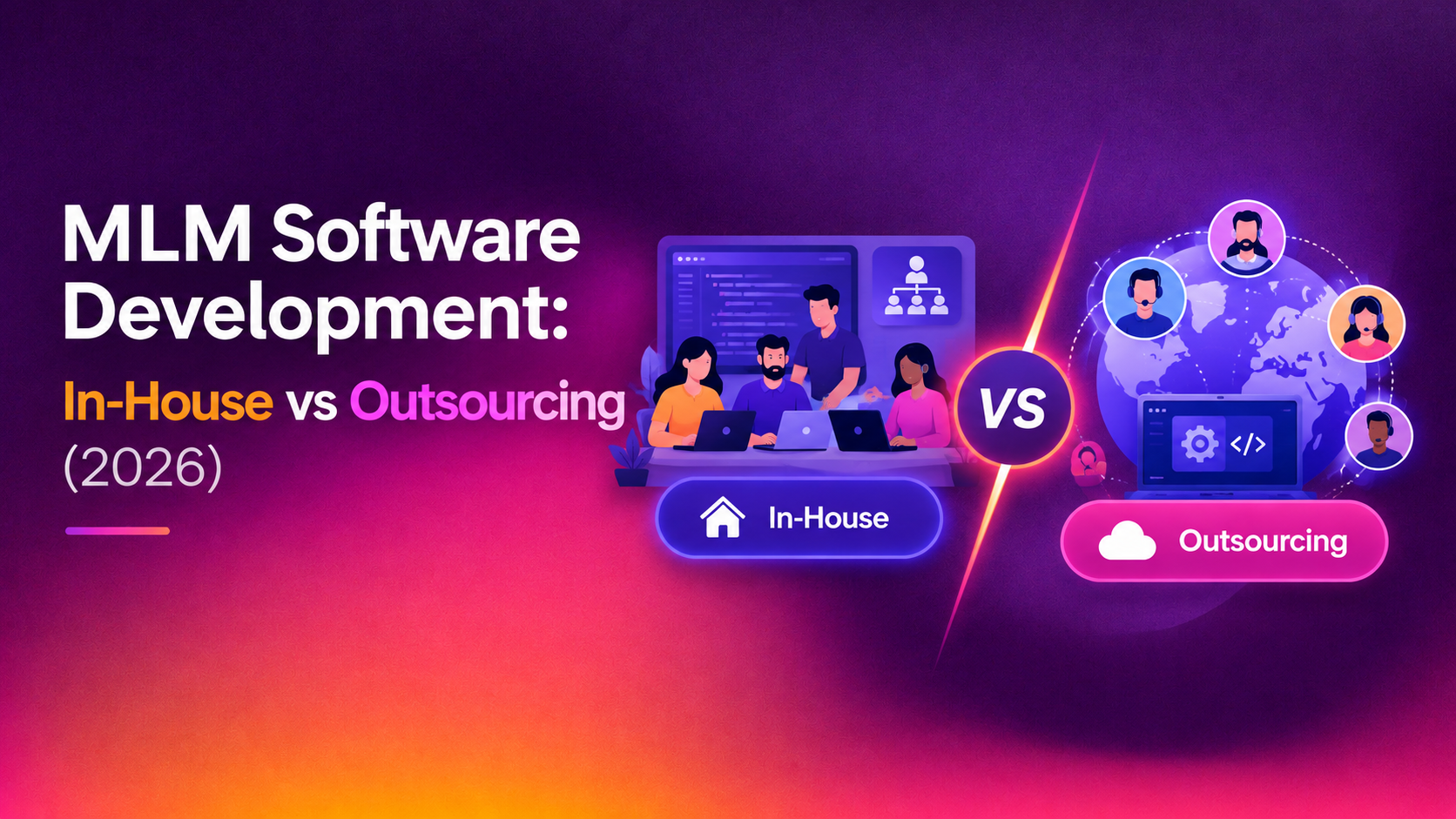
Choosing between building an in-house team and outsourcing to a specialist vendor is the single most consequential decision a network marketing founder makes before launch. Get the mlm software development in-house vs outsourcing call wrong, and you either burn six figures on a team that can't ship a compliant compensation engine, or you get locked into a rigid off-the-shelf platform that can't grow with your plan. This guide breaks down the real cost, compliance, and timeline tradeoffs — not just compensation plan theory — so you can make the call with numbers instead of guesswork.
What Is Custom MLM Software Development and Who Needs It?
Custom MLM software development means building a direct-selling platform — genealogy tree, commission engine, wallet, KYC, and reporting — tailored to your exact compensation plan rather than forcing your business model into a generic template. It's the right call for any network marketing company that has outgrown a spreadsheet-and-plugin setup, is launching a new comp plan (binary, matrix, unilevel, board, or hybrid), or operates across multiple countries with different payout and tax rules.
It's also the right call the moment your existing off-the-shelf platform can't represent a rule change your legal or compensation team wants to make. Template MLM software is built around a fixed set of plan variants; when your business needs a custom cap on binary flush amounts, a hybrid unilevel-plus-matrix structure, or a region-specific tax withholding rule, a templated system either can't do it or requires an expensive, risky workaround from the vendor.
If you're still deciding whether to build mlm software in-house or bring in a custom mlm software company, the decision usually comes down to five questions: Do you have compensation-plan engineering expertise on staff? Can you afford the ongoing compliance overhead? How fast do you need to launch? What happens to your roadmap if a key engineer leaves? And do you have the internal bandwidth to own security patching, uptime monitoring, and payment gateway maintenance indefinitely?
Building In-House: Cost and Compliance Risk
An in-house team sounds appealing because you "own everything" — but MLM software isn't a typical CRUD app. Commission calculation logic for binary and matrix plans involves recursive tree traversal, real-time bonus splitting, and rollback handling for returns and chargebacks. Get this wrong and distributors don't get paid correctly, which triggers disputes, churn, and in some jurisdictions, regulatory scrutiny from anti-pyramid-scheme regulators who scrutinize payout structures closely.
A realistic in-house build requires a minimum of a backend engineer, a frontend engineer, a QA specialist familiar with financial logic, and a DevOps resource for uptime — plus a project manager to keep the compensation plan, legal, and finance teams aligned. Add a part-time compliance or legal advisor once you operate in more than one country, since income disclosure statements and payout tax rules vary by jurisdiction. Fully-burdened, an in-house MLM engineering team typically runs $15,000–$40,000+ per month depending on region and seniority, before you've shipped a single payout cycle.
Timelines commonly stretch to 6-9 months for a first stable release, because most in-house teams are learning MLM-specific compliance (anti-pyramid regulations, income disclosure requirements, cross-border payout tax rules) for the first time on your dime. That learning curve isn't just slower — it's where the expensive mistakes happen: a mis-modeled binary flush rule discovered after three payout cycles means retroactively recalculating commissions for every distributor in the downline, which is both a technical and a trust problem.
The compliance risk compounds after launch too. Every new compensation plan tweak, regulatory change, or payment gateway update needs the same specialized knowledge, and losing even one key engineer — the one who actually understands the tree-traversal and bonus-splitting logic — can stall your roadmap for months while a replacement gets up to speed. Documentation rarely captures every edge case discovered in production, so institutional knowledge walks out the door with the person.
There's also a hidden cost most founders underestimate: infrastructure and tooling. An in-house team still needs to stand up hosting, monitoring, backup and disaster-recovery processes, and a QA environment that can simulate thousands of distributors across multiple compensation cycles before a plan change goes live. Skipping that step to save time is exactly how payout bugs reach production.
Outsourcing to an MLM Software Specialist: What You Get
When you outsource mlm software development to a vendor that has already built dozens of comp-plan engines, you're buying pre-solved problems: tested tree-traversal logic, audited payout calculations, and built-in compliance guardrails for KYC, tax, and disclosure reporting. A specialist mlm compensation plan software vendor has already hit the edge cases — split payouts, plan migrations, multi-currency wallets, partial refunds mid-cycle — that an in-house team would discover the hard way in production.
The realistic mlm software development team cost for outsourced custom builds ranges from $10,000-$25,000 for a growing business with a moderately complex plan, up to $30,000+ for enterprise-grade custom systems with full integrations (payment gateways, SMS/email automation, e-wallet providers, accounting software) — a fraction of the ongoing burn of an internal team, and delivered in 8-14 weeks rather than 6-9 months. You also get ongoing support and plan updates on-demand instead of maintaining permanent headcount, which matters most in year two and three when your comp plan inevitably evolves as the business scales.
Specialist vendors also bring something in-house teams rarely have on day one: a library of pre-audited edge cases across compensation types. Binary plans need flush and carry-forward logic tested against thousands of simulated distributor trees; matrix plans need spillover and re-entry rules validated against cap conditions; unilevel plans need level-based commission caps that don't silently break when a distributor's downline exceeds expected depth. A vendor that has shipped several of each plan type has already found and fixed the bugs that would otherwise surface as unhappy distributors and support tickets.
The biggest objection founders raise here is lock-in — the fear of ending up on a rigid platform that can't be modified later. That's a real risk with template-based MLM software resellers, but not with a genuine custom mlm software company that builds on your own codebase and infrastructure, giving you full source-code ownership and the flexibility to evolve the plan without a rebuild. Before signing with any vendor, confirm in writing: who owns the source code, whether the codebase is delivered to a repository you control, what the hand-off process looks like if you switch vendors later, and what the support-level agreement covers post-launch. CloudHouse's custom MLM software development engagements are built this way — source-owned, not templated, with the full codebase handed to your own repository.
Cost and Compliance Deep Dive
Cost comparisons between in-house and outsourced MLM development often stop at monthly salary versus project fee, but that misses three recurring line items that show up regardless of which path you choose:
- Compliance auditing: Anti-pyramid regulations (particularly in the US, India, and parts of the EU) require documented proof that commissions are tied to actual product sales rather than recruitment alone. An in-house team needs to build and maintain this audit trail from scratch; a specialist vendor typically has audit-ready payout logs baked into the platform already.
- Payment gateway and tax integration: Cross-border payouts trigger withholding tax obligations that differ by country. Building this logic in-house means researching and re-testing tax rules per market; an experienced vendor has usually already integrated with multiple regional payment and tax providers.
- Ongoing plan changes: No compensation plan stays static for three years. Whether it's adding a new bonus tier, adjusting a matrix width, or introducing a new rank qualification rule, someone has to implement and test that change without breaking existing payout history. This is where in-house teams either stall (waiting on the one engineer who understands the codebase) or outsourced support contracts pay for themselves.
On the compliance side specifically, income disclosure statements are now a standard expectation from regulators and from more sophisticated distributors themselves. Your platform should be able to generate accurate historical earnings data per distributor on demand — not as a manual export job someone builds after a regulator asks for it.
Side-by-Side Comparison: In-House vs Outsourced
| Factor | In-House Team | Outsourced MLM Specialist |
|---|---|---|
| Upfront cost | $15,000–$40,000+/month (ongoing) | $10,000–$30,000+ one-time or milestone-based |
| Time to launch | 6–9 months (learning curve included) | 8–14 weeks |
| Compensation-plan compliance expertise | Built from scratch, high risk of errors | Pre-tested across binary, matrix, unilevel, board, hybrid |
| Cross-border tax and payout compliance | Researched and built per market, high effort | Often pre-integrated with regional providers |
| Ongoing maintenance | Requires permanent headcount | On-demand support contracts |
| Key-person risk | High — one engineer leaving can stall the roadmap | Low — vendor team and documentation persist |
| Source code / platform ownership | Full ownership by default | Full ownership (if vendor builds custom, not templated) |
| Risk of vendor lock-in | None | Low, if you choose a custom-build vendor over a reseller |
| Infrastructure and DevOps burden | Owned entirely internally | Typically included in vendor engagement |
| Best for | Large enterprises with dedicated tech budgets and existing engineering depth | Growing and mid-size direct-selling companies that need to launch fast without a permanent engineering department |
How to Decide: A Practical Framework
If you already run an engineering team of five or more with prior fintech or financial-calculation experience, and you have 6-9 months of runway before you need to be live, in-house can work — particularly for large enterprises that plan to keep evolving the platform for a decade or more and want that expertise permanently on staff.
For most growing and mid-size direct-selling companies, though, the math favors outsourcing to a specialist: lower total cost in year one, a launch timeline measured in weeks rather months, and compliance logic that's already been through real-world edge cases instead of being discovered the hard way after distributors start complaining about incorrect payouts. The hybrid approach many founders land on — a small internal product owner managing a specialist outsourced engineering team — often captures the best of both: business context stays in-house, engineering risk sits with the specialist.
Why Businesses Choose CloudHouse for MLM Development
CloudHouse builds MLM platforms as fully custom, source-owned systems rather than reselling a templated engine — so you get the speed and cost advantage of outsourcing without the lock-in risk founders worry about most. Our team has shipped binary, matrix, board, and unilevel compensation engines with built-in KYC, multi-currency wallets, and audit-ready payout logs, backed by ongoing support so your plan can evolve without a rebuild.
If you're weighing an internal hire against a specialist partner, talk to our MLM software development team before committing budget either way — we'll give you a straight answer on which path fits your comp plan and timeline.