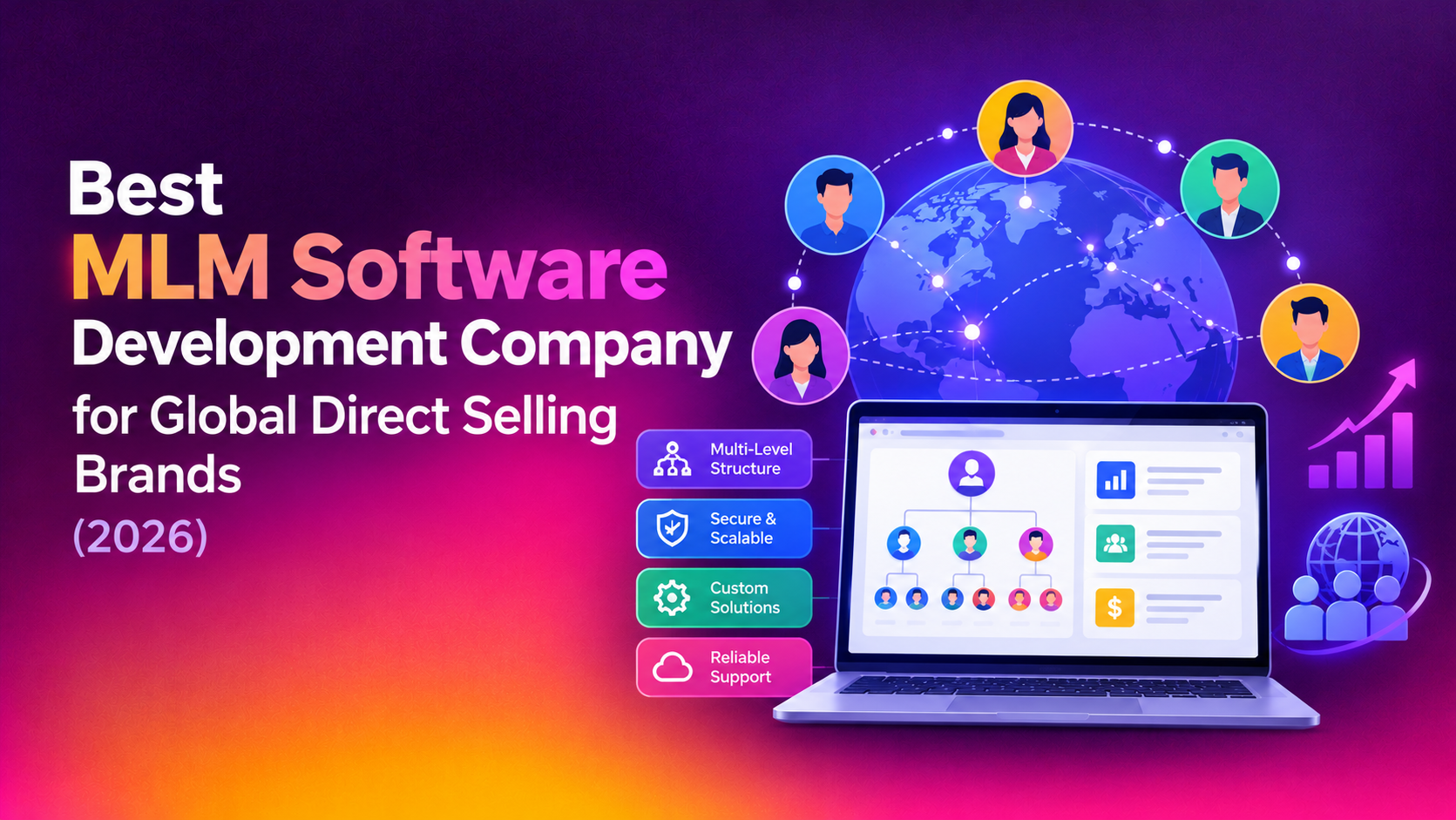
If you are scaling a direct selling brand across borders, choosing the best MLM software development company for direct selling brands is one of the highest-stakes technology decisions you will make this year. A generic local dev shop can build you a binary tree calculator, but it cannot guarantee your commission engine survives a launch in Mexico with peso rounding rules, a rollout in the UAE with Arabic RTL support, or a compliance audit in a market with strict anti-pyramid regulations. This guide breaks down exactly what separates a true global MLM software provider from a template reseller, and how to evaluate vendors before you sign a contract.
Why Global Direct Selling Brands Need More Than "MLM Software"
Most direct selling founders start their vendor search by typing "MLM software" into Google and end up comparing feature checklists that all look identical: binary plan, matrix plan, unilevel plan, e-wallet, mobile app. The real differentiator only shows up once you go international. A direct selling software company that has never shipped a multi-currency payout engine will discover — in production, with real distributors waiting on commissions — that currency conversion timing, rounding logic, and cross-border tax withholding are genuinely hard engineering problems, not checkbox features.
This is the gap CloudHouse Technologies was built to close. As a MLM software development company with hands-on experience across binary, matrix, unilevel, and board compensation structures, our engineering team treats global rollout requirements — multi-currency ledgers, multi-language distributor portals, regional payment gateways — as first-class architecture decisions, not bolt-on modules added after launch.
The Real Cost of Picking the Wrong Vendor
Founders who choose based on price alone almost always pay for it later. Here is what actually goes wrong when a generic dev shop builds MLM software without global experience:
- Commission miscalculations in secondary currencies that erode distributor trust within the first payout cycle.
- Hardcoded compensation logic that requires a full rebuild when you add a new plan type or country-specific bonus.
- No localization architecture, meaning every new language is a separate, expensive re-implementation instead of a configuration change.
- Weak audit trails that create regulatory exposure in markets with anti-pyramid scrutiny (India, several EU states, parts of Southeast Asia).
- Vendor lock-in with undocumented, unmaintainable code that makes switching providers later extremely painful.
Each of these is a direct hit to distributor retention and revenue — the two metrics that matter most to a network marketing business.
Evaluation Table: What to Compare When Choosing an MLM Software Vendor
Use this table as a working scorecard when you shortlist vendors. Score each provider from 1-5 on every row before you commit to a contract.
| Evaluation Criteria | Generic Local Dev Shop | Off-the-Shelf MLM Platform | CloudHouse Technologies |
|---|---|---|---|
| Multi-currency payout engine (native, not bolted on) | Rarely built in | Often limited to major currencies | Built into core architecture |
| Multi-language distributor portal (RTL support included) | Manual translation only | Depends on plan tier | Configurable at deployment |
| Compensation plan flexibility (binary/matrix/unilevel/board/hybrid) | Usually one plan type only | Pre-set templates | Custom-built to your plan logic |
| Regional payment gateway integration | Ad hoc, one at a time | Limited to gateway partners | Multiple gateways per region |
| Source code ownership | Sometimes | Rarely — SaaS lock-in | Full ownership, no lock-in |
| Compliance and audit trail depth | Minimal | Varies | Built for regulatory scrutiny |
| Post-launch support and iteration | Often disappears after handover | Ticket-based SLA | Dedicated engineering support |
Notice the pattern: the deciding factor is rarely "can they build a binary tree." It is whether the vendor has actually shipped multi-currency MLM software and MLM compensation plan software that survived a real international launch.
Core Features a Global-Ready MLM Platform Must Have
1. A Currency-Agnostic Commission Engine
Your compensation engine should calculate commissions in a base currency and convert to local payout currencies at settlement time, with configurable rounding rules per country. This avoids the classic bug where distributors in two countries receive mathematically inconsistent payouts for identical sales volume.
2. True Localization, Not Just Translation
Multi-language support has to cover distributor dashboards, e-wallet statements, genealogy trees, and automated notification emails — including right-to-left layouts for Arabic and Hebrew markets. Bolting Google Translate onto an English-only UI is not localization.
3. Modular Compensation Plan Configuration
Whether you run binary, matrix, unilevel, board, or a hybrid model, the underlying plan logic should be configurable without a code rewrite every time you launch in a new country or adjust a bonus structure.
4. Regional Payment Gateway Coverage
A US-only payment stack will not serve a distributor base spread across Latin America, the Gulf, and Southeast Asia. Your vendor needs demonstrated experience wiring in region-specific gateways and local wallets.
5. Compliance-Grade Reporting
Regulators in several jurisdictions actively scrutinize direct selling compensation structures. Full audit trails, transaction logs, and exportable compliance reports are not optional extras — they protect your business license.
2026 Trends Shaping Global MLM Software Decisions
Direct selling technology has moved fast over the past two years, and any vendor you shortlist should already be building for where the industry is heading, not where it was in 2022.
AI-Assisted Genealogy and Fraud Detection
Leading platforms now layer AI-driven anomaly detection over the genealogy tree to flag suspicious recruitment patterns, duplicate accounts, and commission manipulation before they become compliance problems. A global MLM software provider that cannot explain how their platform detects these patterns is behind the curve.
Embedded Fintech and Instant Payouts
Distributors increasingly expect near-instant access to earned commissions through embedded wallets, rather than waiting for a monthly bank transfer. This requires deep integration with regional payment rails, not just a single global processor bolted onto the checkout flow.
Mobile-First Distributor Experience
In most emerging markets, distributors manage their entire business — recruitment, training, order placement, commission tracking — from a phone. A platform with a desktop-first architecture and a thin mobile wrapper will frustrate exactly the distributor base driving your fastest growth.
Regulatory Pressure on Compensation Transparency
Regulators across multiple regions are pushing direct selling companies toward greater transparency in how compensation plans are disclosed to recruits. Your MLM compensation plan software needs to generate clear, auditable earnings disclosure reports on demand, not require a manual data pull from three different systems.
Common Red Flags When Talking to MLM Software Vendors
Before you sign anything, watch for these warning signs during vendor conversations — they usually predict problems long before launch day:
- "We can build anything in two weeks." A properly architected multi-currency, multi-language compensation engine is not a two-week project. Unrealistic timelines usually mean corners will be cut on testing.
- No mention of rounding or currency conversion logic when you ask how commissions are calculated across currencies — this is usually a sign they have never actually shipped a multi-currency payout system.
- Refusal to hand over source code or vague answers about IP ownership. This is the clearest sign of future vendor lock-in.
- No client references from multi-country deployments, only single-market case studies dressed up as "global experience."
- Generic demo environments that show a single hardcoded compensation plan instead of demonstrating configurability across binary, matrix, and unilevel structures.
If a vendor cannot answer specific, technical questions about currency handling, plan configurability, and compliance reporting in the first sales call, that is a preview of how post-launch support conversations will go.
Build, Buy, or Hybrid: Choosing Your Deployment Model
Founders evaluating a direct selling software company generally choose between three paths. A fully custom build gives you complete control over compensation logic and data ownership but requires a vendor with genuine engineering depth. An off-the-shelf SaaS platform gets you live faster but often locks you into the provider's plan templates and payment partners, limiting flexibility as you expand into new regions. A hybrid approach — a custom core commission engine paired with proven third-party modules for payments or e-commerce — frequently gives the best balance of speed, cost, and long-term flexibility for a growing global brand. The right choice depends on how unique your compensation plan is and how many markets you plan to enter in the next 24 months.
Vendor Evaluation Checklist Before You Sign
- Ask for a live demo of an existing multi-currency payout run, not a slide deck.
- Request references from clients who launched in at least two countries with the vendor's platform.
- Confirm you retain full source code ownership, not just a license to use a SaaS instance.
- Get a written timeline with milestone-based delivery, not a single "go-live" date six months out.
- Clarify post-launch support terms — who fixes a commission calculation bug on day 91?
- Verify the vendor has actually built binary, matrix, and unilevel plans — not just one, rebranded three ways.
Why Direct Selling Companies Choose CloudHouse for Global MLM Software
CloudHouse Technologies builds MLM platforms with multi-currency ledgers, configurable compensation engines, and localized distributor portals designed for international rollout from day one — not retrofitted after a domestic launch outgrows its architecture. Our team has delivered binary, matrix, unilevel, and board MLM software for direct selling brands that needed a platform capable of scaling into new markets without a rebuild, and we provide dedicated engineering support after launch instead of disappearing once the contract closes.
Ready to Build MLM Software That Actually Scales Globally?
If you are evaluating vendors for a multi-country direct selling launch, talk to a team that has already solved the multi-currency, multi-language, compliance-heavy problems you are about to face. Get a free consultation with CloudHouse Technologies and walk away with a clear technical roadmap for your global MLM platform — no generic templates, no vendor lock-in.
Frequently Asked Questions
What makes MLM software "global-ready" versus a standard local platform?
Global-ready MLM software is built with a currency-agnostic commission engine, true multi-language localization (including RTL layouts), modular compensation plan logic, and regional payment gateway support baked into the core architecture — not added as an afterthought once you try to expand into a second country.
How much does custom MLM software development cost?
Costs vary significantly based on compensation plan complexity, number of supported currencies and languages, and integration requirements. A single-country binary plan system costs far less than a multi-currency, multi-language platform built for five-country rollout. CloudHouse scopes every project individually after a technical consultation, so you get an accurate estimate instead of a generic package price.
How long does it take to build and launch a global MLM platform?
A well-scoped multi-currency MLM platform typically takes several months from discovery to launch, depending on the number of compensation plan types, payment gateway integrations, and languages required. Phased rollouts — launching your home market first, then adding currencies and languages market by market — often get you live faster while the full global architecture is completed in parallel.
Can I trust a vendor with my compensation plan logic and distributor data?
Trust should be earned through references, source code ownership guarantees, and transparent audit trails — not marketing claims. Ask any shortlisted vendor for client references from companies that launched in multiple countries, and confirm in writing that you retain full ownership of your source code and data, so you are never locked into a single provider.
Do I need separate software for each compensation plan type (binary, matrix, unilevel)?
No — a properly architected MLM platform should support binary, matrix, unilevel, board, and hybrid compensation plans through configuration rather than separate codebases. This also makes it far easier to run different plan types in different markets without maintaining multiple disconnected systems.