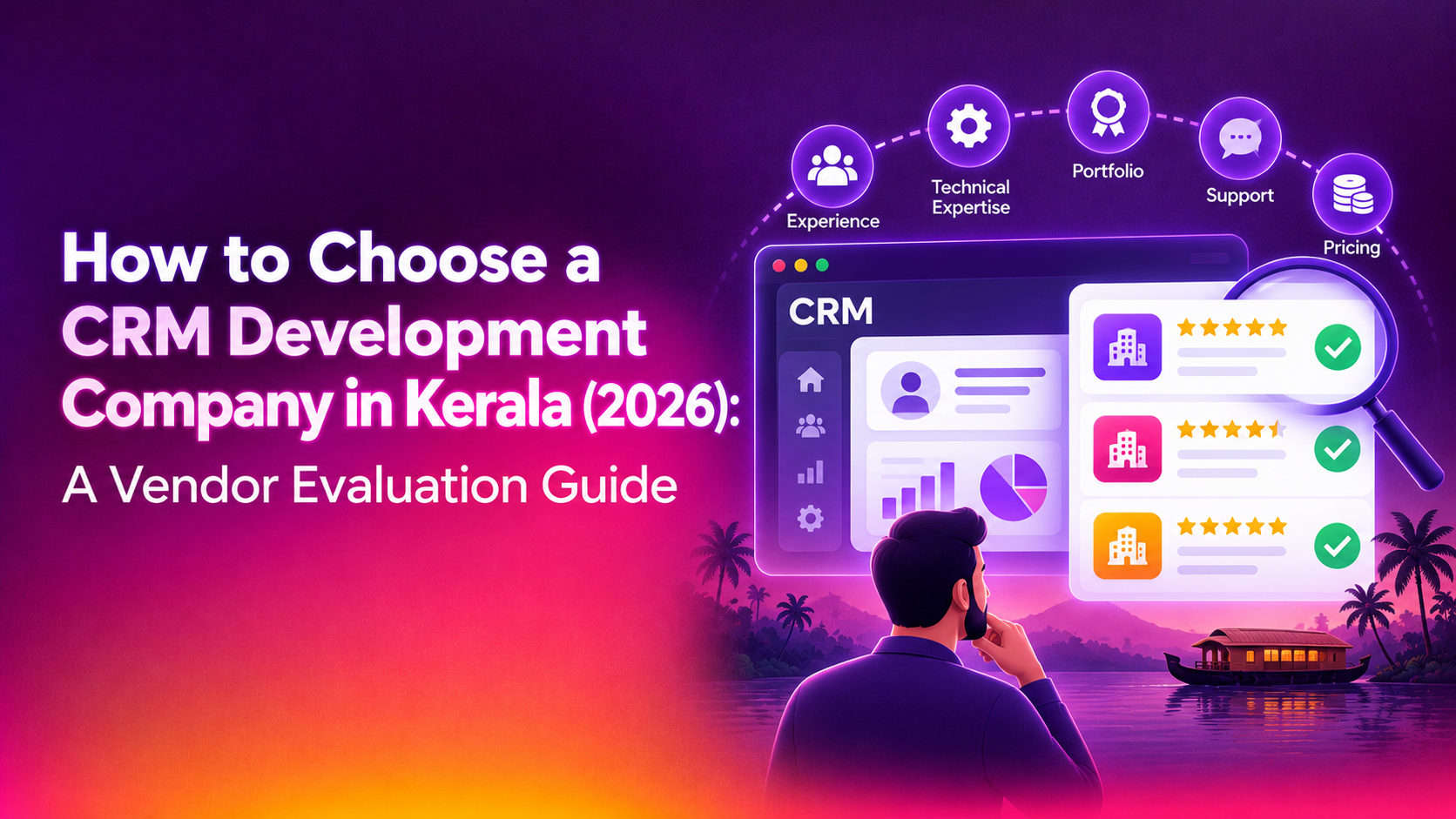
Kerala's IT corridor — from Kochi's Infopark to Thiruvananthapuram's Technopark — is home to dozens of software vendors that claim to build custom CRM systems. But "we build CRMs" and "we build a CRM that your sales team will actually use in six months" are two very different promises. If you are evaluating how to choose a CRM development company in Kerala, the difference between a good decision and an expensive mistake usually comes down to five or six criteria that most buyers never think to ask about until it's too late.
This guide breaks down exactly what to look for in a CRM development company Kerala businesses can rely on long after launch — not just at the pitch stage. You'll get a practical vendor evaluation checklist, the exact questions to ask before signing a contract, and the red flags that predict a failed rollout.
Why Choosing the Right CRM Development Partner Matters More Than the CRM Itself
Industry research consistently points to the same finding: most CRM failures are not caused by bad software. They are caused by poor implementation planning, weak team adoption, and vendors who disappear after the invoice is paid. A generic development shop can write code that technically works. A specialist CRM partner asks how your sales pipeline actually moves, what your support team needs at each customer touchpoint, and how the system should evolve as you grow — before a single line of code is written.
That distinction matters even more for Kerala-based SMEs and mid-size enterprises, where budgets are tighter and there is rarely a dedicated in-house IT team to babysit a project that goes sideways. Getting the vendor selection right the first time saves months of rework and thousands of rupees in wasted development hours.
There's also a scale factor unique to the Kerala market. Many businesses here are growing fast — a gold loan branch network expanding from 5 to 50 locations, a logistics company adding new routes every quarter, a manufacturing unit onboarding new distributors — and the CRM they choose today needs to survive that growth without a rebuild in 18 months. A vendor who only thinks about your requirements on day one, and not where your business will be in two years, is setting you up for a second procurement cycle sooner than you'd like.
This is precisely why the vendor selection process deserves as much rigor as the CRM requirements-gathering itself. Spending an extra two weeks comparing three shortlisted vendors properly is far cheaper than spending six months migrating away from a system built by a team that didn't understand your workflow in the first place.
Vendor Evaluation Checklist: What to Look For in a CRM Development Partner
Use this checklist literally — score each vendor you shortlist against every item before making a final call.
- CRM domain knowledge — Does the team understand sales, marketing, and service workflows, or are they treating your CRM like any other web app? Ask how deals move through your pipeline and see if they ask intelligent follow-up questions.
- Proven implementation track record — Certifications matter less than a portfolio of CRMs that actually went live and are still in active use. Ask for 2-3 recent case studies, ideally in your industry or a similar business model.
- Integration and data migration skill — A CRM is only as useful as the systems it connects to. Ask specifically how they've integrated CRMs with ERP systems, marketing tools (Mailchimp, HubSpot, WhatsApp Business API), and support desks, and how they'd migrate your existing customer data without losing history.
- Technology and platform depth — Whether they build fully custom (Node.js, Laravel, Django) or customize an existing platform (Zoho, Salesforce, Odoo), confirm they have deployed multiple projects on that stack, not just one pilot.
- Project management and adoption planning — Ask how they handle user training, change management, and phased rollout. A vendor who only talks about features and never mentions adoption is a warning sign.
- Post-launch support and SLAs — Confirm exactly what's included after go-live: response times, support channels (phone/email/chat), and how long free support lasts before you're billed hourly.
- Transparent, itemized pricing — Fixed price or hourly? What counts as "customization" versus base scope? Are there hidden costs as your user count or data volume scales?
- Security and data-handling practices — Especially important if your CRM will store customer PII, payment details, or health records. Ask about encryption, access controls, and backup policy.
- Verifiable client references — A serious vendor will happily connect you with a past client for a 15-minute call. Hesitation here is one of the biggest red flags in CRM vendor selection.
Vendor Selection Criteria at a Glance
| Evaluation Criteria | What Good Looks Like | Red Flag |
|---|---|---|
| Domain understanding | Asks about your sales stages, lead sources, support SLAs before quoting | Jumps straight to a generic feature list and price |
| Track record | Shares 2-3 live, verifiable CRM projects with results | Only shows mockups or unfinished demos |
| Integrations | Concrete examples of ERP/marketing/support tool connections | Vague answers like "we can integrate with anything" |
| Pricing | Itemized quote separating base build, customization, and scaling costs | One lump-sum number with no breakdown |
| Support | Written SLA with response times and escalation path | "We'll be around if you need us" — nothing in writing |
| References | Offers direct contact with a past client | Refuses or delays sharing references |
| Ownership | You retain full source code and database ownership | Vendor holds code/data hostage or charges an "exit fee" |
💡 None of these worked? Skip the guesswork.
Get Expert Help →Questions to Ask Before You Sign the Contract
These are the questions that separate a confident, transparent vendor from one that's hoping you don't ask too many follow-ups.
Get a line-item breakdown of what counts as the base build versus what will be billed separately as "customization." Many CRM projects blow past budget because scope creep was never defined in writing.
Understand what happens to your monthly cost as your team grows from 10 to 50 users, or as your data volume increases. Ask for the pricing model in writing, not a verbal estimate.
Real experience in your industry — whether that's real estate, gold loan lending, logistics, or retail — reduces implementation risk significantly. A reference call reveals things a sales pitch never will.
Confirm in the contract that you own the source code, the database, and all documentation. Vendors who are cagey about ownership are planning to lock you in.
Ask for specifics: is support included for 30 days, 90 days, or a full year? What's the guaranteed response time for a critical bug versus a minor request?
Common Mistakes Kerala Businesses Make When Hiring a CRM Vendor
- Choosing based on price alone — The cheapest quote is often cheapest because it skips discovery, testing, or post-launch support entirely.
- Skipping the discovery/requirements phase — If a vendor is ready to start coding after a single call, they don't yet understand your workflow well enough to build the right system.
- No clear post-launch support commitment — Without an SLA in writing, "support" can mean anything from same-day fixes to weeks of silence.
- Vague answers on past integrations — This is where CRM projects most often break in practice. Push for specifics, not reassurances.
- Not asking for client references — A portfolio slide deck is not the same as a real conversation with someone who lived through the implementation.
- Treating the CRM as a one-time project — A CRM needs periodic tuning as your sales process evolves. Vendors who disappear after go-live leave you stuck with a system that slowly stops matching how your team actually sells.
- Ignoring user adoption planning — Even a well-built CRM fails if your sales team reverts to spreadsheets and WhatsApp within a month. Ask upfront how the vendor plans to train your staff and drive adoption, not just deliver a login page.
Each of these mistakes is avoidable with a structured evaluation process. The businesses that get the best outcomes are the ones that treat vendor selection as seriously as they'd treat hiring a senior employee — checking references, verifying claims, and reading the fine print on the contract before committing budget.
How Long Does CRM Development Actually Take in Kerala?
Timelines vary depending on scope, but a realistic range for a mid-size custom CRM — covering lead management, sales pipeline, and basic reporting — is 8 to 16 weeks from kickoff to go-live. Simple platform customizations (on top of Zoho, Salesforce, or Odoo) can go live faster, often in 4 to 8 weeks, while fully custom builds with deep ERP or third-party integrations can extend to 4-6 months. Be wary of any vendor promising a fully custom CRM in under two weeks — that timeline usually means corners are being cut on testing and data validation.
What Does CRM Development Cost in Kerala?
Pricing depends heavily on whether you're customizing an existing platform or building fully custom software, plus the number of integrations required. As a rough guide, platform customizations for a small sales team typically start in the lower lakhs, while fully custom builds with ERP integration, multi-branch support, and advanced reporting can run considerably higher. The exact number matters less than transparency — insist on an itemized quote so you know precisely what you're paying for base development versus ongoing customization requests.
If your evaluation shortlist includes a mix of local Kerala firms and larger outsourcing agencies, weigh responsiveness and post-launch accountability as heavily as technical capability — a local CRM development company in Kerala that answers the phone the same day is often more valuable long-term than a bigger name that treats you as a low-priority account after go-live.
Why Businesses Choose CloudHouse for CRM Development in Kerala
CloudHouse Technologies builds custom CRM systems for businesses across Kerala with a discovery-first process — we map your actual sales, marketing, and support workflows before writing a single line of code. Every engagement includes transparent, itemized pricing, documented post-launch SLAs, and full source code and data ownership handed to you, not held over your head. Our team has delivered CRM integrations across industries including gold loan lending, logistics, and B2B services, with clients still on active support plans years after launch.
Ready to Choose the Right CRM Partner?
Evaluating vendors takes time, but a rushed decision costs far more in rework, missed adoption, and lost data than a careful selection process ever will. If you'd rather skip the guesswork, talk to CloudHouse's CRM development team for a transparent quote and a discovery call built around your actual business, not a generic template.
Choosing a CRM development company in Kerala is ultimately a decision about who you trust to understand your business, not just your requirements document. Use the checklist above, ask the five questions without skipping any, and insist on references before signing anything. The right partner will welcome every one of these questions — and that response, more than any feature list, tells you what your working relationship will actually look like after the contract is signed.