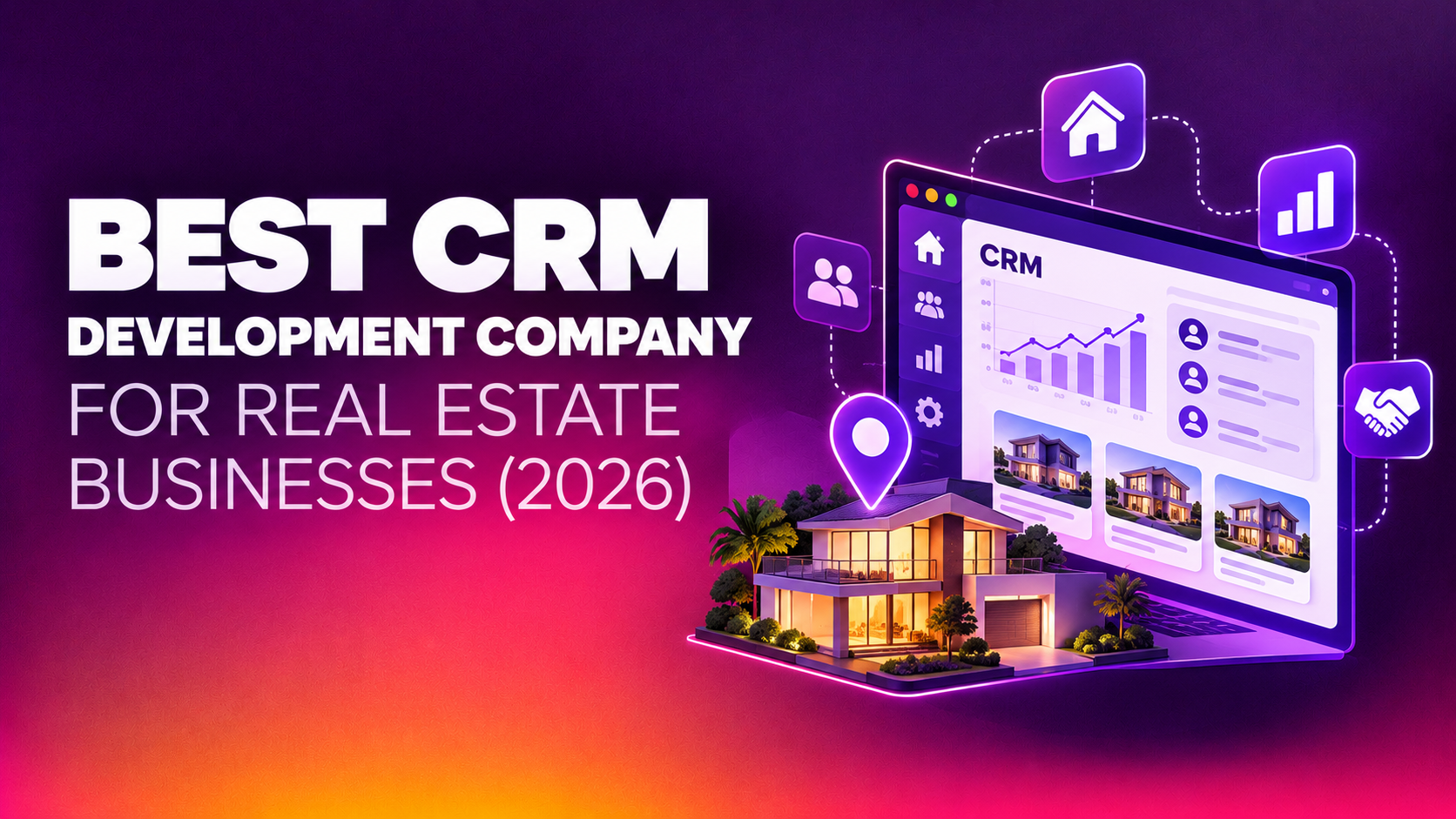
Real estate businesses run on relationships — but relationships fall apart fast when leads sit in spreadsheets, agents chase the same prospect twice, and property listings live in three disconnected tools. If you are searching for the best CRM development company for real estate to fix this, the decision is bigger than picking a vendor from a comparison list — you are choosing the system that will run your lead pipeline, your agent performance, and your closing rate for years. This guide breaks down exactly what to evaluate, what off-the-shelf real estate CRMs get wrong for growing businesses, and how a custom-built platform compares on the criteria that actually matter.
Why Real Estate Businesses Need a Different Kind of CRM
Generic sales CRMs are built for linear deal cycles — one contact, one deal, one close date. Real estate does not work that way. A single property can have dozens of interested leads at different stages, a single agent can be juggling 40 active buyers and sellers, and a single deal can stretch across site visits, loan approvals, legal checks, and possession handovers spanning months. Off-the-shelf tools like generic sales CRMs force real estate teams to bend their workflow around software that was never designed for real estate crm software development use cases like site-visit scheduling, channel-partner commissions, or inventory-linked lead routing.
This is precisely why so many brokerages and developers eventually outgrow template CRMs and start looking for a custom crm for property businesses — one built around how property sales actually happen, not around a generic sales funnel.
Consider the typical week for a mid-sized brokerage: leads arrive from a Facebook ad campaign, a property portal listing, and a walk-in referral, all on the same day. Without a system built for this, each of those leads gets logged differently — one in a spreadsheet, one in a WhatsApp chat thread, one on a sticky note at the front desk. By the time a manager tries to review pipeline health at the end of the month, half the leads are untraceable and nobody can say with confidence which marketing channel is actually driving closings. This is the exact failure mode that purpose-built real estate CRM development is meant to eliminate.
Core Features a Real Estate CRM Must Have in 2026
Before you evaluate any development company, you need a clear checklist of what the CRM itself must do. Based on where most real estate teams lose deals today, these are the non-negotiables:
- Unified lead capture — automatically pulling in leads from your website, WhatsApp, Facebook/Instagram ads, property portals (99acres, MagicBricks, Housing.com), and walk-ins into one pipeline, instead of manual re-entry.
- Lead scoring and auto-routing — ranking leads by budget, location preference, and engagement, then auto-assigning them to the right agent or channel partner based on territory or workload.
- Property listings management — a centralized inventory of units with price, configuration, floor, availability status, and linked media, so no two agents ever quote the same flat to different buyers.
- Site-visit scheduling — calendar-integrated booking that reminds both the agent and the lead, tracks no-shows, and logs visit feedback for follow-up.
- Agent and channel-partner management — performance dashboards, commission tracking, lead-to-close conversion rates per agent, and partner payout automation.
- Automated follow-up sequences — WhatsApp and email nurture flows so cold leads are not abandoned after the first call.
- Post-sale and possession tracking — because in real estate, the relationship (and the referral potential) does not end at booking.
- Mobile-first access — field agents need full CRM functionality from a phone during a site visit, not just a desktop dashboard.
Any provider you shortlist should be able to explain, in specific technical terms, how they would build each of these — not just say "yes, we can do that."
Evaluation Criteria: How to Compare CRM Development Companies
Here is the framework we recommend real estate businesses use when comparing vendors — the same framework used to build the table below.
| Evaluation Criteria | What to Look For | Red Flag |
|---|---|---|
| Real estate domain experience | Case studies with brokerages, developers, or channel-partner networks — not just generic CRM projects | Only shows e-commerce or generic SaaS CRM portfolios |
| Custom vs. templated build | Willingness to design workflows around your sales process, inventory structure, and partner network | Pushes you toward a rigid, pre-built "real estate module" with no customization |
| Integrations | Native or API-based integration with WhatsApp Business, property portals, IVR/telephony, and payment gateways | Integrations require a separate paid add-on from a third party they don't control |
| Data ownership & hosting | You own the source code, database, and hosting environment outright | Vendor locks your lead data inside a proprietary SaaS you cannot export from |
| Scalability | Architecture that supports multiple projects, multiple branch offices, and growing agent counts without a rebuild | System noticeably slows down or needs re-platforming past a few hundred users |
| Post-launch support | Ongoing maintenance, feature additions, and bug fixes included or clearly priced | Support disappears after the handover; every change request needs a new contract |
| Transparent pricing & timeline | Fixed-scope quote with milestones, or clear hourly/sprint-based billing | Vague quotes that balloon once development starts |
Custom-Built CRM vs. Off-the-Shelf Real Estate CRM Software
Popular ready-made platforms are genuinely good products — but they are built for the broadest possible audience, which means real estate businesses with non-standard workflows (multi-project developers, channel-partner-heavy brokerages, or agencies with in-house pre-sales and post-sales teams) end up paying for features they don't need while missing the ones they do.
A custom-built system, by contrast, is designed only around your process: your lead sources, your inventory structure, your commission rules, your reporting needs. It costs more upfront than a subscription, but there is no per-agent SaaS fee compounding every month, no data lock-in, and no waiting on a vendor's roadmap to get a feature your business actually needs today.
There is also a compounding cost most teams underestimate with off-the-shelf tools: workaround debt. Every time an agent builds a manual spreadsheet to track something the CRM can't do natively — commission splits across a channel partner network, or possession-stage follow-ups after a sale closes — that workaround becomes a permanent, unmaintained side-process nobody officially owns. Over two or three years, a growing brokerage can end up running half its operations outside the CRM entirely, which defeats the purpose of having one system of record in the first place. A custom build closes that gap by designing for your actual edge cases from day one, instead of forcing your team to invent them later.
Why Real Estate Companies Choose CloudHouse for CRM Development
CloudHouse Technologies builds CRMs specifically around real estate workflows — lead capture from portals and ad platforms, automated agent assignment, site-visit tracking, and channel-partner commission management — rather than retrofitting a generic sales CRM. Every project ships with full source-code ownership, no recurring per-user licensing, and a support team that keeps improving the system after launch instead of disappearing at handover. If you want a system built around how your team actually sells property, our CRM development company in Kerala team can scope your requirements and show you exactly how the build would work before you commit to anything.
How to Choose the Right Development Partner: A Practical Checklist
Use this checklist during vendor calls — a serious CRM development partner should answer every point without hesitation:
- Can they show at least one real estate or property-sector CRM they have actually built (not just a demo)?
- Do they map your specific lead sources (portals, WhatsApp, ads, walk-ins) into the system design during the discovery call?
- Is the quote scoped by feature/module, with a clear timeline for each phase?
- Will you own the source code and database outright after delivery?
- What does post-launch support cost, and what response time is guaranteed?
- Can the system scale to a second project, a second city office, or double the agent count without a rebuild?
- Do they offer a fixed-scope pilot (e.g., lead capture + agent dashboard) before committing to the full build?
Get Your Real Estate CRM Built Right, the First Time
A CRM that fits your actual sales process pays for itself in recovered leads and faster closings within months. If you are comparing options for a real estate crm software development partner, talk to a team that has actually built for property businesses before — not one adapting a generic template. Request a free CRM consultation with CloudHouse Technologies and get a clear, scoped plan for your property business before you spend a single rupee on development.
Frequently Asked Questions
What does it cost to build a custom CRM for a real estate business?
Costs vary based on the number of modules (lead management, listings, agent dashboards, channel-partner portals, reporting) and integrations required. A focused MVP covering lead capture, listings, and agent assignment typically costs far less than a full enterprise rollout with multi-branch reporting and partner commission automation. Most reputable developers will give you a fixed-scope quote after a discovery call rather than a flat number upfront.
How long does it take to develop a real estate CRM?
A focused MVP with lead management, property listings, and basic agent dashboards can typically be delivered in 6–10 weeks. A full-featured platform with channel-partner management, automated WhatsApp/email nurture sequences, and advanced reporting usually takes 3–5 months, depending on integration complexity.
Is a custom CRM better than a ready-made real estate CRM software?
It depends on your scale and workflow complexity. Ready-made platforms are faster to start with and fine for small teams with standard sales processes. Once you have multiple projects, channel partners, or a non-standard commission structure, a custom crm for property businesses usually pays off faster because you stop paying for unused features and stop working around limitations that a template CRM can't remove.
Will we own our lead and customer data with a custom-built CRM?
Yes — with a properly scoped custom build, you own the source code, the database, and the hosting environment outright. This is one of the biggest advantages over SaaS real estate CRMs, where your lead data effectively lives inside the vendor's platform and migrating away later can be costly and slow.
Can a custom CRM integrate with property portals like 99acres, MagicBricks, or WhatsApp Business?
Yes. A properly built real estate CRM should integrate via API with major property portals for lead capture, and with WhatsApp Business for automated follow-ups and site-visit reminders. This is one of the first things to confirm with any development partner during the discovery phase — if they can't explain how the integration will work technically, treat that as a warning sign.
What happens if we need new features after the CRM is already live?
A good development partner treats the CRM as a living system, not a one-time delivery. Look for a partner offering ongoing support and iterative feature additions — post-sale tracking, new lead-source integrations, or additional agent dashboards — without requiring a full renegotiation of the original contract every time.