If you have outgrown the templated workflows of Zoho or Salesforce, or you are tired of paying per-seat SaaS fees for modules your team never touches, you are not alone. Choosing the best CRM development company is one of the highest-leverage decisions a growing business can make, because a custom CRM either becomes the operational backbone of your sales and support teams — or an expensive shelf-ware project. This guide gives you a concrete evaluation framework, not a directory of names, so you can vet any custom CRM development company in India with confidence before you sign a contract.
What Makes a Great Custom CRM Development Company?
A genuinely capable custom crm software company does three things well: it understands your business process before proposing technology, it builds systems your team will actually adopt, and it stays accountable after go-live. Most "top 10 CRM company" listicles skip straight to naming vendors without explaining what separates a good outcome from a bad one. In practice, the difference almost always comes down to discovery quality — a firm that spends real time mapping your sales pipeline, data model, and existing integrations before writing a line of code will consistently outperform one that jumps straight to a quote.
Watch for a specific warning sign during your first few conversations: if every call is with a sales representative and you never speak to the lead developer or solution architect who will actually build your system, treat that as a red flag. The companies worth shortlisting will offer a technical discovery session up front, where they ask about your existing tools, your team's workflow, and the reporting you need — not just your budget.
Key Evaluation Criteria (Portfolio, Tech Stack, Post-Launch Support)
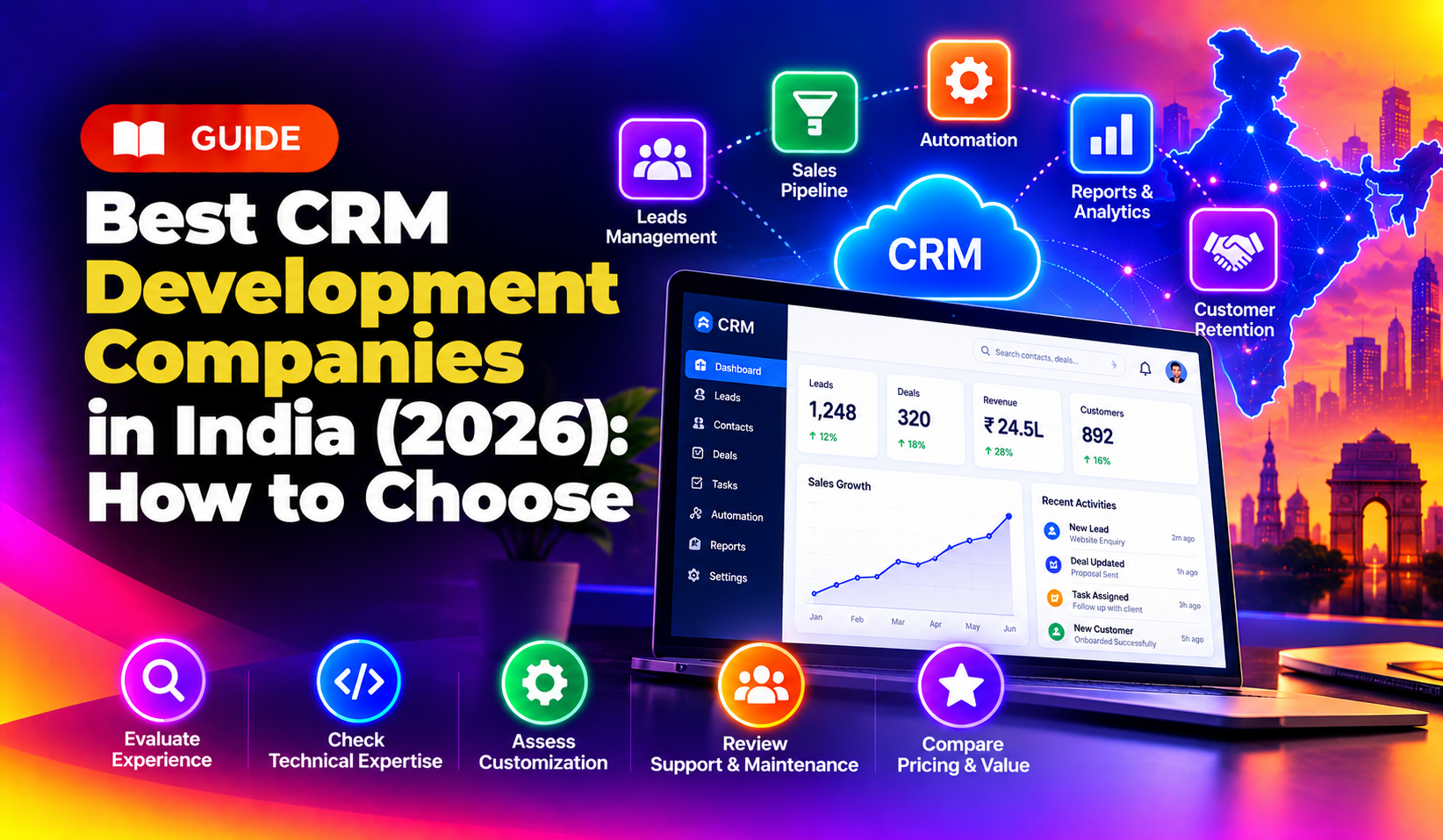
Rather than comparing named vendors, use the criteria below to score any top crm development companies 2026 shortlist you are building. This is the same framework CloudHouse uses internally when scoping a new CRM engagement, and it applies whether you are hiring an agency in Kochi, Bangalore, or anywhere else in India.
| Criterion | Why It Matters | What to Ask |
|---|---|---|
| Relevant portfolio depth | A CRM built for a 5-person real estate team is architecturally nothing like one built for a 200-agent logistics operation. Generic portfolios hide a lack of domain-specific experience. | "Can you show me a CRM you built that handles a workflow similar to mine, and can I speak to that client?" |
| Technology stack transparency | The stack determines your long-term flexibility, hosting costs, and how easily you can hire additional developers later if you ever need to switch vendors. | "What stack will you use, and why is it the right fit for our scale and budget?" |
| Data migration methodology | Migrating years of contact history, deal stages, and email threads from Zoho or Salesforce is where most custom CRM projects quietly fail. | "Walk me through exactly how you migrate historical data without downtime or data loss." |
| Integration capability | Your CRM needs to talk to email, invoicing, WhatsApp, marketing tools, and often a website or ERP. Weak integration skills mean manual double-entry forever. | "Which third-party APIs have you integrated in the last year, and how do you handle breaking API changes?" |
| Post-launch support and SLAs | A CRM is never "done" — user permissions change, new reports get requested, and bugs surface under real load. Support quality post-launch predicts whether the system stays useful. | "What does your support SLA look like after go-live, and is it in the contract or just a verbal promise?" |
| Team continuity | Agencies that rotate developers mid-project lose institutional knowledge of your specific business rules, causing rework and delays. | "Who specifically will be assigned to our project, and will that team stay through the maintenance phase?" |
Score each vendor on these six criteria out of 5, and you will have an objective comparison rather than a gut-feel decision based on whichever sales deck looked the most polished.
Custom CRM vs Off-the-Shelf: When Custom Wins
Off-the-shelf platforms like Zoho and Salesforce are excellent when your process is close to standard sales-and-support workflows and you are comfortable paying recurring per-seat fees indefinitely. But there are clear signals that a custom crm development company in india will deliver better long-term value:
- Your process doesn't fit a template. If your team is bending a generic CRM's pipeline stages, custom fields, and automation rules into unnatural shapes just to approximate your actual workflow, you are paying for flexibility you cannot use.
- Per-seat costs have become unpredictable. Once you cross 15-20 licensed users, SaaS CRM subscriptions often cost more annually than a one-time custom build with modest ongoing maintenance.
- You need deep integration with proprietary systems. ERP, custom billing, industry-specific compliance tooling, or a homegrown logistics platform are all easier to wire into a system you own outright.
- Data ownership and portability matter to you. With a custom build, your data model, hosting, and export rights are entirely yours — no vendor lock-in risk if pricing changes.
If none of the above applies and your workflow is genuinely standard, an off-the-shelf CRM configured well by a good implementation partner may still be the faster, cheaper route. The honest answer to "is custom worth it" depends on how far your process has diverged from generic sales/support workflows — not on which option a vendor happens to sell.
Questions to Ask Before Signing a Contract
Use this checklist in your final vendor calls before signing anything:
- Can you show me a CRM you built for a business of similar size and industry, and can I talk to that reference client directly?
- What does your post-launch support look like — is it SLA-backed, and what is the response time for a critical bug?
- How do you handle third-party integrations, and what happens if a partner API changes unexpectedly?
- What is your exact data migration methodology, and how do you validate that no records are lost or duplicated?
- Who specifically will work on our project, and will that team remain assigned through the maintenance phase?
- How do you handle scope changes mid-project, and is that process documented in the contract?
- What AI or automation capabilities — like lead scoring or auto-follow-up sequencing — can realistically be embedded, and at what added cost?
A genuine CRM development firm will welcome every one of these questions and answer them with specifics, not vague reassurances.
Why CloudHouse Is a Trusted Custom CRM Development Partner
Hosting and service companies choose CloudHouse's CRM development services because we run technical discovery before quoting a price, assign a named developer team that stays through the maintenance phase, and back every build with a documented post-launch SLA rather than a verbal promise. We have built custom CRM systems for sales teams, hosting support desks, and logistics operations that had outgrown template-based platforms, migrating years of historical data without downtime and integrating directly with existing billing, email, and ERP tools. There is no long-term lock-in, and support is available on flexible, hourly terms rather than forcing you into a rigid annual retainer.
Frequently Asked Questions
Is custom CRM development worth it compared to Zoho or Salesforce?
It depends on how far your workflow has diverged from a standard sales pipeline and how many licensed seats you run. If you are bending a template CRM's fields and automations to fit your process, or paying rising per-seat fees for 15+ users, a custom build usually pays for itself within 12-18 months through lower recurring costs and fewer manual workarounds.
How do I know a CRM vendor won't disappear after launch?
Ask for a written support SLA before signing, not a verbal assurance, and check whether the vendor has verifiable long-term clients you can actually call. Firms offering month-to-month or hourly post-launch support (rather than only a one-time build fee) have a financial incentive to stay responsive after go-live.
How much does custom CRM development cost in India?
Costs vary widely based on complexity, but a focused custom CRM for a small-to-mid sized sales or support team typically starts in the range of a few lakhs of rupees for a core build, with ongoing maintenance billed hourly or on a small monthly retainer. Get a detailed scoping call to see an accurate quote for your specific workflow rather than relying on generic price ranges.
How long does it take to build a custom CRM?
A well-scoped custom CRM MVP typically takes 6-10 weeks from discovery to go-live, depending on the number of modules, integrations, and how much historical data needs migrating. Vendors promising a fully custom, integrated CRM in under two weeks are usually reusing a generic template rather than building to your actual process.
Can a custom CRM integrate with tools we already use, like WhatsApp, email, or our ERP?
Yes — integration capability is one of the most important things to verify before signing, since this is where most off-the-shelf platforms fall short. Ask any shortlisted crm development company kerala or elsewhere to show a live example of an integration with a tool similar to yours before committing.
Choosing the right partner comes down to disciplined evaluation, not brand recognition. Score every vendor against the criteria above, insist on a technical discovery session, and get post-launch support written into the contract — and you will avoid the single biggest reason custom CRM projects fail: hiring on a sales pitch instead of a process.