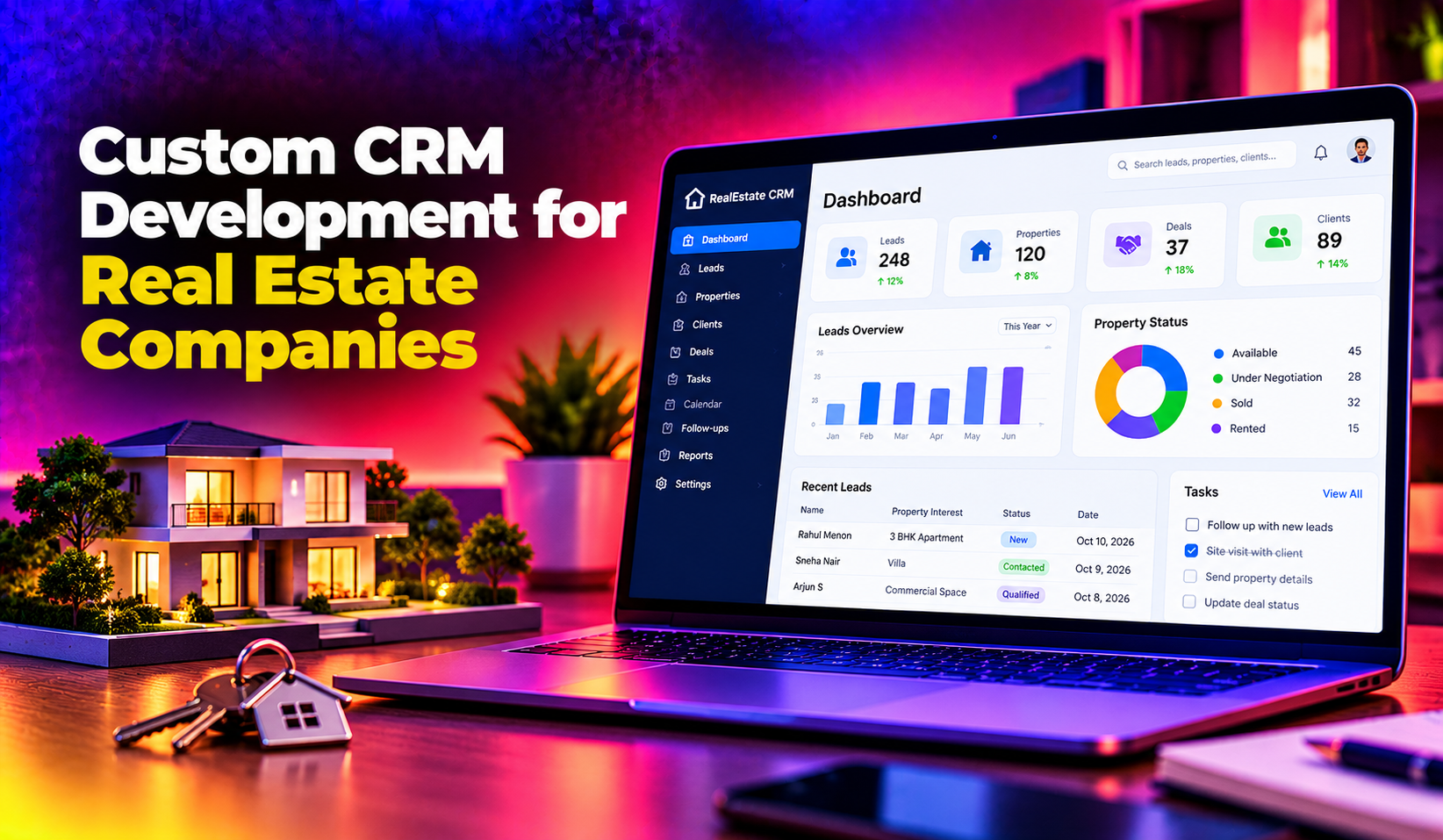
Most real estate companies start with a generic CRM — a spreadsheet, a free trial of a popular sales tool, or a bundled feature inside their property portal subscription. Within a few months, the cracks show. Off-the-shelf CRMs are built for generic B2B sales cycles, not for the messy, high-touch reality of custom crm development for real estate companies: multiple ongoing projects, dozens of site visits a week, broker commission splits, and leads that go cold if a follow-up call slips by even a day. This guide breaks down why 2026 is the year real estate businesses in India are moving to purpose-built CRM software, what features actually matter, what it costs, and how to choose the right development partner.
Why Real Estate Companies Need a Custom CRM
Real estate sales don't behave like typical B2B or retail sales. A single buyer might be nurtured for six to eighteen months across multiple site visits, price negotiations, loan approvals, and family decision-makers. Off-the-shelf CRMs treat every lead the same way — a name, an email, a deal stage — with no concept of "which project," "which tower," "which broker," or "which site visit slot." This is the core reason generic real estate crm software development conversations keep coming back to custom builds.
A few realities that force real estate companies away from generic tools:
- Multi-project portfolios: A developer selling units across 5 different projects needs leads tagged, filtered, and reported by project — something most CRMs handle poorly out of the box.
- Site visits are the real conversion event: Unlike SaaS sales, the site visit — not the demo call — is where real estate deals are won or lost. Generic CRMs have no native site-visit scheduling, driver allocation, or no-show tracking.
- Broker and channel partner commissions: Most Indian real estate sales flow through channel partners and brokers. Off-the-shelf tools don't calculate tiered commission structures or track broker-sourced leads separately from direct leads.
- Long, non-linear sales cycles: A buyer might disappear for three months and return. Generic pipeline stages ("Qualified," "Proposal," "Closed") don't map to how real estate deals actually move.
- Compliance and documentation: RERA registration numbers, booking agreements, and payment schedules need to live inside the same system as the lead record — not in a separate folder.
This is why more real estate businesses are commissioning property lead management crm systems built specifically around their sales process instead of forcing their workflow into a generic tool. The gap tends to show up first in reporting: a sales head asking "how many site visits did we schedule for Project A this week, and how many actually converted to a booking token?" often can't get an answer without manually cross-referencing a spreadsheet, the sales team's WhatsApp group, and the accounts department's payment records. A property-specific CRM collapses all three into a single source of truth.
There's also a people-management dimension that generic CRMs completely ignore. Real estate sales teams typically mix in-house agents, telecallers, and external brokers on the same deal, sometimes for the same lead at different stages. Without a system that clearly attributes who sourced a lead, who converted it, and who deserves the resulting commission, disputes between agents and brokers become a recurring management headache — one that a properly designed custom CRM resolves by design rather than by policy memo.
💡 None of these worked? Skip the guesswork.
Get Expert Help →Must-Have Features for a Real Estate CRM
When evaluating a custom crm for real estate agents and sales teams, these are the features that separate a system your team will actually use from one that gets abandoned within a quarter.
Every lead should be tied to a specific project, tower, and unit type from the moment it enters the system. Sales heads need to see, at a glance, which projects are generating the most qualified interest and which units are moving slowly.
A custom CRM should let agents book site visits directly against a calendar, auto-assign the nearest available agent or driver, send automated WhatsApp/SMS reminders to the prospect, and log a mandatory feedback form immediately after the visit — capturing objections while they're fresh.
Brokers should have their own login to submit leads, track their status, and view real-time commission calculations. This alone eliminates a huge volume of "what happened to my lead" phone calls to the sales office.
Leads that haven't been contacted in 48 hours should be automatically flagged and escalated. Real estate leads decay fast — the CRM needs to enforce follow-up discipline, not just record that it didn't happen.
Once a unit is booked, the CRM should track the payment schedule against construction milestones, send automated payment reminders, and store the booking agreement, RERA disclosures, and KYC documents against the lead record.
Project-wise conversion rates, source-wise lead quality (Google Ads vs. property portals vs. broker referrals vs. walk-ins), agent-wise performance, and site-visit-to-booking ratios — all in a single dashboard, without exporting to Excel every week.
Leads from 99acres, MagicBricks, Housing.com, and Facebook/Google Ads should flow into the CRM automatically via API, with WhatsApp Business API integration for instant first-response messaging — the single biggest lever for real estate lead conversion.
Custom CRM Development Cost for Real Estate in 2026
One of the most common questions we hear is around real estate crm cost india for a custom build versus a subscription tool. Pricing depends heavily on scope, but here's a realistic breakdown for 2026:
| CRM Type | Typical Cost (INR) | Best For |
|---|---|---|
| Off-the-shelf CRM (Zoho, Salesforce, generic real estate SaaS) | ₹500 – ₹3,000 per user/month, ongoing forever | Very small teams testing basic pipeline tracking |
| Customized SaaS CRM (heavy configuration on top of a base product) | ₹2 – ₹8 lakh setup + recurring license fees | Mid-size teams needing moderate customization, willing to accept platform limits |
| Fully custom-built CRM (owned codebase, no recurring license) | ₹6 – ₹25 lakh one-time, depending on modules | Developers and agencies with multiple projects, brokers, and long-term scale plans |
| Enterprise custom CRM with ERP/accounting integration | ₹25 lakh+ | Large developers running 10+ live projects with finance system integration |
The key financial difference is that a fully custom build has no per-user monthly fee compounding over years — for a 30-agent sales team, a ₹1,500/user/month SaaS CRM costs roughly ₹5.4 lakh every year, meaning it can cost more than a one-time custom build within 3-4 years, while a custom CRM keeps improving as an owned asset rather than a rented one. Add to that the cost of switching platforms every time a SaaS vendor changes pricing tiers, and the long-term economics tilt further toward ownership for any team beyond a handful of agents.
It's also worth factoring in hidden SaaS costs that rarely appear in the initial quote: per-integration add-on fees, storage limits that force a plan upgrade once photo and document uploads grow, and support tiers that gate WhatsApp integration behind the most expensive plan. A custom CRM avoids these surprise costs because every module is scoped and priced once, upfront.
What to Look for in a CRM Development Partner
Choosing the wrong vendor for a crm development company for realtors project is expensive to reverse — you'll be migrating years of lead data mid-project. Use this checklist when evaluating partners:
- Real estate domain experience — Ask for at least one live reference client in property sales, not just generic CRM projects.
- Site-visit and broker-module portfolio — Request a demo of these two modules specifically; most agencies can build generic lead forms but few have built site-visit logistics and broker commission engines before.
- Data ownership and source code — Confirm in the contract that you own the full source code and database, not a "white-label" license you're renting.
- Integration capability — Verify they can integrate WhatsApp Business API, property portal lead APIs, and payment gateways, not just build a standalone form.
- Post-launch support model — Ask whether support is hourly, retainer-based, or bundled — and get response-time SLAs in writing.
- Scalability plan — Confirm the architecture can handle additional projects, agents, and modules (like an ERP or accounting sync) without a rebuild.
- Transparent, fixed-scope pricing — Avoid vendors who can't give a written scope-and-cost breakdown before starting.
Most generic comparison articles online simply rank off-the-shelf CRM tools against each other by price and feature checklist — they rarely address the harder question real estate businesses actually face: whether to customize a SaaS product or commission a fully custom build suited to site visits, broker networks, and multi-project sales cycles. That distinction is where the real cost and long-term value decisions are made, and it's the gap this guide is meant to close.
Why Real Estate Companies Choose CloudHouse for CRM Development
CloudHouse Technologies has built and deployed custom CRM software for real estate companies managing everything from single-project residential launches to multi-city developer portfolios with active broker networks. Our real estate CRM builds ship with site-visit scheduling, broker commission tracking, and WhatsApp-first lead follow-up out of the box, and because you own the full codebase, there's no recurring per-user license fee eating into your margins as your sales team grows. We also provide dedicated post-launch support so the system evolves alongside your project pipeline instead of becoming outdated software within a year. Whether you're a boutique developer with one active launch or a regional player managing a multi-project portfolio and broker network, our team scopes the CRM around your actual sales process rather than forcing you into a generic template.
Frequently Asked Questions
Is a custom CRM really necessary for a small real estate business with one or two projects?
Not always — if you have fewer than 5-10 active leads a week and a single project, a well-configured off-the-shelf tool can work initially. But once you're running multiple projects with brokers involved, most teams outgrow generic tools within a year, and migrating lead history mid-growth is more disruptive than building the right system from the start.
How much does a real estate CRM development project typically cost in India?
A fully custom-built real estate CRM typically ranges from ₹6 lakh to ₹25 lakh depending on modules like broker portals, payment tracking, and portal integrations, while lighter customization on top of an existing SaaS product can start around ₹2-3 lakh but carries ongoing per-user license costs indefinitely.
How long does it take to build a custom real estate CRM?
A core system with lead tracking, site-visit scheduling, and basic reporting can typically be delivered in 8-12 weeks. Adding broker portals, payment milestone tracking, and portal/WhatsApp integrations usually extends the timeline to 14-20 weeks for a full-featured build.
Can a custom CRM integrate with property portals like 99acres and MagicBricks?
Yes. Most property portals expose lead APIs or provide bulk lead export/webhooks that a custom CRM can consume automatically, eliminating manual downloading and entry of leads from multiple portal dashboards every day.
Do you offer a trial or phased rollout instead of committing to the full build upfront?
Yes — a phased approach starting with core lead tracking and site-visit scheduling for one project or sales team, then expanding to broker portals and payment tracking, is a common and lower-risk way to validate the system before a full company-wide rollout.