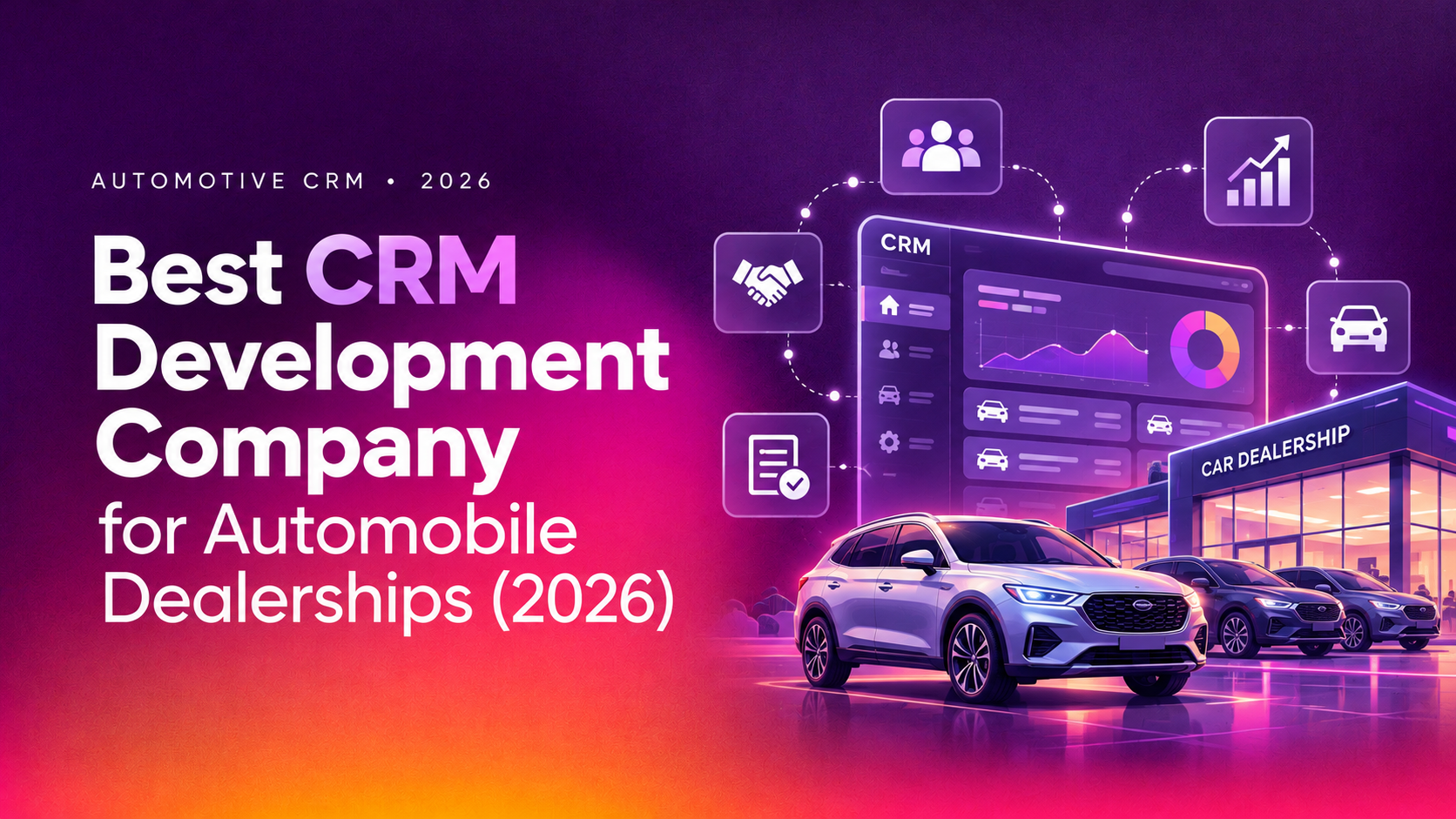
Choosing the best CRM development company for automobile dealerships is not the same as choosing a generic software vendor. A showroom runs on timing: a walk-in who is not followed up by evening, a test drive that clashes with another booking, a service reminder that never goes out. This guide is written for dealer principals and sales heads at car and two-wheeler dealerships who are shortlisting a custom CRM partner and want a clear way to compare their options.
Nothing here is a promise of results, and every dealership works differently. Use the criteria below to question any vendor, including us, and ask for an itemised quote tied to your own sales process.
Why dealerships outgrow spreadsheets and generic CRMs
Most dealerships start with spreadsheets, a messaging app and a basic lead tool. That works until volume and staff turnover expose the gaps.
- Leads arrive from many places: showroom walk-ins, phone enquiries, manufacturer portals, classified listings, social ads and website forms all land in different inboxes.
- Salespeople move on: when an executive leaves, their customer notes often leave with them if they live in a personal phone or notebook.
- The sale is only the start: finance, insurance, accessories, servicing and resale all create further revenue, yet each is usually tracked separately.
- Management has little visibility: a sales head cannot easily see which enquiries are stale, which executive is overloaded or which source brings serious buyers.
A purpose-built system can fix these problems, but only if it is shaped around how a dealership really operates. That is the core argument for custom CRM development over a one-size-fits-all subscription.
What a dealership CRM needs to do
Before comparing vendors, write down the workflows the system must support. The following are the ones we see matter most for showrooms.
Lead capture from every channel
Every enquiry should create a single customer record automatically, whether it came from a portal, a web form, a call or a walk-in typed in by a receptionist. The system should detect duplicates, for example the same person enquiring on two portals, and assign the lead to an executive by rules such as model interest, location or round-robin.
Test-drive scheduling
Test drives depend on a limited number of demo vehicles and drivers. A good CRM shows which vehicle is free, blocks double bookings, sends the customer a confirmation and reminds the executive beforehand. After the drive it should prompt for feedback and a next follow-up date so the lead does not go cold.
Quotations, finance and insurance follow-ups
Once a buyer is interested, the conversation moves to on-road quotations, exchange valuation, loan applications and insurance. The CRM should keep these steps visible on one timeline, record which documents are pending and remind the right person to chase them.
Service reminders and retention
For many dealerships the service workshop is the steadiest income. The system should track service due dates, warranty and insurance renewals and send reminders by SMS, email or messaging channel, with consent recorded. It should also separate a customer who is simply due for service from one with an unresolved complaint, so the wrong message is never sent.
Two-wheeler specifics
Two-wheeler dealerships often handle higher enquiry volumes, faster decisions, accessory sales and festive-season campaigns. Check that the vendor understands short sales cycles, bulk follow-up lists and simple mobile screens that floor staff will actually use.
Options when you need a dealership CRM
There are four realistic routes. None is right for everyone, and the table compares them on the criteria that matter to a showroom.
| Criteria | Custom CRM development agency | Automotive off-the-shelf CRM or DMS | Generic CRM with customisation | In-house build |
|---|---|---|---|---|
| Fit to your sales process | Built around your workflow | Fits common dealer processes, less flexible | Needs heavy configuration to fit | Fits well if requirements are clear |
| Portal and walk-in lead integration | Integrations built to your sources | Often includes popular portals | Depends on available connectors | Every integration is your own work |
| Test-drive and service workflows | Designed in from the start | Usually included in standard form | Typically needs add-ons or custom fields | Built as you specify |
| Upfront cost | Higher than a subscription | Lower upfront, recurring fees | Low to moderate, grows with add-ons | Depends on salaries and time |
| Long-term ownership | You can own the code, if agreed | Vendor controls roadmap and pricing | Tied to platform terms | Full ownership |
| Speed to start | Weeks to months, in phases | Fastest | Moderate | Slowest, needs hiring |
| Ongoing support | Agreed in contract | Vendor helpdesk | Community and partners | Depends on retained staff |
In short, an off-the-shelf automotive product is sensible if your process is standard and you want to start quickly. A custom build earns its higher upfront cost when you have multiple outlets, unusual finance or exchange flows, or a need to connect the CRM to your own billing, DMS or workshop software.
How to evaluate a CRM development company
When you speak to vendors, use this checklist. A serious provider should be comfortable answering every point in writing.
- Discovery first: do they ask to watch your showroom and workshop workflow before proposing screens?
- Dealer-relevant experience: can they explain lead routing, test-drive booking and service reminders without a lecture on generic CRM features?
- Integration plan: do they list how portal leads, telephony, messaging, accounts and your existing DMS will connect?
- Phased delivery: can you launch lead management first and add service reminders later, instead of waiting for one large release?
- Itemised quote: does the proposal separate discovery, development, integrations, training and support?
- Code and data ownership: who owns the source code, the database and the customer data, and can you export it?
- Mobile usability: will floor staff be able to log a walk-in from a phone in under a minute?
- Access control and audit trail: can you limit who sees customer contact details and track who changed a record?
- Support after launch: what happens when a bug appears on a busy weekend, and who answers?
- Training and adoption: is there a plan to get your sales team using it, not just a handover document?
Understanding what drives cost
Pricing for a dealership CRM varies widely, so be wary of any vendor who quotes a fixed figure before understanding your operation. The main cost drivers are:
- the number of outlets, users and user roles;
- how many lead sources and external systems must be integrated;
- the depth of finance, insurance and exchange workflows;
- reporting and dashboard requirements for management;
- data migration from existing spreadsheets or a previous tool;
- mobile app needs versus a mobile-friendly web interface;
- the level of support and maintenance after go-live.
Ask for an itemised quote that breaks these out, so you can remove or postpone items and see what each one adds.
Red flags to watch for
- A fixed price and timeline offered after a single short call.
- No mention of data migration or how your existing leads will be imported.
- Vague answers on who owns the code after delivery.
- No plan for testing with real showroom staff before launch.
- Reluctance to discuss support terms in writing.
If you want a partner who will map your workflow first, you can review our CRM development services and request a scoped proposal.
A sensible rollout plan
Dealerships rarely have the time to retrain everyone at once, so a phased rollout lowers risk.
- Discovery and mapping: document the current lead journey, test-drive process, finance steps and service workflow.
- Core build: lead capture, assignment and follow-up reminders for the sales team.
- Pilot: run one outlet or one team on the system, collect feedback and fix friction.
- Extend: add test-drive scheduling, quotations, finance and insurance tracking.
- Service and retention: add workshop reminders, renewals and campaign tools.
- Review: check reports against real sales meetings and adjust.
Why Companies Choose CloudHouse for CRM Development
We plan delivery in clear phases so a dealership can start using the system early, rather than waiting for one large release. We stay available after launch to fix issues and adjust workflows as your showroom changes. Our quotes are itemised, so you can see what each part of the build costs before you commit.
Conclusion
The best CRM development company for a dealership is the one that understands showroom reality: many lead sources, limited demo vehicles, long finance follow-ups and a service workshop that depends on timely reminders. Compare vendors on discovery, integrations, ownership, support and an itemised quote, not on a polished demo alone. If you would like to talk through your sales process, visit our CRM development company page and request a quote.