If you're preparing to hire a CRM development company in 2026, the single biggest predictor of project success isn't the vendor you choose — it's how prepared you are before the first call. This CRM development checklist gives operations and IT managers a concrete, pre-hire framework covering requirements, budget, integrations, and the exact questions to ask vendors, so you avoid scope creep and budget overruns before a contract is signed.
What Is Custom CRM Development and Who Needs It?
Custom CRM development means building a customer relationship management system tailored to your specific sales pipeline, support workflows, and internal tools — rather than adapting your business to fit an off-the-shelf product like Salesforce or HubSpot. It typically makes sense once your team outgrows generic CRM limitations: you're paying for features you don't use, hitting per-seat cost walls, or spending more on third-party integrations and workarounds than a custom build would cost outright.
Businesses that benefit most from custom CRM development include those with unusual sales cycles (multi-entity B2B, MLM/distributor networks, freight and logistics), companies needing deep ERP or accounting integration, and organizations with 20+ users where licensing costs compound year over year. If none of that applies yet, a SaaS CRM may still be the right call — but if you're reading a crm development requirements 2026 checklist, you've probably already hit the ceiling.
💡 None of these worked? Skip the guesswork.
Get Expert Help →The Complete CRM Development Checklist (Requirements, Budget, Integrations)
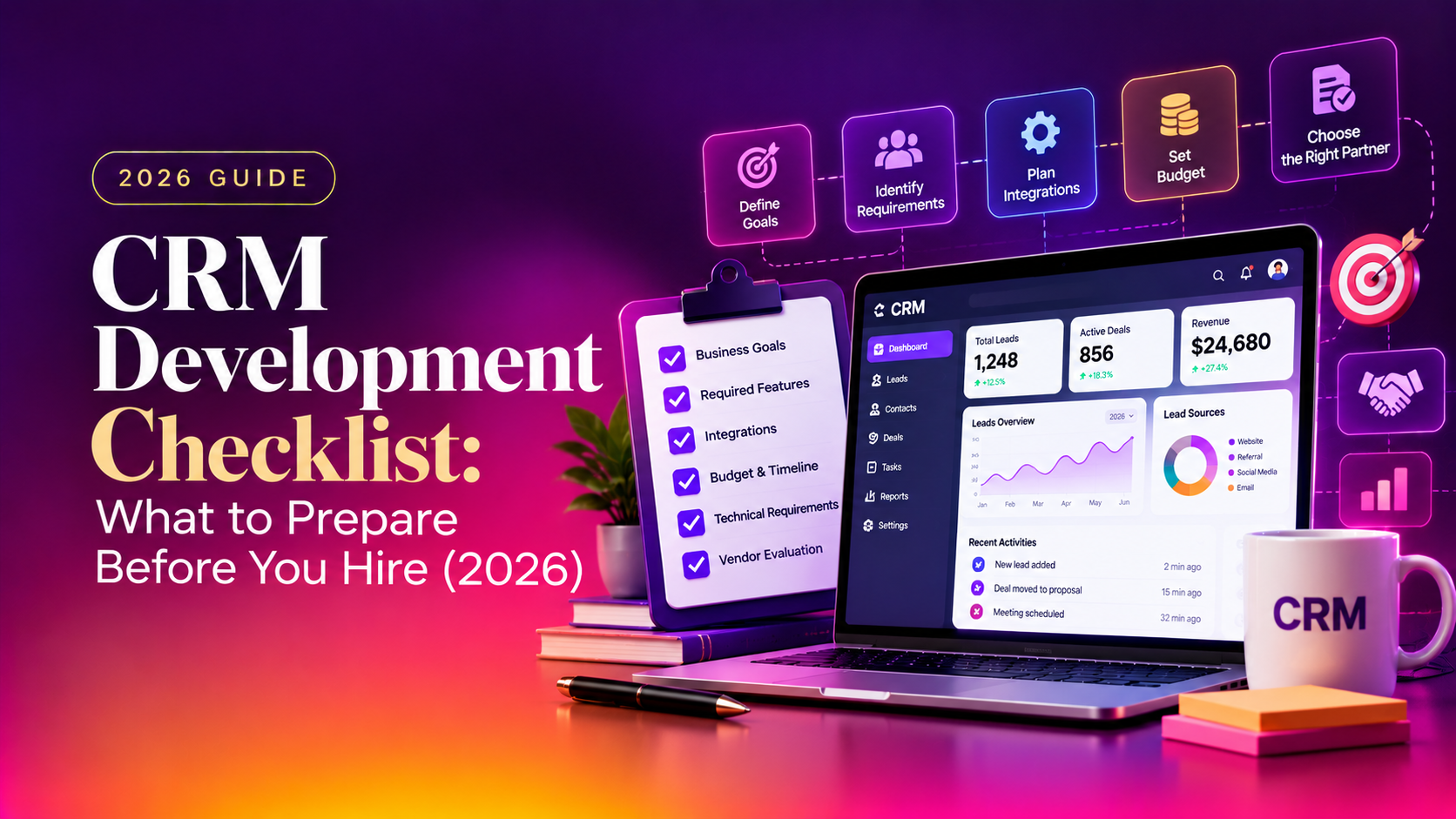
Use this custom crm requirements checklist to prepare a scope document before you contact any vendor. Vague requirements are the #1 cause of scope creep and mid-project budget overruns.
Map every stage from lead capture to closed-won (or ticket-open to ticket-closed for support-driven CRMs). Note where manual work-arounds, spreadsheets, or email threads currently plug gaps — these are your real requirements, not a wishlist of "nice to have" features.
ERP/accounting software, email (Google Workspace/Outlook), telephony/VoIP, WhatsApp Business API, payment gateways, marketing automation, and any internal tools. Each third-party API integration typically adds $1,500–$10,000 to the project, so listing them early prevents surprise change orders.
In 2026, a basic custom CRM (contact management, pipeline, reporting) runs $30,000–$60,000. Mid-range builds with integrations and workflow automation land between $50,000–$150,000+, and enterprise CRMs with AI-driven insights or ERP integration run $100,000–$200,000+. Budget an additional 15–20% contingency for scope changes, plus 15–20% of the build cost annually for ongoing maintenance.
Migrating existing customer data typically costs $3,000–$15,000 depending on volume and how clean your current records are. Audit your existing CRM/spreadsheet data for duplicates and dead fields before migration to avoid paying to migrate garbage data.
Sales reps, managers, support agents, and admins typically need different visibility and edit rights. Documenting this upfront avoids a costly permissions-model rebuild mid-project.
If you handle EU or California customer data, GDPR and CCPA compliance needs to be architected in from day one, not bolted on after launch.
Will the CRM run on your own cloud infrastructure or the vendor's? Confirm you retain full source code ownership and database export rights in the contract — this single clause prevents vendor lock-in.
A mid-complexity custom CRM typically takes 3–6 months from discovery to launch. Break this into discovery, design, core build, integrations, UAT, and go-live milestones so you can track progress and catch delays early.
Questions to Ask Before You Hire a CRM Development Company
These are the questions that separate a vendor who understands your business from one reciting a generic sales pitch. This is the what to ask crm development company list every buyer should walk into a discovery call with.
- Can you show us a CRM you've built for a company with a similar sales process or industry?
- Who exactly will work on our project — is it a dedicated team (backend, frontend, QA, project lead) or a single generalist developer?
- What's your process for handling scope changes once development starts, and how are they priced?
- Do we retain full ownership of the source code and database, and can we export our data at any time?
- What does post-launch support look like — response times, bug-fix SLAs, and monthly retainer cost?
- Can you walk us through how you'd migrate our existing customer data without downtime?
- What happens if a key integration (e.g. our ERP or telephony provider) changes its API mid-project?
- Can you provide references from clients who went live at least a year ago, and what would they say went wrong in the first 90 days?
This is also the point to confirm scope boundaries — a crm project scope checklist shared with the vendor before the contract is signed, listing every feature, integration, and user role agreed above, reduces disputes over "is this in scope" later in the build.
In-House vs Outsourced CRM Development
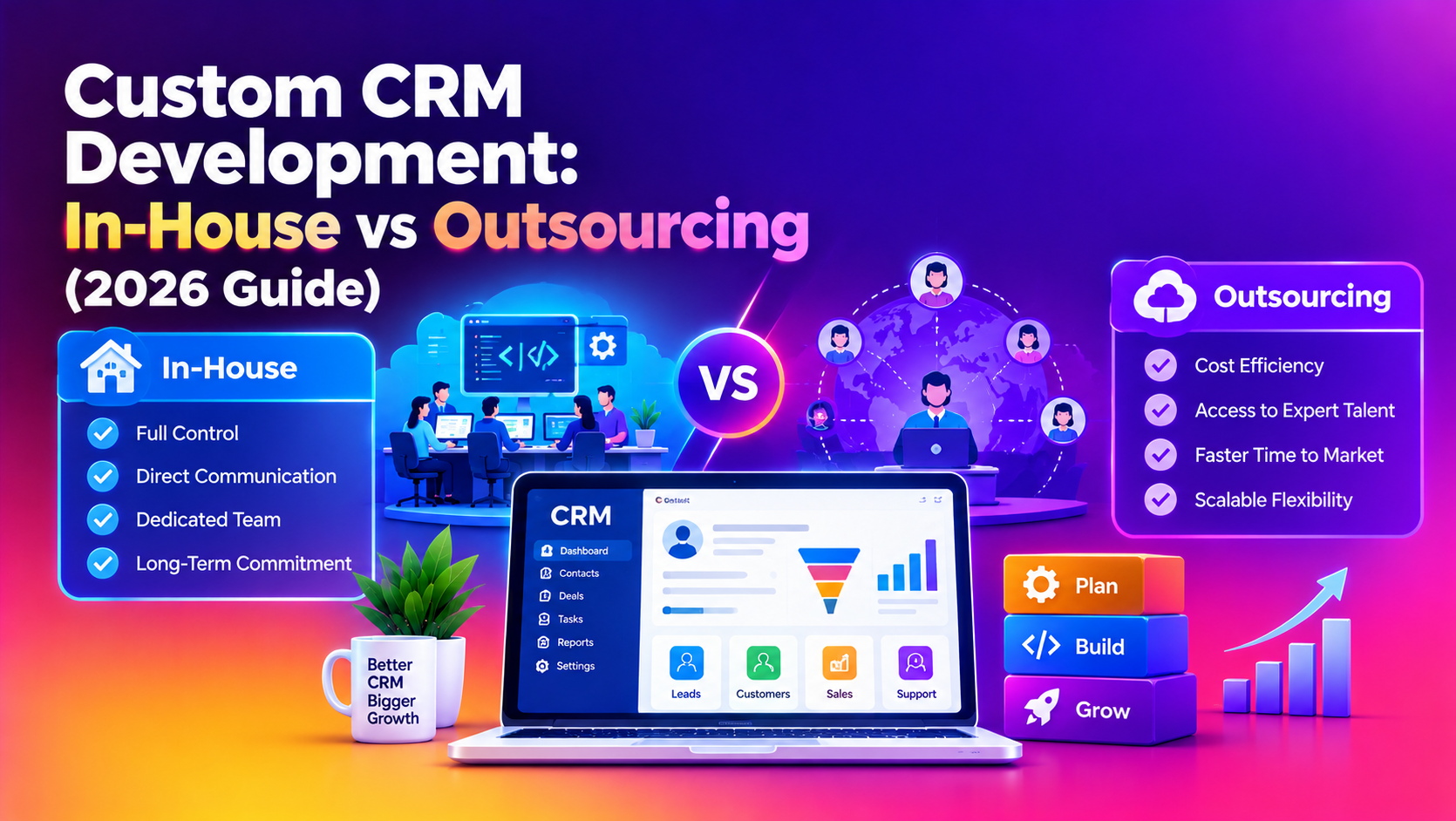
| Factor | In-House Team | Outsourced (CloudHouse) |
|---|---|---|
| Upfront cost | High — hiring, salaries, benefits for 3-5 specialists | Lower — pay only for the build, no long-term payroll |
| Time to hire | 2-4 months to recruit a qualified team | Team assigned within days |
| Ongoing maintenance | Requires retaining staff after launch | Flexible support plans, scale up/down as needed |
| Domain expertise | Limited to what your hires have seen before | Cross-industry CRM build experience |
| Risk of technical debt | Higher if a single generalist handles everything | Lower — dedicated backend, frontend, QA roles |
Most operations teams find outsourcing makes sense unless you're building CRM development as a permanent internal capability across multiple products. A hybrid approach — outsourcing the initial build, then retaining a small in-house team for day-to-day configuration — is common once the CRM is live.
Why Businesses Choose CloudHouse for CRM Development
CloudHouse assigns a full dedicated team — backend, frontend, QA, and a project lead — to every CRM development engagement, rather than a single generalist developer juggling every layer of the build. Clients keep full source code and database ownership from day one, integrations are scoped and quoted before development starts (not discovered mid-build), and post-launch support is billed transparently with no long-term lock-in contract.
Frequently Asked Questions
How much does custom CRM development cost in 2026?
A basic custom CRM (contact management, pipeline, reporting) typically costs $30,000–$60,000. Mid-range builds with integrations and automation run $50,000–$150,000+, and enterprise systems with AI features or ERP integration can exceed $200,000. Get a scoped quote based on your specific requirements checklist rather than relying on generic price ranges.
How long does it take to build a custom CRM?
Most mid-complexity CRM projects take 3–6 months from discovery to go-live, broken into discovery, design, core build, integrations, and UAT/launch phases. Simple builds can launch in 8-10 weeks; enterprise systems with heavy ERP integration can take 8-12 months.
Should I hire a CRM developer or use an off-the-shelf CRM?
If your sales or support process fits standard pipeline stages and you have fewer than 15-20 users, an off-the-shelf CRM is usually more cost-effective short term. Custom development becomes the better investment once per-seat licensing costs, missing integrations, or workflow rigidity start costing more annually than a one-time build would.
What information do I need to prepare before contacting a CRM development company?
At minimum: a documented sales/support workflow, a list of systems to integrate (ERP, email, telephony, payment gateways), an approximate budget range, user roles and permission levels, and any compliance requirements (GDPR, CCPA). Use the hire crm developer checklist above as a starting template.
Can I trust an outsourced vendor with my customer data during development?
Reputable CRM development companies sign an NDA and data processing agreement before any data migration begins, use staging environments with anonymized or dummy data during build and testing, and give you full audit access to the codebase. Ask any shortlisted vendor for their data-handling policy in writing before sharing production data.