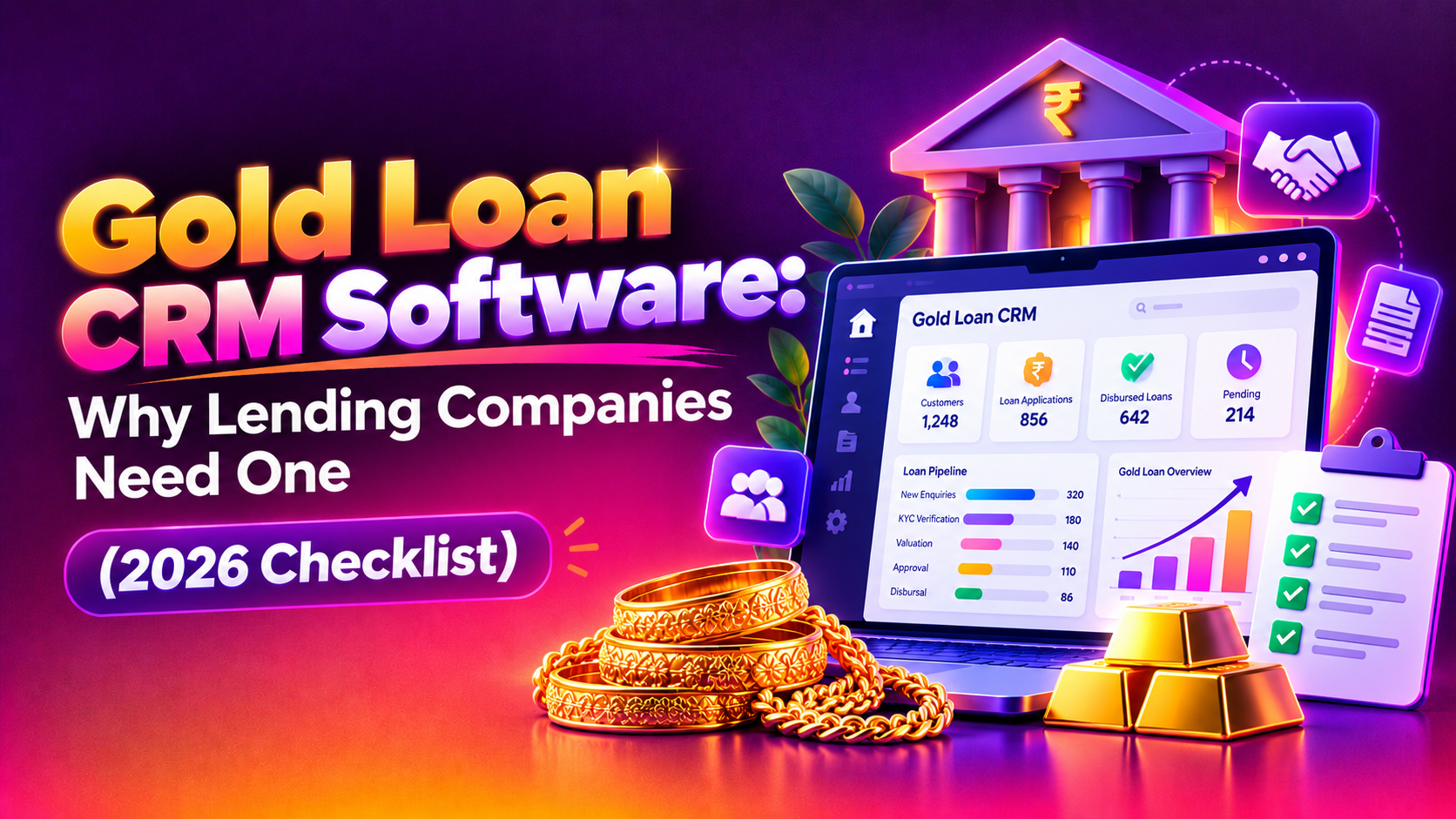
If your branch managers are still tracking loan renewals, follow-ups, and cross-sell opportunities on WhatsApp messages and Excel sheets, you are not running a lending business — you are running a memory test. A true gold loan CRM software does what generic loan origination systems don't: it tells you exactly which customer is about to default on renewal, which lead went cold three weeks ago, and which branch is sitting on lakhs of maturing loans nobody has called about.
Most gold loan software vendors sell you a loan processing engine — KYC, gold valuation, disbursal, interest calculation. Useful, but incomplete. It answers "how much gold is pledged and what's the interest due," not "which of my 3,000 customers should my staff call today." That second question is a CRM question, and it's the one that actually protects renewal revenue.
Why Gold Loan Businesses Need a CRM, Not Just Loan Software
A gold loan portfolio is fundamentally a renewal business. Average tenures run 6-12 months, and a significant share of annual revenue comes from renewals, top-ups, and repeat borrowing rather than fresh disbursals. Yet most gold loan software India vendors ship, at best, a static customer list with a phone number and a loan ID attached. There is no follow-up scheduling, no maturity-date alerting, and no way for a regional manager to see which branch employee last spoke to a given customer.
Without a CRM layer sitting on top of the loan ledger, branches default to manual tracking — a physical register, a shared spreadsheet, a WhatsApp group for "loans due this week." That works fine at low volume. It breaks the moment a branch manager goes on leave, a staff member resigns mid-quarter, or the portfolio crosses a few hundred active loans. At that scale, maturing loans quietly slip through the cracks and customers walk straight to a competitor for their next renewal — often without your branch even realizing the relationship was lost until months later.
This is the blind spot most competitor content on gold loan software misses entirely: they cover loan processing exhaustively but treat "customer relationship" as an afterthought, when in a renewal-heavy business it's actually the revenue engine.
What a Gold Loan CRM Should Track
A purpose-built gold loan management software with genuine CRM capability should give you a single view of every customer relationship, not just every transaction. At minimum, it needs to track:
- Loan maturity dates — with automated alerts 30/15/7 days before due date, escalating in urgency
- Lead source and status — walk-in, referral, digital campaign, and where each lead currently sits in the pipeline
- Follow-up history — who called, when, what was discussed, and the agreed next action date
- Cross-sell opportunities — customers eligible for a top-up, a second loan against new gold, or another product entirely
- Branch-wise assignment — which staff member owns which customer relationship at any given time
- Renewal conversion rate — how many maturing loans actually get renewed versus how many walk away unrenewed
This is gold loan lead tracking in the truest sense — not just capturing a fresh enquiry, but following every customer through the entire loan lifecycle from first walk-in through renewal or eventual closure.
Buyer's Checklist: Must-Have CRM Features
Before signing a contract with any gold loan software vendor, run their platform against this checklist during the demo. If they can't demonstrate each item live, that's a gap you will feel operationally within the first quarter.
- Automated maturity and renewal alerts — SMS/WhatsApp/email reminders triggered automatically by the system, not manually typed into a calendar by staff
- Centralized lead pipeline — every enquiry, walk-in, and referral logged in one dashboard, visible across all branches, not siloed per branch
- Task and follow-up assignment — the system should assign a follow-up to a named staff member with a hard due date, not leave it to memory or a sticky note
- Branch-level and company-level reporting — renewal rate, lead conversion rate, and overdue-follow-up counts, broken down by branch and rolled up company-wide
- Role-based access control — branch staff see only their assigned customers; regional and head-office management see the full portfolio
- Mobile access for field and branch staff — CRM data should be usable and updatable from a phone, not locked to a single desktop terminal
- Integration with the loan ledger — CRM data should pull live loan status directly, not rely on a stale nightly export or manual reconciliation
- Audit trail — every follow-up, status change, and reassignment logged, both for compliance and for staff accountability
- Data migration support — the vendor should be able to import your existing spreadsheet or register data without forcing your team to re-type thousands of records manually
- Scalable across branches — the same system should work identically for 1 branch or 50, without requiring a re-platform as you grow
CRM vs Standalone Spreadsheet Tracking
It's tempting to think "we already track this in Excel, why pay for a CRM?" The honest answer is that spreadsheets work at small scale and fail silently at growth scale — nobody notices a missed renewal until the customer has already walked into a competitor's branch.
| Capability | Spreadsheet / Register | Dedicated Gold Loan CRM |
|---|---|---|
| Renewal reminders | Manual, easily missed | Automated, rule-based alerts |
| Multi-branch visibility | Requires manual consolidation | Real-time, centralized dashboard |
| Follow-up accountability | No ownership tracking | Assigned tasks with due dates |
| Staff turnover risk | Knowledge lost when staff leaves | All history retained in the system |
| Reporting | Manual pivot tables, delayed | Live conversion and renewal reports |
| Scalability | Breaks down beyond a few hundred loans | Scales to thousands of active loans |
The gap widens fastest during renewal season — exactly when a spreadsheet-based process is most likely to drop a follow-up, because that's also when staff are busiest processing walk-ins and have the least time to manually scan a register for upcoming due dates.
How CloudHouse's Gold Loan Platform Handles CRM
CloudHouse's gold loan software is built with lead and renewal tracking as a core module, not a feature bolted onto a loan ledger as an afterthought. Every pledged loan is automatically linked to a maturity timeline, follow-up tasks are assigned to specific staff members with due-date alerts, and branch managers get a live dashboard showing exactly which customers are due for renewal this week and which leads have gone cold and need a callback.
Why lending businesses choose CloudHouse for this: the platform is built by a team that also runs server infrastructure and technical support for financial-sector clients day to day, so uptime, data security, and support responsiveness aren't afterthoughts — they're the baseline the platform is engineered around. There's no rigid multi-year lock-in contract, and onboarding includes migrating your existing spreadsheet or register data into the system so branches aren't starting from a blank slate on day one.
If your business has outgrown manual tracking, or you're evaluating gold loan software for NBFC operations for the first time, running the checklist above against any shortlist — including CloudHouse's platform — is the fastest way to separate genuine CRM capability from a repackaged loan ledger with a customer list attached.
Frequently Asked Questions
Is gold loan CRM software different from gold loan management software?
Not entirely — a good gold loan management software includes CRM capability as one of its modules. The distinction matters because many vendors sell only the loan processing engine (KYC, valuation, disbursal, interest) without the lead-tracking and renewal-alert layer that actually protects recurring revenue.
How much does gold loan CRM software cost?
Pricing varies by vendor and depends on the number of branches, users, and whether it's cloud-hosted or on-premise. Most providers price per branch or per active loan volume rather than a flat fee, so it's worth requesting a quote based on your actual branch count and loan volume rather than relying on a published list price.
Can we migrate our existing spreadsheet data into a gold loan CRM?
Yes. A reputable vendor should offer data migration as a standard part of onboarding — importing existing customer, loan, and follow-up records so branch staff aren't stuck manually re-entering thousands of rows from a paper register or spreadsheet.
Do we need CRM software if we only have one branch?
Even single-branch operations start to benefit once loan volume crosses a few hundred active accounts, since manual tracking of renewal dates becomes unreliable well before that point. The return on investment comes from renewals saved, not from branch count alone.
How long does implementation typically take?
For a single-branch setup, most gold loan CRM implementations go live within 1-3 weeks including data migration and staff training. Multi-branch rollouts take longer depending on how many branches need onboarding and how much historical data needs migrating across locations.