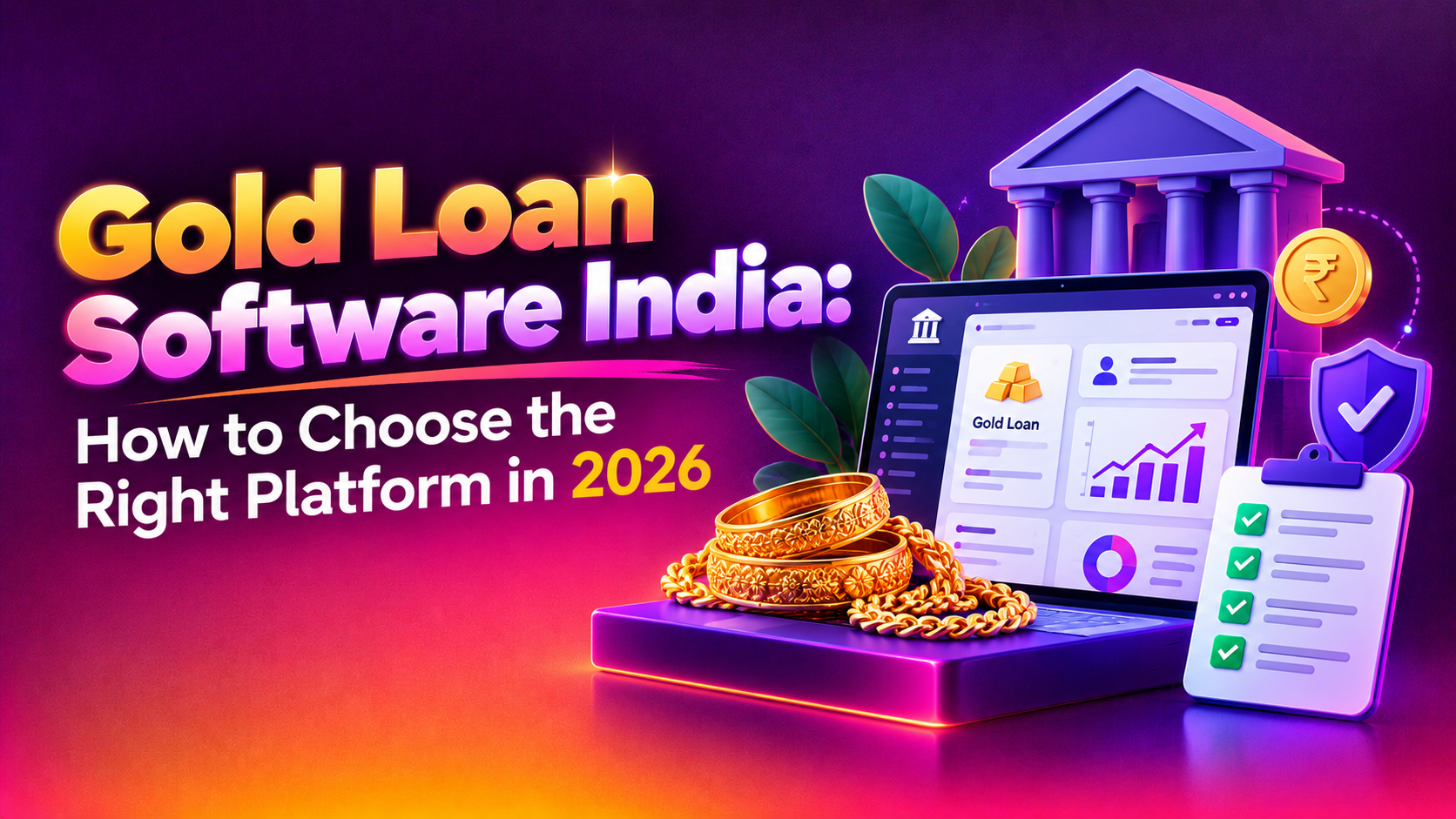
If you're evaluating gold loan software in India, you've probably noticed the same problem: every vendor's website says "RBI compliant," "secure," and "easy to use" — but almost none of them tell you what that actually means for your branch operations, your audit trail, or your monthly bill. This guide cuts through the marketing and gives you a real buyer's framework: the features that matter, what gold loan software actually costs in 2026, and a vendor checklist you can use in your next demo call.
What Is Gold Loan Software and Who Needs It?
Gold loan software (also called a gold loan management system or GLMS) is the core operating platform that runs a lender's entire gold-backed loan lifecycle — from customer onboarding and gold appraisal, through loan disbursement, interest accrual, renewal, part-release, and closure, right up to auction management for defaulted loans. It's built specifically around the mechanics of gold lending, which standard loan origination systems (LOS) built for personal or business loans simply don't handle well.
You need dedicated gold loan management software if you are:
- An NBFC disbursing gold loans across multiple branches and need centralised visibility into collateral and exposure
- A cooperative bank or regional bank running a gold loan desk alongside other lending products
- A new-age gold loan startup trying to launch fast without building loan infrastructure from scratch
- An established lender still running gold loans on spreadsheets, paper registers, or a generic LOS that wasn't designed for bullion-backed collateral
If your team is manually reconciling gold weight, purity, and valuation against loan ledgers in Excel, or your auditors keep flagging gaps in your collateral trail, that's the clearest sign you've outgrown ad hoc tooling.
Must-Have Features: RBI Compliance, Custody Tracking, Auction Management
This is the section most comparison articles skip — they list "user-friendly dashboard" and "cloud-based" as if those were differentiators. Here's what to actually check.
RBI Compliance Built Into the Workflow, Not Bolted On
The RBI's Responsible Business Conduct Directions for gold loans (effective April 1, 2026) replaced 31 scattered circulars with a single, stricter framework covering both banks and NBFCs. Your software needs to enforce, not just document:
- Tiered LTV limits — 85% for loans up to ₹2.5 lakh, 80% between ₹2.5–5 lakh, and 75% above ₹5 lakh — calculated automatically at disbursement and monitored through the loan tenure, not checked manually at month-end
- Mandatory credit assessment for loans above ₹2.5 lakh, with the assessment data captured in the system, not a separate PDF
- Standardised valuation certificates generated directly from XRF/karat-meter readings, with collateral photographs attached to the loan record — this is now a mandatory field, not optional documentation
- Auction process controls — notice periods, reserve price rules, and buyer eligibility checks that match RBI's revised auction norms, so you're not manually tracking compliance on a defaulted account
Ask any vendor to show you — live, in a demo, not in a slide deck — how the system blocks a disbursement that would breach the LTV cap. If they can't demonstrate it, the "RBI compliant" claim is marketing, not a feature.
Custody and Collateral Tracking
Every gram of gold sitting in your vault needs an unbroken digital chain of custody: item-level weight and purity, packet sealing records, dual-custodian sign-off, vault movement logs, and reconciliation against the loan ledger — ideally with a daily automated tally that flags any mismatch same-day, not at the next internal audit.
Auction Management
For NPAs, the software should handle notice generation, auction scheduling, bidder empanelment, and reserve-price calculation without manual intervention — and produce an audit-ready trail for every step, since gold loan auctions are a frequent target of RBI inspection and customer litigation.
Gold Loan Software Pricing in India (2026)
Pricing is the part vendors are least transparent about. Based on current market positioning, here's a realistic range for gold loan software price in India:
| Deployment Model | Typical Price Range (2026) | Best For |
|---|---|---|
| Per-branch SaaS subscription | ₹8,000 – ₹35,000 / branch / month | NBFCs scaling branch count without upfront capex |
| Enterprise licence + AMC | ₹8 lakh – ₹40 lakh one-time + 15–20% annual AMC | Established lenders wanting on-prem control |
| Custom-built platform | ₹15 lakh – ₹60 lakh+ (project-based) | Lenders with unique workflows or existing core banking integration needs |
| Add-on modules (auction, e-KYC, XRF integration) | ₹1 lakh – ₹6 lakh per module | Anyone bolting features onto an existing core system |
Watch for hidden costs that rarely appear in the initial quote: per-user licensing on top of per-branch fees, charges for API integrations with your core banking or accounting system, data migration fees if you're switching from another platform, and mandatory annual maintenance contracts that can run 15–20% of the licence cost every year. Always ask for the fully-loaded three-year cost, not just the sticker price.
In-House Build vs Buying Ready-Made Software
Some NBFCs consider building a gold loan platform in-house, usually because they already have a development team for other products. It's rarely the right call unless gold lending is your primary and largest business line.
| Factor | Build In-House | Buy Ready-Made / Customised |
|---|---|---|
| Time to launch | 9–18 months | 4–10 weeks |
| RBI compliance updates | Your team tracks and rebuilds every circular change | Vendor pushes compliance updates as part of AMC |
| Upfront cost | High (dev team + infra + testing) | Moderate, spread over subscription/licence |
| Ongoing maintenance | Fully on your payroll indefinitely | Bundled into AMC/support contract |
| Auction & custody modules | Built from scratch, high risk of gaps | Pre-built, tested across other lenders |
The honest answer: building in-house makes sense only if you have a dedicated fintech engineering team, a multi-year runway, and gold loans as a strategic core business — not a side product. For most NBFCs and regional lenders, a purpose-built or custom-configured platform gets you compliant and live far faster, and a good vendor absorbs the ongoing burden of RBI circular changes for you. Teams evaluating this trade-off often work with a custom software development partner to configure a ready platform around their exact branch workflow rather than starting from zero.
How to Choose a Gold Loan Software Vendor: A Checklist
Use this checklist in every vendor demo — literally take it into the call:
- Can they demo live LTV enforcement at the point of disbursement, not just describe it?
- Do they support item-level gold tracking (weight, purity, photograph) with an audit trail, not just a lump loan-value entry?
- Is auction management built in, or is it a manual workaround / separate spreadsheet?
- What's the actual all-in 3-year cost — licence/subscription, AMC, per-branch fees, integration charges, data migration?
- How do they handle RBI circular updates — is it included in AMC, or a paid change request every time?
- What's their support SLA — 24/7 phone support, or ticket-only with a 48-hour response?
- Can it integrate with your core banking, accounting, and XRF/karat-meter hardware without a six-month integration project?
- Do they have live NBFC references you can actually call, not just logos on a website?
- What's the data migration process if you're moving off an existing system or spreadsheets?
- Is multi-branch, role-based access control available out of the box for cashiers, appraisers, and branch managers?
Any vendor who hesitates on more than two of these is a red flag, not a coincidence.
Why Hosting Companies and NBFCs Choose CloudHouse for Gold Loan Software
CloudHouse builds and configures gold loan management software around your actual branch process rather than forcing you into a rigid template — covering RBI-aligned LTV enforcement, item-level custody tracking, and auction workflows from day one. Because we build and support the platform ourselves, updates for new RBI circulars ship as part of ongoing support rather than a separate paid change request, and you get a direct line to the engineers who built your system rather than a generic support ticket queue.
Frequently Asked Questions
How much does gold loan software cost in India?
Costs range from roughly ₹8,000–₹35,000 per branch per month for SaaS subscriptions, up to ₹8–60 lakh for enterprise licences or fully custom builds, plus 15–20% annual AMC. Always ask for a 3-year total cost of ownership, not just the setup quote.
Is a monthly or trial plan available for gold loan software?
Most vendors won't advertise it, but many will offer a pilot period on one or two branches before you commit to a multi-branch rollout — ask directly, since it's rarely on the pricing page.
How long does it take to implement gold loan software for an NBFC?
A configured, ready-made platform typically takes 4–10 weeks from kickoff to go-live across pilot branches, including data migration and staff training. A fully custom build can take 4–9 months depending on integration scope.
What makes gold loan software RBI compliant?
It must enforce the tiered LTV caps (85%/80%/75%), mandate credit assessment above ₹2.5 lakh, generate standardised valuation certificates with collateral photographs, and support the revised auction notice and reserve-price rules — enforced in the workflow, not just documented in a manual.
Should NBFCs build gold loan software in-house or buy it?
Buying or customising a ready-made platform is faster and lower-risk for most lenders, since the vendor absorbs ongoing RBI compliance updates and has already tested the auction and custody modules. In-house builds only make sense when gold lending is your core, largest business line with a dedicated engineering team.