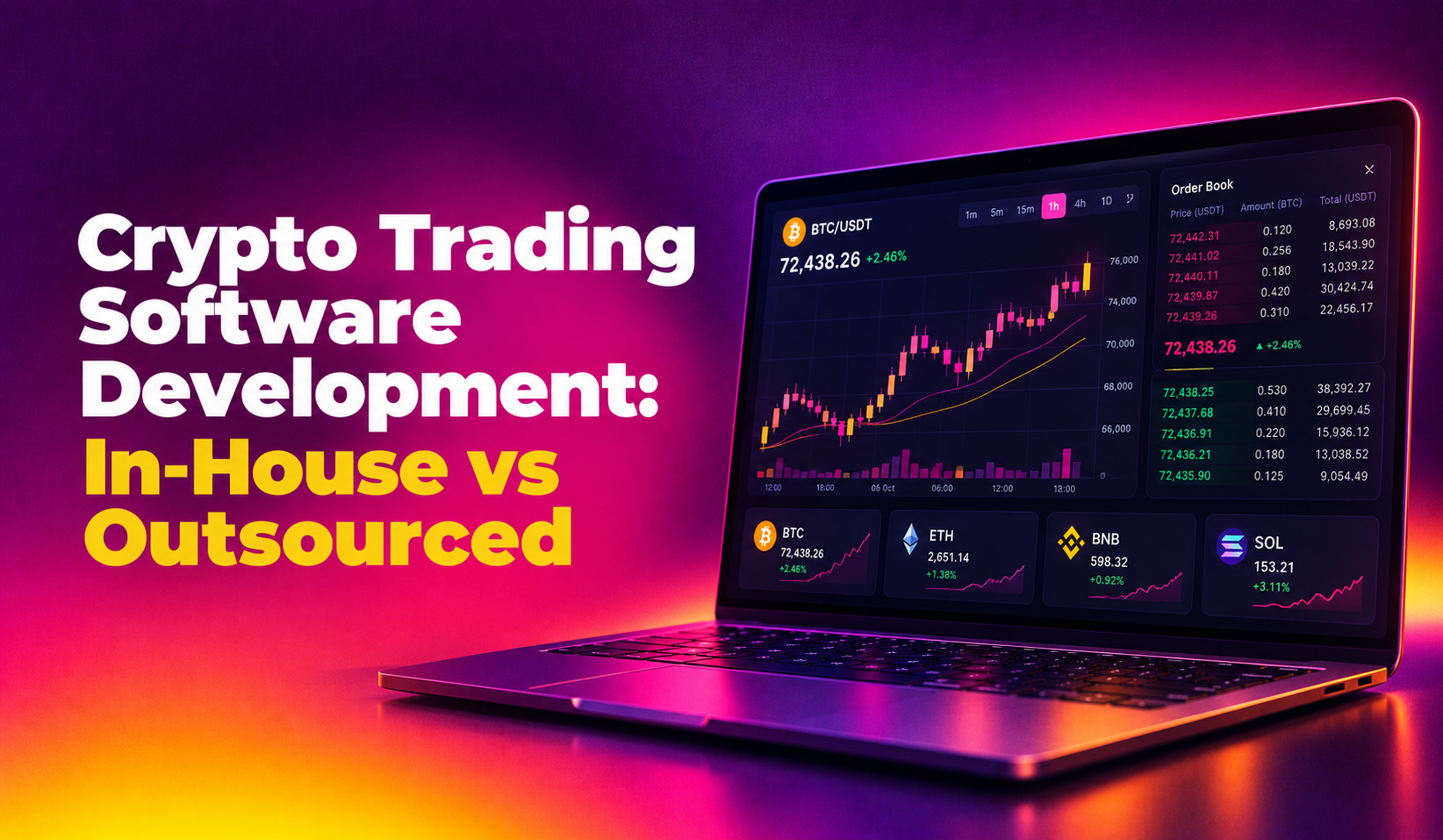
Deciding between in-house crypto trading software development and outsourcing to a specialist is one of the highest-stakes calls a fintech founder makes before launch. Get it wrong and you risk blown budgets, delayed regulatory approval, or worse — an exploited smart contract. This guide breaks down the real cost, security, compliance, and speed-to-market trade-offs of crypto trading software development in-house vs outsourced so you can decide with confidence.
What Is Custom Crypto Trading Software Development?
Custom crypto trading software development covers the engineering of order-matching engines, wallet infrastructure, KYC/AML modules, liquidity integrations, and trading UIs that power a cryptocurrency exchange or trading platform. Unlike off-the-shelf trading bots, a custom build is tailored to your asset mix, jurisdiction, and user base — which is why founders evaluating crypto exchange development team options usually land on either hiring internally or working with a firm that specializes in this niche.
Whether you're building a centralized exchange (CEX), a decentralized exchange (DEX), or a hybrid trading terminal, the core components are similar: a matching engine, custody/wallet layer, risk and compliance engine, and a front-end trading interface. Each of these carries different security and regulatory implications, which is exactly where the in-house vs outsourced decision starts to matter — and where founders most often underestimate scope in early planning.
Building In-House: Cost, Talent, and Security Risk
Building an internal team sounds appealing on paper — full control, in-house IP, and no vendor dependency. But the numbers tell a harder story. A realistic in-house crypto engineering team for even an MVP-stage exchange looks like this:
| Role | Typical Annual Salary (US/EU market) | Headcount Needed for MVP |
|---|---|---|
| Blockchain / backend engineer | $110,000–$155,000 | 2–3 |
| Smart contract / security engineer | $130,000–$170,000 | 1–2 |
| Frontend / trading UI engineer | $90,000–$125,000 | 1–2 |
| QA / test automation engineer | $75,000–$100,000 | 1 |
| Compliance / KYC-AML specialist | $95,000–$130,000 | 1 |
| DevOps / infrastructure engineer | $100,000–$140,000 | 1 |
Add benefits (typically 20–30% on top of base salary), recruiting fees, security audit engagements ($15,000–$60,000 per audit, and exchanges usually need 2–3 rounds), infrastructure, and tooling, and a lean seven-person in-house team easily runs $700,000–$1.1 million in year one before a single trade executes on the platform.
The bigger risk isn't cost — it's talent scarcity and security exposure. Genuine blockchain security engineers who understand smart contract exploits, custody architecture, and exchange-specific attack vectors (flash loan manipulation, front-running, wallet key compromise, oracle manipulation) are rare and expensive, and demand for them consistently outstrips supply. Most first-time in-house teams have never shipped a production trading system before, and crypto exchanges are a uniquely unforgiving environment to learn in — a single custody bug or unaudited smart contract can mean total, irreversible loss of user funds with no chargeback mechanism to fall back on.
Hiring timelines compound the problem. Recruiting, vetting, and onboarding a qualified in-house crypto engineering team typically takes 4–8 months before meaningful development even starts, on top of the 6–12 months needed to build a production-grade platform. That's a realistic 10–18 month runway before launch, during which payroll, benefits, and office/infrastructure overhead continue to accrue whether or not the product ships on schedule.
There's also an often-overlooked retention risk: crypto engineers with in-demand skills are heavily recruited by competitors and larger firms. Losing even one senior blockchain engineer mid-build can set a first-time team back months, since exchange codebases (particularly custody and matching-engine logic) are dense and poorly documented in most early-stage startups.
Outsourcing to a Specialist: What You Get
When you outsource crypto trading platform development to an established team, you're buying proven architecture, pre-built compliance modules, and engineers who have already shipped exchanges under real regulatory scrutiny. Outsourced blockchain developer rates typically run $45,000–$75,000 per year equivalent (often billed hourly at $25–$49/hr for offshore/nearshore specialist teams), a fraction of in-house salary costs, because you're not carrying full-time overhead, benefits, recruiting costs, or idle bench time between projects.
The real value isn't just the cost delta — it's risk transfer. A specialist team has already solved the hard problems: multi-signature custody, cold/hot wallet separation, KYC/AML integration with providers like Sumsub or Jumio, rate-limiting and anti-front-running logic in the matching engine, and smart contract audit workflows with firms like CertiK or Halborn. That experience compresses build time significantly; most outsourced teams can deliver an MVP exchange in 3–5 months versus 10–18 months for a first-time in-house build.
Outsourced engagements also typically bundle in things an in-house team would need to build or buy separately: liquidity aggregation connectors to external market makers, monitoring/alerting for wallet anomalies, and documented incident-response runbooks for exchange outages or suspected breaches. These aren't nice-to-haves — regulators in most jurisdictions expect documented incident response as part of a licensing review.
CloudHouse's crypto trading software development team builds on hardened, audited architecture patterns from prior exchange and wallet projects, so founders aren't paying to relearn lessons the industry has already learned the hard way.
Side-by-Side Comparison: In-House vs Outsourced
| Factor | In-House Team | Outsourced Specialist |
|---|---|---|
| Year-1 cost | $700,000–$1.1M+ (salaries, benefits, tools, audits) | $25,000–$150,000+ depending on platform scope |
| Time to MVP | 10–18 months (hiring + build) | 3–5 months |
| Security track record | Unproven on first build; higher exploit risk | Reuses audited, battle-tested architecture |
| Compliance (KYC/AML) | Built from scratch, longer legal review | Pre-integrated compliance modules |
| Talent access | Limited to local/remote hires you can recruit | Full specialist bench, no recruiting lag |
| Key-person risk | High — one departure can stall the build for months | Low — vendor maintains bench depth and redundancy |
| Post-launch support | Requires retaining full team indefinitely | Often available as an ongoing support retainer |
| Long-term ownership | Full IP control, in-house institutional knowledge | IP typically transferred to client; ongoing support optional |
| Best fit | Well-funded teams committing 3+ years to in-house crypto R&D | Startups needing to launch fast without compliance/security missteps |
A Practical Checklist: How to Decide
Before committing budget or headcount, walk through these questions honestly — they surface the trade-off faster than any cost spreadsheet:
- Runway: Can you fund 10–18 months of full in-house payroll before generating exchange revenue? If not, outsourcing buys you speed you can't otherwise afford.
- Security expertise on staff today: Do you currently have a security engineer who has personally shipped and defended a live exchange or custody system? If the honest answer is no, a first build carries meaningfully higher exploit risk in-house.
- Regulatory timeline: Is there a licensing deadline or investor milestone that requires a working platform within 6 months? Outsourced teams compress this window; in-house recruiting alone can consume it.
- Post-launch roadmap: Do you plan continuous, differentiated feature development for 3+ years? That favors eventually building in-house expertise, even if you launch outsourced.
- IP sensitivity: Is your trading logic or matching-engine design a genuine competitive moat, or a standard implementation of known patterns? Highly proprietary strategies may justify tighter in-house control earlier.
- Audit budget: Have you budgeted $30,000–$120,000+ for independent smart contract and infrastructure audits, regardless of who builds the platform? Skipping this step is the single most common cause of exchange breaches.
Why Businesses Choose CloudHouse for Crypto Trading Software Development
Founders come to CloudHouse after realizing that hiring a crypto exchange development team from scratch is slower and riskier than expected. We bring pre-built, security-audited matching engine and wallet frameworks, hands-on experience with exchange-grade KYC/AML compliance, and fixed-scope delivery timelines — so you get a production-ready platform without gambling your runway on an unproven internal build. Our engagements are transparent on cost and timeline from day one, with no lock-in beyond the project scope you approve, and we offer optional ongoing support retainers so you're not left maintaining a complex exchange codebase alone after launch.
Frequently Asked Questions
How much does crypto trading software development cost?
A basic MVP or white-label exchange typically costs $25,000–$80,000, while a full custom centralized exchange with deep liquidity and compliance features can run $150,000–$400,000+. A decentralized exchange (DEX) with automated market-maker pools tends to fall in the $60,000–$200,000 range depending on chain complexity and audit scope. Outsourcing generally costs 40-60% less than building the equivalent in-house due to lower overhead and reused architecture.
How long does it take to build a crypto trading platform?
An outsourced specialist team can typically deliver an MVP exchange in 3-5 months. Building the same platform with a newly hired in-house team usually takes 10-18 months once recruiting and onboarding time is included. Adding a full audit cycle (recommended before any mainnet launch handling real funds) typically adds 3–6 weeks regardless of which path you choose.
Is outsourcing crypto trading software development secure?
Yes, provided you vet the vendor's track record. A specialist team that has already shipped audited wallet and matching-engine architecture carries lower security risk than a first-time in-house team learning exchange-specific attack vectors on the job. Ask prospective vendors for references from prior exchange launches, evidence of past third-party audits, and their incident-response process — a credible partner will have documented answers to all three.
Do I lose ownership of my platform if I outsource development?
No. Reputable outsourced development agreements transfer full IP and source code ownership to the client at project completion — always confirm this in the contract before signing. Watch for vague "license to use" language in place of an outright IP assignment clause; that distinction matters if you later want to bring development in-house or switch vendors.
Can I switch from an outsourced build to an in-house team later?
Yes. Many founders launch with an outsourced team to hit market speed, then hire an in-house team for ongoing feature development once the platform is live and generating revenue. A well-documented outsourced build makes this handover far smoother — insist on clean architecture documentation, deployment runbooks, and commented code as a condition of the contract, not an afterthought requested after launch.
What hidden costs catch founders off guard in crypto exchange development?
The most common surprises are: recurring smart contract audit fees for every major upgrade (not just the initial launch), liquidity provider and market-maker integration fees, insurance for custodied assets, and the ongoing cost of 24/7 monitoring for wallet and matching-engine anomalies. Founders comparing in-house vs outsourced quotes should confirm which of these are included in a proposal versus billed separately post-launch.
Should a startup choose a centralized (CEX) or decentralized (DEX) architecture?
It depends on your regulatory posture and target users. A CEX gives you more control over compliance, fiat on/off-ramps, and user experience, but carries custody liability and heavier licensing obligations. A DEX shifts custody to users' own wallets, reducing certain compliance burdens but requiring deep smart contract security expertise and exposing you to on-chain exploit vectors like flash loan attacks. Many outsourced specialists, including CloudHouse, can scope either path and advise based on your target jurisdiction and user base before you commit budget.