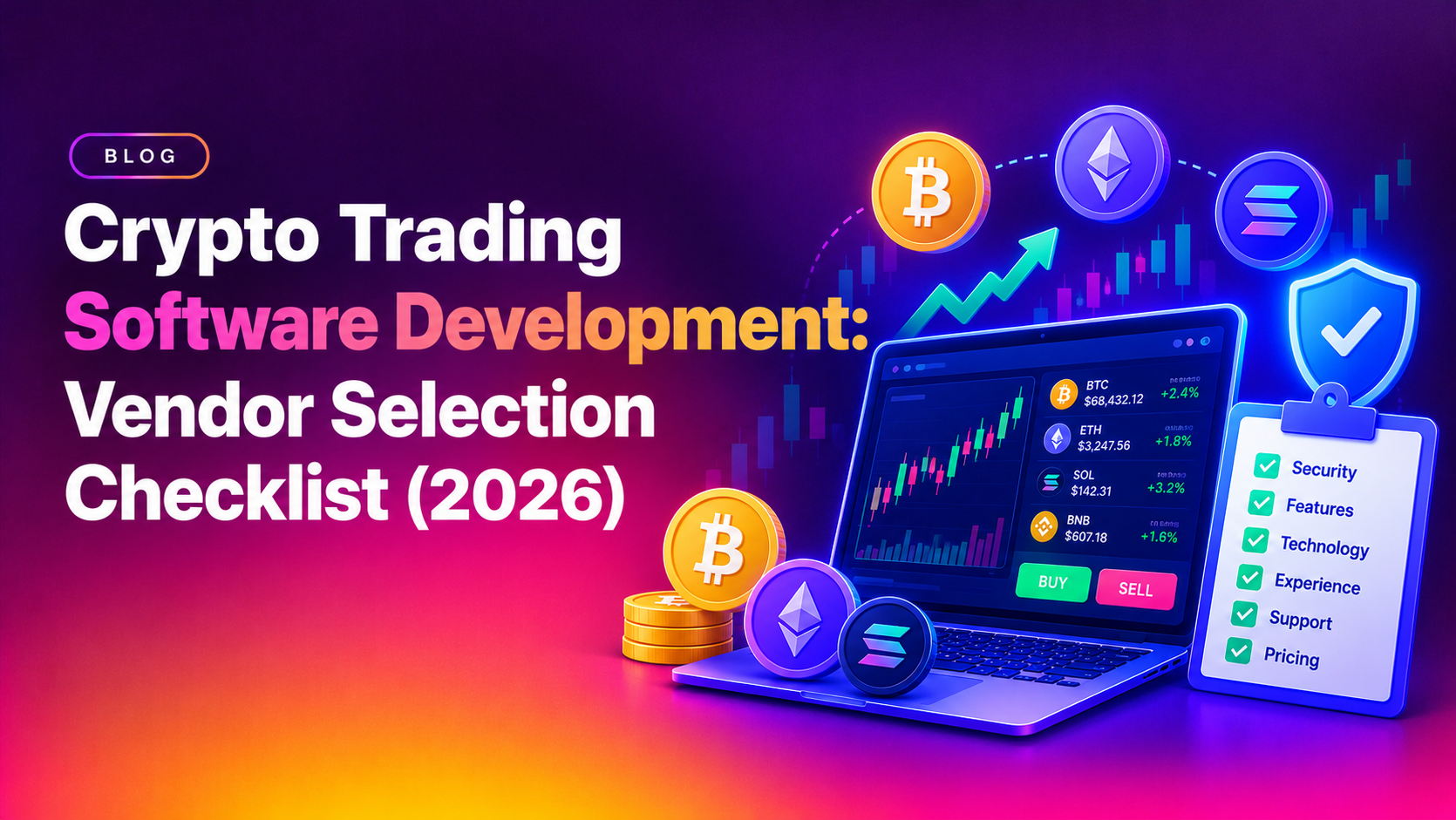
Hiring the wrong vendor for crypto trading software development can cost you months of runway, a failed security audit, or a regulator's cease-and-desist letter. This crypto trading software development checklist gives fintech founders and exchange operators a concrete, pre-signature framework for verifying that a vendor can actually deliver a secure, compliant, and liquid trading platform — not just a demo.
Most vendor pitch decks describe the same generic feature list: order books, wallets, KYC. What they rarely show is proof of matching engine throughput, third-party audit history, or real liquidity provider integrations. This guide fixes that gap with the specific questions and requirements you should demand answered before you sign a contract.
What a Crypto Trading Platform Actually Requires in 2026
A production-ready crypto exchange in 2026 is not a single application — it is a cluster of interdependent subsystems that must each meet institutional-grade standards. Any vendor proposing to build one should be able to walk you through every layer below without hand-waving.
- Matching engine — the core order-matching logic that must handle high-frequency order flow with sub-millisecond latency and deterministic execution.
- Wallet infrastructure — hot, warm, and cold wallet architecture with multi-signature and MPC (multi-party computation) key management.
- KYC/AML and compliance modules — identity verification, transaction monitoring, and sanctions screening built into the onboarding flow, not bolted on afterward.
- Liquidity connectivity — APIs and FIX/WebSocket feeds to external liquidity providers and market makers so order books don't sit empty.
- Risk and treasury management — real-time exposure monitoring, circuit breakers, and reconciliation between on-chain and internal ledgers.
- Admin, reporting, and audit-trail systems — immutable logs for every trade, deposit, withdrawal, and admin action.
If a vendor cannot point to concrete experience across all six subsystems, they are not equipped for a 2026-grade launch. This is also where crypto trading software development teams differentiate themselves — not by claiming to build "an exchange," but by demonstrating depth in each of these components individually.
Deployment Model Matters
Before you evaluate features, settle on deployment model: a fully managed SaaS exchange platform, a white-label license, or a custom-built, self-hosted stack. Each has different implications for how much control you retain over compliance, security posture, and future customization — and vendors often push whichever model is cheapest for them to deliver, not what's right for your business.
Security & Compliance Checklist Before You Hire
Security failures are the single most common reason crypto platforms collapse post-launch. Before signing with any crypto trading software development company, insist on documented answers to each item below.
- Has the vendor's codebase (or a comparable prior project) undergone an independent third-party security audit, with the report available for your review?
- Do they run a crypto trading software security audit at defined milestones — pre-launch, post-deployment, and after every major code release — rather than a single one-time check?
- Is multi-signature or MPC wallet architecture standard, or is it an "add-on" priced separately?
- Do they support KYC/AML integration with recognized providers (Chainalysis, Sumsub, or equivalent) out of the box?
- Can they demonstrate an active sanctions and IP-blocking program to mitigate OFAC exposure?
- Do they provide penetration testing reports and a documented incident-response plan?
- Is there a clear data protection and encryption-at-rest/in-transit policy covering user PII and transaction data?
- Will they support your licensing process (MiCA, MSB, VASP registration, or local equivalents) with technical documentation, or leave compliance entirely to you?
A vendor that treats security and compliance as afterthoughts — rather than requirements baked into the architecture from day one — will cost you far more in remediation than you saved on the initial quote.
💡 None of these worked? Skip the guesswork.
Get Expert Help →Matching Engine, Liquidity & Wallet Integration Requirements
This is the technical core of any evaluation, and where generic agencies most often fall short.
Ask for benchmarked throughput numbers (orders per second) and latency under load, not just a claim that the engine is "fast." Request a live demo with simulated order flow, and confirm the engine supports the order types your business needs — market, limit, stop-loss, and iceberg orders at minimum.
Verify the vendor has previously integrated with real liquidity providers or market makers via FIX API, REST, or WebSocket feeds. Liquidity provider integration is what prevents your order book from looking empty on day one — ask specifically which liquidity partners they've connected to before, and whether smart order routing across multiple venues is supported.
Confirm the split between hot, warm, and cold storage, who holds signing keys, and whether the vendor supports self-custody or requires a third-party custodian. Ask how withdrawals are approved — automated thresholds, manual multi-sig sign-off, or a hybrid model.
Every trade must reconcile against on-chain settlement and internal accounting in real time. Ask how discrepancies are flagged and resolved, and whether reconciliation reports are available for audit purposes.
Vendor Evaluation Checklist: Questions to Ask Before Signing
Use this crypto trading platform vendor evaluation checklist directly in your vendor calls. Treat vague or evasive answers as a red flag.
- Can you show a working demo of the matching engine under simulated load, not just a slide deck?
- Which liquidity providers or market makers have you integrated with in production, and can we speak with a reference client?
- What is your process and cadence for security audits, and will you share past audit reports?
- Who owns the source code and infrastructure after the engagement — do we have full IP rights and deployment control?
- What is your post-launch support model, and what are your SLAs for critical security incidents?
- How do you handle regulatory changes (e.g., MiCA updates, new AML directives) after go-live — is this included or billed separately?
- What does your pricing actually cover — development only, or also QA, security stack, and ongoing operations?
- Can you provide a realistic total cost of ownership for year one, including infrastructure, compliance tooling, and support?
Vendors who welcome these questions and answer with specifics — not marketing language — are the ones worth shortlisting. This checklist mirrors the same evaluation criteria we recommend clients apply to CloudHouse itself when scoping crypto trading software development engagements.
Why Businesses Choose CloudHouse for Crypto Trading Software Development
CloudHouse builds crypto trading platforms with security and compliance treated as architectural requirements from day one, not retrofits after a failed audit. Our engineering team works directly with clients on matching engine design, liquidity integration, and wallet architecture, and we document every security decision so it stands up to independent audit and regulatory review. Rather than a one-size-fits-all white-label package, we scope each engagement around your specific licensing jurisdiction, liquidity strategy, and growth plan.
Frequently Asked Questions
How much does crypto trading software development cost in 2026?
Costs vary widely based on scope, but founders should budget beyond the base development quote: QA typically runs 25-35% of the development budget, a security stack (audits, monitoring, penetration testing) can run $50,000-$150,000+, and ongoing operations often add $10,000-$30,000 per month. A "$50K exchange" pitch rarely reflects the real year-one cost once these are included.
How long does it take to build a crypto trading platform?
A custom platform with a matching engine, wallet infrastructure, KYC/AML, and liquidity integration typically takes 4-9 months depending on complexity and whether components are built from scratch or assembled from proven modules. White-label or SaaS deployments can launch faster, but often trade off customization and long-term control.
Does a crypto trading software security audit come included in vendor pricing?
Not always — and this is one of the most common hidden costs. Always ask explicitly whether pre-launch and periodic post-launch security audits are included in the quoted price or billed as a separate line item, and get the answer in writing before signing.
Can a development vendor help with compliance and licensing?
A good vendor won't file your license application, but they should provide the technical documentation, audit trails, and architecture diagrams your compliance counsel or regulator will need for MiCA, MSB, VASP, or equivalent licensing processes. If a vendor says compliance is "entirely your problem," treat that as a red flag.
What happens if we need to switch vendors mid-project?
This is why IP ownership and code portability should be settled before you sign. Confirm upfront that you retain full rights to the source code and infrastructure configuration, so you are not locked into a single vendor if the relationship doesn't work out.