Deployments that go out at 11pm because the team is scared to ship during the day. A production outage that eats a whole engineering sprint. A founder who is quietly Googling "kubernetes crashloopbackoff" at 2am instead of talking to customers. If any of that sounds familiar, you already know why devops support for startups and saas companies has become one of the most searched services among early-stage engineering teams in 2026. Manual, error-prone deployments and infrastructure reliability problems eat engineering time that should be going into your product roadmap, not firefighting.
The good news: you do not need a five-person platform team to fix this. You need the right slice of DevOps support, delivered in a way that matches your stage. This guide breaks down what that support should actually include, what it costs compared to a full-time hire, and how to pick a partner you can trust with production.
Why Startups and SaaS Companies Need DevOps Support Early
Most founding engineers are excellent at building product and mediocre — through no fault of their own — at operating infrastructure at scale. That gap is invisible when you have ten users. It becomes very visible the moment you close your first enterprise customer who asks for an uptime SLA, or the day a bad deploy takes checkout down during a marketing push.
DevOps problems tend to show up in a predictable pattern for growing startups and SaaS teams:
- Manual deployments — someone SSHs into a server, pulls the latest code, and restarts a service by hand, with no rollback plan if it breaks.
- No CI/CD pipeline — every release is a special event instead of a routine, low-risk push button process.
- Infrastructure drift — staging and production quietly diverge until nobody can reproduce a bug.
- No monitoring or alerting — the first sign of an outage is a customer complaint, not a dashboard.
- Security and compliance gaps — no patching cadence, weak secrets management, no backup verification.
None of these problems require a Google-scale platform team to solve. They require a small amount of dedicated, senior DevOps attention applied consistently — which is exactly the gap devops support for startups is designed to fill. Waiting until you're in real pain (a major outage, a lost deal over security questions, a failed audit) is far more expensive than getting ahead of it now.
What DevOps Support Should Actually Cover
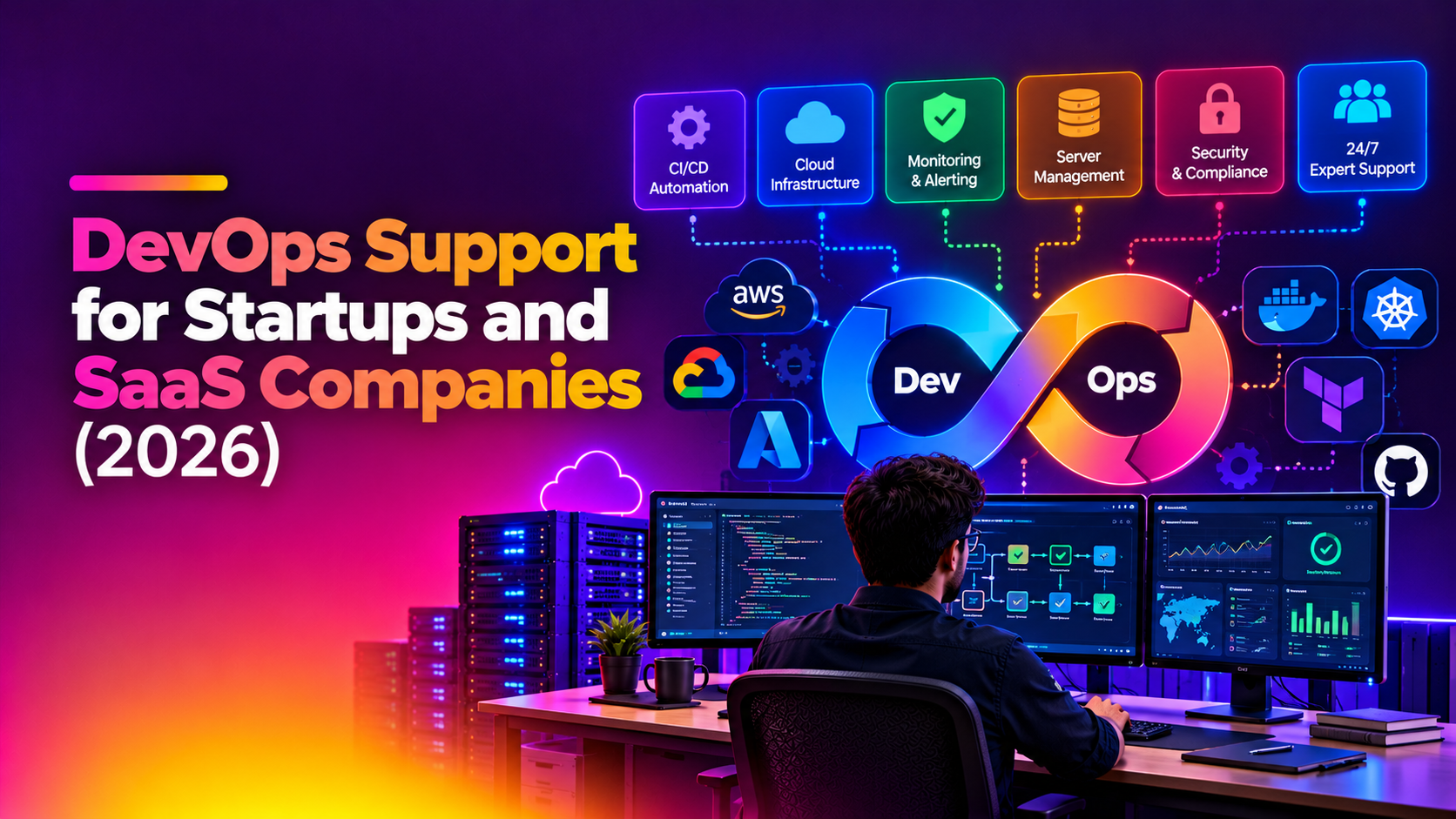
"DevOps support" gets used loosely in the market, so it's worth being precise about what a genuinely useful engagement covers for a startup or SaaS team:
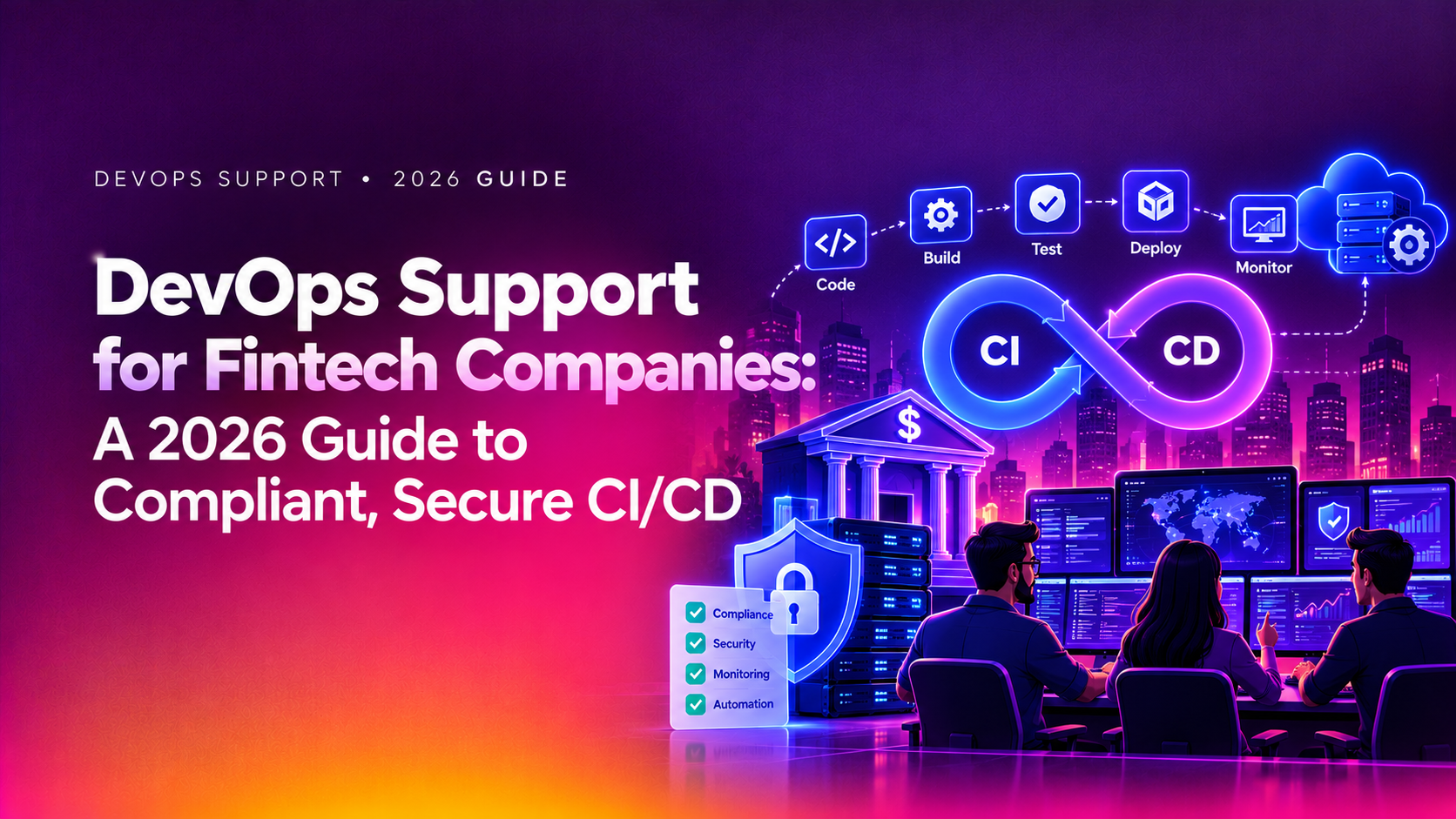
- CI/CD pipeline setup and maintenance — automated build, test, and deploy pipelines (GitHub Actions, GitLab CI, Jenkins) so every push follows the same tested path to production.
- Infrastructure as Code — Terraform or Pulumi definitions so your infrastructure is version-controlled, reviewable, and reproducible instead of hand-configured.
- Cloud infrastructure management — AWS, GCP, or Azure setup, right-sizing, and cost optimization across environments.
- Containerization and orchestration — Docker images and Kubernetes or ECS orchestration where it genuinely makes sense (not every startup needs Kubernetes — a good partner will tell you when it doesn't).
- Monitoring, logging, and alerting — dashboards and on-call alerts (Grafana, Prometheus, Datadog) so problems get caught before customers notice.
- Security hardening — patch management, secrets rotation, firewall and access control review, SSL/TLS management.
- Backup and disaster recovery — tested, verified backups and a documented recovery process, not just a cron job nobody has checked in months.
- On-call incident response — someone who actually answers when production is down at 3am, with clear escalation paths.
Consider a common startup trajectory: a two-person engineering team ships fast for the first year using manual deploys and a single production server. Then the company closes a round, headcount doubles, and the product suddenly has real customers who notice downtime. Without dedicated DevOps attention, that team ends up splitting focus between building features and fighting fires — code reviews slip, releases get riskier, and the founders spend evenings debugging infrastructure instead of talking to customers. Bringing in structured devops support for startups at this inflection point — rather than after the first serious outage — is consistently the cheaper path, both in engineering hours and in customer trust.
A capable DevOps support service should be able to flex across all of these depending on what your stack actually needs this quarter, rather than selling you a fixed package regardless of fit.
Full-Time DevOps Hire vs Outsourced DevOps Support: Cost Comparison
This is the calculation every founder and engineering lead eventually runs. Here's how the two options actually compare in 2026, based on current US salary data and market rates for managed DevOps support.
| Factor | Full-Time In-House DevOps Hire | Outsourced DevOps Support |
|---|---|---|
| Base cost | $130,000–$195,000/year salary (senior) | Typically $2,000–$8,000+/month retainer, scaled to need |
| True annual cost | $180,000–$390,000+ once you add payroll tax, benefits, recruiting fees, onboarding, and bad-hire risk | Predictable monthly cost with no hidden employment overhead |
| Time to productive | Weeks to months of hiring plus 30–90 days onboarding | Usually days to start, since the partner brings existing playbooks |
| Coverage | Single point of failure — vacation, sick days, and attrition leave gaps | Team-based coverage; someone is always reachable |
| Breadth of expertise | Limited to what one person knows well | Access to a team with varied specializations (cloud, security, CI/CD, cost optimization) |
| Flexibility | Fixed cost regardless of workload swings | Can scale support up or down as the startup grows |
| Best fit | Later-stage companies with steady, high-volume infrastructure work to justify a full seat | Early-stage startups and SaaS teams that need reliability now without a six-figure commitment |
The pattern is consistent across the market: a full-time senior DevOps engineer realistically costs a startup $180,000 to $390,000 a year once every real cost is counted, while outsourced devops support for startups and saas companies typically runs a fraction of that for the same senior-level expertise, because you're sharing a team's capacity rather than funding one person's full-time salary, benefits, and idle time between incidents.
That doesn't mean outsourcing is always the right long-term answer — once your infrastructure workload is genuinely full-time and growing, an in-house hire (often supported by an outsourced partner for overflow and specialist work) makes sense. But for most startups and early SaaS teams, outsourced support is the more capital-efficient way to get reliable ci cd support for startups without a premature six-figure hire.
It's also worth noting that the "DevOps as a service" market itself has matured considerably. What used to mean a single freelance consultant patching together scripts now typically means a small team with defined specializations — someone who owns CI/CD tooling, someone who owns cloud cost and architecture, someone who owns security and compliance. That team structure is exactly why devops as a service cost comparisons against a single in-house hire so often favor outsourcing early: you're getting several areas of expertise for less than the fully-loaded cost of one generalist employee.
What to Look for in a DevOps Support Partner
Not all saas devops outsourcing providers are built the same. Before you sign anything, check for these:
- Real production experience with your stack — ask for specific examples of CI/CD pipelines, cloud providers, and container orchestration they've run in production, not just listed on a website.
- Transparent, flexible pricing — you should understand exactly what's included in a retainer and what triggers extra cost, with no long lock-in contracts.
- Genuine on-call response — ask what the actual response time is for a production-down incident at 3am, and get it in writing.
- Security-first practices — secrets management, least-privilege access, and a documented patching cadence should be standard, not an upsell.
- Clear communication and documentation — your team should always be able to see what changed, when, and why, via runbooks and change logs.
- References from similar-stage companies — a partner who's only worked with enterprises may over-engineer a startup's infrastructure; ask for startup and SaaS references specifically.
- No vendor lock-in — infrastructure as code and documented processes should belong to you, not live only in one consultant's head.
Why Startups Choose CloudHouse for DevOps Support
Startups and SaaS teams choose CloudHouse for devops as a service cost that scales with them rather than a fixed enterprise-style contract — support starts where they are today and grows as infrastructure complexity grows. There's no long-term lock-in, billing is transparent and hourly or retainer-based depending on need, and a real engineer is reachable around the clock rather than routed through a ticket queue that resets every morning. For a team that just needs deployments to stop being a source of anxiety, that combination of flexibility, responsiveness, and senior-level expertise is exactly the gap a DevOps support service from CloudHouse is built to close.
Frequently Asked Questions
How much does DevOps support cost for a startup?
Outsourced DevOps support for a startup typically ranges from a few thousand dollars a month for foundational CI/CD and monitoring setup, up to higher retainers for teams needing full-time coverage across multiple environments. This is generally a fraction of the $180,000–$390,000 all-in annual cost of a full-time senior DevOps hire, which is why most early-stage teams start with outsourced support and revisit an in-house hire once workload justifies it.
How long does it take to get DevOps support set up?
A capable partner can typically have basic CI/CD pipelines, monitoring, and alerting running within the first one to two weeks of engagement, since they're applying existing playbooks rather than building from scratch. More involved work — infrastructure-as-code migration, container orchestration, or a full security hardening pass — usually takes four to eight weeks depending on the current state of your infrastructure.
Can I trust an outside team with access to my production infrastructure?
A reliable DevOps support partner works under least-privilege access controls, documented change processes, and audit logging, so you always know what changed and who changed it. Ask any prospective provider how they handle access control and secrets management before granting them production access — a partner who can't answer clearly is a red flag.
Do I need Kubernetes for my startup's infrastructure?
Not necessarily. Many early-stage SaaS products run perfectly well on simpler managed services or container platforms like ECS, and adding Kubernetes too early just adds operational overhead without a corresponding benefit. Good devops support service providers will tell you honestly when your workload doesn't need it yet, rather than selling you complexity.
What's included in CI/CD support for startups specifically?
CI/CD support for startups typically includes setting up automated build, test, and deployment pipelines tied to your Git workflow, so every code change goes through the same tested path before reaching production, with rollback built in if something breaks. This removes the manual, error-prone deploy process that causes most early-stage outages and frees engineers to focus on shipping product instead of babysitting releases.