Choosing the best ERP development company is one of the highest-stakes technology decisions a manufacturing or trading business will make this year. Get it right, and you gain a system that unifies inventory, finance, procurement, and production into one reliable source of truth. Get it wrong, and you're stuck with a half-finished rollout, ballooning costs, and a vendor who disappears the moment the invoice is paid. This guide breaks down exactly what separates a genuinely capable ERP partner from a directory listing, so you can make a confident, informed decision about your next enterprise resource planning investment.
What Makes an ERP Development Company "the Best"?
Most "best ERP company" roundups online are little more than alphabetized directories — a logo, a one-line blurb, and a link. They rarely tell you what actually matters: does this company understand your industry's workflows? Have they shipped ERP systems that survived real-world scale? Will they still answer your calls six months after go-live?
A genuinely strong custom erp development company india businesses can rely on is defined by three things: proven delivery track record, deep process understanding of your sector (manufacturing, trading, distribution, or services), and a support model that doesn't vanish after launch. Anyone can build a demo. Few can build an ERP that survives your busiest quarter without breaking.
It also helps to understand what "best" should mean for your specific business rather than for the market in general. A large multinational manufacturer evaluating SAP or Oracle implementation partners has very different needs from a mid-sized trading company in Kerala looking for a lean, custom-built inventory and accounting system. The "best" partner is the one whose scale, industry depth, and pricing model actually match your situation — not the vendor with the biggest marketing budget.
Key Criteria to Evaluate Before Hiring
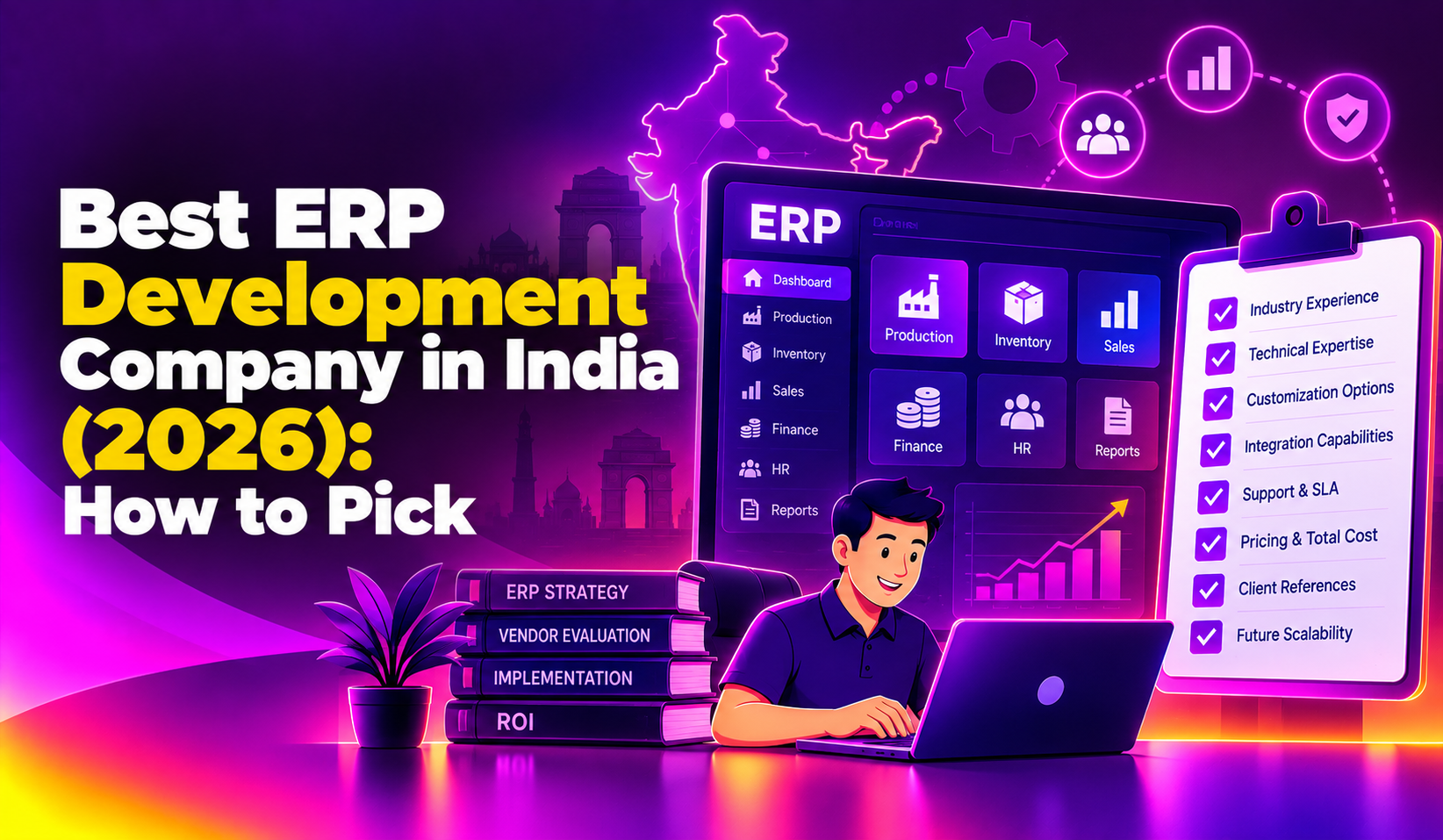
Before you sign a contract with any ERP vendor, run them through this vendor-evaluation checklist. It is the single most useful filter for separating serious partners from resellers and freelancers stretching beyond their depth.
- Track record: Ask for at least 3 references from businesses of similar size and industry — not just logos on a website.
- Industry experience: A team that has built ERPs for manufacturing understands BOM management and shop-floor workflows far better than a generalist web agency.
- Post-launch support: Confirm what happens after go-live — is there a dedicated support SLA, or does the team disappear once the final milestone is invoiced?
- Transparent pricing: Reject vendors who won't break down costs by module, integration, and support tier. Vague quotes are a red flag, not a feature.
- Tech stack fit: Verify the proposed stack (Odoo, custom Node/Python, or a hybrid build) matches your scalability and integration needs, not just what the vendor is comfortable reselling.
- Data migration plan: Ask exactly how they will migrate your existing spreadsheets, legacy software records, and historical data without loss.
- Team continuity: Find out whether the developers who scope your project are the same ones who will build and support it — high staff turnover mid-project is a common cause of failed ERP rollouts.
- Change management support: A good partner helps train your staff and manage the transition, not just hand over a login screen on launch day.
Print this checklist, or keep it open, during every vendor call. Vendors who dodge two or more of these questions are telling you something important — pay attention.
💡 None of these worked? Skip the guesswork.
Get Expert Help →What the Best ERP Development Companies Offer in 2026
The market has matured significantly. Businesses evaluating a top erp development company 2026 shortlist should expect these as baseline offerings, not premium add-ons:
Modern ERP platforms are built with modular, API-first architecture rather than rigid monoliths, so individual modules — inventory, HR, finance — can be updated or scaled independently without a full system rebuild. This also means you can start with one or two core modules and add more as your business grows, instead of paying for a full enterprise suite on day one.
Whether your infrastructure lives on AWS, a private cloud, or an on-premise server, the best vendors deploy flexibly instead of forcing a one-size-fits-all hosting model. This matters especially for manufacturing businesses with existing on-site infrastructure investments they don't want to abandon.
Encryption at rest and in transit, granular role-based access control, and audit logging are now table stakes for any ERP handling financial or production data. If your industry has specific compliance requirements, confirm the vendor has delivered systems that meet them before, not as a first attempt.
A serious partner integrates your ERP with your existing accounting software, CRM, and e-commerce channels rather than asking you to abandon tools that already work. Ripping out every existing tool to fit a new ERP is usually a sign the system wasn't designed with integration in mind.
Raw data tables are not enough in 2026 — the best ERP builds now include configurable dashboards that give owners and managers real-time visibility into stock levels, production status, and cash flow without needing a spreadsheet export every morning.
On cost: current industry data shows full custom ERP builds in India typically range from roughly ₹5 lakh for a lean single-module rollout up to ₹60 lakh or more for a multi-module, multi-location enterprise system, while hiring dedicated hire erp developers resources runs from $15–$50/hour depending on seniority. Any quote wildly outside this range — in either direction — deserves scrutiny. A quote far below market usually means corners will be cut on testing, security, or support; a quote far above market for a mid-sized business often reflects agency overhead rather than added value.
It's also worth understanding the typical phases a well-run ERP project moves through, since the vendors who skip phases are usually the ones who deliver systems that don't fit. A serious engagement generally covers: discovery and workflow mapping, module design and prototyping, iterative development with regular demos, data migration and testing, staff training, and a defined post-launch support window. If a vendor's proposal jumps straight from a sales call to a fixed delivery date with no discovery phase mentioned, that is worth questioning directly.
Red Flags to Avoid When Choosing an ERP Partner
Just as important as knowing what to look for is knowing what to walk away from:
- Vendors who quote a fixed price before understanding your workflows in detail.
- No named project manager or single point of contact for the duration of the build.
- Portfolios full of screenshots but no verifiable, contactable client references.
- Support contracts that end the day the system goes live, with no transition plan.
- Reluctance to explain their tech stack or data ownership terms in plain language.
- Pressure to sign quickly, or discounts that only apply if you commit within 24-48 hours.
- No clear answer on who owns the source code and data once the project is complete.
Most directory-style "best ERP company" listicles skip this section entirely — they list names without giving you a single evaluation criterion or a clear next step, which leaves the actual decision exactly as hard as before you started reading. A genuinely useful guide should arm you with questions to ask, not just names to Google.
Why CloudHouse Is a Top Choice for Custom ERP Development
Hosting companies and manufacturing businesses choose CloudHouse's custom ERP development services because the team combines transparent, module-by-module pricing with hourly-billed post-launch support — no disappearing after go-live, no lock-in contracts. As an enterprise erp development partner, CloudHouse builds on modular, API-first architecture tailored to manufacturing, trading, and distribution workflows specifically, rather than forcing a generic template onto your business.
The team's process starts with mapping your existing workflows before writing a single line of code, which means the resulting system reflects how your business actually operates rather than how a generic template assumes it should. Combined with a named point of contact throughout the engagement and continued support after launch, this makes CloudHouse a genuinely low-risk choice for businesses that have been burned by vendors before.
Frequently Asked Questions
How much does custom ERP development cost in India?
Custom ERP projects in India typically range from around ₹5 lakh for a focused single-module system to ₹60 lakh or more for a multi-module, enterprise-scale rollout. The final number depends on the number of modules, integrations, and the complexity of your existing workflows.
How long does it take to build and deploy a custom ERP system?
A focused single-module ERP can typically go live in 6-10 weeks, while a full multi-department system with integrations, data migration, and user training usually takes 4-6 months. Vendors who promise a full enterprise ERP in a matter of days should be treated with caution.
Do you offer support after the ERP system goes live?
Yes — reliable ERP partners should offer ongoing, hourly-billed or SLA-based support after launch, covering bug fixes, performance monitoring, and feature additions as your business grows. Ask any vendor to put this in writing before signing.
What is the difference between an ERP software development company and an ERP reseller?
An ERP software development company builds and customizes the system's underlying code to match your exact workflows, while a reseller typically configures a pre-built third-party platform with limited customization. If your processes are unique, a genuine development partner will usually serve you better long-term.
Should I choose an ERP built on a platform like Odoo, or a fully custom build?
Platform-based ERP (like Odoo) is often faster and cheaper to deploy for standard workflows, while a fully custom build makes sense when your processes don't fit existing modules well. The right erp software development company kerala businesses trust will assess your specific needs before recommending either path — not push you toward whichever earns them the higher margin.
Selecting the right ERP partner comes down to disciplined evaluation, not a popularity contest. Use the checklist above, ask direct questions about support and pricing, and insist on references before you commit. A well-chosen ERP partner pays for itself many times over in the years of smooth operations that follow.