Manufacturing SMEs lose more money to bad ERP decisions than almost any other software purchase they make. A generic accounting-first system that cannot handle bills of materials, shop-floor routings, or real-time inventory quickly becomes shelfware — and the switching cost of a failed implementation can run into months of lost production visibility. If you are searching for the best ERP development company for manufacturing SME operations, the right partner needs to understand production planning, inventory control, and supply chain workflows specific to a factory floor, not just general business software.
This guide breaks down exactly what to evaluate, gives you a practical comparison framework, and shows why manufacturing-specific ERP expertise — not just "ERP experience" in general — is the deciding factor for small and mid-sized manufacturers in 2026.
Why Manufacturing SMEs Need a Different Kind of ERP Partner
Most off-the-shelf ERP vendors build for retail, services, or generic accounting workflows first and bolt manufacturing modules on afterward. For a small manufacturer, that gap shows up fast: bill-of-materials (BOM) explosions that don't cascade properly, material requirements planning (MRP) that can't handle multi-level assemblies, or inventory counts that don't reconcile with what is actually on the shop floor.
Manufacturing ERP software development done right accounts for discrete, process, and project-based manufacturing modes differently, because each has distinct requirements around routings, work-in-process (WIP) tracking, and costing. A generic implementation partner will treat all three the same way — and that's usually where projects go over budget or under-deliver.
- Bill of Materials (BOM) depth — multi-level, engineering-change-aware BOMs that update production plans automatically
- Material Requirements Planning (MRP) — accurate reorder points driven by demand history, open orders, and supplier lead times
- Shop-floor data capture — real-time WIP status via barcode, RFID, or mobile terminals on the factory floor
- Traceability — lot and serial tracking for quality, recalls, and compliance audits
- Costing — standard, actual, or job costing that reflects true production economics, not just financial-ledger estimates
Core Modules Every Manufacturing SME ERP Must Have
Before comparing vendors, define the module set you actually need. Skipping this step is the single biggest reason manufacturing SMEs end up paying for — and then abandoning — modules they never use.
Inventory Management
Multi-warehouse stock visibility, automated reorder points, and lot/batch tracking are non-negotiable for manufacturers holding raw materials, work-in-process, and finished goods simultaneously. Look for real-time inventory valuation that ties directly into your general ledger, not a nightly batch sync.
Production Planning & Scheduling
Advanced planning and scheduling (APS) capability — even a lightweight version — lets you sequence jobs against machine capacity and labor availability. For SMEs, this is often the single highest-ROI module because it directly reduces idle machine time and missed delivery dates.
Supply Chain & Procurement
Supplier lead-time tracking, automated purchase requisitions tied to MRP output, and vendor performance scorecards keep raw material shortages from stalling production runs. A custom-built ERP can integrate directly with your key suppliers' portals — something rigid off-the-shelf packages rarely support out of the box.
Quality & Compliance
Non-conformance tracking, inspection checklists, and audit trails matter even for small manufacturers serving regulated industries (automotive, medical device, food processing). Build this in from day one — retrofitting quality modules later is expensive.
Shop-Floor Integration
Modern manufacturing ERPs communicate with MES and SCADA systems via REST APIs, OPC UA, or MQTT. If your development partner can't speak to these protocols, your ERP will stay disconnected from what's actually happening on the machines.
Evaluation Criteria: How to Compare ERP Development Companies
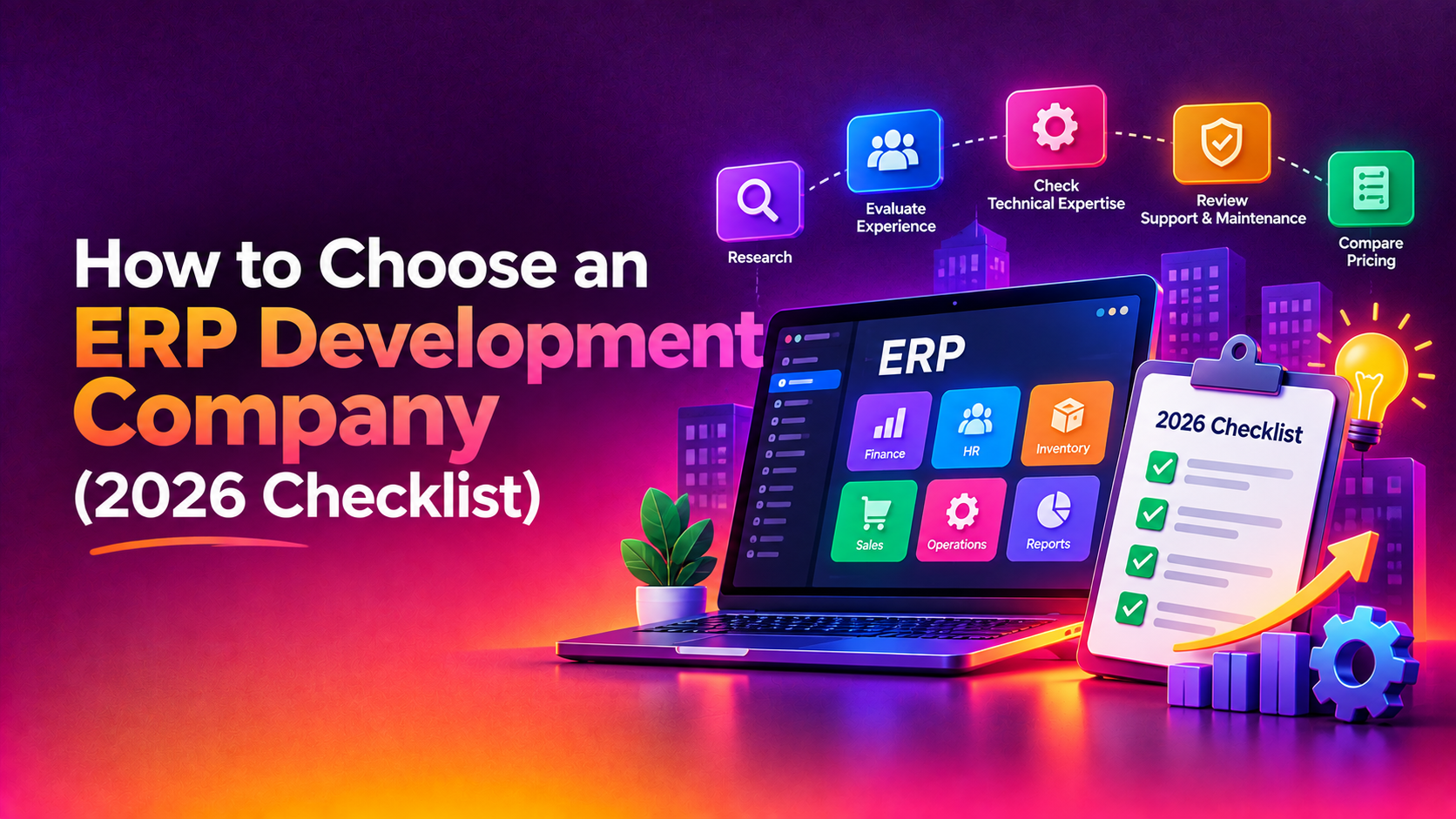
Use the table below as a scorecard when you shortlist vendors. Score each company 1–5 on every criterion, then weight the total toward the rows that matter most to your production model.
| Evaluation Criteria | What to Look For | Red Flag |
|---|---|---|
| Manufacturing-specific experience | Prior projects in discrete/process manufacturing, real client references you can call | Portfolio is mostly retail, SaaS, or generic CRM projects |
| BOM & MRP depth | Multi-level BOM, engineering change management, demand-driven MRP | Vendor treats BOM as a flat parts list |
| Customization vs. rigid templates | True custom development around your workflows, not a forced-fit template | "One-size-fits-all" package with no configuration flexibility |
| Integration capability | Native support for REST APIs, EDI, MES/SCADA connectors | Integrations require expensive third-party middleware for basic tasks |
| Implementation timeline & cost transparency | Phased rollout plan, fixed-scope quote, clear change-request pricing | Vague timelines, "final cost depends on scope" with no detail |
| Post-launch support | SLA-backed support, dedicated account manager, ongoing module updates | Support ends at go-live or is outsourced to a ticket queue |
| Scalability | Architecture that grows with added product lines, users, or locations | System requires a full rebuild to add a second facility |
Manufacturers evaluating custom ERP for small manufacturers should run a scripted demo using their own jobs, items, and routings rather than the vendor's canned demo data — this is the fastest way to separate genuine manufacturing ERP expertise from an accounting-first system with a manufacturing label slapped on.
Common Mistakes Manufacturing SMEs Make When Choosing an ERP Partner
Even manufacturers who do their homework on paper often stumble on the same handful of mistakes during vendor selection. Recognizing these patterns early can save months of rework and a painful renegotiation midway through implementation.
- Choosing based on brand recognition alone. A well-known ERP name does not guarantee manufacturing-specific expertise. Some of the biggest platforms are excellent for retail or services but require heavy, expensive customization to handle discrete manufacturing routings properly.
- Skipping the process audit. Vendors who quote a fixed price without first mapping your actual BOM structure, routings, and supplier relationships are guessing. That guess usually turns into scope-change invoices six months in.
- Underestimating data migration. Moving years of inventory history, supplier records, and open work orders into a new system is often the most time-consuming part of the project — and the part most vendors underquote.
- Ignoring the shop floor's input. If the people running the machines aren't consulted during requirements gathering, the resulting system usually gets worked around within weeks of go-live, not adopted.
- No plan for scaling. A system that works for one facility and 20 users but requires a full rebuild to add a second location or double the headcount is a short-term fix, not a long-term platform.
Avoiding these mistakes comes down to one thing: picking a development partner who treats manufacturing-specific requirements — inventory accuracy, production planning depth, and supply chain visibility — as the starting point of the project, not an afterthought bolted onto a generic template.
Custom-Built vs. Off-the-Shelf: What's Right for a Manufacturing SME?
Off-the-shelf ERP suites (SAP Business One, NetSuite, generic mid-market packages) offer faster initial deployment but often force manufacturers to adapt their processes to the software's assumptions. For SMEs with unique production flows — a mixed discrete/process operation, or a make-to-order shop with frequent engineering changes — that trade-off can quietly cap growth.
A custom ERP for small manufacturers built around your actual BOM structure, routing logic, and supplier relationships costs more upfront but avoids the recurring "the software can't do that" conversations that plague rigid template deployments. CloudHouse Technologies designs ERP development engagements specifically around this trade-off — starting with a manufacturing process audit before a single line of code is written, so the system fits how your factory actually runs rather than the other way around.
Why Manufacturing SMEs Choose CloudHouse for ERP Development
CloudHouse Technologies builds ERP systems with manufacturing-specific modules — multi-level BOM management, MRP-driven procurement, shop-floor data capture, and lot traceability — designed around each client's actual production model rather than a generic template. Our development team works directly with your production managers during requirements gathering, not just your finance team, which is where most off-the-shelf ERP rollouts quietly fail manufacturers. Every engagement includes phased delivery with fixed milestones, so you see working modules early instead of waiting a year for a single "big bang" go-live.
Get Started: Evaluate Your Manufacturing ERP Options
If your current system can't keep up with production planning, inventory accuracy, or supply chain visibility, the cost of waiting compounds every quarter. Explore CloudHouse's ERP development services and request a free process audit to see exactly where a custom-built system would save you the most time and money.
Frequently Asked Questions
How much does custom ERP development cost for a manufacturing SME?
Custom ERP projects for manufacturing SMEs typically range from a scoped module build (inventory + MRP only) to a full multi-module system covering production, procurement, and quality. Pricing depends on module count, integrations with existing MES/accounting systems, and user count. CloudHouse provides a fixed-scope quote after an initial process audit, so you know the cost before committing — not a rough estimate that changes mid-project.
How long does it take to implement a manufacturing ERP system?
A phased rollout for a small manufacturer usually takes 8–16 weeks for core modules (inventory, BOM, MRP) with additional modules (quality, shop-floor integration) added in subsequent phases. This is faster than most off-the-shelf implementations, which often stall for months waiting on configuration changes from the vendor's central team.
Can a custom ERP integrate with our existing MES or accounting software?
Yes. A properly built manufacturing ERP should support REST API, EDI, and direct database integrations with existing MES, SCADA, or accounting platforms, avoiding costly middleware. Ask any prospective vendor to demonstrate a live integration with a system similar to yours before signing a contract.
What's the difference between manufacturing ERP and generic business ERP?
Generic ERP systems are built primarily for accounting, sales, and services businesses, with manufacturing features added as an afterthought. Manufacturing ERP software development is built around BOM structures, MRP logic, shop-floor data capture, and production costing from the ground up — the difference shows up immediately in how well the system handles multi-level assemblies and real-time WIP tracking.
Do you offer ongoing support after the ERP system goes live?
Yes. CloudHouse provides SLA-backed post-launch support with a dedicated account manager, so module updates, bug fixes, and process changes as your production lines grow are handled by a team that already understands your system — not a generic support queue that has to relearn your setup from scratch every time you raise a ticket.
Do we need to replace our entire accounting system to add manufacturing ERP modules?
Not necessarily. A well-architected custom ERP can integrate with your existing accounting platform through APIs rather than requiring a full rip-and-replace, which keeps costs down and avoids disrupting your finance team's workflows during the transition. In some cases, manufacturers start with inventory and production modules first, then decide later whether to migrate financials into the same system once the manufacturing side has proven itself.