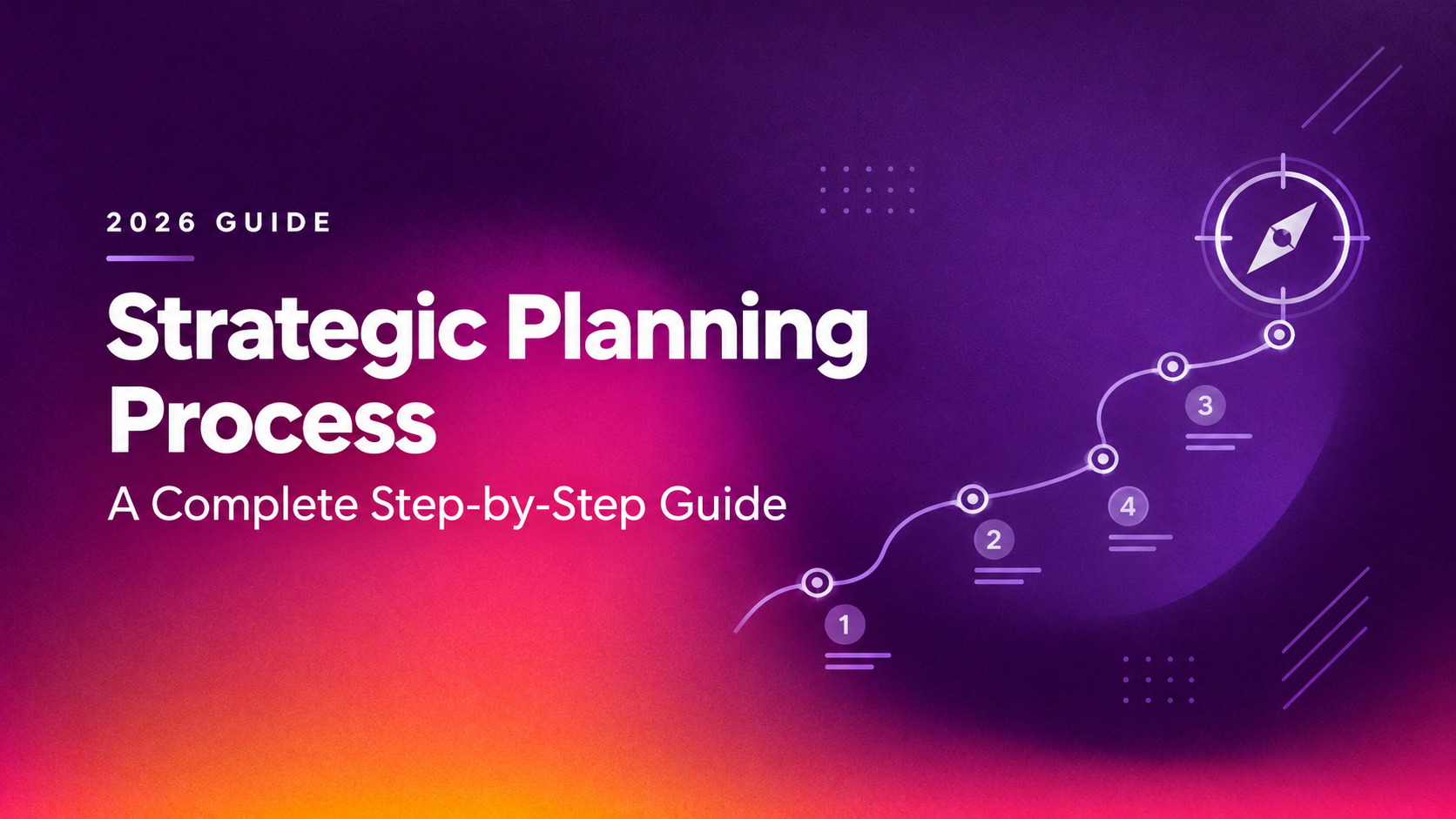
Strategic planning is the backbone of every high-performing organisation — it provides direction, aligns resources, and transforms long-term vision into measurable action. Yet most businesses either skip the strategic planning process entirely or follow a framework so generic it produces a plan that collects dust within weeks. This comprehensive guide walks you through exactly how to build, communicate, and execute a strategic plan that genuinely works — including the risk management and change management dimensions that most guides ignore.
What Is Strategic Planning?
Strategic planning is a disciplined management process through which an organisation defines its future direction, sets long-term goals, and determines the best course of action to achieve them. Unlike day-to-day operational planning — which focuses on quarterly execution — strategic planning addresses the big picture: typically a three-to-five-year horizon. It answers three fundamental questions that every leadership team must be able to answer clearly:
- Where are we now? — current competitive position, strengths, weaknesses, and market environment
- Where do we want to go? — vision, mission, long-term objectives, and the definition of success
- How do we get there? — strategies, action plans, resource allocation, and performance measures
A well-executed strategic plan is not a static document. It is a living framework that evolves as markets shift, competitors move, and internal capabilities grow. Organisations that treat their strategic plan as a living management system consistently outperform those that complete an annual planning ritual and file it away. The difference between a strategic plan that drives results and one that gathers dust is almost always in the quality of the execution system — not the quality of the strategy itself.
Why Strategic Planning Is Critical for Business Success
Research consistently shows a direct link between structured strategic planning and business performance. Organisations with formal strategic plans are significantly more likely to achieve sustained revenue growth, retain top talent, and successfully navigate market disruptions. A study of planning practices across thousands of organisations found that those with consistent strategic planning processes were over twice as likely to achieve their five-year financial targets compared to those operating without formal plans.
Without a clear strategic planning framework, businesses tend to fall into predictable failure patterns:
- Reacting to short-term pressures rather than proactively pursuing long-term opportunities
- Allocating budget and people inefficiently across too many competing priorities
- Losing alignment between departments — each optimising for local goals rather than shared objectives
- Struggling to attract investors, lenders, or strategic partners who require a clear growth narrative
- Missing early warning signals of competitive threats until it is too late to respond effectively
- Experiencing leadership team conflict when direction and priorities are ambiguous
Conversely, organisations with a robust strategic planning process benefit from clearer decision-making at every level, stronger cross-functional alignment, and the organisational resilience to adapt without losing direction when unexpected challenges arise.
💡 None of these worked? Skip the guesswork.
Get Expert Help →The Strategic Planning Process: 7 Steps
The following strategic planning steps provide a complete, actionable framework for organisations of any size — from SMBs to large enterprises. Each step builds directly on the last, so the sequence matters.
Before setting any goals, you need an honest, evidence-based picture of where your organisation stands. This means analysing both your internal environment — capabilities, culture, financial performance, operational efficiency, talent — and your external environment — market trends, customer behaviour shifts, competitive dynamics, regulatory changes, and macro-economic forces. The most widely used tools are SWOT analysis (Strengths, Weaknesses, Opportunities, Threats) for a holistic internal/external view, and PESTLE analysis (Political, Economic, Social, Technological, Legal, Environmental) for deep external scanning. Gather data from customer interviews, financial reports, employee engagement surveys, industry benchmarks, win/loss analysis, and direct competitor research. The output of this step is a clear-eyed strategic assessment of your current reality — without it, every goal you set is educated guesswork rather than grounded strategy.
Your mission defines why your organisation exists — the core purpose it serves beyond generating profit. Your vision describes what success looks like three to five years from now — the specific, inspiring future state you are working toward. Your values define how you behave along the way — the non-negotiable principles that guide decisions at every level. These three elements must be explicit, genuinely shared, and operationally meaningful — not copied from a template or written for an investor deck. If your frontline team cannot explain your organisation's mission without reading it off a wall poster, it is not doing its job. Take time to workshop these statements with leadership and representative stakeholders so there is authentic ownership, not imposed compliance. A compelling, specific vision creates the emotional pull that sustains teams through the difficult phases of execution.
With your analysis complete and direction set, translate your vision into concrete strategic goals. Use the SMART framework: goals must be Specific, Measurable, Achievable, Relevant, and Time-bound. Instead of "grow the business," write "increase annual recurring revenue by 30% by December 2027 by expanding into two new customer segments." Break each strategic goal into shorter-term objectives that departments and teams can own and influence directly. The most critical discipline at this stage is limiting the number of goals. Three to five strategic priorities is the sweet spot for most organisations — enough to create meaningful progress across multiple dimensions, but few enough to maintain genuine focus. Too many goals means no real priorities; without priorities, execution collapses under the weight of competing demands.
A goal without a strategy is a wish. For each strategic goal, define the specific initiatives, projects, and campaigns that will move performance in the right direction. This is where you make genuine strategic choices: which markets to enter (and which to exit), which capabilities to build or acquire, which partnerships to pursue, which customer segments to prioritise. Assign clear, single-name ownership to every action item — vague accountability ("the leadership team" or "all departments") is one of the most consistent predictors of strategic plan failure. Set realistic timelines, assign dedicated budget, and identify dependencies between initiatives. Your action plans should be detailed enough that a team member picking them up on day one knows exactly what to do, what success looks like, and when it is due. Document these plans in a shared, living format — not buried in a PowerPoint that nobody updates.
Strategic plans fail most frequently when there is a gap between what leadership wants to achieve and what the organisation is actually funded and staffed to deliver. This step requires honest, sometimes difficult conversations about resource trade-offs. Which strategic initiatives receive priority investment? Which existing activities need to be scaled back, paused, or stopped entirely to free up budget and capacity? Align your annual budget cycle explicitly to your strategic priorities — if the budget does not reflect the strategy, the strategy is aspirational at best. This alignment exercise must include headcount planning (do you have the right people in the right roles?), technology investments (do your systems support what the strategy requires?), and capital expenditure (what physical or digital infrastructure does execution require?).
A strategy that only lives in the boardroom is not a strategy — it is a document. Effective strategic planning requires communicating the plan across the entire organisation so every team understands how their daily work connects to the bigger picture. Use town halls, team briefings, visual dashboards, and regular leadership communications to cascade the strategy. Crucially, translate the high-level strategic goals into team-level objectives and individual performance targets. When a customer support agent understands how their ticket resolution quality connects to the company's customer retention goal — which connects to the three-year revenue vision — engagement, initiative, and alignment improve dramatically. The cascading process also surfaces misalignments early, before they manifest as execution failures.
The final — and most consistently neglected — step in the strategic planning process is ongoing performance monitoring and structured review. Set a clear cadence: monthly progress tracking at the team level, quarterly strategic reviews at the leadership level, and an annual full-cycle planning refresh. Track key performance indicators (KPIs) tied to each strategic goal and make course corrections early, while deviations are still recoverable. Build a culture where data drives decisions, where surfacing an off-track initiative is rewarded rather than penalised, and where adapting the plan when circumstances change is seen as strategic agility — not failure. The best strategic plans are not the ones that predicted the future correctly; they are the ones that adapted fastest when reality diverged from assumptions.
Strategic Planning Frameworks: Which One Is Right for Your Organisation?
No single strategic planning framework suits every organisation. Understanding the most widely used approaches helps you select the method — or combination of methods — that fits your size, industry, and strategic context.
SWOT Analysis
SWOT (Strengths, Weaknesses, Opportunities, Threats) is the most universally recognised strategic analysis tool. It provides a structured way to simultaneously assess your organisation's internal capabilities and external environment. Conduct it as a facilitated workshop with diverse stakeholders — not just the C-suite — to get an honest, multi-perspective picture that includes operational realities leadership may not see. The real value of a SWOT analysis comes not from completing the four quadrants, but from the strategic questions it generates: How can we use our strengths to capture this emerging opportunity? How do we defend our weaknesses from this identified competitive threat? Those questions, not the matrix itself, are what make SWOT a useful planning tool.
Balanced Scorecard
The Balanced Scorecard (BSC), developed by Kaplan and Norton at Harvard Business School, translates an organisation's strategy into four interconnected performance perspectives: Financial, Customer, Internal Business Processes, and Learning & Growth. It is particularly effective for organisations that want to move beyond purely financial metrics and track the leading indicators of long-term performance — the things that drive financial results rather than just reporting on them. Each perspective includes objectives, measures, targets, and initiatives, creating a comprehensive management system that ties daily operations directly to strategic outcomes.
OKRs (Objectives and Key Results)
OKRs, popularised by Google and Intel, are a goal-setting framework built around ambitious qualitative objectives supported by measurable, time-bound key results. The structure is deliberately simple: each Objective is an inspiring, directional goal ("Become the go-to provider for SMB cloud infrastructure in South India"), supported by three to five quantitative Key Results that define what achieving it actually looks like ("Acquire 50 new SMB clients by Q4," "Achieve NPS of 65+," "Reach ₹2 crore in new ARR from SMB segment"). OKRs operate on a quarterly cycle, making them highly responsive to change — ideal for fast-moving businesses. They are most effective when cascaded from company level to team level and reviewed weekly in brief team check-ins.
PESTLE Analysis
PESTLE (Political, Economic, Social, Technological, Legal, Environmental) is an external environment scanning framework that identifies the macro-level forces shaping your industry over the planning horizon. It is most valuable during the environmental analysis phase of strategic planning. Conducted annually or in response to major market shifts, PESTLE surfaces risks and opportunities that internally-focused teams might otherwise miss — upcoming regulatory changes, demographic shifts in your customer base, technology disruptions that could reshape competitive dynamics, or environmental pressures that will affect your supply chain within three to five years.
Hoshin Kanri (Policy Deployment)
Hoshin Kanri is a Japanese strategic planning methodology that creates a direct, traceable line between organisational vision and front-line action through a process called "catchball" — where goals are negotiated up and down the organisational hierarchy until there is genuine alignment and commitment at every level. It is particularly powerful in manufacturing, operations-heavy businesses, and organisations pursuing Lean or continuous improvement cultures. The Hoshin X-Matrix is the core tool, visually mapping annual priorities, three-to-five-year goals, strategies, and accountability on a single page — creating unprecedented clarity about strategic alignment.
Risk Management in Strategic Planning
One of the most significant gaps in most strategic plans — and one that competitors rarely address — is the absence of explicit risk management. Identifying strategic risks and planning responses in advance dramatically improves an organisation's ability to execute without being derailed by problems that were, in hindsight, entirely predictable.
Embed these risk management practices into your strategic planning process:
- Risk register: For each strategic goal, identify the top five to ten risks that could prevent achievement. Assess each risk's likelihood and potential impact. Assign a named risk owner responsible for monitoring the risk and implementing mitigation actions.
- Scenario planning: Develop two or three alternative scenarios (optimistic, base case, pessimistic) for the key assumptions underpinning your strategy — projected revenue growth rate, market demand, cost of key inputs, regulatory environment. For each scenario, define the early indicators that would signal you are tracking toward it, and pre-define the strategic pivots you would make in response.
- Contingency budget: Reserve 10-15% of your strategic initiative budget for unexpected challenges and opportunities. Organisations that fully commit their strategic budget at the start of the year are consistently caught flat-footed by real-world variability that anyone with operational experience could have predicted.
- Defined pivot triggers: Determine in advance what conditions would trigger a fundamental shift in a specific strategy — and who holds the authority to make that call. Without pre-agreed triggers, organisations routinely continue executing a failing strategy long past the point where an earlier course correction could have salvaged the outcome.
Change Management: The Human Side of Strategic Execution
Strategy execution is fundamentally a human challenge. The majority of strategic plans that fail do not fail because the strategy was wrong — they fail because the organisation could not change fast enough or deeply enough to execute it. Effective change management is therefore a core component of the strategic planning process, not an optional supplement added after the plan is finalised.
- Stakeholder mapping: Identify who in the organisation will be most affected by the strategic changes and who has the most influence over adoption. Engage high-impact, high-influence stakeholders early and continuously — they are either your most powerful advocates or your most damaging blockers, and the difference is often how early you involved them.
- Communication cadence: Over-communicate the why behind the strategy. Resistance to change is most common when people understand what is changing but not why. Leaders must explain the business case for the strategic direction repeatedly, in multiple formats, at every level of the organisation.
- Visible quick wins: Design early, visible wins into the first 90 days of execution. Quick wins demonstrate that the strategy is real, build momentum, and increase stakeholder confidence — especially among sceptics who need proof before they commit.
- Culture alignment assessment: Assess honestly whether your existing organisational culture supports or conflicts with the strategic direction you have chosen. Culture change is slow — if your strategy requires a significant cultural shift, build a multi-year culture transformation programme as an explicit strategic workstream, not an assumption baked silently into your plan.
Strategic Planning for Small and Medium Businesses
Most strategic planning literature is written with large organisations in mind — they assume dedicated strategy teams, multi-day planning retreats, and the organisational bandwidth to run sophisticated planning processes. SMBs face a fundamentally different reality: limited resources, founder-dependency, rapidly changing team composition, and the constant pull of daily operations that crowds out long-term thinking.
Here is how to adapt the strategic planning process for SMBs without losing its essential value:
- Keep it lean and readable: A one-page strategic plan is infinitely more valuable than a 50-page strategic planning document that nobody reads after the planning session. Focus on three strategic priorities maximum, with clear owners, quarterly milestones, and a single KPI per priority.
- Shorten the planning horizon: A two-to-three-year horizon is more realistic for most SMBs than five years. Markets move faster at smaller scale, and the organisation itself changes significantly in three years — new hires, new customers, new capabilities.
- Externalise implicit founder strategy: In founder-led businesses, the strategic thinking often exists entirely in the founder's head. One of the primary goals of the planning process is to make that thinking explicit, documented, and transferable so the team can execute with confidence and the founder can step back from operational decisions.
- Use lightweight, consistent tools: You do not need expensive enterprise strategy software. A well-structured shared spreadsheet or a lightweight OKR tool handles most SMB strategic planning needs without the overhead of complex systems. Consistency of use matters far more than sophistication of tooling.
- Build strategy into existing rhythms: For SMBs, a 90-minute quarterly strategy review and a 30-minute monthly check-in per team leader is typically sufficient. The key is regularity — a simple, consistent review cadence dramatically outperforms an elaborate planning process that never quite gets off the ground.
How ERP Systems Power Strategic Plan Execution
One of the most consistent breakdowns in strategic plan execution is the gap between the plan and the data needed to track it. Leaders set goals in one document, operations run in another system, and finance tracks results in a third — creating a fragmented, manually-aggregated picture that makes it nearly impossible to see in real time whether the strategy is actually working.
Enterprise Resource Planning (ERP) systems address this fundamental problem by centralising data across finance, operations, HR, sales, and supply chain into a single platform. When your ERP is aligned with your strategic goals, you gain continuous visibility into the KPIs that matter — without the hours of manual data consolidation that typically precede every strategic review meeting.
Specific ways ERP supports the strategic planning process:
- Unified strategic dashboards: Pull cross-functional performance data — revenue, margins, operational efficiency, customer metrics — into a single view that tracks strategic KPIs in real time, not just at month-end reporting.
- Budget-to-actuals tracking: Compare strategic initiative spend against planned budget on a continuous basis, enabling early intervention when initiatives are over-spending or under-delivering.
- Demand and revenue forecasting: Use integrated ERP data to model future scenarios and stress-test strategic assumptions before committing resources.
- Capacity and headcount planning: Align operational capacity and workforce planning to strategic growth targets, surfacing resource gaps before they become execution bottlenecks.
- Process automation: Automate routine operational and administrative tasks so your team has bandwidth to focus on strategic priorities rather than data entry and manual reporting.
If your organisation is scaling and your current fragmented systems are creating the visibility gaps that undermine strategic execution, our custom ERP development services can help you build an integrated platform designed around your specific strategic needs — not a generic system you have to force-fit your business into.
Strategic Plan Examples: What Good Looks Like in Practice
Understanding what an effective strategic plan looks like grounds the framework in operational reality. Here are two illustrative examples showing how the principles translate into actual strategic priorities and objectives.
Manufacturing Business — Three-Year Growth Plan
Vision: Be the leading manufacturer of precision components for the renewable energy sector in South Asia by 2028.
Strategic Priority 1: Enter two new renewable energy sub-segments (solar inverter components and wind turbine fasteners) by Q3 2026, generating ₹5 crore in new segment revenue within 18 months.
Strategic Priority 2: Reduce production defect rate from 3.2% to under 1% by December 2026 through Six Sigma implementation, saving ₹1.2 crore annually in rework and warranty costs.
Strategic Priority 3: Build a six-person direct enterprise sales team by Q2 2026, reducing revenue dependency on distributors from 80% to 50% and improving gross margin by 8 percentage points.
IT Services Company — Operational Excellence Plan
Vision: Become the most trusted managed IT partner for growing businesses in Kerala, known for zero-downtime service delivery and measurable ROI.
Strategic Priority 1: Achieve ISO 27001 certification by Q4 2026 to qualify for enterprise and government client procurement panels, unlocking an estimated ₹3 crore in new annual contract opportunities.
Strategic Priority 2: Reduce average client ticket resolution time from 4.2 hours to under 2 hours by Q2 2026 through AI-assisted triage and a re-structured Level 1 support model.
Strategic Priority 3: Launch three productised service packages (Starter, Growth, Enterprise) by Q1 2026 to standardise service delivery, reduce proposal-to-close cycle from 21 days to 10 days, and improve new client onboarding consistency.
Common Strategic Planning Mistakes to Avoid
Even well-intentioned organisations make predictable errors in their strategic planning process. Recognising these patterns in advance is the first step to avoiding them.
- Confusing goals with strategy: "Grow revenue by 25%" is a goal, not a strategy. A strategy describes how you will compete — which markets, which capabilities, which differentiators, which choices you are making that your competitors are not. Without genuine strategic choices, you have a wish list backed by optimism, not a competitive strategy.
- Planning in isolation: Strategies built exclusively by senior leadership teams routinely fail to account for operational realities that middle managers and front-line team leaders understand intimately. Involve these stakeholders in the planning process — they know where the friction points are, and their buy-in is essential for execution.
- Phantom ownership: When every initiative is owned by "the leadership team" or "all departments," nothing gets done. Every strategic action item must have a single named individual who is accountable for delivery, with authority to make the necessary decisions.
- Overloading the organisation: The single biggest execution killer is launching too many strategic initiatives simultaneously. The initiatives that are started but never finished are consistently more damaging than the ones that are never started. Be ruthless about sequencing and prioritisation.
- Treating the plan as fixed: Rigid adherence to a strategic plan in the face of materially changed circumstances is not strategic discipline — it is denial. Build a formal quarterly review process that gives leaders both permission and a mechanism to adapt the plan without abandoning the vision.
- Disconnecting strategy from performance management: If employees are not evaluated on their contribution to strategic goals, the strategy is effectively a side project. Align individual performance reviews, team incentives, and leadership recognition explicitly to strategic priority achievement.
Conclusion
The strategic planning process is not a one-time annual event — it is a continuous management discipline that separates organisations that merely react to their market from those that actively shape it. By following the seven steps outlined in this guide, selecting the right frameworks for your organisational context, embedding risk management and change management from the outset, and aligning your ERP and technology systems to support real-time execution visibility, you give your organisation the strongest possible foundation for sustainable, measurable success. The goal is not a perfect strategic plan — it is a living strategy that your team genuinely believes in, clearly understands, and executes with purpose and accountability every single day.