If you are comparing providers to install or manage an SSL certificate on your production server, you already know the free "just enable SSL" tutorials don't answer the question that matters: who should actually do this for my business, and what will it really cost? This guide is written for that decision — evaluating a best ssl installation service for a live business site, not a personal blog you're happy to tinker with.
Every year, businesses lose visitors, transactions, and search rankings because of botched SSL installs — mismatched chains, expired certs nobody renewed, wrong cert types on multi-domain setups. This article breaks down what a real ssl certificate installation service should deliver, how to evaluate one, what it costs, and where DIY quietly becomes more expensive than paying an expert.
What Does an SSL Installation Service Actually Do
A professional ssl installation company does far more than run a single command. The scope typically includes: selecting the right certificate type for your domain structure (single, wildcard, or multi-domain/SAN), generating and securing the private key, installing the certificate on your web server or control panel (Apache, Nginx, Plesk, cPanel, DirectAdmin), configuring the full chain so intermediate certificates don't break trust on older browsers and mobile devices, forcing HTTPS redirects site-wide, fixing mixed-content issues on existing pages, and — critically — setting up automated renewal so the certificate never silently expires.
Done properly, none of this touches your uptime. Done by someone unfamiliar with your server stack, even one of these steps going wrong can knock your site offline or leave it flagged "Not Secure" in the browser bar, which tanks conversion rates immediately.
Why DIY SSL Installation Goes Wrong (Cost of Mistakes)
DIY SSL installation looks simple on paper — grab a free Let's Encrypt cert, run certbot, done. In practice, the most common failure points we see are: incomplete certificate chains that work in Chrome but fail on older Android devices, cron jobs for renewal that were never actually verified to run, SNI misconfiguration when multiple domains share an IP, and private keys generated with the wrong permissions, creating a security hole rather than closing one.
The financial cost of getting this wrong is rarely the certificate price — it's the downtime, the lost checkout conversions when customers see a security warning, and the emergency support call at 2 a.m. when the renewal silently failed three days ago. A managed managed ssl installation service exists specifically to remove that risk from your plate.
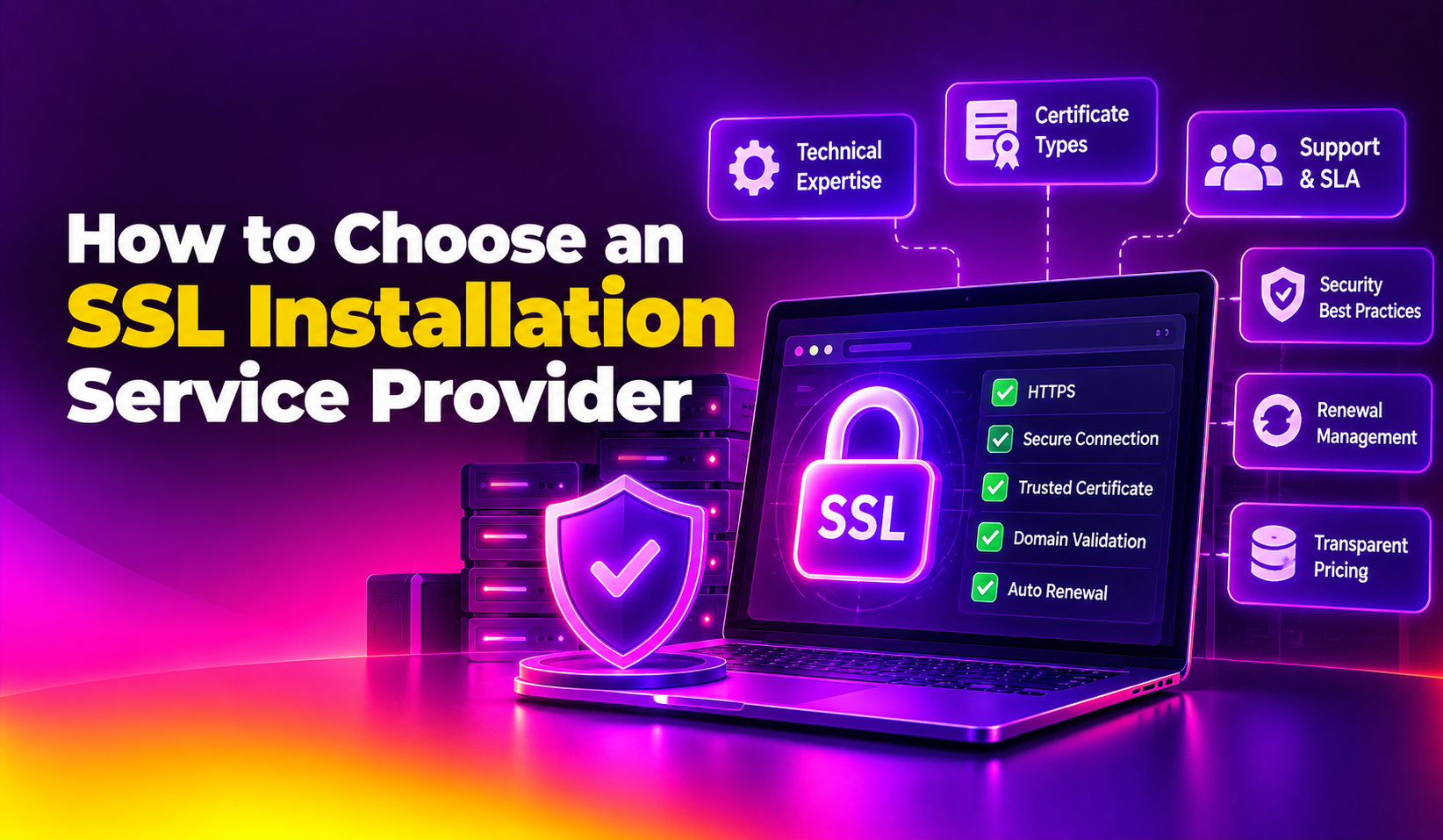
What to Look for in an SSL Installation Provider (Checklist)
- Server stack expertise — do they have proven experience with your exact panel (Plesk, cPanel, DirectAdmin, Webmin) or raw Nginx/Apache config?
- Automated renewal, verified — not just configured, but tested and monitored so you get an alert if a renewal actually fails
- Zero-downtime installation — the certificate should go live without taking your site offline during a maintenance window
- Full chain validation — tested across multiple browsers and devices, not just "it loaded once for me"
- Transparent, flat pricing — no per-incident billing surprises for a routine install
- Ongoing support included — someone to call when a cert-related issue appears months later, not just at install time
- Security hardening bundled in — SSL is one piece of a hardened server; look for a provider that treats it as part of broader server hardening, not an isolated task
Comparing Approaches: DIY vs Free Cert Tools vs Managed SSL Installation Service
| Approach | Upfront Cost | Renewal Risk | Time Required | Best For |
|---|---|---|---|---|
| DIY with Let's Encrypt / certbot | $0 (cert) + your time | High — depends on someone remembering | 2-6 hours first setup, ongoing monitoring | Personal sites, low-traffic projects |
| Free cert via hosting panel auto-tool | $0-$20/yr | Medium — panel-dependent, chain issues common | 30 min - 2 hours if it works cleanly | Simple single-domain sites |
| Paid cert, self-installed | $30-$250/yr | Medium — you still own renewal | 2-4 hours plus troubleshooting | Businesses comfortable with server admin |
| Managed SSL installation service | $50-$150 flat install fee + cert cost | Low — provider owns renewal & monitoring | ~0 hours your time | Production business sites, e-commerce, multi-domain setups |
Cert Type Confusion Explained (DV/OV/EV, Wildcard, Multi-domain)
One of the biggest sources of hesitation when buying an ssl certificate management service is simply not knowing which certificate type to buy. Domain Validation (DV) certificates only confirm you control the domain — they're cheap ($3-$50/year) and issue almost instantly, which is fine for most standard business sites. Organization Validation (OV) certificates verify your actual business details and typically run $30-$100/year, useful when customer trust in your company identity matters. Extended Validation (EV) certificates add the deepest verification — business registration, phone verification, and more — and cost $50-$700+/year depending on provider, though since browsers removed the special green address-bar UI, the visible trust signal is now identical to OV in most browsers.
If you operate multiple subdomains, a wildcard certificate covers all of them under one certificate; if you run several distinct domains, a multi-domain (SAN) certificate is usually cheaper than buying separate certs. A good provider will tell you honestly which tier your business actually needs instead of upselling EV to everyone.
Renewal & Automation: Why It Matters More Than the Install
The install is a one-time task. Renewal is forever. Let's Encrypt certificates expire every 90 days; even paid certificates expire annually. The single most common reason businesses end up with an expired-certificate outage isn't a bad install — it's a renewal automation that was configured once and never actually verified. A serious ssl installation company will set up monitored auto-renewal with a real alert path (not just a silent cron job), so if renewal ever fails, a human finds out before your customers do.
Pricing: What SSL Installation Services Actually Charge
Expect flat-fee managed installation to run roughly $50-$150 for a standard single or multi-domain setup, on top of the certificate cost itself (which can be $0 for Let's Encrypt through $700+/year for EV certificates from major CAs). Providers charging per-server or per-additional-domain fees are common — always ask for the full itemized quote before you commit, including whether renewal monitoring is bundled or billed separately. Cheapest is rarely best here: a $20 one-off install with no renewal monitoring often costs more in downtime than a $100 install with ongoing support included.
Why Hosting Companies Choose CloudHouse for SSL Installation
CloudHouse Technologies handles SSL installation as part of a broader server hardening engagement — meaning your certificate is installed correctly, your chain is validated across devices, and renewal is monitored, alongside firewall, patching, and access-control hardening on the same server. Businesses choose us because support is available around the clock, billing is transparent and hourly where needed, and there's no long-term lock-in contract required to get started.
How CloudHouse Technologies Handles SSL Installation as Part of Server Hardening
Rather than treating SSL as an isolated ticket, our engineers install and validate your certificate as one step inside a full server hardening review — checking chain completeness across browsers and mobile, forcing HTTPS site-wide, resolving mixed-content warnings on existing pages, and setting up monitored auto-renewal so you never see an expiry warning again. If you're evaluating a best ssl installation service for a production environment, this bundled approach typically costs less than paying separately for an install, a security audit, and an emergency fix months later.
What a Bad SSL Installation Actually Costs You
It's worth putting a number on this before you shop purely on the cheapest quote. An hour of e-commerce downtime for a mid-size online store can easily cost more than an entire year of managed SSL installation. A "Not Secure" browser warning on your checkout page measurably increases cart abandonment within minutes of appearing, and search engines penalize sites with mixed-content or expired-certificate issues in ranking signals. None of these costs show up on the invoice from a cut-rate installer — they show up in your analytics dashboard weeks later, disguised as a slow, unexplained drop in conversions.
Frequently Asked Questions
How much does professional SSL installation actually cost?
Most managed SSL installation services charge a flat fee of $50-$150 for a standard install, separate from the certificate cost itself. Certificates range from free (Let's Encrypt) to $700+/year for Extended Validation certs from major CAs. Get an itemized quote that separates install fee, certificate cost, and renewal monitoring.
How long does SSL installation take with a managed service?
A standard single or multi-domain install typically takes under an hour once DNS and access are confirmed. Wildcard and multi-server setups can take longer, but a competent provider should schedule the work with zero expected downtime.
Is a free Let's Encrypt certificate good enough for a business site?
Yes, for encryption strength Let's Encrypt certificates are cryptographically identical to paid DV certificates. The tradeoff is entirely about validation level and renewal responsibility — Let's Encrypt certs expire every 90 days and need reliable automated renewal, which is exactly where many DIY setups fail.
What's the real difference between DV, OV, and EV certificates?
DV only confirms domain ownership; OV additionally verifies your business identity; EV adds the deepest verification including business registration and phone confirmation. Since browsers removed the special EV address-bar treatment, the visible difference to visitors is minimal — the business-trust difference is mostly relevant for compliance and enterprise contracts.
Do SSL installation services offer month-to-month plans, or do I have to sign a long-term contract?
Reputable providers, including CloudHouse, offer installation as a standalone service or bundled hourly support with no long-term lock-in required. Always confirm before signing whether renewal monitoring is included or billed as a separate recurring charge.