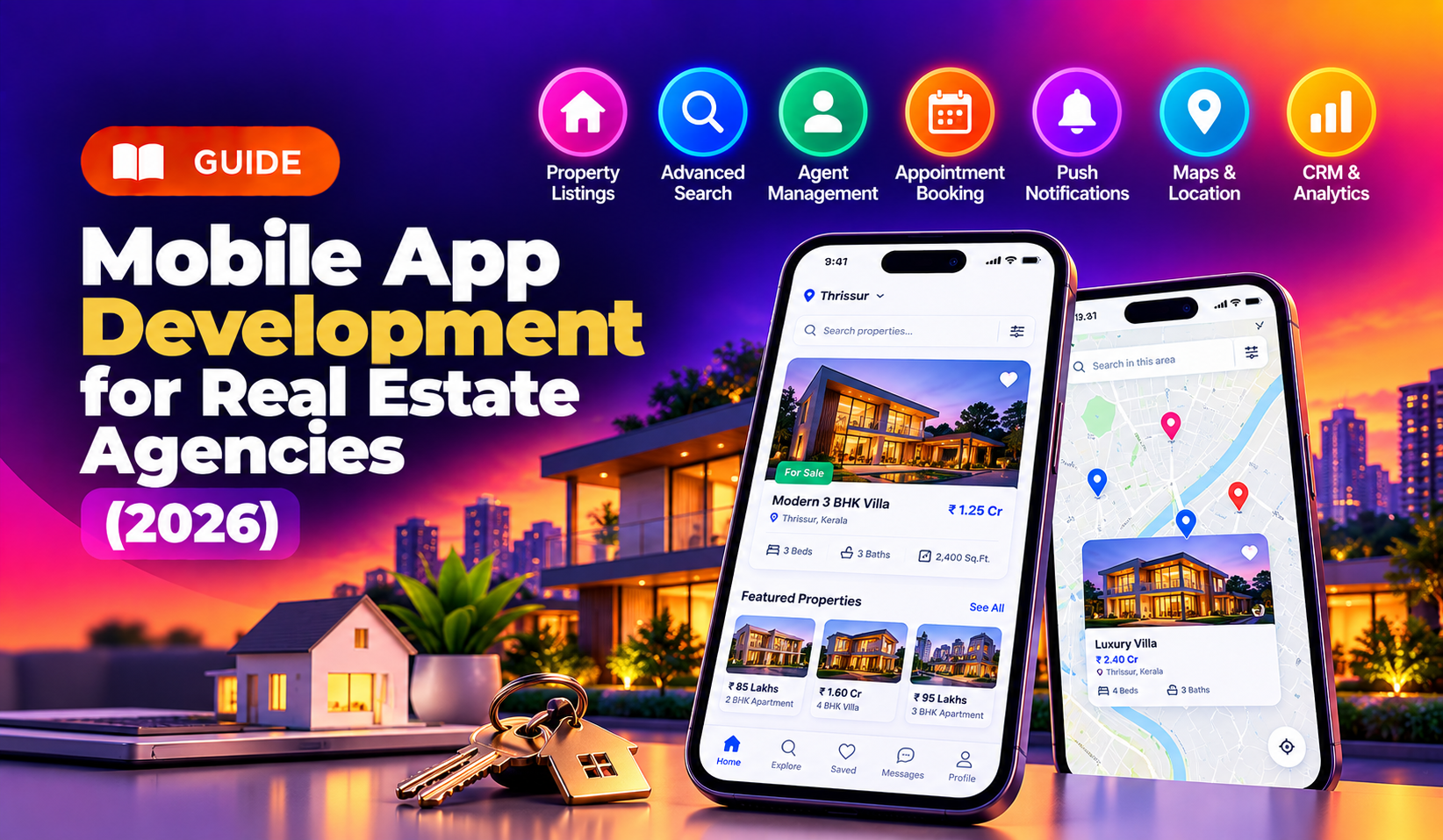
Your agents are juggling portal enquiries, WhatsApp messages and spreadsheets, and a buyer who asked about a flat on Monday hears back on Thursday. If you are weighing mobile app development for real estate agencies, the real question is whether an app will help your team respond faster, show listings better and keep leads from slipping away. This guide covers what to build, what it costs, what drives the budget, and how to choose a team. If you already know what you need, you can talk to a mobile app development company in Kerala about a scoped quote.
Published 2026 agency guides put real estate app budgets anywhere from about $15,000 for a basic listing MVP to $300,000 or more for enterprise platforms with MLS or IDX feeds, AI matching and AR tours. These figures come from vendor blog posts and vary widely, so treat them as market reference points, not quotes. Your own number depends on scope, platform choices and who builds it.
Why Real Estate Agencies Build Their Own Apps
Portals send you leads, but they also share them with competitors and own the relationship. A branded app gives an agency or developer a direct channel to buyers, tenants and investors.
- Direct lead capture. Enquiries, callback requests and saved searches go straight to your team, not through a third party.
- Faster follow-up. Push notifications and instant agent alerts shorten the gap between interest and first contact.
- Better presentation. Photo galleries, floor plans, map views and video walkthroughs load faster and look better in a native app than in a crowded portal.
- Repeat engagement. Saved properties, price-drop alerts and new-listing notifications bring past visitors back.
- Brand ownership. Your logo, your listings and your data stay in one place you control.
Core Features Real Estate Buyers Expect
Start with the features that touch revenue directly. Most agency apps are built around the same handful of building blocks.
Listings and search
Property listings with filters for location, budget, type, bedrooms and status; map search; photo and video galleries; and saved searches. If you are a property developer, add project pages with unit availability and floor plans.
Lead capture and CRM sync
Enquiry forms, click-to-call, WhatsApp handoff and callback requests should create a lead record automatically and notify the right agent. Connecting the app to your CRM stops leads living in two places.
Site visit booking
Let buyers pick a slot for a property visit, send reminders to both sides and let agents reschedule from their phone. This is one of the highest-value features because it moves a browsing user to a physical meeting.
Agent tools
A companion view for agents lets them add or update listings from the field, upload photos, see assigned leads and log visit outcomes. Without it, listing data goes stale.
Notifications and accounts
User accounts, favourites, price-change alerts, new-match alerts and visit reminders. Keep messaging useful, not noisy, so users do not switch notifications off.
Optional advanced features
- Virtual tours or 360-degree walkthroughs
- EMI and mortgage calculators
- Document upload for KYC and booking forms
- Online booking amounts or token payments
- Multi-language support, including Malayalam and Hindi where relevant
- MLS or portal data feeds where your market supports them
What Mobile App Development for Real Estate Agencies Costs in 2026
Agency pricing pages and cost guides disagree a lot, because they assume different regions, team sizes and feature lists. Use the table below as a planning frame based on the public ranges we found, not as a quote.
| App level | Typical scope | Published range (varies by source) |
|---|---|---|
| Basic MVP | Listings, search, map, enquiry form, accounts | Roughly $15,000 to $30,000 in some guides; higher in others |
| Mid-level | Adds messaging, CRM sync, notifications, agent dashboard, visit booking | Roughly $30,000 to $120,000 |
| Enterprise | Adds MLS or IDX feeds, AI matching, AR or VR tours, multi-role portals | Roughly $120,000 to $300,000 or more |
The same guides note that developer hourly rates differ by region, with Asia-based teams generally listed below US rates, and that MLS or IDX integration can add a large share of cost. Annual maintenance is usually quoted separately. Many MLS and data feeds are a US concept; for Indian and Gulf markets you will usually integrate your own inventory database or an existing CRM instead.
What Drives the Budget for a Property App
- Platforms. iOS and Android together cost more than one platform. Cross-platform frameworks can reduce duplication, while fully native builds can suit heavier media features.
- Number of user roles. Buyers only is simpler. Buyers, agents, admins and owners each need their own screens and permissions.
- Data and integrations. CRM, WhatsApp, payment gateways, maps, SMS and any listing feed each add integration and testing work.
- Media handling. Image-heavy listings, video and 3D tours need careful storage and delivery to stay fast.
- Admin panel. You need a back office to manage listings, leads and users. Budget for it from the start.
- Design depth. Custom interface design and animation cost more than a clean, standard layout.
- Ongoing costs. App store fees, hosting, map and messaging usage, OS updates and bug fixes continue after launch.
Native App, Cross-Platform App or Mobile Website?
Not every agency needs a full app on day one. A responsive website with strong listing pages is often the first step. An app makes sense when you have repeat users, a steady listing inventory, a field team that needs mobile tools, or a developer project with many buyers to keep informed.
- Mobile website or PWA: lowest cost, no app store approval, weaker push and device features.
- Cross-platform app: one codebase for iOS and Android, a common choice for listing and lead apps.
- Native apps: best for demanding features such as AR tours or heavy offline use, at a higher cost.
A good partner will recommend the smallest option that meets your goals instead of the biggest build.
Use Cases by Type of Real Estate Business
Residential brokerages
Listings, saved searches, instant agent chat and visit booking. The goal is to shorten response time and keep enquiries inside your own system.
Property developers
Project showcases, unit availability, payment milestone tracking and construction progress updates for existing buyers. Post-sale updates reduce repeated calls to your sales desk.
Rental and property management firms
Tenant onboarding, rent reminders, maintenance requests and document storage. These are retention features, not just lead generation.
Commercial and investment agencies
Investor profiles, brochure downloads, secure document sharing and enquiry routing for larger deals.
How to Plan the Project and Timeline
Timelines depend on scope, so be wary of anyone who quotes a fixed date before seeing requirements. A typical sequence looks like this:
- Discovery. Define users, must-have features and integrations. Write down what you will not build in version one.
- Design. Wireframes and screen designs you approve before development starts.
- Build. App, admin panel and backend developed in stages, with demos along the way.
- Testing. Device testing, performance checks and fixes.
- Launch. App store submission, which has its own review times outside any developer's control.
- Support. Monitoring, updates and improvements based on real usage.
A focused MVP can often be planned in a matter of months rather than weeks; larger platforms take longer. Ask for a phased plan so you can launch the core and add features later.
Questions to Ask Before You Hire
- Can you show real apps you built, with listings, maps or booking flows, and explain your role in them?
- Who owns the source code and the app store accounts at handover?
- Is the quote fixed-scope or time-and-materials, and how are changes priced?
- What is included in post-launch support, and for how long?
- Where will data be hosted, and how are user details protected?
- Can we start with a smaller phase and expand?
Be careful with promises about lead volume or app store ranking. No developer can guarantee those; a good partner focuses on building something fast, stable and easy for your team to use.
Why Real Estate Teams Choose CloudHouse for Mobile App Development
Real estate buyers tend to want a practical app that fits how agents actually work: fast listing updates, reliable lead alerts and a simple admin panel. CloudHouse Technologies builds custom mobile apps with a scoped plan and a written quote, and we are happy to start with a smaller first phase instead of a large commitment. You can review our mobile app development services before you speak to us.
Conclusion
For an agency or developer, the best app is the one your agents use daily and your buyers open more than once. Start with listings, lead capture and site visit booking, connect them to your CRM, and add advanced features after you see real usage. If you want a clear scope and quote for your agency, request one from our custom mobile app development team.