If you're a founder trying to plan a budget, the honest answer to mobile app development cost for startups 2026 is: it depends on complexity, but most funded startups end up spending somewhere between $15,000 for a bare-bones MVP and $250,000+ for a feature-rich, multi-platform product. That range feels useless until you break it down by tier, feature set, and team location — which is exactly what this guide does, with real numbers instead of vague "it depends" answers.
Whether you're pricing out your first MVP or scoping a Series A rebuild, understanding how much does it cost to build a mobile app in 2026 means understanding the variables that actually move the number: app complexity, platform choice, feature depth, design polish, backend architecture, and who you hire to build it. Let's walk through each one, then land on a pricing table you can actually use to plan.
Mobile App Development Cost for Startups in 2026: The Quick Answer
Across dozens of 2026 industry cost surveys and agency rate cards, the numbers cluster into three predictable bands:
- Simple MVP apps: $15,000 – $50,000
- Mid-complexity apps (accounts, payments, APIs, push notifications): $50,000 – $120,000
- Complex / AI-powered / enterprise-grade apps: $120,000 – $300,000+
The average cost of a custom mobile app across a large sample of completed projects sits around $170,000 — but that figure is skewed upward by large enterprise builds. For an early-stage startup building a first product, the realistic budget for startup app development pricing is usually $40,000–$80,000 for a solid cross-platform MVP with a genuine feature set, not a throwaway prototype.
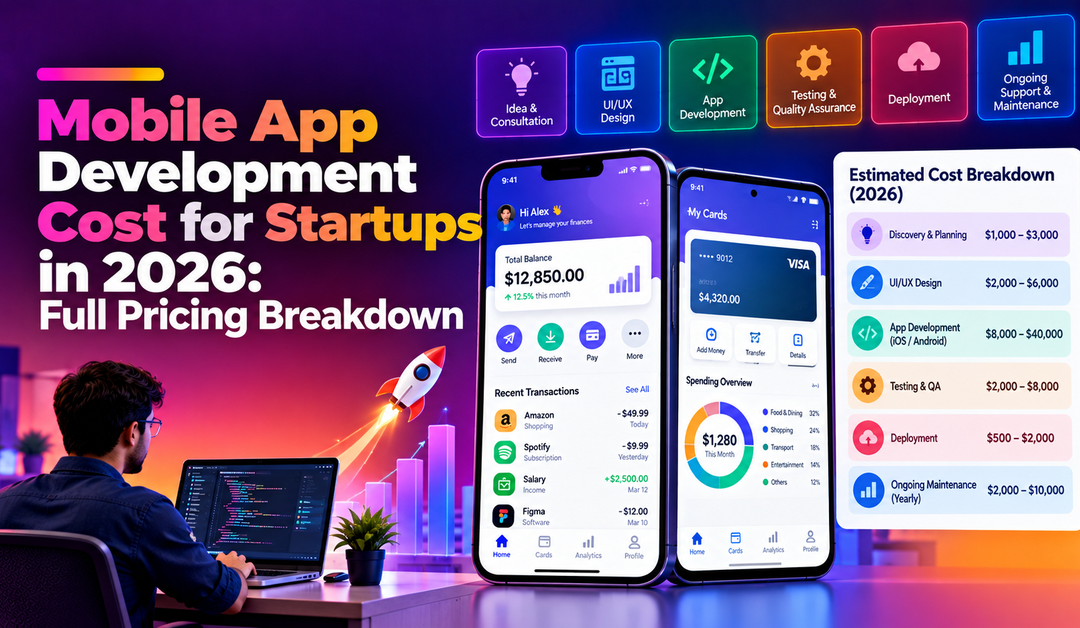
Full Pricing Breakdown by App Complexity Tier
Here is the tier-by-tier breakdown startups should use when budgeting. Ranges assume a professional development partner (not a freelancer marketplace) building for iOS and Android, either natively or cross-platform.
| Complexity Tier | Typical Cost Range | Timeline | What's Included |
|---|---|---|---|
| Tier 1 — Simple MVP | $15,000 – $50,000 | 6 – 10 weeks | Single core feature, basic UI, one or two platforms, login, minimal backend, no third-party integrations |
| Tier 2 — Standard Business App | $50,000 – $120,000 | 3 – 6 months | User accounts, push notifications, payment processing, API integrations, admin dashboard, cross-platform (iOS + Android) |
| Tier 3 — Advanced / AI-Enabled App | $120,000 – $250,000+ | 6 – 10 months | Custom backend architecture, AI/ML features, real-time data sync, advanced security, multi-role permissions, third-party API ecosystem |
| Tier 4 — Enterprise Platform | $250,000 – $500,000+ | 10+ months | Complex microservices, custom infrastructure, compliance requirements (HIPAA, PCI-DSS), multi-region scaling, dedicated DevOps |
Most startups reading this guide fall into Tier 1 or Tier 2. If your app needs user logins, a payment gateway, push notifications, and a basic admin panel — the honest number to plan around is $50,000–$120,000, not the $15,000 headline figure some agencies advertise to win the first call.
💡 None of these worked? Skip the guesswork.
Get Expert Help →What Actually Drives the Cost Up or Down
Building natively for both iOS and Android roughly doubles development effort compared to a single platform. Most startups now choose cross-platform frameworks (React Native, Flutter) to launch on both stores from one codebase, cutting cost by 30-40% compared to two native builds.
Every integration — payment gateways, maps, chat, analytics, CRM sync — adds development and QA hours. A simple booking app with Stripe and push notifications costs meaningfully more than the same app without payments.
A templated UI with standard components is cheap. A fully custom design system with animations, micro-interactions, and a dedicated brand identity can add $10,000–$30,000 on its own.
Apps that need real-time sync, multi-tenant data isolation, or heavy server-side logic require more backend engineering than a simple CRUD app talking to a basic REST API.
Hourly rates vary dramatically: US/UK agencies often charge $100–$200/hour, Eastern Europe $40–$80/hour, and India/Kerala-based teams like CloudHouse typically run $20–$45/hour for comparable senior-level output — which is the single biggest lever startups pull to stretch a limited budget without cutting quality.
Budget an additional 15–20% of your total build cost per year for bug fixes, OS updates, and security patches. A $60,000 app typically needs $9,000–$12,000/year in ongoing maintenance.
Cut every feature that isn't essential to proving your core value proposition. Features can always be added in version two once you have paying users and real usage data guiding priority.
Unless your app depends on deep native hardware access, React Native or Flutter delivers 90%+ of native performance at 50-60% of the cost of building separate iOS and Android apps.
Choosing a development partner with lower hourly rates but senior-level engineers — rather than a cheap freelancer marketplace — is the single biggest cost lever available. Fixed-price milestone billing also removes the risk of open-ended hourly overruns.
Auth, payments, push notifications, and analytics all have mature, inexpensive third-party providers. Building these from scratch instead of integrating an existing service rarely makes financial sense at the MVP stage.
The single biggest cause of budget overruns is vague scoping. A clear feature list, wireframes, and a fixed-price quote tied to that exact scope prevents the "why do quotes vary so much" problem entirely — because you're comparing apples to apples across vendors.
Why Hosting Companies and Startups Choose CloudHouse for Mobile App Development
CloudHouse Technologies builds custom mobile apps for startups at rates significantly below US/UK agency pricing, without the quality gap that usually comes with "cheap" development — because our senior engineers work fixed-scope, fixed-price contracts with transparent milestone billing instead of open-ended hourly quotes that balloon mid-project. Every engagement includes a clear pricing breakdown before a single line of code is written, so you know exactly what Tier 1, Tier 2, or Tier 3 will cost before you commit.
Get a Free Quote for Your Mobile App
Ready to find out exactly what your app idea will cost? Our custom mobile app development team will scope your project, map it to the right pricing tier above, and hand you a fixed-price proposal within 48 hours — no obligation, no vague hourly estimate. Book a free consultation today and turn your budget guesswork into a real number.
Frequently Asked Questions
How much does it cost to build a mobile app for a startup in 2026?
Most startups spend between $15,000 and $120,000 depending on complexity. A simple single-feature MVP starts around $15,000-$50,000, while a standard business app with accounts, payments, and integrations typically lands at $50,000-$120,000. Enterprise or AI-powered apps can exceed $250,000.
Is a no-code app cheaper than custom development?
Upfront, yes — no-code apps can cost as little as $5,000-$20,000. But no-code platforms charge ongoing subscription fees, hit hard ceilings on custom features and scalability, and are expensive to migrate away from later. For a startup planning to scale or raise funding, custom development is usually the cheaper option over a 2-3 year horizon, not the more expensive one.
Why do mobile app development quotes vary so much between agencies?
Quotes vary because agencies scope projects differently — some quote bare development hours, others include design, QA, project management, and post-launch support in the same number. Location also matters enormously: a US agency quoting $150/hour and a Kerala-based team quoting $35/hour for the same senior-level work can produce a 4x difference on the final invoice. Always ask what's included before comparing two numbers side by side.
How long does it take to build a startup mobile app?
A simple MVP typically takes 6-10 weeks. A standard business app with payments and integrations takes 3-6 months. Complex, AI-enabled, or enterprise-grade platforms can take 6-10+ months. Timeline scales directly with the same complexity factors that drive cost.
Do app development costs include ongoing maintenance?
No — the pricing tiers above cover initial design, development, QA, and app store deployment only. Budget an additional 15-20% of your total build cost per year for maintenance, OS updates, bug fixes, and security patches. A $60,000 app typically needs $9,000-$12,000 annually to stay current and secure.
Building a mobile app as a startup doesn't have to mean guessing at a number and hoping it's close. Once you know your complexity tier, your must-have feature list, and your platform strategy, the mobile app development cost for startups 2026 becomes a predictable, plannable line item rather than an open-ended risk — and the right development partner will hand you a fixed, transparent quote to match.