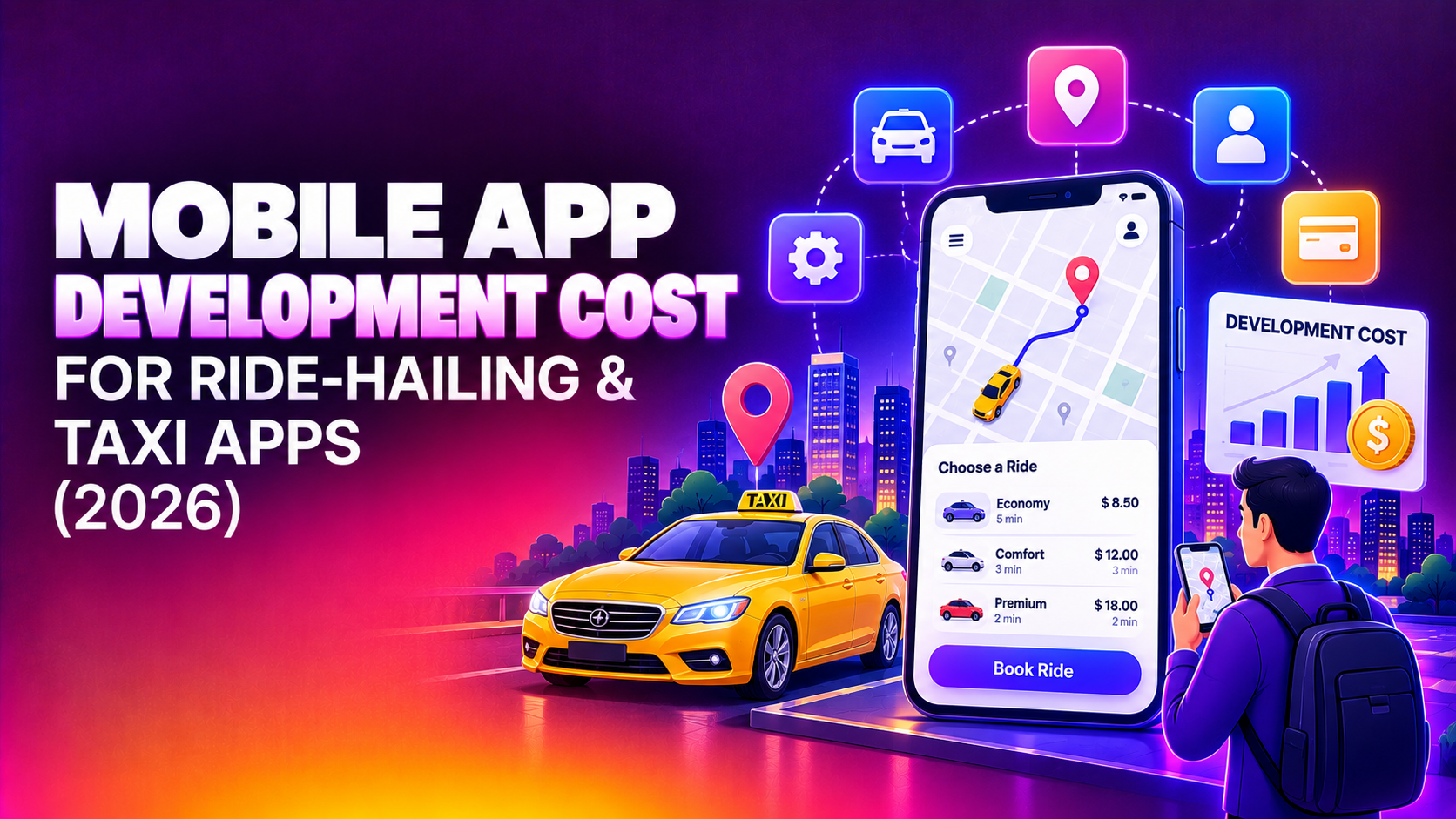
If you are planning a taxi or ride-hailing startup, the first budgeting question is usually the hardest to answer: what will it actually cost to build? This guide explains the mobile app development cost for a ride hailing taxi app in terms founders can use, by breaking the product into its real parts, the cost drivers behind each one and the scope tiers that change the total. It is written for founders and product owners who need to budget a rider app, a driver app and an admin panel together.
We do not quote fixed figures here, because any number published without seeing your scope would be a guess. Instead, you will get a framework to compare quotes honestly, and a clear idea of what to ask for in an itemised proposal.
Why a ride-hailing app is three products, not one
Founders often ask for "an app like Uber" and expect a single build. In practice you are commissioning three connected products that must work in real time, and each has its own design, testing and release needs.
- The rider app: sign-up, pickup and drop-off selection, fare estimate, ride request, live driver tracking, payment, ride history and ratings.
- The driver app: onboarding and document upload, online and offline status, ride request alerts, turn-by-turn navigation, trip controls, earnings view and background location updates.
- The admin panel: driver approval, fare and zone settings, dispatch oversight, payment reconciliation, promotions, support tools and reports.
Budgeting for only the rider app is the most common mistake. The driver app is usually harder to build well, because it has to keep location updates flowing reliably while the phone is locked or running other apps, and the admin panel is what lets you operate the business day to day.
The features that drive taxi app cost
Some features are inexpensive to add. Others pull in real-time infrastructure, third-party services and a long testing cycle. These are the ones that move a budget most.
Live tracking and location handling
Showing a car moving smoothly on a rider map sounds simple but involves frequent location updates from the driver device, a real-time channel to push them to the rider, smoothing so the marker does not jump and battery-conscious background behaviour on both Android and iOS. Each platform has its own rules about background location, and getting them right takes testing on real devices and real roads.
Dispatch and matching
The simplest approach sends a request to the nearest available driver and moves to the next if there is no response. More advanced dispatch weighs distance, estimated arrival time, driver rating, vehicle type and zone demand, and may support scheduled rides, shared rides or batch matching. The more rules you add, the more logic, edge cases and testing you pay for.
Fares, surge and payments
A basic fare is distance plus time plus a base amount. Add waiting charges, tolls, night rates, zone pricing, promo codes, wallets, cash payments, driver payouts and commission rules, and the pricing engine becomes a significant module. Payment integration also involves a gateway, refund and failed-payment handling, and compliance with the rules that apply in your market. Always confirm local requirements with your payment provider and legal adviser.
Maps, routing and API usage
Maps are both a build item and a running cost. Maps, geocoding, directions and place search services are typically billed by usage, so cost grows with the number of rides, searches and tracking calls. Choosing a provider, caching sensible results and limiting unnecessary calls are design decisions that affect your monthly bill after launch. Ask your development partner to estimate expected usage and show which provider plan it assumes.
Notifications, safety and trust features
Push notifications, SMS or call masking, ride-sharing links, an emergency button, driver verification and rating systems all add integrations. They are worth considering early, because riders and drivers judge a new service heavily on whether they feel safe using it.
Scope tiers: MVP, growth and scale
The most useful way to control budget is to decide which tier you are building first. The tiers below are a planning aid, not price bands, so ask any vendor to cost each one separately.
- Launch MVP: one city or zone, one vehicle category, simple nearest-driver dispatch, standard fare calculation, one or two payment methods and a lean admin panel. The aim is to test real demand.
- Growth version: multiple vehicle types, scheduled rides, promo codes, wallets, driver payout automation, richer reports and better support tools.
- Scale version: advanced dispatch, surge or demand pricing, multi-city and multi-currency support, corporate accounts, analytics, and infrastructure tuned for heavy concurrent use.
Many founders do best by funding the MVP tightly, launching in a small area and using real ride data to decide which growth features deserve investment. Our team plans custom builds this way through our mobile app development services.
Ride-hailing app cost drivers table
Use this table when you compare quotes. The relative effect column is qualitative and describes how much each driver typically moves the total, not a price.
| Cost driver | What changes the effort | Relative effect on budget |
|---|---|---|
| Number of apps | Rider, driver and admin panel each need design, build and testing | High |
| Platforms | Native Android and iOS versus one cross-platform codebase; web admin is separate | High |
| Live tracking quality | Update frequency, background behaviour, smooth map movement, battery use | High |
| Dispatch logic | Nearest-driver only versus weighted matching, scheduling and shared rides | High |
| Pricing engine | Simple distance and time fare versus zones, surge, tolls and promotions | Medium to high |
| Payments and payouts | Gateway integration, wallets, cash handling, commission and driver payouts | Medium to high |
| Maps and API usage | Provider choice, number of calls per ride, caching; recurring usage-based cost | Medium, and ongoing |
| Admin panel depth | Basic approvals versus full reporting, support tooling and finance views | Medium |
| UI and brand design | Standard components versus custom design and animation | Low to medium |
| Security and compliance | Data protection, driver document handling, secure payments, audit trails | Medium |
| Testing and launch | Real-device and field testing, store submission, load testing before launch | Medium |
| Post-launch support | Bug fixes, OS updates, monitoring, hosting and feature iteration | Ongoing |
Running costs founders forget to budget
Build cost is only the first line of the budget. A live ride-hailing service has recurring costs that continue every month, and several of them grow with your success.
- Maps and location services: usage-based billing that increases with rides, searches and tracking.
- Cloud hosting and real-time infrastructure: servers, databases and messaging channels that must stay responsive at peak hours.
- SMS, calls and push notifications: one-time passwords, ride alerts and masked calling are charged per message or per minute.
- Payment gateway fees: typically charged per transaction by the provider.
- App store accounts and updates: developer accounts plus the work of adapting to new Android and iOS releases.
- Support and operations: driver onboarding, rider support and dispute handling.
Ask your vendor for a monthly running-cost estimate alongside the build quote, with the assumptions written down. If a proposal ignores recurring costs, treat that as a warning sign.
Ways to lower cost without weakening the product
- Launch in one area first: a single city keeps dispatch, pricing and support simple.
- Choose cross-platform where it fits: one shared codebase can reduce duplicated effort, though you should discuss performance for tracking and background location.
- Use proven services for commodity parts: maps, payments and messaging are better bought than built.
- Defer advanced pricing: start with a clear fare formula and add surge later when you have demand data.
- Keep the admin panel practical: build the screens your operations team will use in the first months, and expand from there.
- Own your code and accounts: make sure source code, store listings and cloud accounts are in your name, so you can change vendors later.
What a good itemised quote should contain
A single total with no breakdown makes it impossible to compare vendors. A useful proposal for a taxi app lists the following.
- Each deliverable separately: rider app, driver app, admin panel and any web booking page.
- Feature list per scope tier, with what is included and what is excluded.
- Third-party services assumed, such as the maps provider, payment gateway and messaging service.
- Testing approach, including real-device and field testing for tracking.
- Delivery plan with milestones, review points and a clear definition of done.
- Post-launch support terms and what would change the price.
When we scope a project, we write these assumptions down before development starts so there are no surprises later. You can see how we work on our mobile app development company page.
Questions to ask before you choose a development partner
- Have you built real-time, location-based apps, and can you explain how you handle background tracking on Android and iOS?
- Which maps and payment providers do you recommend for my market, and why?
- What is included in the MVP and what would move into a later phase?
- Who owns the source code, designs and cloud accounts at handover?
- How do you test live tracking and dispatch before launch?
- What support is available after the app goes live?
Why Companies Choose CloudHouse for Mobile App Development
CloudHouse Technologies plans each build in phases with defined milestones, so you know what is being delivered and when. Support continues after launch, which matters for apps that depend on maps, payments and operating system updates. Our quotes are transparent and itemised, so you can see where the budget goes and decide which scope tier fits your stage.
Conclusion
The cost of a ride-hailing app depends less on the idea and more on scope: how many apps, how advanced the dispatch and pricing, how reliable the live tracking must be and how much you spend on maps and messaging once the service is running. Start with a focused MVP, insist on an itemised quote and plan for recurring costs from day one. To discuss your plan, request a mobile app development quote from CloudHouse and get a clear scope for your rider, driver and admin apps before you commit your budget.