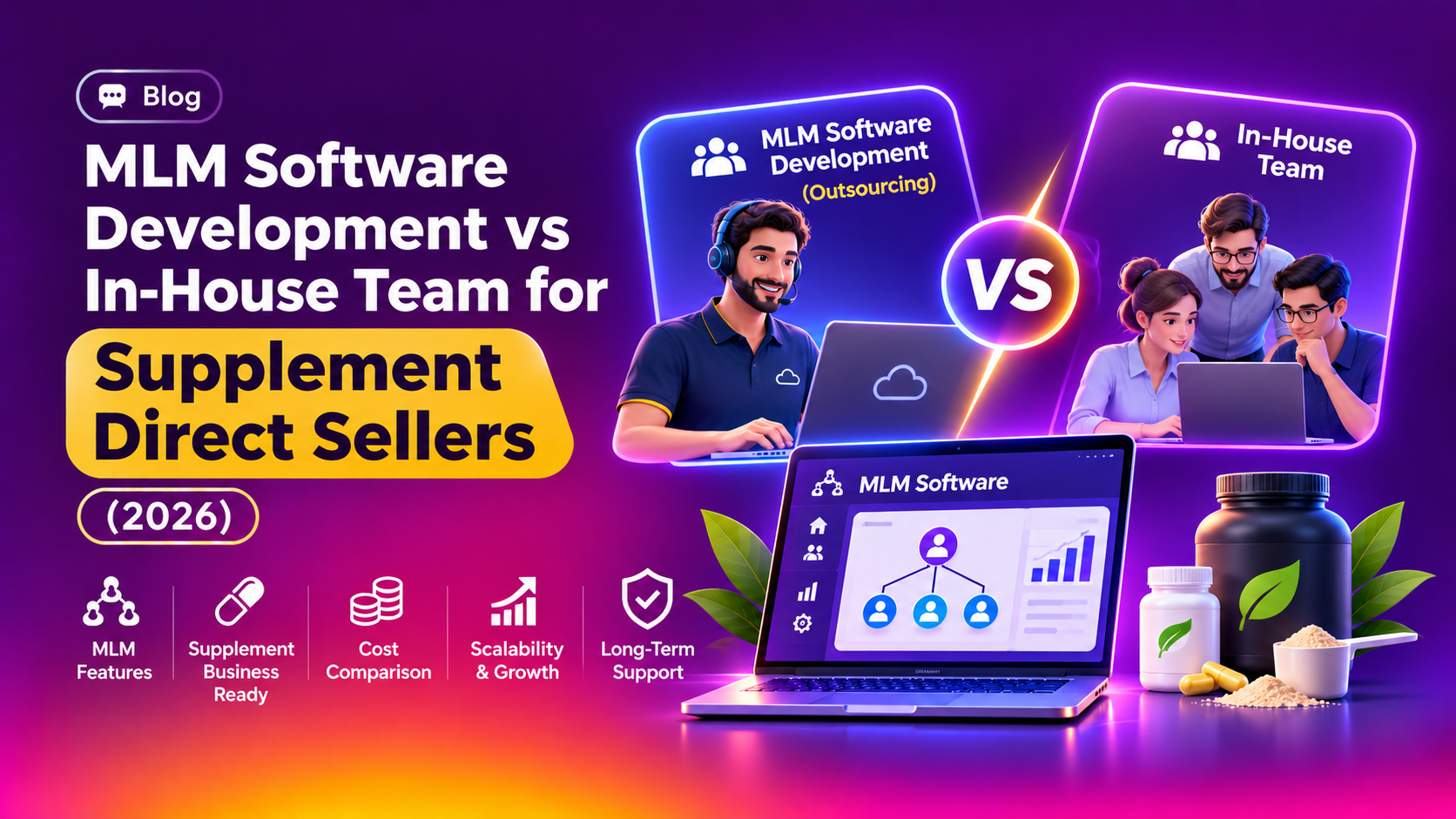
If you run or plan to launch a supplement or nutrition direct selling business, sooner or later you must decide who builds the software that pays your distributors. This article compares MLM software development vs in-house team for health supplement direct sellers, so founders and operations heads can decide whether to hire engineers or work with a specialist company. It covers the plan engine, commissions, e-wallet, KYC, payouts, replicated websites and the order and inventory flow.
Nothing here guarantees a result, and every business is different. Use it as a framework, then request an itemised quote against your own requirements. If you want to see how an outside build is scoped, our MLM software development service page explains the process.
Why supplement direct sellers have specific software needs
A supplement business is not just a network with a payout formula. It sells a physical, repeat-purchase product, and that shapes the software from day one.
- Repeat orders and autoship: customers reorder the same products monthly, so subscription-style orders and reminders matter.
- Batch and stock awareness: products have batches and expiry dates, so inventory needs more than a simple quantity count.
- Product claims: your website and distributor pages must show only approved descriptions, because loosely worded health claims can cause trouble with regulators.
- Many small distributors: most members are part-timers who want a simple phone-friendly back office, not a complex dashboard.
- Frequent plan tweaks: promotions, rank incentives and product bundles change often, and the system must change with them.
What you are actually building
"MLM software" is shorthand for several parts that work together. Looking at them separately makes the build-or-buy decision clearer.
The plan engine
The plan engine calculates who earns what. Supplement companies commonly use a binary, matrix or unilevel structure, or a hybrid of them. Each has different rules for placement, spillover, depth and pairing, and each produces different edge cases. A binary plan needs careful handling of leg balance and carry-forward volume. A matrix needs rules for filling positions. A unilevel needs clear depth and rank requirements. Whatever you choose, the engine should read its rules from settings you can edit, not from values buried in code.
Commissions and ranks
Commission logic covers retail margin, team bonuses, rank advancement, fast-start rewards and any repurchase incentives. The hard part is not the first calculation. It is making results reproducible, so that when a distributor disputes a payout you can show exactly which orders and which rules produced it. Returns and cancelled orders must also reverse commissions correctly.
E-wallet and payouts
The e-wallet holds earnings, records every credit and debit and lets members request withdrawals. Payout runs need approval steps, minimum thresholds, holds for unverified accounts and exports for your bank or payment partner. Because this is money, the ledger must be append-only and auditable.
KYC and member verification
Most companies collect identity and bank details before releasing payouts. The software should store documents securely, track review status, let staff approve or reject with reasons and block withdrawals until verification is complete. Handling personal data carefully matters, so access should be limited by role.
Replicated websites and the order flow
Each distributor often gets a personal storefront that carries their referral link. Orders placed there must be credited to the right member, taxed correctly, paid through a gateway and passed to the warehouse. Inventory then needs to update, with low-stock alerts and support for batch and expiry tracking.
Building in-house: where it fits
An in-house team can make sense when you already have experienced developers, your plan is unusual enough that no standard engine fits, and you are ready to treat software as a permanent part of the business.
The costs are less visible than salaries alone. You need people who understand payment flows, data security and plan logic, and those skills are hard to hire and hard to replace. After launch someone must fix bugs, handle plan changes, keep up with payment gateway updates and respond when a payout run fails. If one developer holds all the knowledge and leaves, your business may depend on code nobody else can safely change. Management time also counts, because a founder who should be building the distributor base ends up supervising a technical team.
Outsourcing to an MLM software company: where it fits
Outsourcing suits companies that want a working system without building an engineering department. A specialist team has usually met the common problems before, such as spillover rules, rank rollups and reversal of commissions on returns, and can start from tested components instead of learning on your payouts.
The risks are different. You depend on the vendor after launch, you must share business rules with an outside team, and weak contract terms can leave you unable to maintain what you paid for. These risks are manageable if you choose carefully and negotiate the right terms, which we cover below. Our MLM software development company team works this way, with planned delivery, documented handover and an itemised quote.
In-house vs outsourced: side-by-side comparison
| Factor | In-house team | MLM software company |
|---|---|---|
| Upfront cost | Moderate to high: recruiting, salaries, tools and testing before anything launches | Project-based and easier to predict when the scope is itemised |
| Ongoing cost | Permanent headcount, training and on-call cover | Optional maintenance or support plan, scaled to your needs |
| Time to launch | Slower, because hiring and design come first | Usually faster, since an experienced team starts from a defined plan |
| Plan engine accuracy | Depends on the experience of your developers | Benefits from earlier experience with binary, matrix and unilevel plans |
| E-wallet and payout safety | Fully in your control, but needs strong internal review | Stronger when the vendor has handled ledgers and payout approvals before |
| KYC and data handling | Built to your process, though security is often under-resourced | Can be specified up front, with role-based access as a deliverable |
| Plan changes and promotions | Quick if the right developer is available | Handled through a change request or support agreement |
| Key-person risk | High when one or two people hold the knowledge | Lower if documentation and handover are contractual |
| Flexibility to switch later | High | High if you own the code and documentation |
The table shows that neither route always wins. In-house gives maximum control. Outsourcing gives speed, breadth of experience and less dependence on individuals.
What drives cost either way
We do not quote figures in an article, because they depend on scope. These are the factors that move the price, whichever route you take.
- The number of plan types and bonus rules, and how often they change.
- The depth of the e-wallet, payout approvals and bank or gateway integrations.
- KYC requirements, document storage and review workflows.
- Replicated websites, multi-language support and mobile apps.
- Inventory complexity, including batches, expiry, several warehouses and autoship.
- Security testing and the support response you expect after launch.
When you compare routes, put a realistic estimate of salaries, management time and replacement risk next to an itemised vendor quote. Compare like with like.
A middle path many companies consider
The choice is not strictly binary. A common arrangement has an outside team build and maintain the core engine, wallet and website, while your own staff manage products, content, promotions and day-to-day operations. A small internal technical person then acts as the owner of the relationship, reviews releases and understands the system well enough to question it. Define clearly which parts belong to whom, so responsibility is never vague.
Terms to insist on if you outsource
- Code and documentation ownership: you should receive the source code, database design and deployment notes.
- Plan rules in writing: the commission logic should be documented and signed off before development begins.
- Test payouts: a trial run with sample data that you can verify by hand before real money moves.
- Data protection: written terms on where member and KYC data is stored and who can view it.
- Exit plan: a defined handover process so you can move maintenance elsewhere without being locked in.
- Support commitments: written response expectations for payout-day incidents.
Compliance: check local rules first
Direct selling and network marketing are regulated differently from one country and state to another. Rules can cover how compensation is structured, how products and income can be described, how distributors are registered and how personal data is handled. We are not lawyers and this is not legal advice. Check the rules where you operate and speak to a qualified adviser before you finalise your plan, then give the software team clear requirements so the system supports your decisions.
Questions to ask before you decide
- Who inside the company will own the system after launch?
- What happens if the lead developer or vendor contact leaves?
- Can we describe our plan in rules precise enough for a system to follow?
- How would we prove a disputed commission to a distributor?
- How often do we expect to change the plan or add products?
If these answers are unclear, a short scoping engagement with an outside team can clarify requirements before you commit to either route.
Why Companies Choose CloudHouse for MLM Software Development
Clients come to CloudHouse because we plan delivery in stages, stay available for support after launch and provide transparent, itemised quotes so you can see what each component costs. We build around your plan and your product range instead of forcing you into a rigid template. You can read more about our approach on our MLM software development company in Kerala page.
Conclusion
For a supplement direct seller, the in-house versus outsourced decision comes down to control, continuity and the real cost of owning specialised software over time. Build in-house if you have the people, the appetite for ongoing maintenance and a strong reason to keep it internal. Outsource, or split the work, if you want tested engineering, documented handover and less dependence on a few individuals. Either way, insist on ownership of your code, a reproducible commission ledger and careful handling of member data. To discuss your plan and receive an itemised proposal, visit our MLM software development company page and request a quote.