
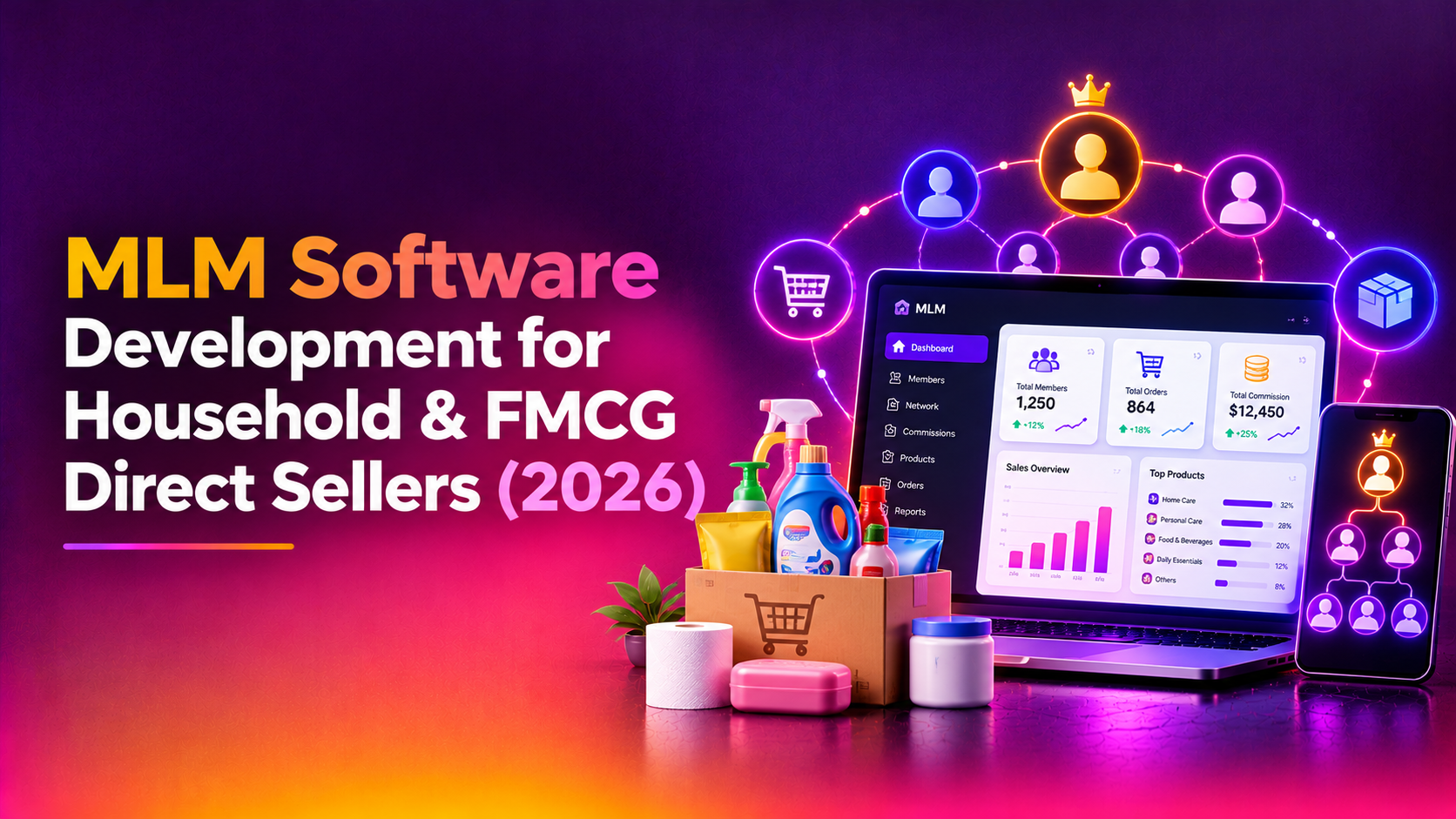
Selling detergent, floor cleaner, toothpaste, staples or personal-care items through a network is a very different business from selling a high-ticket wellness package. MLM software development for FMCG direct selling has to cope with thousands of small orders, products that run out and are reordered every month, stock sitting in several locations, and distributors who check their earnings on a phone between customer visits. Generic software built for a handful of large enrolment fees tends to struggle here. This guide explains what a household or FMCG direct-selling owner should ask for, where the real complexity sits, and how to compare what different builds offer.
It is written for founders and operations heads who already sell household products through distributors, or are about to launch, and are considering custom software. Nothing here is legal advice. Direct-selling and network-marketing rules differ by country and state, so confirm your plan, product claims, refund terms and record-keeping duties with your own counsel before launch.
Why household and FMCG direct selling is a software problem of its own
In a consumables business, the order is small and the relationship is long. A distributor may place a modest order every few weeks, and the company lives on repeat purchases rather than one big sale. That shifts what the software must do well.
- High order volume, low value per order: every order triggers stock checks, volume credit, commission entries and a payment record. Slow processing per order becomes a serious bottleneck at scale.
- Repeat purchase as the core engine: the plan usually rewards monthly product volume, so the system must track who is active, who has lapsed and who is close to a qualification threshold.
- Physical stock in many places: warehouses, regional depots and local pick-up points all hold inventory that must reconcile with orders.
- Margin pressure: commission, shipping and returns all come out of a thin unit margin, so small payout errors hurt more than they would on a premium product.
- Mobile-first distributors: many sellers run the business from a phone, often on unreliable connections.
Inventory and stock-point management
Most FMCG networks need more than a single warehouse count. Ask whether the system supports a hierarchy such as a central warehouse, regional depots and franchise or stock-point outlets, each with its own stock level, reorder trigger and user permissions.
Useful capabilities include stock transfers between locations with a clear audit trail, batch and expiry tracking for products that have a shelf life, low-stock alerts, and the ability to route an order to the nearest location that has the items. If distributors collect goods from a local point, the software should confirm the hand-over so volume is credited only once the order is genuinely fulfilled. Returns and damaged goods need their own flow, because a returned order may need to reverse volume, bonus and commission that were already calculated.
A team building this for you should ask how your stock actually moves before designing it. A custom MLM software development project that skips this discovery usually ends with inventory kept in a separate spreadsheet that no one trusts.
Repeat purchases and autoship
For a consumables company, autoship is often the most valuable feature after the compensation plan itself. A customer or distributor chooses a basket and a schedule, and the system generates the order each cycle.
The detail matters. Look for the ability to skip or reschedule a cycle, to swap a product that is out of stock, to handle a failed payment with a sensible retry and notification, and to pause a subscription without losing history. Autoship orders should flow through the same volume, commission and inventory logic as manual orders so that nothing is calculated differently depending on how the order arrived.
Also decide how autoship interacts with your plan. If you require a minimum monthly volume to stay active, the software should show each distributor their progress and warn them before the month closes, which reduces support questions and lapses.
Commission plan flexibility
Consumables plans often combine several elements: retail margin on personal sales, a team volume bonus, rank advancement, a leadership or generation bonus, and promotional incentives for a launch or a seasonal product. Whatever you start with will change. Products are added, margins shift and a competitor's offer forces a response.
This is where MLM plan software development choices have long-term consequences. Ask whether commission rules are configured through settings that your team can adjust, or whether each change needs a developer. Ask how a plan change is tested before it goes live, and whether it can be applied from a future date without touching earlier periods. A good build lets you run a simulation on past data so you can see what a proposed change would have paid before you commit to it.
Payout accuracy and transparency
Nothing damages trust in a network faster than a wrong payout. In a low-ticket model there are many small calculations, so errors can hide until a distributor notices a shortfall.
- Itemised statements: each distributor should see how every credit was earned, by order and by level, not only a total.
- Locked periods: once a commission period is closed and paid, changes should require an authorised adjustment with a reason recorded.
- Return handling: reversals should be automatic and visible, so a refund does not leave an overpayment behind.
- Deductions and tax records: the system should store the information your accountant needs. Which deductions apply is a matter for your accountant and counsel, not for the software vendor.
- Payout methods: bank transfer files, wallet balances or approved gateways, depending on what your market and regulators allow.
Before go-live, insist on a parallel run in which the software calculates a real period alongside your existing method, and the two results are compared line by line.
The distributor app and back office
For household products, the distributor app is closer to a daily tool than a reporting portal. The most useful screens are simple: place or repeat an order, check stock availability, see today's volume, view the team, share a referral or product link, and read an earnings statement.
Ask whether the app handles slow connections gracefully, whether it supports your local languages, and whether it offers notifications for order status, rank progress and payouts. On the admin side, your own team needs product and price management, order and fulfilment queues, distributor onboarding with document checks, reports by region and product, and role-based permissions so a warehouse clerk cannot change commission rules.
Compliance and direct-selling rules
Direct-selling regulation varies widely. Some places have specific guidelines on registration, product-led versus recruitment-led income, cooling-off or refund rights, advertising claims and record retention. Because household and personal-care products often carry labelling and safety requirements as well, the software may need to hold product information and batch details that you can produce on request.
Software cannot make a business compliant by itself, but it can make compliance easier to demonstrate. Features worth discussing include recorded distributor agreements and consent, a clear refund and return workflow, an audit log of commission changes, controls that stop earnings being tied to recruitment alone where the rules require sales to consumers, and exportable records. Confirm what you actually need with counsel first, then write it into the requirements so the builder is not guessing.
Criteria table: what to look for in an FMCG MLM build
Use the table below to structure vendor conversations. It describes what to ask for and why it matters in a household or FMCG network, not a ranking of products.
| Area | What to ask for | Why it matters for FMCG |
|---|---|---|
| Order processing | Fast checkout, bulk and repeat ordering, clear volume credit per order | Many small orders must be processed without delay or manual rework |
| Stock points | Multi-location inventory, transfers, batch and expiry tracking, low-stock alerts | Physical goods sit in several places and must reconcile with orders |
| Autoship | Schedules, skips, substitutions, payment retry and notifications | Repeat purchase is the main revenue engine |
| Commission engine | Configurable rules, simulation on past data, effective-date changes | Plans and promotions change often, and each change must be safe |
| Payout accuracy | Itemised statements, locked periods, automatic return reversals, parallel run | Thin margins mean small errors add up and erode trust |
| Distributor app | Reorder, stock view, earnings, team view, local languages, low-bandwidth use | Sellers work from their phones throughout the day |
| Compliance support | Agreement records, audit logs, refund workflow, exportable reports | Rules vary by region and records must be producible on request |
| Integrations | Payment gateways, courier tracking, accounting export, SMS or messaging | Avoids double entry between systems |
| Scalability | Tested handling of large order and distributor counts, background commission runs | Volume grows quickly once a network gains traction |
Custom build, ready-made script or hybrid
A ready-made script is quicker to start with and may suit a company with a standard plan and few stock complexities. Its limits show up when you need stock points, local payment methods or an unusual bonus. A fully custom build fits your exact flows but takes longer to plan and test. Many household sellers choose a hybrid in which proven modules such as the genealogy tree and wallet are adapted, while inventory, autoship and the commission engine are tailored. A reputable MLM software company will explain the trade-off honestly, show you a plan for each approach and tell you who owns the source code at the end.
What drives cost and timeline
No credible vendor can give a meaningful price without understanding your plan and stock model. The main cost drivers are the number of stock locations, the complexity of the compensation plan, the number of integrations, whether you need native mobile apps or a responsive web app, the languages and currencies involved, and the level of testing and data migration required. Timelines follow the same drivers. Ask for an itemised quote that separates discovery, development, testing, deployment and support so you can compare proposals line by line, and ask what would cause the price to change.
Why Companies Choose CloudHouse for MLM Software Development
CloudHouse Technologies plans the build around your plan, stock model and market before writing code, so the delivery schedule is based on your real requirements. Quotes are itemised so you can see where the effort goes, and support continues after launch because a commission engine needs attention as your products and plan evolve. You can read more on our MLM software development service page.
Conclusion
For a household or FMCG direct seller, good software is the quiet machinery that keeps stock, repeat orders and payouts accurate while thousands of small transactions pass through each month. Define your plan, stock points and autoship rules clearly, confirm the regulatory points with your counsel, and use the criteria table to hold every vendor to the same standard. When you are ready to discuss your own network, request an MLM software quote from CloudHouse and get an itemised plan before your next launch or season begins.