Hiring the wrong mobile app development company can cost you six figures and a year of runway before you even realize the product isn't going anywhere. If you're a founder or product manager about to sign a contract, how to choose a mobile app development company comes down to one skill: separating vendors who can genuinely execute from vendors who are simply good at sales calls. This guide gives you the exact vendor-vetting criteria, red flags, and questions that experienced buyers use — not a generic listicle.
What Is Custom Mobile App Development and Who Needs It?
Custom mobile app development means building an iOS, Android, or cross-platform application designed specifically around your business logic, user flows, and integrations — rather than adapting a template or no-code builder. It typically covers native development (Swift/Kotlin), cross-platform frameworks (Flutter, React Native), backend APIs, cloud infrastructure, and ongoing maintenance.
You need a custom mobile app development partner if your product requires: complex business logic that off-the-shelf builders can't handle, integrations with existing ERP/CRM/payment systems, offline-first functionality, or a scalable architecture meant to support growth well past MVP. Startups validating an idea, funded companies scaling to thousands of users, and enterprises digitizing internal workflows all fall into this bucket — but each needs a vendor evaluated slightly differently.
Vendor-Vetting Criteria: What Actually Matters
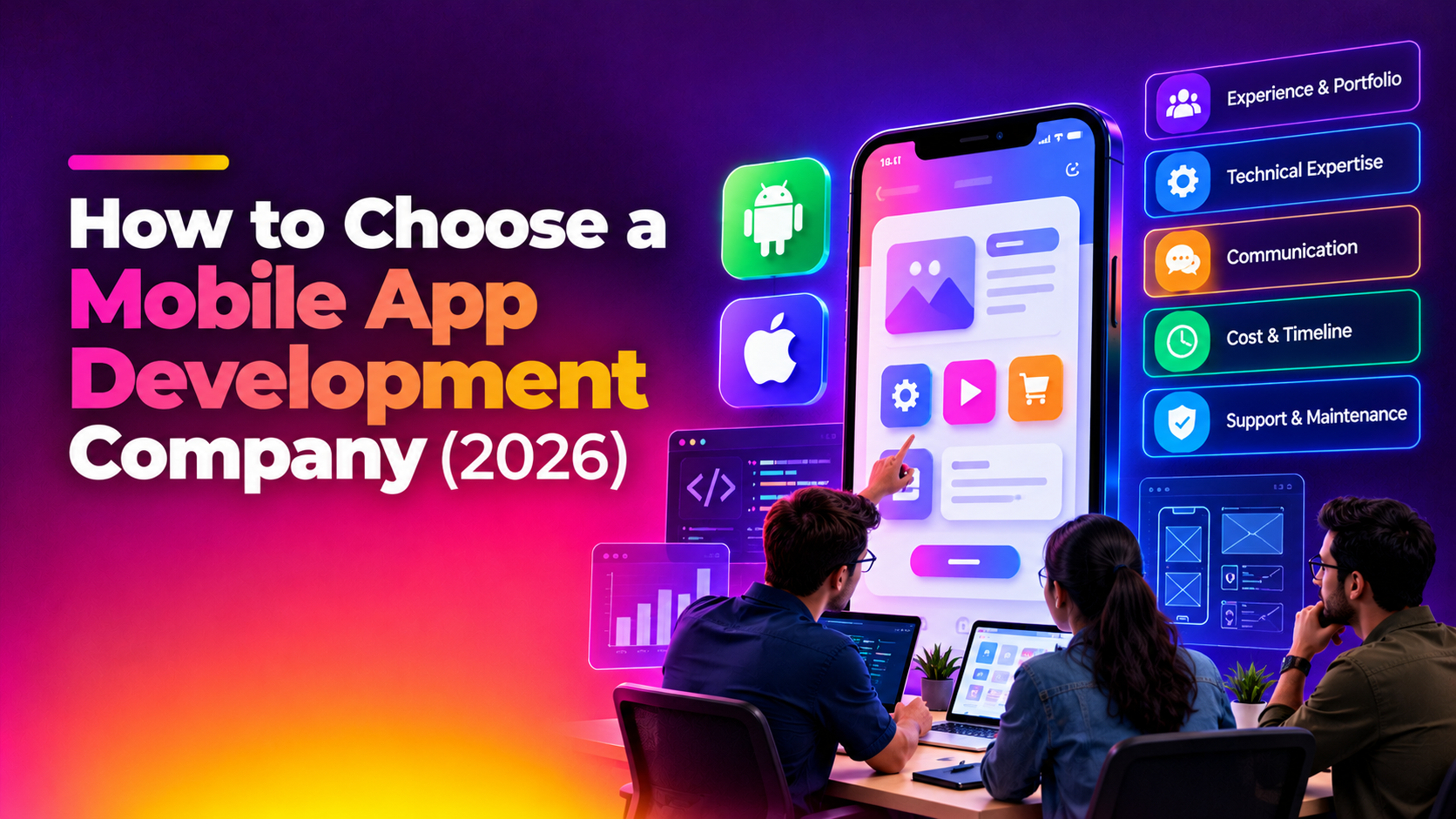
Most buyers judge agencies on portfolio screenshots and a friendly sales rep. Neither predicts delivery. Use this checklist instead — it's built from what actually breaks projects, not what looks impressive in a pitch deck.
- Relevant portfolio depth, not just screenshots — ask for the business outcome behind each app (downloads, retention, revenue impact), not just the UI
- Named team, not "our expert team" — you should know the specific project manager, lead developer, and QA engineer assigned before signing
- Transparent, itemized pricing — a real quote breaks down design, development, QA, and post-launch support as separate line items
- Documented development process — discovery, wireframes, sprints, QA cycles, and staged releases, with realistic milestones you can track
- Full IP and source code ownership — confirmed in writing, transferring to you on payment, with no vendor lock-in
- Post-launch support plan — defined response times for critical bugs and a clear maintenance retainer, not a vague "we'll help if needed"
- Verifiable references — actual client contacts you can call, not anonymized "case studies"
- Security and compliance practices — code reviews, secure API design, and awareness of relevant standards (HIPAA, PCI-DSS, GDPR) if your app touches sensitive data
Run every shortlisted vendor through this checklist side by side. A company that hesitates on any of these — especially IP ownership or references — should drop out of contention immediately.
Vendor Evaluation Table
| Criteria | What a Strong Vendor Shows You | What a Weak Vendor Shows You |
|---|---|---|
| Portfolio | Outcome data (retention, revenue, downloads) | Screenshots only, no metrics |
| Team | Named PM, devs, QA assigned upfront | "Our expert team" with no names |
| Pricing | Itemized, fixed-scope quote | Vague hourly estimate with no scope |
| Process | Discovery → design → sprints → QA → launch | "We'll figure it out as we go" |
| IP Ownership | Written contract transferring full IP | Refuses to confirm or delays the answer |
| Support | Defined SLA for critical bugs | No maintenance plan mentioned |
| References | Live client contacts you can call | "Can't share due to NDA" |
Red Flags to Avoid When Hiring an App Developer
These are the patterns that show up again and again in failed engagements. If you spot two or more during vendor conversations, walk away.
- Skipping the discovery phase — agencies that jump straight to a quote without understanding your users, competitors, or technical constraints are guessing at scope
- Refusing to confirm code ownership — this is the single most serious red flag; without it you can be locked into one vendor forever
- Extremely low bids — a quote far below every other vendor usually means corners will be cut on QA, security, or scalability
- Fixed price with zero flexibility — either they'll resist every change request or nickel-and-dime you with change orders later
- Reactive-only communication — "just email us if you need something" instead of scheduled check-ins and proactive status updates
- No QA process mentioned — relying on ad-hoc testing instead of structured test cycles before release
- Can't name specific past clients — vague references or "we can't disclose due to NDAs" for every single project is a warning sign
💡 None of these worked? Skip the guesswork.
Get Expert Help →Questions to Ask Before Signing a Contract
Bring this list to every vendor call. Their answers — not their sales pitch — tell you who can actually deliver.
A credible answer covers discovery, wireframing, sprint planning, QA cycles, and staged deployment with realistic milestones. Vague answers about "agile" with no specifics mean there's no real process.
You should get named individuals — a project manager, developers, a designer, and QA — not a generic team description.
The only acceptable answer is an unambiguous yes, confirmed in the contract.
Real vendors provide live references you can actually call and ask about delays, communication, and post-launch support.
Ask specifically about critical bug response time, OS update handling, and whether maintenance is included or billed separately.
A mature vendor has a defined change-request process with cost and timeline impact spelled out — not a rigid fixed price or unlimited free changes (both are red flags in opposite directions).
Get an itemized breakdown of design, development, testing, deployment, and support — vague lump-sum quotes hide scope gaps that surface as change orders later.

Why Businesses Choose CloudHouse for Mobile App Development
CloudHouse Technologies runs every mobile app engagement through a documented discovery-to-launch process, assigns a named team you can speak with directly, and puts full source code and IP ownership in writing from day one. Clients get itemized pricing with no hidden change-order surprises, and post-launch support with defined response times rather than a vague promise. If you're ready to move past vendor guesswork, explore CloudHouse's custom mobile app development services and see how a transparent, accountable process compares to the agencies you've been evaluating.
Frequently Asked Questions
How much does custom mobile app development cost in 2026?
Established agencies typically charge $75–$250 per hour, with most small-to-mid complexity apps landing between $50,000 and $120,000 in total project cost. Simple apps can start near $15,000, while complex, feature-rich apps can exceed $500,000. Get an itemized quote so you know exactly what's included before comparing vendors on price alone.
How long does it take to build a custom mobile app?
A typical MVP takes 3-6 months from discovery to launch, while more complex apps with multiple integrations can take 6-12 months. Any vendor promising a full-featured app in a few weeks is likely skipping QA or discovery — treat unusually short timelines as a red flag, not a benefit.
What questions to ask an app development company are most important?
Prioritize questions on IP/code ownership, named team members, itemized pricing, and post-launch support SLAs — these four areas predict project success far more reliably than portfolio aesthetics or sales-call rapport.
Do app development companies offer a trial or month-to-month engagement?
Many reputable vendors, including CloudHouse, offer a scoped discovery or pilot sprint before committing to the full build, letting you evaluate communication and code quality with limited financial risk. Ask specifically whether a paid discovery phase is available before signing a long-term contract.
What's the biggest mobile app development red flag to watch for?
Refusing to confirm in writing that you'll own 100% of the source code and IP after payment is the most serious red flag — it can lock you into a single vendor indefinitely and block you from switching teams or scaling independently.