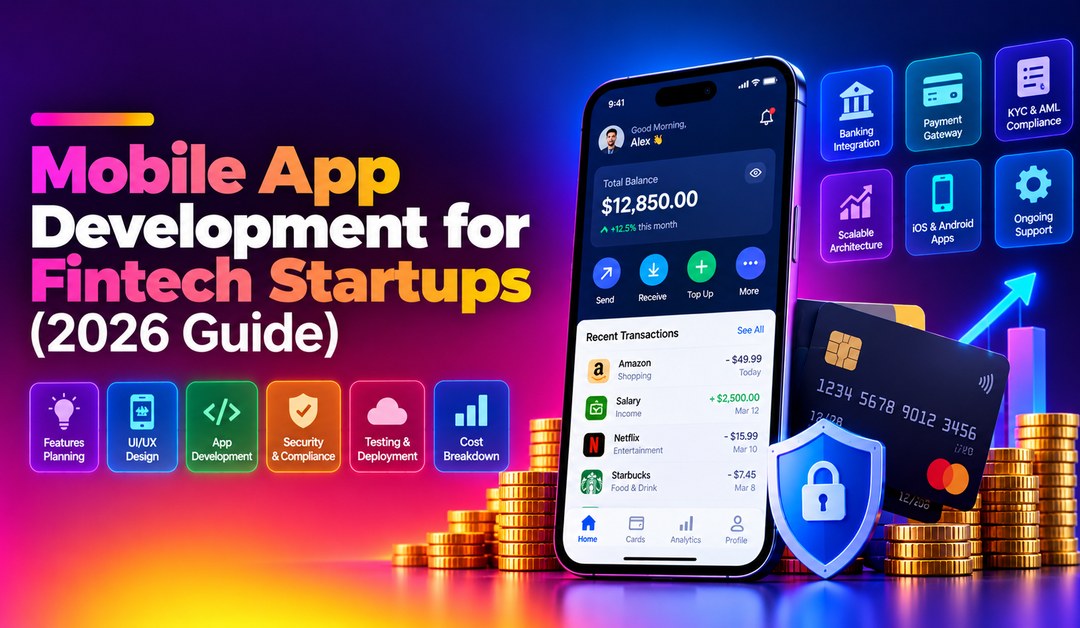
Fintech founders don't need another generic "how to build an app" tutorial. They need a partner who understands that a single missed encryption standard, a poorly scoped KYC flow, or an unaudited payment gateway integration can sink a funding round or trigger a regulatory freeze. Mobile app development for fintech startups is a fundamentally different discipline from building a retail or productivity app — compliance, security, and payment architecture have to be baked in from day one, not bolted on after a security audit fails.
This guide breaks down exactly what fintech founders and CTOs should demand from a development partner in 2026: the compliance frameworks that matter, the security architecture that investors and banking partners expect, realistic cost ranges, and the red flags that separate a fintech app development company from a generalist shop that "also does finance apps."
Why Fintech App Development Is Not Like Building a Regular App
A food delivery app that goes down for an hour is an inconvenience. A payments app that goes down — or worse, leaks transaction data — is a regulatory incident, a press headline, and potentially the end of a startup's banking relationships. Fintech mobile products carry a different risk profile at every layer:
- Regulatory exposure — RBI guidelines in India, PCI DSS globally, GDPR for EU users, and KYC/AML obligations all apply simultaneously for cross-border fintech products.
- Data sensitivity — bank account numbers, card PANs, government IDs, and transaction histories are all classified as sensitive data requiring encryption at rest and in transit.
- Third-party dependency risk — payment gateways, KYC verification vendors, credit bureaus, and banking APIs each introduce their own compliance surface area.
- Investor and banking partner scrutiny — before a bank or NBFC will partner with a fintech startup, they typically require a security audit of the mobile app itself, not just the backend.
This is why custom mobile app development for fintech has to start with a compliance and threat model, not a Figma file.
Core Requirements Checklist for Fintech Mobile Apps
Before evaluating vendors, founders should be clear on what "done right" actually looks like. The table below maps the requirements that separate a compliant, investor-ready fintech app from a generic MVP.
| Requirement Area | What It Covers | Why It Matters for Fintech |
|---|---|---|
| Data encryption | AES-256 at rest, TLS 1.3 in transit, encrypted local storage/keychain | Mandatory baseline for PCI DSS and most banking partner audits |
| Authentication | Biometric login, multi-factor authentication, session timeout policies | Prevents account takeover, a top fraud vector in mobile banking apps |
| KYC/AML integration | Aadhaar/PAN verification, video KYC, sanctions screening APIs | Legally required before onboarding a paying customer in most jurisdictions |
| Payment gateway architecture | Tokenized card storage, PCI-scoped payment flows, UPI/card/wallet rails | Keeps raw card data out of your systems, drastically reducing PCI DSS scope |
| Audit logging | Immutable transaction logs, admin action trails | Required for regulatory audits and dispute resolution |
| Data residency | In-country data storage for payment data | RBI's 2018 directive requires Indian payment data to stay in India |
| Fraud detection hooks | Device fingerprinting, velocity checks, anomaly flags | Reduces chargeback and fraud losses post-launch |
| App store compliance | Apple/Google financial app review requirements | Non-compliant apps get rejected or delisted, delaying launch |
💡 None of these worked? Skip the guesswork.
Get Expert Help →Secure Banking App Development: The Non-Negotiables
When founders search for secure banking app development, they're usually trying to answer one question: "How do I know this vendor won't cut corners?" Here's what a genuinely secure build process looks like in practice.
A competent team maps out attack surfaces — API endpoints, third-party SDKs, local storage, deep links — before wireframing begins. This determines architecture decisions like whether sensitive data ever touches the device at all.
OWASP Mobile Top 10 checks, static and dynamic code analysis, and dependency vulnerability scanning should run on every build, not as a one-time pre-launch audit.
Every API call is authenticated and authorized independently — no implicit trust between the app, backend, and third-party services, even internally.
Third-party pen testing (not just internal QA) is standard practice for any app handling money, and most banking partners will ask for the report directly.
A documented plan for what happens if a vulnerability is discovered post-launch — including disclosure timelines — is something regulators and banking partners increasingly expect to see in writing.
Fintech Mobile App Compliance: What Actually Applies to You
Not every fintech startup needs every framework. Fintech mobile app compliance requirements depend on what the app actually does:
- PCI DSS — applies if your app touches, stores, or transmits card data. Most startups avoid full-scope PCI DSS by tokenizing card data through their payment gateway rather than handling raw card numbers themselves.
- RBI guidelines — apply to any app operating as a payment aggregator, wallet, or lending product in India, including the requirement that payment data be stored exclusively within India.
- KYC/AML regulations — apply to any app onboarding customers for financial services, requiring identity verification before transactions are enabled.
- GDPR — applies if you have EU users, regardless of where your company is headquartered.
- Data localization laws — increasingly common across Southeast Asia, the Middle East, and India for financial data specifically.
The mistake most startups make is bringing in a compliance consultant only after the architecture is already built — at which point fixing gaps often means rebuilding core data flows. Compliance needs to be a design input, not a post-launch audit item.
Custom Fintech App Cost: Realistic Budgets for 2026
Founders searching for custom fintech app cost figures are usually trying to sanity-check a vendor quote or set a fundraising budget. Realistic 2026 ranges look like this:
- MVP fintech app (single core feature, basic KYC, one payment rail): typically starts in the tens of thousands of dollars and scales with feature scope and compliance depth.
- Full-featured payments or lending app (multi-rail payments, credit scoring integration, advanced fraud checks): a substantially larger investment, often 3-5x an MVP build.
- Enterprise-grade banking app (multi-currency, full regulatory audit trail, high-availability infrastructure): the highest tier, reflecting the depth of compliance and infrastructure work required.
Across all tiers, regulatory compliance work alone commonly adds 20-40% to total development cost compared to a non-regulated app of similar complexity. Vendors who quote fintech apps at the same price as a generic MVP are almost always underestimating the compliance and security work — or skipping it, which shows up later as a rejected banking partnership or a failed audit.
Evaluating a Fintech App Development Company: A Vendor Checklist
Most fintech founders aren't equipped to evaluate a vendor's security architecture in depth, and that's exactly the gap generalist agencies exploit with confident-sounding proposals that skip the hard questions. Use this checklist during vendor calls before signing anything:
- Can they name the specific regulatory frameworks (PCI DSS, RBI, GDPR, KYC/AML) that apply to your product, not just generic "we follow best practices" language?
- Do they ask about your target markets and payment rails before quoting a price, since compliance scope changes the entire estimate?
- Can they describe their threat modeling process, or do they treat security as a pre-launch checklist item?
- Have they supported a previous client through an actual banking partner or NBFC security audit, and can they share (anonymized) references?
- Do they propose tokenized payment architecture by default, or do they suggest storing raw card data because "it's simpler"?
- Is their pricing milestone-based and transparent, or a single lump sum that leaves no room to explain what compliance work costs?
- Do they have a documented incident response process for post-launch vulnerabilities?
A vendor that stumbles on more than one or two of these questions is likely to treat your fintech app the same way they'd treat a restaurant ordering app — and that mismatch tends to surface at the worst possible time, usually during a funding round's technical due diligence or a bank's onboarding audit.
Common Mistakes Fintech Startups Make When Choosing a Development Partner
Beyond the checklist above, a few recurring mistakes show up again and again in post-mortems of fintech app launches that stalled or required expensive rework:
- Choosing on price alone. A quote that's 30-40% cheaper than competitors is almost always cheaper because compliance and security work has been scoped out, not because the vendor is simply more efficient.
- Treating compliance as a post-launch task. Bringing in a compliance consultant after the architecture is finalized usually means rebuilding core data flows rather than adjusting them.
- Underestimating third-party integration complexity. KYC vendors, credit bureaus, and payment gateways each have their own onboarding timelines, sandbox limitations, and compliance documentation requirements that can add weeks to a launch if not planned for early.
- Skipping a real penetration test before launch. Internal QA is not a substitute for third-party penetration testing, which is often the actual document a banking partner or investor will ask to see.
- Assuming compliance is a one-time cost. Regulatory requirements evolve, and a fintech app needs a maintenance plan for ongoing compliance reviews, not just a one-time certification at launch.
Why Fintech Startups Choose CloudHouse for Mobile App Development
CloudHouse Technologies builds fintech mobile apps with compliance and security architected in from the first sprint, not retrofitted before launch. Our teams work directly with startup founders and CTOs to design KYC flows, tokenized payment architectures, and audit-ready logging systems that satisfy banking partners and regulators without slowing down time-to-market. We also offer transparent, milestone-based pricing so founders can plan fundraising and runway around real cost estimates rather than surprise change orders.
Get a Free Consultation for Your Fintech App
If you're a fintech founder or CTO evaluating vendors, the difference between a compliant, bank-ready app and a costly do-over usually comes down to who you build with. Talk to CloudHouse's mobile app development team about your compliance requirements, payment architecture, and timeline — get a scoped proposal before you commit budget or equity to a vendor who's never shipped a regulated financial product.
Frequently Asked Questions
How much does fintech mobile app development cost in 2026?
Costs range from tens of thousands of dollars for a compliant MVP to several hundred thousand for a full-featured banking or lending app, with compliance work typically adding 20-40% on top of standard development cost. The exact figure depends on which regulatory frameworks apply, how many payment rails you support, and whether you need custom fraud detection.
How long does it take to build a fintech app that passes a banking partner's security audit?
A compliant MVP typically takes 4-6 months when compliance and security are designed in from the start, versus 8-12+ months if a team has to retrofit security controls after an initial build fails an audit. Building the audit requirements into the architecture from day one is the single biggest time-saver.
Do I really need PCI DSS compliance if I'm just an early-stage startup?
If your app ever touches, stores, or transmits card data, PCI DSS applies regardless of your company's size or funding stage. Most early-stage fintech startups avoid full-scope compliance by tokenizing card data through their payment gateway, which is why choosing the right payment architecture early matters more than company size.
How do I trust that a development vendor actually understands fintech compliance and won't just say they do?
Ask for specific examples: which regulatory frameworks they've implemented against, whether they've supported a client through a banking partner's security audit, and whether they can walk you through their threat modeling process before any code is written. A vendor that can't answer these concretely, or that treats compliance as an afterthought line item, is a red flag.
What secondary keywords like "fintech app development company" should I look for when comparing vendors?
Look for vendors that explicitly discuss KYC/AML integration, PCI DSS scoping, RBI or regional data residency rules, and audit logging as part of their standard process — not as add-on services. A genuine fintech app development company will ask you compliance questions before you ask them, because they know those answers shape the entire architecture.