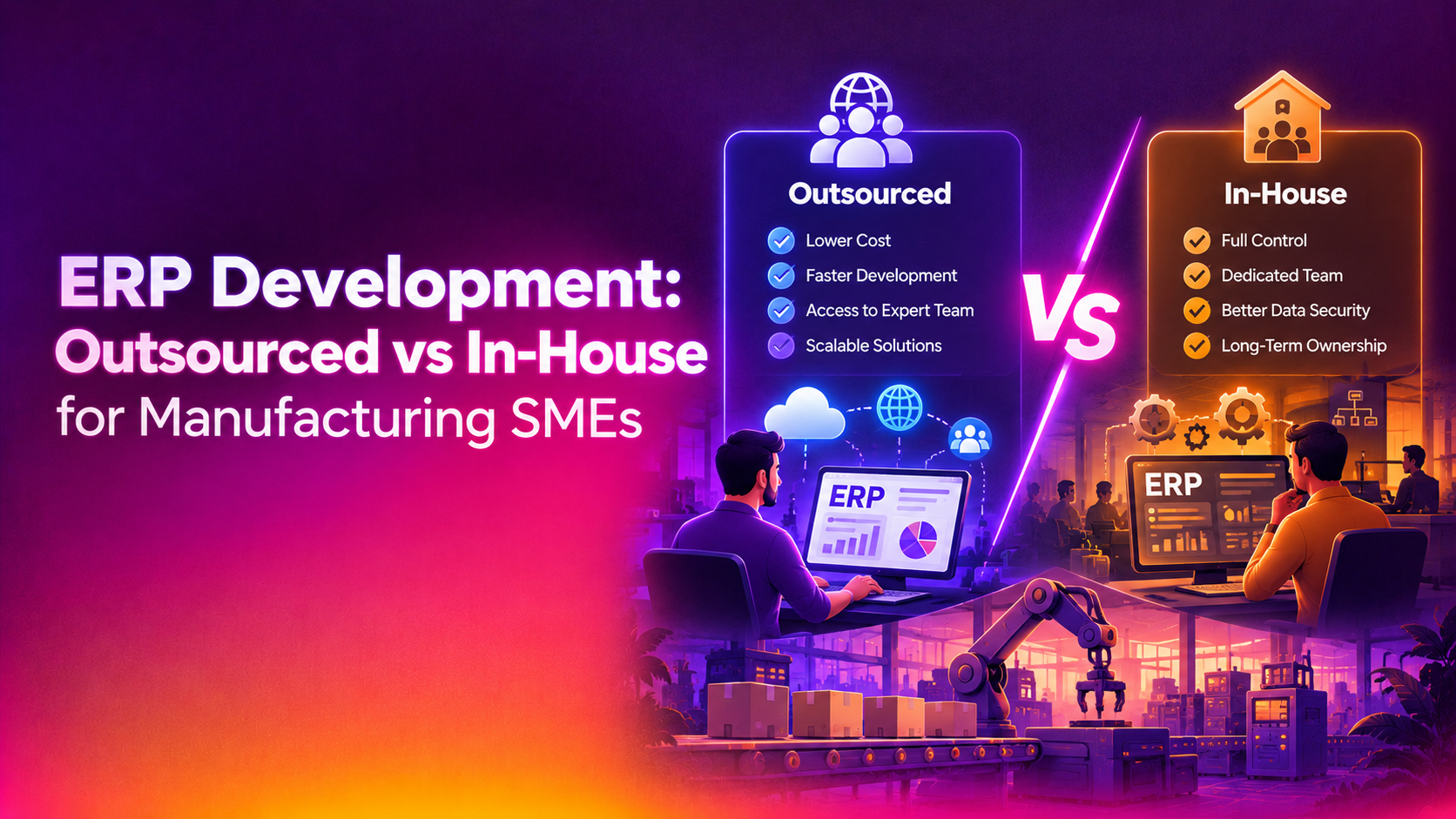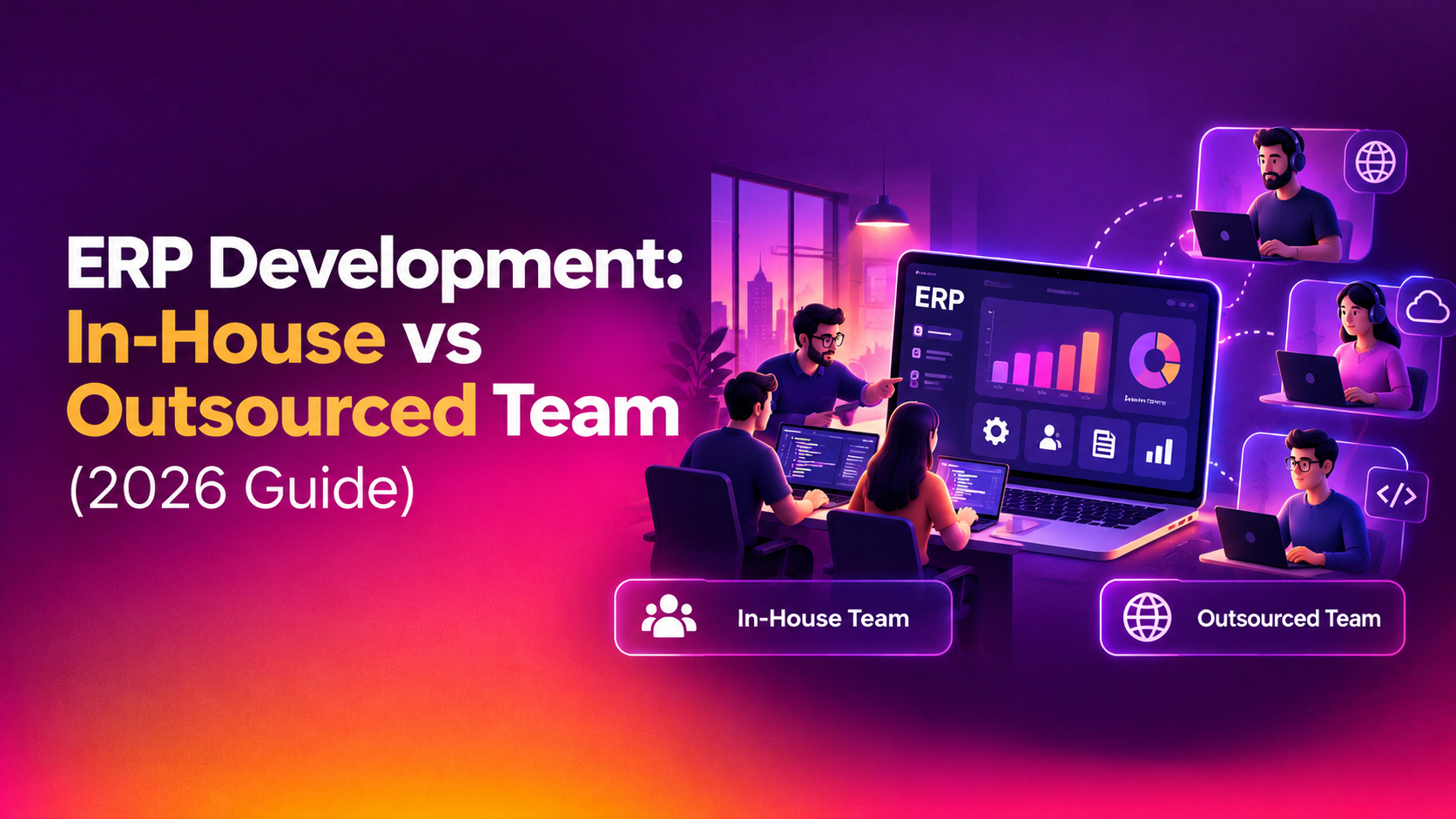
Choosing between building an in-house ERP development team and hiring an outsourced ERP development company is one of the highest-stakes decisions a CTO or operations head makes — get it wrong and you either burn six figures on salaries for a system that never ships, or lock yourself into a vendor that can't adapt to how your business actually runs. This guide compares ERP development in-house vs outsourced models on cost, timeline, control, and risk, with a real side-by-side comparison table so you can make the call with numbers in front of you, not guesswork.
What Is Custom ERP Development and Who Needs It?
Custom ERP (Enterprise Resource Planning) development means building a system tailored to your exact workflows — inventory, finance, HR, procurement, manufacturing, or logistics — rather than configuring an off-the-shelf platform like SAP or Odoo around your business. Companies typically consider custom ERP vs off-the-shelf software when their processes are too specific for generic modules, when licensing costs for enterprise platforms scale poorly with headcount, or when they need deep integration with existing tools that pre-built ERPs don't support out of the box.
If your operations team is still stitching together spreadsheets, disconnected SaaS tools, and manual approvals, you're a candidate for custom ERP. The next decision — build the team yourself or bring in specialists — determines whether that investment pays off in months or drags on for years.
In-House ERP Development: Costs and Risks
Building an internal team sounds appealing because it feels like control. In practice, it means recruiting, hiring, and retaining a full stack of specialists: backend developers, database architects, QA engineers, DevOps, a project manager, and often a dedicated ERP consultant who understands business-process modeling. In the US, a team like this runs $30,000 to $80,000 per month; even budget-conscious regional hires rarely bring total in-house team cost under $15,000–$25,000 per month once benefits, tooling, and management overhead are included.
- Hiring risk: Specialized ERP developers are scarce; recruitment alone can take 2-4 months before a single line of code is written.
- Ramp-up time: A new in-house team typically needs 3-6 months just to reach productive velocity on a system this complex.
- Key-person dependency: If your one senior ERP architect leaves, the project can stall for months.
- Idle cost after launch: Once the ERP ships, you're still paying full salaries during the (much lighter) maintenance phase — unless you reassign or lay off staff.
- Opportunity cost: Every month spent hiring and onboarding is a month competitors spend running on a working system.
In-house makes sense when ERP is a permanent, core part of your product (e.g., you're building an ERP to sell, not just to run your own operations) and you can commit to a multi-year hiring runway.
Outsourced ERP Development: What You Get
An outsourced ERP development company gives you an already-assembled team — architects, developers, QA, and a project manager — who have already built similar systems for other clients. This compresses the timeline dramatically: most outsourced ERP builds start delivering working modules within 4-8 weeks instead of the 3-6 month in-house ramp-up.
Regional rate differences matter here. Onshore US teams charge $100-$200/hour, Eastern European teams run $30-$90/hour, and experienced teams in India and similar regions charge $20-$45/hour — often the same engineering quality at a fraction of the erp development team cost. A mid-size custom ERP that would cost $300,000 built entirely onshore can realistically land between $80,000 and $140,000 with an equally skilled outsourced team.
- Faster start: No recruitment cycle — the team is already staffed and has built ERPs before.
- Flexible scaling: Add or reduce developers as project phases demand, without severance or benefits obligations.
- Built-in QA and PM: You're not hiring these roles separately.
- Post-launch support included: Most vendors bundle maintenance SLAs rather than requiring you to retain full-time staff indefinitely.
- Risk transfer: Delivery risk, technical risk, and staffing risk sit with the vendor, not your balance sheet.
The trade-off: you need a vendor with genuine ERP domain experience — not a generalist agency — and a contract structure (fixed-price milestones or dedicated team) that keeps incentives aligned. Businesses evaluating outsourced ERP development should specifically ask for past ERP projects in their industry, not just "custom software" case studies.
Side-by-Side Comparison: In-House vs Outsourced
| Factor | In-House Team | Outsourced ERP Company |
|---|---|---|
| Typical monthly cost | $15,000 – $80,000+ | $8,000 – $40,000 |
| Time to start building | 2-4 months (hiring) | 1-2 weeks |
| ERP development timeline to MVP | 9-14 months | 4-8 months |
| Domain expertise on day 1 | Rarely — must be built | Yes, if vendor is ERP-specialized |
| Staffing/turnover risk | High — key-person dependency | Low — vendor absorbs it |
| Post-launch maintenance | Full team stays on payroll | Scaled-down support contract |
| Long-term control over roadmap | Full control | High, with clear contract terms |
| Best fit | ERP is your core product | ERP supports your operations |
For most operations-focused businesses — where the ERP is a tool to run the company, not the product being sold — outsourcing wins on cost and speed without a meaningful loss of control, provided the contract and communication cadence are set up properly.
Why Businesses Choose CloudHouse for ERP Development
CloudHouse Technologies runs dedicated ERP development teams that plug in within days, not months, and we bill by milestone or hourly — not a fixed retainer you're stuck with after launch. Clients choose us because we've already built inventory, HR, manufacturing, and finance ERP modules for businesses across sectors, so there's no learning curve eating into your budget. Every engagement includes a defined maintenance SLA after go-live, so you're never paying for a full development team to sit idle once the system is stable.
Frequently Asked Questions
How much does outsourced ERP development actually cost?
Most custom ERP projects with an outsourced team run between $40,000 and $220,000 depending on scope — small business ERPs land at the lower end (3-6 months), while mid-size and enterprise systems with multiple modules (finance, HR, inventory, manufacturing) push toward $220,000+. Outsourcing typically costs 30-60% less than an equivalent in-house build.
How long does ERP development take?
A realistic ERP development timeline for an outsourced team is 4-8 months for a mid-size custom system, versus 9-14 months if you're building and ramping up an in-house team from scratch. Enterprise-scale ERPs with heavy integration work can take 12+ months either way.
Is it cheaper to build ERP in-house or outsource it?
For most businesses, outsourcing is cheaper on a total-cost basis. In-house teams carry ongoing salary, benefits, and idle-time costs even after launch, while outsourced contracts scale down once the build phase ends. In-house only becomes cost-competitive if ERP work is continuous and permanent — for example, if you plan to keep expanding the system indefinitely with new modules every quarter.
Do you offer a trial or phased engagement instead of a long-term contract?
Yes — CloudHouse structures ERP engagements around a scoped first module or pilot phase so you can evaluate delivery quality and communication before committing to the full build. There's no requirement to sign a multi-year contract upfront.
Should I choose custom ERP development or an off-the-shelf platform?
Off-the-shelf ERP (SAP, Odoo, NetSuite) makes sense if your processes are fairly standard and you're comfortable adapting workflows to the software. Custom ERP development is the better fit if your operations are specific enough that off-the-shelf licensing and configuration costs start to exceed what a tailored build would cost over 2-3 years, or if you need integrations the platform doesn't natively support.
Whether you lean in-house or outsourced, the decision should come down to whether ERP is your product or your infrastructure. If it's infrastructure — a system to run your business more efficiently — an experienced outsourced partner gets you live faster, at lower risk, and without the long-term payroll commitment. Talk to CloudHouse about your ERP development project to get a scoped timeline and cost estimate before you commit to either path.