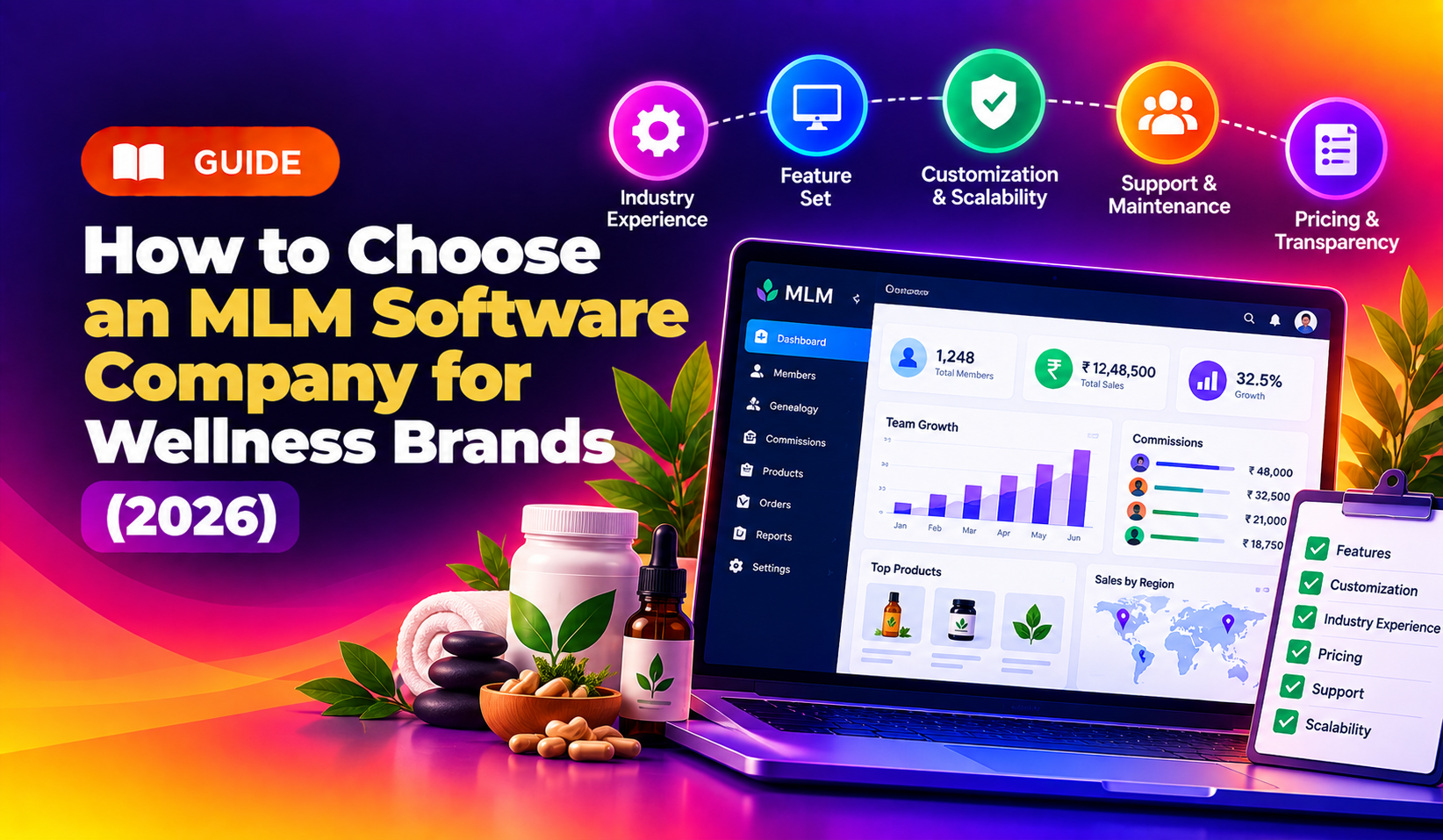
If your network grows through WhatsApp groups, Instagram reels and word-of-mouth resellers, you will eventually outgrow spreadsheets and chat-based order taking. Choosing the best MLM software development company for social selling is the decision that determines whether that growth stays organised or turns into payout disputes and lost orders. This guide gives founders a practical way to judge vendors on what matters: plan engine, genealogy, wallet and payouts, e-commerce, mobile app, admin controls, compliance posture and support. You can also see how our MLM software development approach is structured and use this guide to test it.
Most vendor demos look similar. A tree appears on screen, a commission number updates, and a login page opens. The difference shows up months later, when you change a plan, run a bonus campaign, onboard ten thousand resellers or face an audit question. The sections below help you ask for evidence before you sign.
Why Social-Selling Networks Need Different Software
A traditional direct-selling company often sells through events, catalogues and distributor offices. A social-selling or reseller network behaves differently. Orders start in a chat, a product link is shared in a story, and a new member joins from a phone within minutes. Your software has to fit that rhythm.
- Mobile first: members register, share links, place orders and check earnings from a phone, not a desktop.
- Shareable storefronts: each member needs a referral link or personal store that attributes the order to the right sponsor automatically.
- Fast onboarding: sign-up, identity details and first order should take minutes, with admin approval where you require it.
- Frequent plan changes: campaigns, ranks and promotions change often, so the plan engine must be configurable and not hard-coded.
- Message-driven engagement: notifications for orders, payouts and rank changes should reach members where they actually spend time.
If a vendor treats your business as a generic back-office system, you will end up paying for workarounds. Start by writing down how a typical member joins, sells and gets paid today, and use that as your test script.
What Makes the Best MLM Software Development Company for Social Selling
The best partner is not simply the one with the longest feature list. It is the one that can map your compensation logic and sales flow accurately, keep the money side auditable, and keep supporting you after launch. Judge each vendor on the following areas.
1. Compensation plan engine
Your plan is the core of the business, so the engine must express it exactly. Ask whether the vendor supports the structures you use or expect to use, such as binary, unilevel, matrix, generation, stair-step or hybrid plans, along with direct referral bonuses, rank advancement, pools and repurchase incentives. Ask who changes the plan when you need a new bonus: your admin through settings, or the vendor through code. Request a walkthrough using your own plan, including edge cases like a member who is inactive at the cut-off date.
2. Genealogy and network management
Genealogy views should stay usable with a large network. Check tree and list views, search by member, placement rules, sponsor changes, spillover handling and how the system treats a member who is removed or blocked. Ask what happens to earnings history when the tree is edited, and whether every change is logged with a user and time.
3. Wallet, payouts and ledger
Money handling is where trust is won or lost. Look for a proper ledger in which every credit and debit has a source, a timestamp and a reference. Ask about member wallets, minimum withdrawal rules, deductions and charges, payout cycles, bank or payment-gateway disbursement, reversal handling and reconciliation reports. Every payout figure should be explainable line by line to a member who questions it.
4. E-commerce and order management
For social sellers, the store is part of the network engine. Check product catalogue and variants, pricing tiers for members and customers, stock and warehouse handling, order status, returns, coupons, tax invoices and shipping integration. The key question is whether an order automatically triggers volume, commission and rank calculations without manual steps.
5. Mobile app and member experience
Ask whether the vendor builds a branded Android and iOS app or only a responsive website, and what it costs in effort to maintain each. A good member app shows earnings, team, orders, shareable links, training content and notifications. Check how updates reach members and how the app is published under your own developer accounts.
6. Admin controls and reporting
Your operations team needs role-based access, approval workflows, member and order search, payout approval, support tickets, announcements and exports. Ask for reports on sales volume, new joins, active members, payout liability and top performers. Check that finance, support and management users see only what they should.
7. Compliance posture (hedged)
Direct selling and multi-level models are regulated differently in different places, and regulators look closely at schemes that depend mainly on recruitment instead of genuine product sales. No software can make a business compliant by itself. Confirm current requirements with your legal and compliance advisor, then ask each vendor how their product supports your decisions, for example through product-led compensation rules, member agreements and consent capture, KYC fields, tax and invoice handling, complaint records and a full audit trail. Be cautious of any vendor who promises that their software guarantees legality.
8. Security, data ownership and support
You hold personal and financial information about your members. Ask about access control, authentication for admins, encryption, backups and recovery, and environment separation. Also settle data ownership and export rights in writing, and ask what support looks like after launch: how issues are raised, how fixes and changes are delivered, and who is reachable when a payout run fails.
Vendor Evaluation Comparison Table
Use the table below as a scoring sheet. Give every shortlisted vendor the same rows, ask for a live demonstration or sandbox access for each, and score them yourself instead of relying on a brochure.
| Evaluation area | What to ask for | Strong sign | Warning sign |
|---|---|---|---|
| Plan engine | Live setup of your own plan and a mid-month change | Admin can edit rules, ranks and bonuses without code | Every change needs a developer ticket |
| Genealogy | Large-tree demo, search, placement and sponsor change | Fast views and a logged history of every change | Tree edits silently alter earnings history |
| Wallet and payouts | Ledger view, payout run, reversal and reconciliation | Every amount traceable to a source event | Totals only, with no line-level detail |
| E-commerce | Order to volume to commission flow | Order triggers calculations automatically | Manual import between store and MLM module |
| Mobile app | Working app on a real device, publishing process | Branded app under your own store accounts | Only a desktop site shrunk to a phone |
| Admin controls | Role setup, approvals, exports, audit log | Granular roles and complete activity logs | One shared admin login |
| Compliance support | How the product supports your advisor's guidance | Configurable rules, consent and audit records | Claims that the software guarantees legality |
| Security and data | Access, backup, encryption and export terms | Written data ownership and exit export | Vague answers or vendor-held data |
| Support and delivery | Onboarding plan, support channels, change process | Named contacts and a clear scope document | No defined process after go-live |
How to Compare the Best MLM Software Development Company for Social Selling in Practice
Once you have your table, run the comparison like a pilot and not like a sales call. The steps below keep the process fair and reveal real differences.
- Write your plan on one page. Include levels, percentages, qualification rules, ranks, cut-off dates and bonuses, exactly as you intend to run them.
- Create three test scenarios. For example a new member joining through a shared link, a repeat order that crosses a rank threshold, and a refund after commission has been credited.
- Ask each vendor to run the scenarios. Watch every manual step and every place the system needs developer help.
- Review the payout trail. Pick one member and ask the vendor to explain each rupee-level line of their earnings from the ledger.
- Check references that are available to you. Ask for contactable customers and speak to them directly instead of relying on a logo slide.
- Read the scope document. Confirm modules, integrations, app publishing, hosting, support and change handling in writing.
A vendor that handles these steps calmly is usually a safer partner than one that hurries you toward a contract.
Build Versus Customise Versus Off-the-Shelf
Founders usually face three options. Each fits a different stage.
- Off-the-shelf script: fastest to start and usually the lowest effort, but limited when your plan or social-selling flow is unusual, and customisation may be restricted.
- Customised platform: a proven base adapted to your plan, store and app. This suits most reseller networks that need their own rules without building from zero.
- Fully custom build: maximum control, but it requires longer planning and a team you trust for ongoing maintenance.
When you speak to a partner for MLM software development company in Kerala or elsewhere, ask which of these paths they recommend for your stage and why. A good vendor will explain trade-offs openly, including cases where a lighter option is enough.
Red Flags When Choosing an MLM Software Vendor
- A demo that never leaves a prepared sandbox and refuses your own plan.
- Payout logic that cannot be shown line by line.
- Promises of guaranteed compliance, income or ranking for your business.
- No clear answer on who owns your member and order data.
- Source code, hosting or app accounts controlled entirely by the vendor with no exit terms.
- No defined support process after launch.
- Pressure to sign before you have seen a scope document.
Plan the Rollout Before You Sign
Even the right vendor cannot save a rushed launch. Agree on phases: plan configuration and testing, member and product data setup, app and store testing, a limited pilot with trusted resellers, and then the full launch. During the pilot, compare calculated commissions against a manual check so you catch plan errors before real money moves. If you are migrating members from an existing tool or spreadsheet, plan data cleaning and a reconciliation step, and keep the old records available for reference during the transition. Timelines depend on scope, the number of integrations and how quickly your team supplies content and approvals, so ask the vendor for a plan based on your actual requirements.
Why Choose CloudHouse for MLM Software Development
CloudHouse Technologies builds custom business software, and our MLM software work is shaped around the areas in this guide: plan configuration, genealogy, wallet and payouts, e-commerce, mobile access and admin control. You can read more about our MLM software development service before you speak to us.
- Built around your plan: we start from your compensation logic, products and member journey, instead of forcing you into a fixed template.
- Social-selling friendly: shareable links, mobile-first member experience and order-to-commission flow are treated as core requirements.
- Transparent money handling: ledger-based wallets and payout records that can be explained line by line.
- Admin control: role-based access and activity logs so your team stays in charge of the network.
- Honest on compliance: we help you configure rules and record-keeping, and we recommend you confirm current requirements with your own legal advisor.
- Clear scope and pricing: pricing is agreed after we review your requirements, so you pay for what you need.
- People you can reach: a team that works with you through requirements, rollout and support.
Conclusion
The best MLM software development company for a social-selling network is the one that proves its plan engine, ledger, store and mobile experience against your own scenarios, is straightforward about compliance, and commits to scope and support in writing. Use the comparison table, run a pilot, and walk away from vendors who dodge direct questions. When you are ready to see how this applies to your network, request a free quote or book a consultation with CloudHouse and we will review your requirements and agree scope and pricing with you.