Most wellness founders do not discover a bad software vendor in the demo. They find out three months after launch, when a commission run does not match the plan document, batch-expiry stock ships to a distributor, or a simple plan change becomes a paid change request. If you are working out how to choose an MLM software development company for wellness brands, this guide gives you a practical way to compare vendors, a checklist you can copy into your own shortlist, and the questions that expose weak providers early. If you already have a plan and want a scoped quote, you can also talk to our MLM software development team in Kerala.
Why Wellness and Ayurveda Direct Selling Is Not a Generic MLM Build
A software company that has built a binary plan for a fashion or gadget business has not necessarily solved the problems of a wellness brand. Ayurveda and wellness catalogues bring requirements that generic templates often skip.
- Perishable and regulated products. Herbal and nutrition products carry batch numbers and expiry dates. Public vendor pages for wellness MLM software commonly describe batch tracking, expiry alerts and first-expiry-first-out fulfilment. Ask whether your vendor has built these, not only whether they can.
- Repeat orders. Wellness is a replenishment category, so auto-ship, subscription cycles and failed-payment retries matter more than they do for one-time purchase products.
- Distributor onboarding and KYC. In India, onboarding usually involves PAN, bank account and sometimes Aadhaar checks before payouts. The software should handle this through verified integrations.
- Claims and compliance. Product and earnings claims in wellness are sensitive. Your system should make it easy to control what distributors see, publish approved content and keep audit records. Always confirm current rules with your legal advisor, since direct selling regulation varies by country and changes over time.
- Multi-country selling. Many brands start with one market and add currencies, taxes and languages later.
Launching New vs Migrating an Existing MLM System
The vendor you need depends on which situation you are in, and many buyers underestimate the second one.
If you are launching a new brand
Your priority is fit and flexibility. Your compensation plan may still change after the first few months of real sales, so you need a vendor who can adjust plan rules without rebuilding the product. Ask how plan changes are handled, who can make them and what they cost.
If you are migrating from another platform
Your priority is data integrity. Distributor trees, rank history, wallet balances, order history and pending commissions all have to move across accurately. A vendor that cannot describe a data migration plan, a reconciliation step and a parallel-run period is a risk. Never switch payout systems on the same day you retire the old one without a verified comparison of results.
What a Good MLM Software Development Company Should Deliver
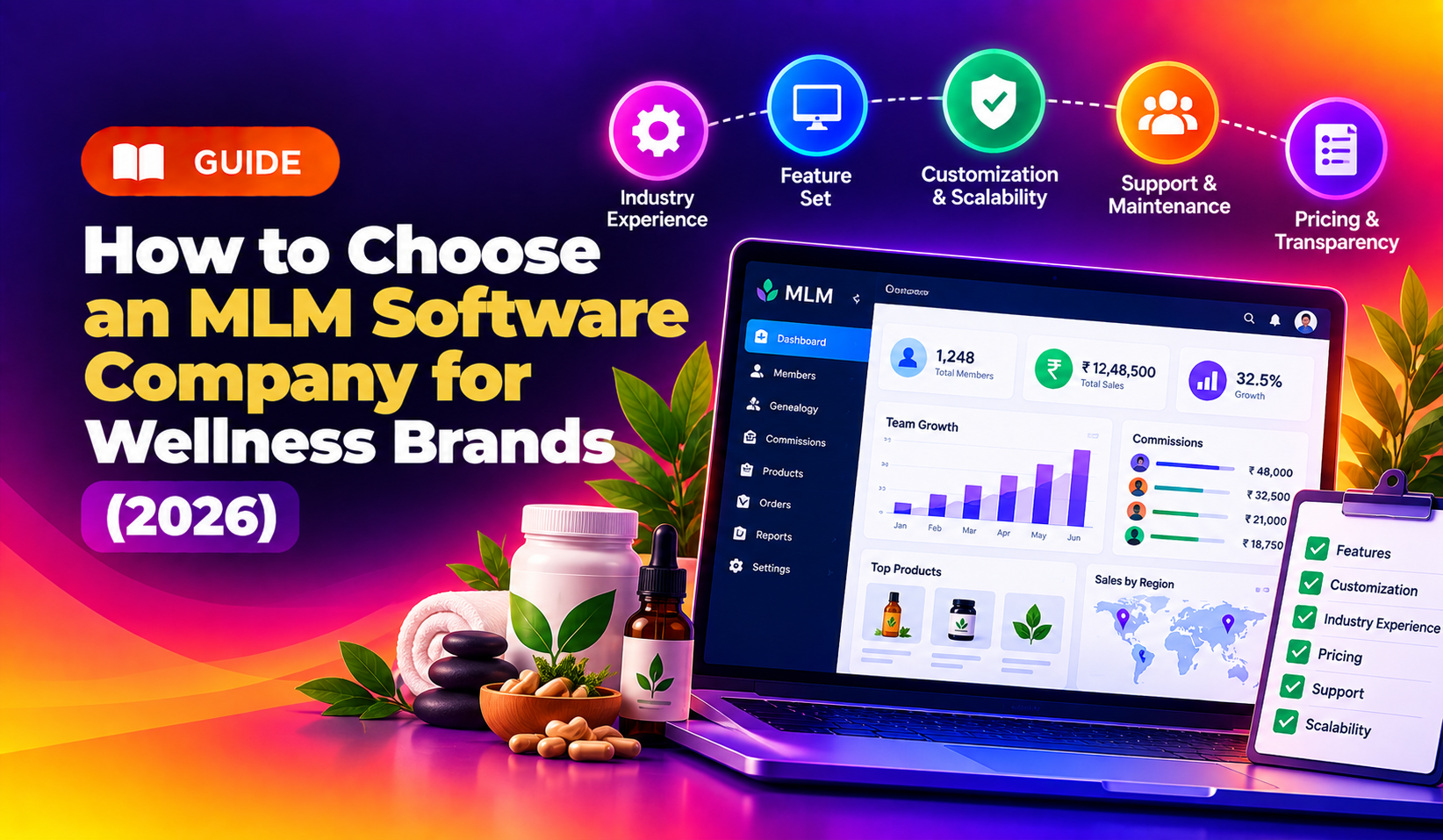
Independent buyer guides on MLM software repeat a few themes: the software must support your exact compensation plan, handle compliance natively, scale with growth and come with real support. Translated into specifics for a wellness brand, a capable vendor should be able to show you the following.
- Compensation plan engine. Binary, unilevel, matrix, hybrid, party plan or your own custom design, with rank rules, bonuses, caps and carry-forward handled correctly.
- Edge-case handling. Returns, cancelled orders, chargebacks and distributor position moves, and what each does to commissions already calculated.
- Admin and distributor panels. Distributor dashboard, genealogy view, wallet, e-pin or coupon options, reports and a back office your team can actually run.
- E-commerce and inventory. Product catalogue, orders, stock, batches, warehouses, shipping and payment gateways.
- Mobile experience. Distributors in direct selling work mainly from phones, so the mobile experience is not optional.
- Security and data protection. Role-based access, audit logs, backups and encrypted handling of personal and bank data. Ask for specifics rather than slogans.
- Integrations. Payment gateways, payout methods, SMS and email, KYC verification and accounting tools.
Ready-Made Script vs Custom Development
Public vendor pricing shows how wide the range is. Some providers list entry plans from a low monthly fee in rupees, others advertise one-time licences starting around a thousand US dollars, and fully custom builds are quoted individually. Those are vendor-published starting points, not guarantees of what your project will cost, and they usually exclude hosting, customisation and support.
| Option | Where it fits | Watch out for |
|---|---|---|
| Ready-made script | Standard plans, fast start, tight budget | Limited plan flexibility, shared code, paid change requests |
| Customised script | Standard base with wellness-specific changes such as batches and auto-ship | Upgrade conflicts, unclear ownership of custom code |
| Fully custom build | Unique plan, multi-country plans, complex inventory | Longer timeline, higher cost, needs a clear specification |
| Hosted SaaS platform | Teams who prefer a managed service | Ongoing fees, less control over code and data portability |
The Vendor Evaluation Checklist for Wellness Brands
Copy this list into a spreadsheet and score each vendor on it. Anything a vendor will not answer in writing deserves a lower score.
- Plan fit. Did the vendor run a live demo using your compensation plan rules, not a stock demo?
- Edge cases. Can they show what happens to commissions after a return, a cancellation or a distributor move?
- Wellness features. Batch and expiry tracking, auto-ship, product bundles, and approved-claims content control.
- KYC and payouts. PAN, bank and identity verification, TDS handling where relevant, and payout reports your accountant can reconcile.
- Source code and data ownership. Who owns the code, and can you export your distributor and order data in a standard format at any time?
- Written scope. Features, number of user roles, integrations, and what counts as a change request.
- Fixed timeline with milestones. Dates for plan sign-off, staging demo, user testing and go-live.
- Testing approach. Do they test commission calculations against a sample dataset you can verify by hand?
- Hosting and performance. Where it runs, how it handles peak days such as month-end payouts or launch events.
- Support and maintenance. Response times, who answers, what is included after launch and the cost of ongoing support.
- Security. Access control, backups, audit logs and named certifications only if they are genuinely held.
- Relevant experience. Real examples of MLM or similar transaction-heavy platforms, with references you can speak to.
- Migration plan. For existing brands, a written approach to data transfer, reconciliation and parallel running.
- Contract terms. Payment schedule tied to milestones, termination terms and handover obligations.
Red Flags When Comparing Providers
- Income promises. A vendor who tells you how much your distributors or your business will earn is selling hope. Software does not guarantee sales.
- Pyramid-style plan advice. Plans that reward recruitment over genuine product sales create legal and reputational risk. A responsible vendor should raise this, not ignore it.
- Vague pricing. A very low headline price with every feature listed as an add-on.
- No named team. You cannot find who will actually build and support the system.
- Demo only, no staging. Refusal to let you test a working build before final payment.
- Locked-in code. No access to source code or data export when you leave.
How Cost and Timeline Are Usually Set
Cost follows scope. The main drivers are the complexity of the compensation plan, number of user roles, inventory and batch features, integrations, mobile apps, multi-currency and multi-language needs, and the support level you choose after launch. Timelines follow the same logic: a configured ready-made system can be live much sooner than a custom platform, and a migration adds data cleaning and parallel-run time. Any vendor should give you a written estimate after reviewing your plan, not before. Be cautious of a fixed price and date quoted on the first call.
How to Run a Fair Vendor Comparison
Shortlist three vendors, not ten. Send each the same one-page brief that covers your compensation plan, expected number of distributors in year one, product types, target countries and any existing system you are leaving. Proposals built from the same brief are far easier to compare than proposals built from different assumptions.
Then ask every vendor to demonstrate the same three scenarios: a normal month-end commission run, a returned order after payout, and a distributor changing sponsor or rank. Watch how long each takes and whether the answer matches a calculation you have done by hand. Finally, speak to at least one reference client and ask what went wrong during their project and how it was handled. Every project has problems, so the way a vendor responds tells you more than a flawless sales story. Keep notes in one place and score each vendor against the checklist above before price enters the conversation.
Finally, plan your own side of the work. Delays on MLM projects often come from unfinished plan documents, late content or slow approvals rather than from development. Assign one decision-maker on your team who can sign off plan rules, product data and test results quickly. A vendor can only hold a timeline if you can hold your part of it.
Questions to Ask Before You Sign
- Can you run our actual compensation plan in a demo with sample data?
- What happens to commissions when an order is returned after payout?
- How do you handle batch, expiry and stock across warehouses?
- Who owns the source code, and what is delivered at handover?
- What is the cost of changing the plan after launch?
- What is included in post-launch support, and for how long?
- Can we speak to a client running a similar platform?
Why Wellness Brands Choose CloudHouse for MLM Software Development
Wellness and ayurveda brands tend to come to CloudHouse Technologies when they need a team that will build around their plan and their product catalogue rather than force them into a template. We are based in Kerala, work from a written scope, and can discuss batch tracking, auto-ship, KYC onboarding and migration from an existing system during the first call. We would rather agree the details and limits up front than overpromise, so you can compare us on the checklist above like any other vendor.
Conclusion
The right MLM software development company for a wellness brand is the one that can run your plan correctly, handle perishable inventory and compliance, give you ownership of your data and stay available after launch. Score every vendor on the same checklist, ask for a staging demo, and insist on a written scope. When you are ready to compare, you can get a free quote for your MLM software project and measure it against the other proposals on your list.