If you insert a memory card and your Windows 10 SD card reader is not detected in File Explorer or Device Manager, you're dealing with one of the most common — and most frustrating — hardware recognition issues on laptops and desktops. Whether you're a photographer trying to import photos, a small business owner backing up POS data, or an IT admin troubleshooting a client's laptop, a dead card reader can bring work to a halt. The good news is that this problem is almost always fixable without replacing hardware.
In this guide, we'll walk through exactly why Windows 10 stops recognizing SD card readers, the specific error codes you'll see in Device Manager, and five proven fix methods — from simple driver refreshes to registry-level repairs.
What Causes "SD Card Reader Not Detected" on Windows 10?
Before jumping into fixes, it helps to understand the root causes. In most cases, the issue falls into one of these categories:
- Outdated or corrupted card reader drivers — especially common with Realtek, O2Micro, and Genesys Logic card reader chipsets found in most laptops.
- Disabled device in Device Manager — sometimes triggered accidentally, or by a Windows Update that resets driver states.
- Corrupted UpperFilters/LowerFilters registry keys — leftover entries from uninstalled security or imaging software that break the driver stack.
- Windows Update conflicts — a recent cumulative update can silently roll back or break a previously working driver.
- Missing drive letter — the card reader is detected but doesn't get assigned a drive letter, so it never appears in "This PC."
- Physical issues — dust, bent pins, or a card that's locked (the small physical write-protection switch on SD cards).
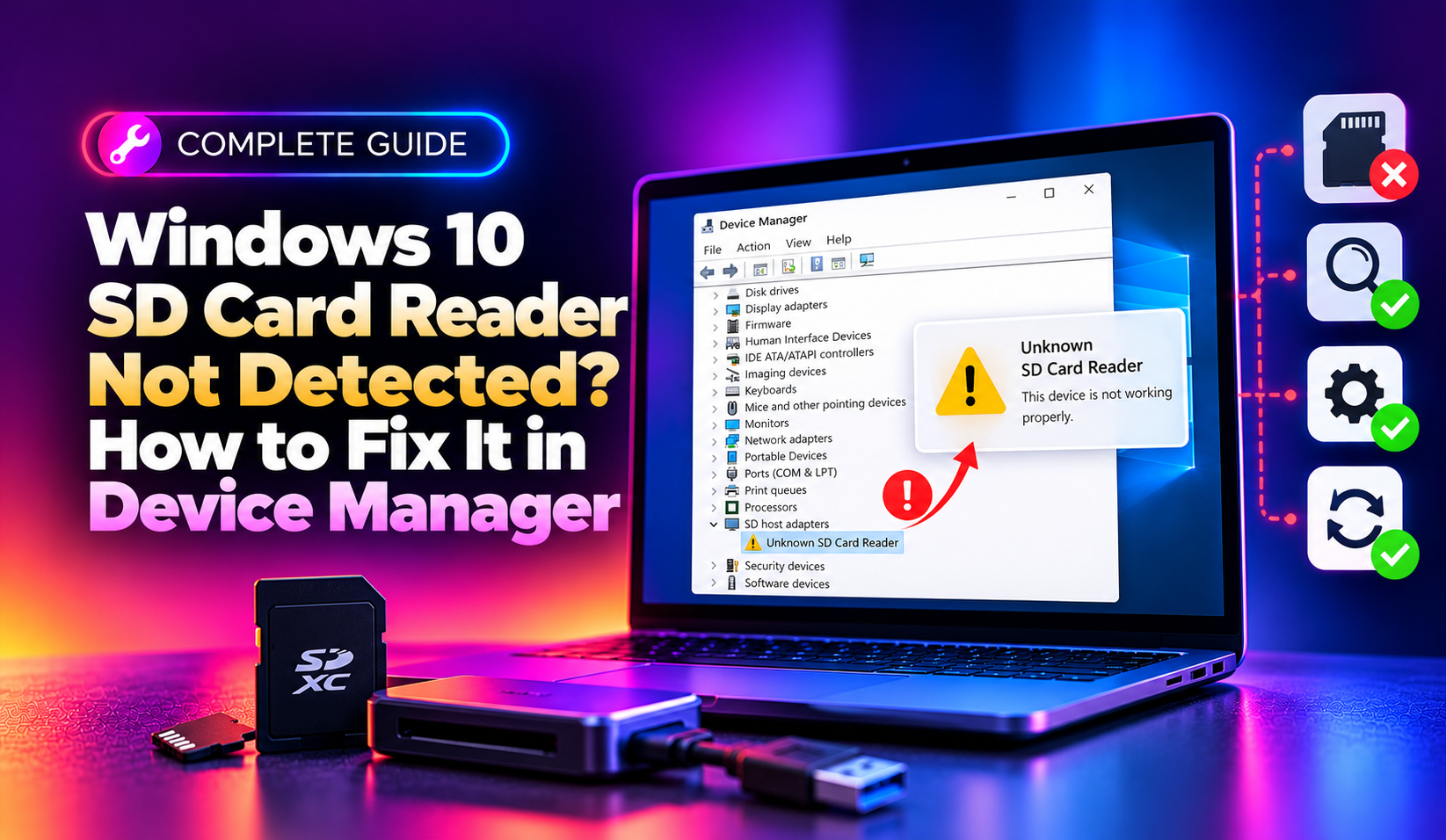
You'll typically see one of these signs in Device Manager: a yellow exclamation mark next to "SD Storage Device" or the card reader entry under Memory Technology Devices or Disk drives, along with an error message such as "This device cannot start (Code 10)", "Windows has stopped this device because it has reported problems (Code 43)", or the device may be missing from Device Manager entirely.
💡 None of these worked? Skip the guesswork.
Get Expert Help →Method 1: Update or Reinstall the Card Reader Driver
This resolves the majority of cases, especially after a Windows Update.
Right-click the Start button and select Device Manager. Expand Memory Technology Devices or Disk drives — your card reader may appear as "Realtek USB2.0 Card Reader," "SD Storage Device," or similar.
Right-click the device, choose Update driver, then select Search automatically for drivers. If Windows says the best driver is already installed, that driver may be the corrupted one — proceed to the manual reinstall below instead.
Right-click the device again and choose Uninstall device. Check the box for "Attempt to remove the driver for this device" if available. Restart your PC — Windows will automatically reinstall a fresh copy of the driver on boot.
If Windows Update doesn't have the right driver, download it directly from your laptop manufacturer's support page (Dell, HP, Lenovo, ASUS) by searching your exact model number plus "card reader driver," or from the chipset maker (Realtek's official site for Realtee card readers).
Press Win + R, type regedit, and hit Enter. In Registry Editor, go to File > Export and save a full backup before making any changes.
Go to:
HKEY_LOCAL_MACHINE\SYSTEM\CurrentControlSet\Control\ClassFind the GUID that matches your card reader's device class — for most SD readers this is {4D36E967-E325-11CE-BFC1-08002BE10318} (DiskDrive class) or {71A27CDD-812A-11D0-BEC7-08002BE2092F} (Memory Technology Driver class).
Inside that key, look in the right-hand pane for UpperFilters and LowerFilters. Right-click each and select Delete (only delete these two specific values, nothing else in the key).
Close Registry Editor and restart your computer. Reinsert your SD card and check Device Manager — the Code 10 error should be gone.
Right-click the Start button and choose Disk Management. Insert your SD card and look for a new "Removable" entry in the list.
Right-click the removable disk entry and select Change Drive Letter and Paths. Click Add, choose an unused letter, and click OK.
If the card shows as Unallocated or RAW instead of a healthy file system, the card itself may have data corruption. Back up any recoverable data before attempting to format it.
Method 4: Disable Fast Startup and Selective USB Suspend
Windows 10's power-saving features are a frequent, overlooked cause of intermittent card reader detection — especially on laptops.
- Go to Control Panel > Power Options > Choose what the power buttons do, click "Change settings that are currently unavailable," and uncheck Turn on fast startup.
- In Device Manager, expand Universal Serial Bus controllers, right-click each USB Root Hub, go to Properties > Power Management, and uncheck Allow the computer to turn off this device to save power.
Method 5: Rule Out Physical and Card-Level Problems
If none of the software fixes work, test with a different SD card and a different reader (or USB adapter) to isolate whether the problem is the laptop's built-in reader, the card itself, or a driver conflict unique to your system. Also check the physical lock switch on the side of the SD card — if it's slid to the "locked" position, Windows will refuse to mount it properly.
For businesses that rely on card readers for daily operations — point-of-sale backups, camera imports, or field data collection — recurring hardware detection issues are rarely worth troubleshooting solo every time they recur. CloudHouse Technologies' pay-per-ticket IT support lets you get a technician to remotely diagnose and fix driver and hardware issues like this on demand, without a monthly retainer.
How to Prevent SD Card Reader Detection Issues
- Avoid removing SD cards while data is being read or written — always use "Safely Remove Hardware" first.
- Keep drivers current, but pause automatic driver updates for a few days after a major Windows Update ships, since early driver packages are sometimes buggy.
- Periodically clean the card reader slot with a can of compressed air to prevent dust buildup, especially on laptops used in dusty environments.
- Avoid using low-quality or counterfeit SD cards, which are more prone to corruption and can also trigger reader-level errors.
- Create a System Restore point before installing third-party disk utilities or antivirus software that can leave behind problematic filter drivers.
Frequently Asked Questions
Why does my SD card reader work on one PC but not another?
This usually points to a driver or Windows configuration issue rather than a hardware fault on the card itself. Try the driver reinstall and UpperFilters/LowerFilters registry fix on the affected PC — if the same card and reader work fine elsewhere, the problem is isolated to that machine's driver stack.
How do I know if my SD card reader is disabled in Windows 10?
Open Device Manager, expand Memory Technology Devices or Disk drives, and look for a down-arrow icon or a device name followed by "(Disabled)." Right-click it and select Enable device to reactivate it.
Can a Windows Update break my SD card reader?
Yes. Cumulative updates occasionally replace a working manufacturer driver with a generic Microsoft driver, or reset device power settings. If your card reader stopped working right after an update, check Device Manager for driver rollback options under the Driver tab's "Roll Back Driver" button.
Why does Windows say "SD card is not formatted" when I know it has files on it?
This error typically means file system corruption, not that the card is truly blank. Do not format the card immediately — first try reading it in a different device or running chkdsk from an elevated Command Prompt to attempt a repair, since formatting will erase existing data.
Is it safe to delete UpperFilters and LowerFilters registry values?
Yes, as long as you only delete these two specific values from the device's Class key and not the entire key itself. Always export a registry backup first. Windows will regenerate default, clean filter values as needed after a restart.