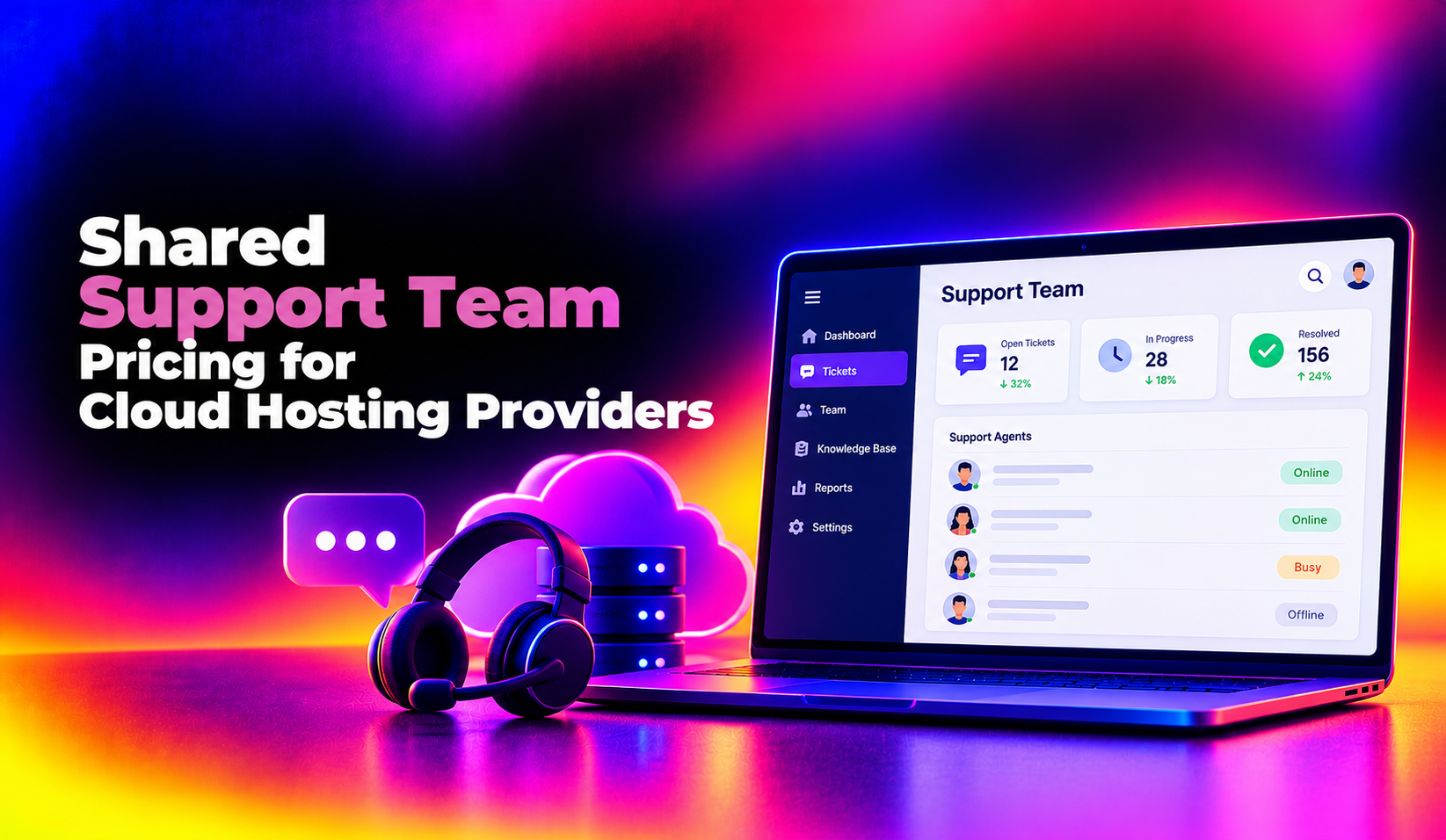
If you run a multi-tenant cloud hosting platform, you already know that customer expectations never sleep — but building an internal 24/7 team to meet them can quietly drain your margins. Shared support team pricing for cloud hosting providers typically ranges from $8–$45 per ticket or $1,500–$12,000+ per month depending on tier count, coverage window, and how deep your stack goes (Kubernetes, multi-cloud, container orchestration, and elastic auto-scaling all raise the skill bar above a typical shared-hosting help desk). This guide breaks down exactly what drives that price, what real 2026 pricing models look like, and how to pick a plan that doesn't bleed you dry during a traffic spike.
Why Cloud Hosting Support Pricing Is Different From Regular Hosting Support
A shared cPanel or WordPress hosting company mostly fields password resets, DNS tweaks, and "my site is down" tickets. A cloud hosting provider — running OpenStack, VMware, AWS-compatible APIs, or a custom IaaS/PaaS layer — deals with a fundamentally different ticket mix: autoscaling failures, Kubernetes pod crash loops, multi-tenant noisy-neighbor complaints, API rate-limit disputes, container registry issues, and compliance questions from enterprise tenants who expect SOC 2 or ISO answers, not a canned reply.
This is exactly why a generic "shared support team pricing" article aimed at traditional hosting companies undersells what cloud infrastructure support actually costs. Multi-tenant cloud environments need engineers who understand orchestration layers, not just control panels — and that expertise is priced differently.
What Drives Shared Support Team Pricing for Cloud Hosting Providers
- Ticket complexity tier — Tier 1 (account/billing/basic connectivity) is cheapest; Tier 3 (Kubernetes, orchestration, networking, security incidents) commands 3-5x the per-ticket rate.
- Coverage window — 24/7/365 coverage with guaranteed response SLAs costs meaningfully more than business-hours-only support.
- Volume and seasonality — Providers with unpredictable ticket spikes (Black Friday, product launches) need elastic capacity, not a fixed headcount, which changes the pricing model entirely.
- Stack depth — Multi-cloud (AWS + Azure + GCP), container platforms (Kubernetes, Docker Swarm), and custom cloud control panels all require specialized agents, which raises the blended hourly rate.
- Compliance requirements — Cloud tenants in fintech, healthcare, or enterprise SaaS often require support staff trained on specific compliance frameworks, adding a premium.
- Escalation and engineering backup — Whether the shared team can escalate directly to senior DevOps/SRE engineers when a ticket goes beyond scripted troubleshooting.
2026 Pricing Models Compared
Below is a realistic breakdown of the three pricing models most cloud hosting providers evaluate when shopping for a shared support team, along with typical 2026 market ranges.
| Pricing Model | Typical 2026 Range | Best For | Watch-Outs |
|---|---|---|---|
| Per-ticket / pay-per-resolution | $8–$45 per ticket (Tier 1–3 blended) | Providers with variable, spiky ticket volume | Complex Kubernetes/multi-cloud tickets can push per-ticket cost toward the top of the range |
| Flat monthly shared-team retainer | $1,500–$6,000/month (part-time shared coverage) up to $12,000+/month (dedicated pod, 24/7) | Providers wanting predictable budgeting and SLA guarantees | Confirm what ticket volume is actually included before overage fees kick in |
| Hourly / block-hours support | $25–$85/hour depending on tier and urgency | Providers needing overflow or after-hours-only coverage | Hourly models without a minimum can get expensive during incidents |
| Per-tenant / per-seat pricing | $3–$12 per managed tenant/month | Providers billing support cost back into tenant-level pricing | Requires clear definition of what "managed tenant" includes |
Most cloud hosting providers land on a hybrid: a flat monthly retainer covering baseline Tier 1-2 volume, with Tier 3 escalations billed hourly or per-incident. This keeps your fixed costs predictable while still giving you specialist coverage for orchestration-level emergencies.
Hidden Costs That Inflate Cloud Support Pricing (And How to Avoid Them)
Many cloud hosting providers get quoted an attractive base rate, then discover the real monthly bill is 30-50% higher once these factors kick in:
- Overage fees on "unlimited" plans — many "unlimited ticket" retainers actually cap Tier 1-2 volume and bill Tier 3 separately. Always ask for the exact ticket-tier breakdown in writing before signing.
- After-hours premiums — some shared support vendors quote a business-hours rate, then add a 1.5x-2x multiplier for nights, weekends, and holidays. If your tenants expect true 24/7 coverage, confirm the after-hours rate up front rather than discovering it on your first 2am invoice.
- Onboarding and knowledge-transfer fees — a one-time setup charge for building your runbooks, escalation matrix, and tenant documentation into the shared team's workflow. Reasonable providers fold this into the first month; less transparent ones bill it separately.
- Tooling and integration costs — if the shared team needs seats in your ticketing system, monitoring stack, or Kubernetes dashboards, confirm whether those license costs are included or passed through to you.
- Contract minimums — annual contracts sometimes lock in a ticket-volume floor that no longer matches your actual usage after a few months, especially if you've since automated away a chunk of Tier 1 volume.
Providers who publish a clear, itemized breakdown of what's included in the base retainer versus what's billed separately are almost always the safer long-term partner, even if their sticker price looks slightly higher than a vaguer competitor.
Support Tiers Explained: What You're Actually Paying For
Understanding the tiering system is the single biggest lever for controlling shared support team pricing, because misclassified tickets are the most common source of billing disputes.
Tier 1 — Account & Access. Password resets, billing questions, basic connectivity checks, control-panel navigation help. Usually the cheapest per-ticket rate ($8-$15) and the highest volume.
Tier 2 — Configuration & Diagnostics. DNS troubleshooting, SSL certificate issues, storage/bandwidth questions, basic performance complaints. Mid-range pricing ($15-$28 per ticket).
Tier 3 — Infrastructure & Orchestration. Kubernetes pod failures, autoscaling misconfiguration, multi-cloud networking, container registry problems, security incidents, and compliance-related tenant questions. This is where cloud hosting support diverges sharply from traditional shared hosting, and it commands the highest per-ticket or hourly rate ($30-$45+, sometimes billed purely hourly at $65-$85).
A well-structured shared support contract prices each tier separately rather than blending everything into one flat number — that transparency is what lets you forecast costs accurately as your tenant base and ticket mix evolve.
💡 None of these worked? Skip the guesswork.
Get Expert Help →Real-World Example: What a Mid-Size Cloud Host Pays
Consider a cloud hosting provider running roughly 4,000 tenant accounts across a Kubernetes-based multi-cloud platform. A typical 2026 shared support arrangement looks like this:
$3,200/month covers Tier 1-2 tickets (account access, billing, basic connectivity, control-panel questions) with a 15-minute first-response SLA, 24/7.
$45/ticket for orchestration-level issues — pod crash loops, autoscaling misconfigurations, networking/CNI faults — averaging 40-60 tickets/month, roughly $1,800–$2,700/month.
$65/hour for major outage bridge calls and root-cause write-ups, typically 5-10 hours/month.
Total monthly spend: roughly $5,300–$6,500 — far below the fully-loaded cost of hiring even two mid-level DevOps-capable support engineers in-house, once salary, benefits, tooling, and management overhead are factored in.
In-House Team vs. Shared Support Team: The Real Cost Comparison
| Cost Factor | In-House Team (3 engineers, 24/7 rotation) | Shared Support Team |
|---|---|---|
| Monthly cost | $18,000–$27,000+ (salary, benefits, tooling) | $1,500–$12,000 |
| Ramp-up time | 2-4 months to hire and train | Days to 2 weeks |
| Coverage gaps (leave, attrition) | High risk, needs backfill | Team-level redundancy built in |
| Kubernetes/multi-cloud expertise | Depends on hires | Pre-vetted, cross-trained specialists |
| Scalability during spikes | Fixed headcount | Elastic — add capacity on demand |
Why Hosting Companies Choose CloudHouse for Shared Support
CloudHouse Technologies runs shared support plans built specifically for hosting and cloud infrastructure providers, with engineers who are comfortable inside Kubernetes clusters, multi-cloud control panels, and container orchestration — not just cPanel tickets. Coverage is 24/7/365, billing is transparent with no long-term lock-in, and you can scale ticket volume up or down monthly as your tenant base grows. Because the team already supports multiple cloud hosting clients, you get orchestration-level expertise at a fraction of what it costs to recruit and retain that skill set in-house.
Questions to Ask Before Signing a Shared Support Contract
Before you sign anything, get written answers to these questions — vague answers here are the strongest early warning sign of hidden costs later:
- What exact ticket volume is included in the base retainer, and what happens the moment you exceed it?
- Is 24/7 coverage genuinely staffed around the clock, or does it route to an on-call engineer with a slower response SLA overnight?
- Can the team show you a redacted example of how they've handled a Kubernetes or multi-cloud incident for another client?
- What's the average agent tenure and turnover rate? High turnover means you're constantly re-training your support partner on your stack.
- How is escalation to senior engineering handled, and is there an additional fee each time it happens?
A shared support provider that answers all five clearly and specifically, without redirecting you to a generic sales deck, is far more likely to deliver on the pricing they quote.
How to Choose the Right Shared Support Pricing Model for Your Cloud Platform
- Audit your last 90 days of tickets — what percentage are Tier 1 vs. Tier 3 (orchestration/networking)? This tells you which pricing model fits.
- Confirm the provider's engineers have hands-on Kubernetes, Docker, and multi-cloud API experience — not just generic sysadmin skills.
- Ask for a sample SLA with response times broken out by tier, not a single blended number.
- Check whether the pricing includes incident/outage response, or whether that's a separate hourly add-on.
- Request month-to-month terms during your first 60-90 days so you can validate fit before committing annually.
If you're ready to see real numbers for your ticket volume and stack, CloudHouse's shared support plans for hosting companies team can build a custom quote in under 24 hours — no obligation, no generic per-seat guesswork.
Frequently Asked Questions
How much does shared support team pricing cost for a cloud hosting provider?
Most cloud hosting providers pay between $1,500 and $12,000 per month for shared support, depending on ticket volume, coverage hours, and how much Kubernetes/multi-cloud expertise is required. Per-ticket models typically range from $8-$45, with orchestration-level tickets at the higher end.
Is a shared support team cheaper than hiring in-house engineers?
Yes, in almost every case. A fully-loaded in-house team of three engineers with 24/7 rotation typically costs $18,000-$27,000+ per month once salary, benefits, and tooling are included, compared to $1,500-$12,000 for an equivalent shared support arrangement — with far less hiring risk.
Do shared support plans include Kubernetes and multi-cloud troubleshooting, or just basic tickets?
It depends entirely on the provider. Generic shared IT support pricing models are built around basic account and billing tickets. Cloud-specific providers like CloudHouse specifically staff engineers experienced in orchestration, container platforms, and multi-cloud environments as part of the standard tiered pricing.
How long does it take to onboard a shared support team for a cloud hosting platform?
Typical onboarding takes 1-2 weeks, covering access provisioning, knowledge-base transfer, escalation-path setup, and a shadow period where the shared team handles tickets alongside your existing staff before taking over fully.
Can I start with a month-to-month plan before committing long-term?
Yes — reputable outsourced support providers, including CloudHouse, offer month-to-month terms for the first 60-90 days specifically so you can validate response times, ticket quality, and cost-per-ticket before signing an annual agreement.
Shared support team pricing for cloud hosting providers isn't one-size-fits-all — it's shaped by ticket complexity, coverage window, and how deep your infrastructure stack runs. Get the model wrong and you either overpay for capacity you don't use, or underpay and end up with support that can't actually troubleshoot a crash-looping pod at 3am. Match the pricing model to your real ticket mix, and a shared team almost always beats the true cost of building this in-house.