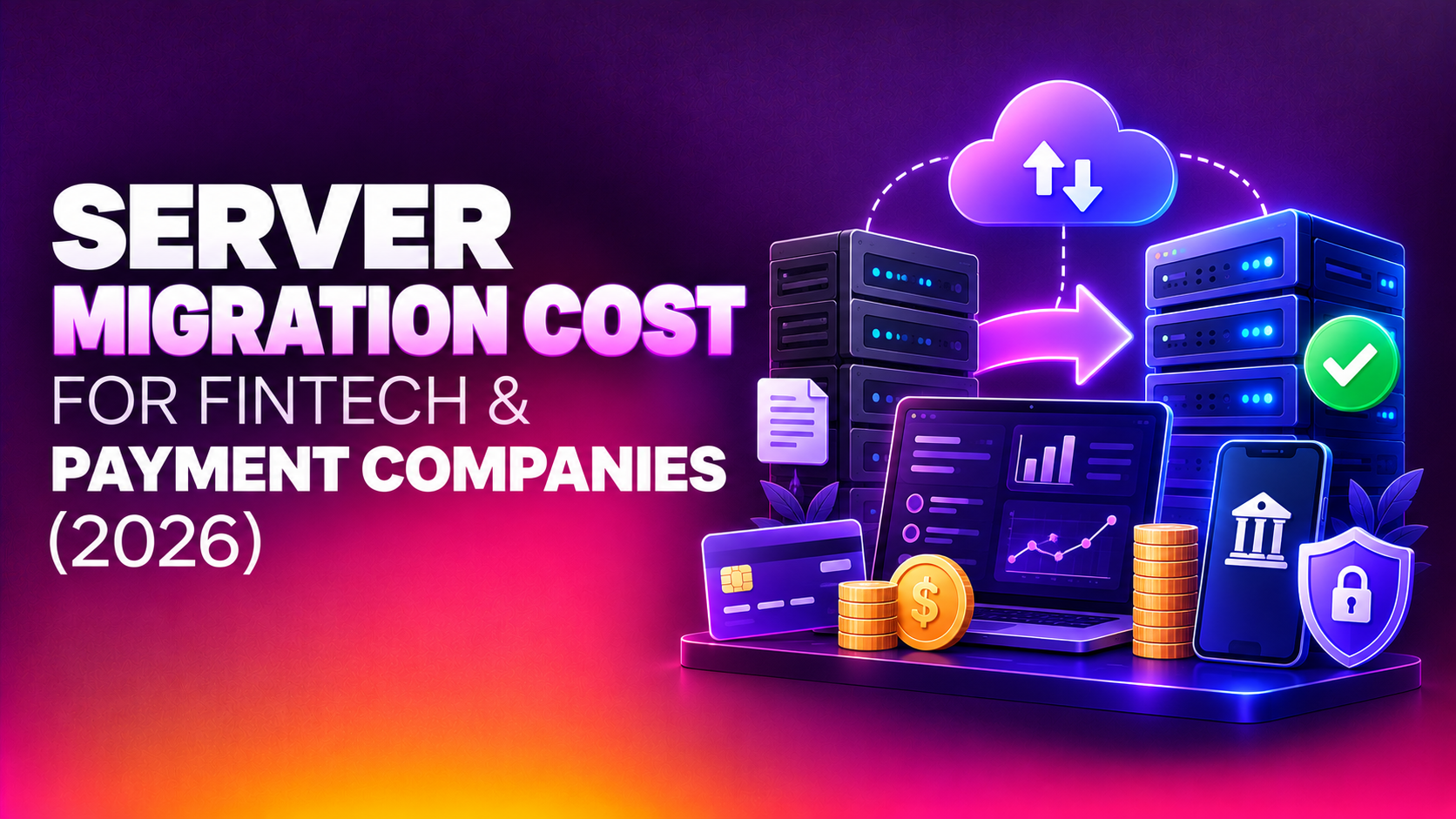
If you are budgeting a server migration for a fintech or payment company, the first thing to accept is that the price of the servers themselves is rarely the main number. The cost sits in the surrounding work: mapping where regulated data lives, rehearsing the move, protecting transaction continuity, producing evidence for auditors and keeping a safe way back if the cutover goes badly. This guide explains what actually drives server migration cost for fintech and payment companies, how scope changes the bill, and how to ask for a quote you can defend internally.
It is written for IT and operations leads who have been asked to put a figure next to a Linux or Windows migration and need to explain it to finance, security and compliance colleagues. We deliberately do not quote specific prices. Any honest number depends on your environment, and a figure copied from a blog post will not survive contact with your real systems. What you can take away is the structure of the cost, so you can compare proposals like for like. Nothing here is legal or compliance advice, so confirm your obligations with your own compliance team or assessor.
Why fintech migrations are priced differently
A migration for a brochure website and a migration for a payment platform may involve the same operating systems, but they are not the same project. Payment and financial workloads add constraints that each carry effort, and therefore cost.
- Compliance-sensitive data: cardholder data, bank account details, identity documents and transaction records may be subject to standards and regulator expectations. Moving them means controlling who can see them at every stage.
- Narrow cutover windows: payment flows, settlement runs and reconciliation jobs follow a calendar. The outage window is negotiated around them, not the other way round.
- Rollback as a requirement: you need a defined way to return to the old server if the new one misbehaves, which means keeping both environments alive and in sync for a period.
- Audit trail: you may need to show what moved, when, who approved it and how the result was verified.
- Third-party dependencies: banks, processors, gateways and partners often allow-list IP addresses or certificates, so a new server can mean external coordination.
The main cost drivers, explained
Discovery and data mapping
Before anyone moves a byte, someone has to find out what is on the servers, which services depend on which, and where regulated data sits. In older estates this is often the least predictable phase, because documentation is thin and some jobs only run at month end. Skimping here is the most common cause of later budget overruns, so a good proposal treats discovery as a defined, itemised step.
Number and type of servers
Count matters, but variety matters more. A set of similar web servers is cheaper to move than the same number of different machines, each with its own database, scheduled tasks and service accounts. Mixed Linux and Windows estates need people who are comfortable on both, and a provider who must bring in a second vendor for one side will usually price in coordination.
Data volume and condition
Larger datasets take longer to copy and verify, but condition is just as important. Years of unused files, inconsistent permissions and orphaned accounts add clean-up effort. Clean-up can feel like an extra cost, yet it often leaves you with a simpler and safer environment to run and audit.
Databases and transaction continuity
Databases behind payment applications are the highest-risk component. Options range from a planned short outage to replication-based approaches that keep two copies in step until the switch. The lower the downtime you demand, the more engineering, testing and temporary infrastructure you should expect to pay for.
Testing and rehearsal
A full rehearsal on a copy of production data, with application owners checking the result, is one of the best investments in the project. It also takes time and a staging environment, so it appears as a real line in the quote. Be cautious of any proposal that has none.
Parallel running and rollback
Keeping the old environment ready for a defined period, and the new one synchronised, costs infrastructure and attention. The longer the safety period, the higher the cost, but for payment systems a rollback you have never tested is not a rollback.
Security controls and evidence
Encrypted transfer, restricted and logged access, time-limited credentials, secure deletion of staging copies and a written verification report all take effort. If your assessor expects particular evidence, say so early, because it changes what the provider must produce.
Cost-driver table by migration scope
The table below describes how common scopes compare in relative terms. It is a planning aid, not a price list. Ask each provider to map their quote to the same scopes so the proposals can be compared fairly.
| Migration scope | Typical complexity | What pushes cost up | Relative effort |
|---|---|---|---|
| Non-regulated web or marketing servers | Low | Many sites, custom configuration, certificate changes | Lower |
| Internal file and application servers | Low to medium | Legacy permissions, old software, scheduled jobs | Lower to moderate |
| Servers holding customer identity or financial records | Medium | Access controls, encryption, evidence for compliance reviews | Moderate |
| Production databases behind payment applications | High | Replication, tight cutover windows, rollback testing | Higher |
| Payment gateway and API servers with partner allow-lists | High | External coordination, certificate and IP changes, strict continuity | Higher |
| Full multi-tier estate across Linux and Windows | Highest | Dependency mapping, phased waves, extended parallel running | Highest |
Most real projects combine several rows. A common and sensible approach is to migrate lower-risk systems first as a rehearsal of the process, then move the regulated and transaction-critical systems in a later wave with the lessons applied.
Planning the cutover window and rollback
For a payment company the cutover is a business event, not just a technical one. Agree the window with operations, finance and any partners who need notice. Avoid settlement runs, month end and promotional peaks, and build in time for verification before traffic is fully switched.
- Pre-seed the data: copy the bulk ahead of time so only recent changes move during the outage.
- Freeze changes: agree when deployments and configuration changes stop on the old system.
- Define go and no-go criteria: specific checks that must pass before the old system is retired from service.
- Set a rollback trigger: who decides, based on which evidence, and by what time.
- Keep the old environment intact: do not decommission it until the agreed safety period has ended.
Treat promises of zero downtime with caution. For some workloads it is achievable with extra engineering, and for others a short, well-planned outage is the lower-risk choice. The right answer is the one that matches your transaction tolerance and is honest about the trade-off in cost.
Audit trail and evidence your assessor may ask for
Compliance reviews tend to ask the same kinds of questions: what moved, where is it now, who had access, and how do you know nothing was lost or exposed. Build the answers into the project plan, and into the quote, rather than reconstructing them afterwards.
- An inventory of systems and data in scope, agreed before the migration starts.
- A change record covering approvals, the cutover plan and the rollback decision points.
- Access logs showing who worked on the systems and when credentials were revoked.
- A verification report with file counts, size comparisons and checksum or sample checks.
- Confirmation of how staging copies and the retired servers were securely wiped or retained.
Your own assessor decides what is sufficient for your environment. Ask them early what they expect, then ask your provider whether it is included in the price or charged separately.
How to get a quote you can compare
Quotes for migration often look wildly different because they assume different things. A short list of requests makes them comparable.
- Ask for an itemised proposal covering discovery, build, rehearsal, cutover, verification and post-migration support.
- Ask the provider to list their assumptions, such as server count, data volume and cutover windows, and what happens to the price if they turn out to be wrong.
- Ask what is excluded, for example third-party licences, partner coordination or extended parallel running.
- Ask how change requests are handled once work has started.
- Ask who will do the work and whether any part is subcontracted.
A single-line quote with no assumptions is a warning sign. So is a firm price offered before anyone has looked at your systems. A reasonable provider will want a short discovery step first, and will tell you plainly that the price depends on what it finds. You can read how we scope projects on our server migration service page.
Ways to keep the cost under control without adding risk
Some savings are real, and some simply move risk onto you. These tend to be the genuine ones.
- Decommission before you migrate: servers, accounts and datasets nobody needs are cheaper to retire than to move.
- Standardise where you can: consolidating similar machines reduces per-server effort.
- Phase the work: moving in waves spreads the effort and lets you apply lessons from the first wave.
- Document as you go: good handover notes lower your support costs after the project.
- Do not cut rehearsal or rollback: these are the cheapest insurance in the project, and removing them tends to cost more later.
Also keep the cost of delay in mind. Running ageing servers past their support period has its own price in security exposure and maintenance. When you present the budget, compare the migration cost with the cost of staying put, not with zero.
Why Companies Choose CloudHouse for Server Migration
CloudHouse Technologies handles both Linux and Windows servers, so a mixed fintech estate can be planned as one project rather than split between suppliers. Migrations are delivered to a plan with discovery, rehearsal, an agreed cutover window and a defined rollback point. Support continues after the move, and quotes are itemised so you can see what you are paying for and what is assumed. If you want to see how we approach it, visit our server migration page.
Conclusion
The cost of a fintech server migration is the sum of its risks: regulated data, narrow cutover windows, rollback and evidence. Understand which of those apply to your scope, insist on itemised quotes with clear assumptions, and protect the rehearsal and rollback steps when budgets get tight. To see what your own environment would involve, request an itemised server migration quote from CloudHouse and lock in a cutover window before your next peak period.