If you run IT or compliance for a healthcare company, you already know that "HIPAA compliant" is not a checkbox — it is a moving target that touches every server, workstation, and API in your stack. When leadership asks "what will it actually cost to harden our servers for HIPAA," most vendors respond with vague retainers instead of numbers. This guide breaks down the real server hardening cost for HIPAA-compliant healthcare companies in 2026, so you can budget accurately before you sign with a vendor.
We will walk through what server hardening actually includes under HIPAA, a full cost breakdown by practice size, the line items vendors often bury in "custom quotes," and how to evaluate a provider without getting locked into an enterprise contract you don't need. If your team is comparing quotes right now, CloudHouse's server hardening service is built specifically around this kind of transparent, HIPAA-aligned pricing model.
What "Server Hardening" Means Under HIPAA
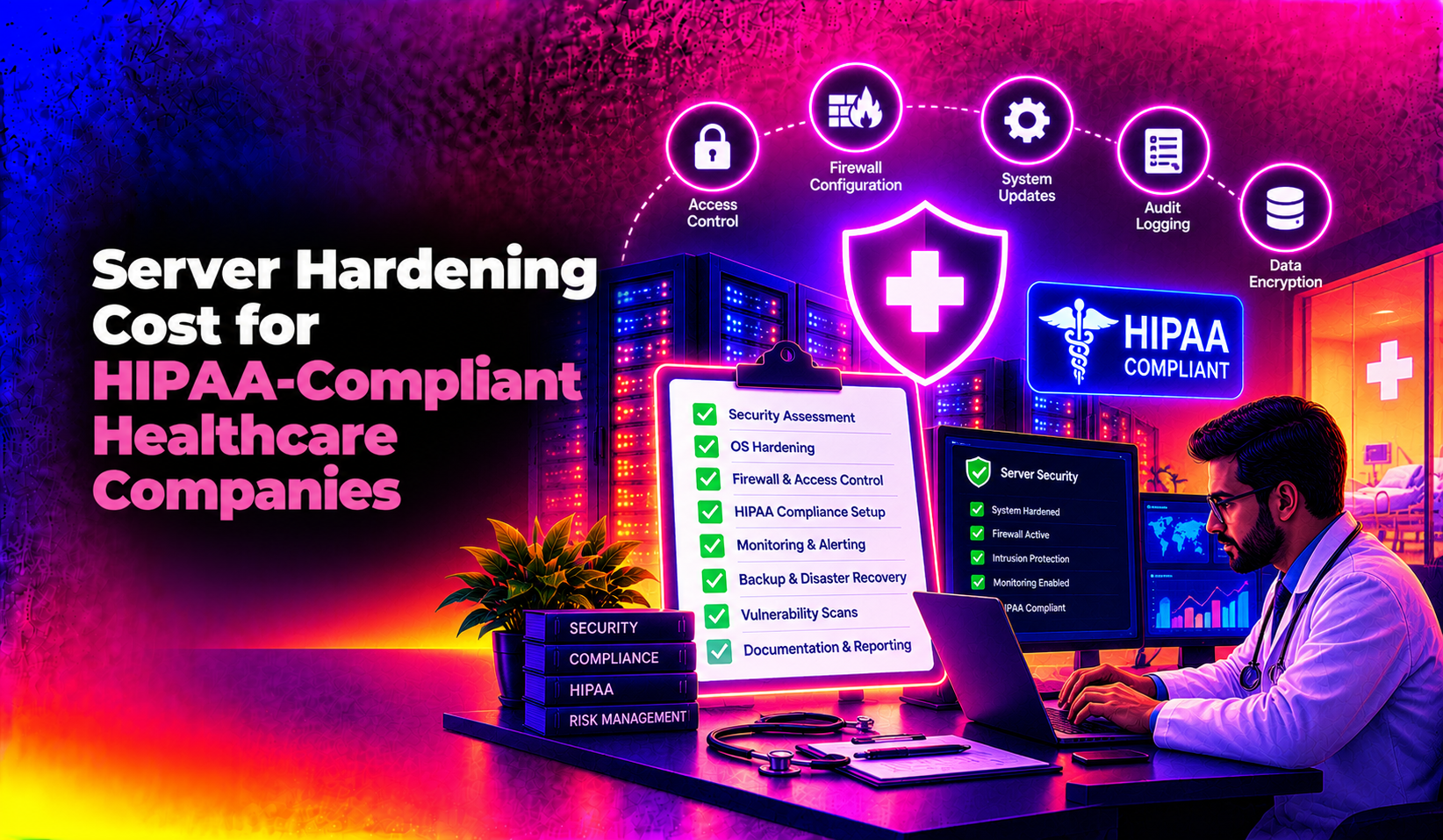
HIPAA's Security Rule does not hand you a hardening checklist — it requires "reasonable and appropriate" technical safeguards for any server that stores, processes, or transmits electronic protected health information (ePHI). In practice, auditors and cyber-insurance underwriters expect the following baseline controls on every HIPAA-adjacent server:
- OS-level hardening — disabling unused services, closing unnecessary ports, applying CIS Benchmarks for Linux/Windows Server
- Encryption at rest and in transit — full-disk encryption, TLS 1.2+ enforcement, encrypted database columns for ePHI fields
- Access controls — role-based access, unique user IDs, automatic session timeouts, MFA on all administrative accounts
- Audit logging — centralized, tamper-evident logs retained for a minimum of 6 years per HIPAA's documentation requirement
- Patch management — a documented, recurring patch cycle with emergency patching SLAs for critical CVEs
- Network segmentation — isolating ePHI systems from general office traffic and guest networks
- Backup and disaster recovery — encrypted, tested backups with a documented recovery time objective (RTO)
None of this is optional once a server touches ePHI — the question is never "do we need it," it's "what does doing it properly cost."
Server Hardening Cost for HIPAA-Compliant Healthcare Companies: The Real Numbers
Costs vary by organization size, number of servers, and whether you're hardening an existing environment or building one from scratch. Based on current market rates for HIPAA-focused hardening engagements, here is a realistic breakdown:
| Organization Size | One-Time Hardening & Setup | Ongoing Monthly (Patching, Monitoring, Compliance Docs) | Annual Pen Testing / Risk Assessment |
|---|---|---|---|
| Small practice (1-3 servers) | $1,500 – $4,000 | $400 – $900/month | $2,000 – $4,000/year |
| Multi-location clinic / growing SaaS (4-15 servers) | $4,000 – $12,000 | $1,200 – $3,500/month | $4,000 – $8,000/year |
| Mid-size healthcare platform (15-50 servers) | $10,000 – $25,000 | $3,000 – $8,000/month | $8,000 – $15,000/year |
| Enterprise / hospital network (50+ servers) | $25,000 – $60,000+ | $10,000 – $30,000+/month | $15,000 – $40,000+/year |
Notice the pattern: the one-time hardening cost is usually the smaller number. The ongoing monthly spend — patch management, log monitoring, MFA administration, and compliance documentation — is where budgets get blown, because many vendors quote the initial hardening project but leave the recurring maintenance vague until after the contract is signed.
What Drives the Price Up or Down
- Number and type of servers — bare-metal, VMs, and cloud instances (AWS/Azure/GCP) each have different hardening playbooks
- Legacy systems — hardening an old EHR server running an unsupported OS costs significantly more than hardening a fresh deployment
- Compliance documentation depth — insurers and auditors increasingly want evidence, not just controls, which adds documentation hours
- MFA and identity provider integration — SSO/MFA rollout across clinical staff logins adds setup time
- 24/7 monitoring requirement — round-the-clock log review and incident response costs more than business-hours-only monitoring
💡 None of these worked? Skip the guesswork.
Get Expert Help →What's Usually Hidden in "Custom Quote" Pricing
Healthcare IT leads frequently get burned by vendor quotes that look cheap on the surface. Watch for these commonly excluded line items:
Some hosting vendors charge extra to sign a BAA, or only offer it on their highest-tier plan. Confirm the BAA is included in the base hardening price, not an upsell.
Standard patch cycles (monthly) are usually included, but expedited patching for critical CVEs (e.g., a zero-day in your EHR's underlying framework) is often a separate, higher-tier service.
HIPAA effectively requires 6 years of documentation retention. Many hosting plans only include 30-90 days of active log storage by default — long-term retention is billed separately.
Hardening reduces risk but doesn't eliminate it. Ask whether a breach investigation and forensics retainer is bundled or billed hourly during an actual incident — this is a very expensive time to discover it's not included.
Recurring access recertification (required by most cyber-insurance policies) is labor-intensive and frequently omitted from initial quotes.
Cloud vs. Dedicated vs. On-Prem: How Hardening Costs Differ
The infrastructure model you choose changes both the hardening approach and the price tag. Here's how the three most common setups compare for a HIPAA-compliant healthcare workload:
- Public cloud (AWS/Azure/GCP) — hardening focuses on IAM policies, security groups, encrypted storage volumes, and CloudTrail-style audit logging. Setup is often faster and cheaper (toward the lower end of the ranges above) because the physical layer is already the cloud provider's responsibility under the shared responsibility model, but monthly costs can climb with WAF, GuardDuty-style threat detection, and cross-region backup replication.
- Dedicated/bare-metal servers — you own the full stack, so hardening includes BIOS/firmware settings, RAID and disk encryption, and physical access controls at the data center. Setup costs run mid-range, but you avoid the recurring per-service cloud security add-ons, which can make dedicated servers cheaper long-term for stable, predictable workloads.
- On-premises servers — typically the most expensive to harden properly, because you're also responsible for physical security, environmental controls, and often lack the automated patching tooling cloud and dedicated providers offer out of the box. On-prem environments also tend to carry more legacy OS versions, which drives up remediation hours.
Most healthcare companies migrating away from on-prem toward cloud or dedicated hosting see their ongoing hardening and monitoring costs drop by 20-35% within the first year, simply because fewer components need manual, human-hours-based maintenance.
A Vendor Evaluation Checklist Before You Sign
Before choosing a server hardening provider for your HIPAA environment, run their proposal through this checklist:
- Will they sign a BAA at no extra cost, in writing, before work begins?
- Does their quote separate one-time hardening from recurring monthly costs, or is it bundled into a single opaque number?
- Do they provide documented evidence (not just verbal assurance) of CIS Benchmark or NIST 800-66 alignment?
- Is audit log retention for 6+ years included, or billed as a separate storage add-on?
- Do they offer emergency/critical patching SLAs, and what is the guaranteed response time?
- Can they support hourly or month-to-month engagements, or do they require a multi-year contract?
- Do they have verifiable references from other healthcare or HIPAA-regulated clients?
- Is incident response support bundled, or an extra retainer billed only after a breach occurs?
A vendor that can answer all eight questions clearly and in writing is far less likely to surprise you with hidden fees six months into the engagement.
Why Hosting Companies Choose CloudHouse for Server Hardening
CloudHouse Technologies runs HIPAA-aligned server hardening engagements with transparent, itemized pricing instead of vague "compliance packages." Our team hardens the OS, configures encryption and MFA, sets up centralized audit logging with long-term retention, and documents every control in a format your auditor or cyber-insurance underwriter will actually accept — with hourly billing available so you're never paying for a retainer you don't use. Whether you're hardening three servers or fifty, our server hardening service scales with your organization instead of forcing you into an enterprise contract on day one.
A Practical Budgeting Approach
Rather than accepting a single lump-sum quote, ask any vendor to break their proposal into these four buckets so you can compare apples to apples:
- One-time hardening and configuration (OS, encryption, access controls, network segmentation)
- Recurring patch management and monitoring (monthly)
- Compliance documentation and audit-readiness (often billed as a project or included in monthly retainer)
- Incident response and annual penetration testing (separate line item, budgeted annually)
This structure exposes hidden costs before you sign, and it lets your finance team model the true annual cost rather than being surprised by add-ons in month three.
Get a Firm Quote for Your Environment
Every healthcare environment is different — the number of servers, whether you're on-prem or cloud, and how legacy your EHR stack is will all shift the numbers above. The fastest way to get an accurate server hardening cost for your HIPAA-compliant healthcare company is to get a scoped assessment rather than guess from industry averages.
Ready to see exactly what HIPAA server hardening will cost for your infrastructure? Request a free scoped quote from CloudHouse Technologies and get an itemized breakdown — no vague retainers, no surprise add-ons — before you commit to a vendor.
Frequently Asked Questions
How much does server hardening cost for a HIPAA-compliant healthcare company?
Most small practices spend $1,500-$4,000 on one-time hardening plus $400-$900/month for ongoing patching, monitoring, and compliance documentation. Mid-size and enterprise healthcare platforms with more servers and stricter uptime/audit requirements can spend $10,000-$60,000+ upfront and $3,000-$30,000+/month. Get a scoped quote based on your actual server count for an accurate number.
Is server hardening a one-time project or an ongoing service?
It's both. The initial hardening (OS configuration, encryption, access controls) is a one-time project, but HIPAA compliance requires continuous patch management, log monitoring, and periodic access reviews — so budget for an ongoing monthly cost alongside the initial setup, not just a single upfront payment.
Can we trust an outsourced vendor with HIPAA-regulated infrastructure?
Yes, provided the vendor signs a Business Associate Agreement (BAA) and can show you documented hardening procedures mapped to the HIPAA Security Rule's technical safeguards. Ask for references from other healthcare clients and confirm they support your specific audit or cyber-insurance documentation requirements before signing.
How long does HIPAA server hardening typically take?
A small environment (1-3 servers) can usually be fully hardened in 1-2 weeks. Multi-location or mid-size platforms with 15+ servers and legacy systems typically take 4-8 weeks to harden, document, and validate. Enterprise hospital networks with complex legacy infrastructure can take several months for a full rollout.
What happens if we skip server hardening and rely only on our EHR vendor's compliance claims?
Your EHR vendor's compliance covers their application layer — it does not automatically cover your underlying servers, network, workstations, or third-party integrations. HIPAA liability extends to your entire infrastructure, so skipping independent server hardening leaves gaps that both auditors and cyber-insurance underwriters will flag during a breach investigation or renewal review.
Do you offer hourly or month-to-month server hardening support instead of long-term contracts?
Yes. CloudHouse offers hourly and month-to-month engagement options for server hardening, so healthcare companies aren't forced into multi-year enterprise contracts to get HIPAA-aligned security. This lets smaller practices start with exactly the scope they need and scale up as their infrastructure grows.