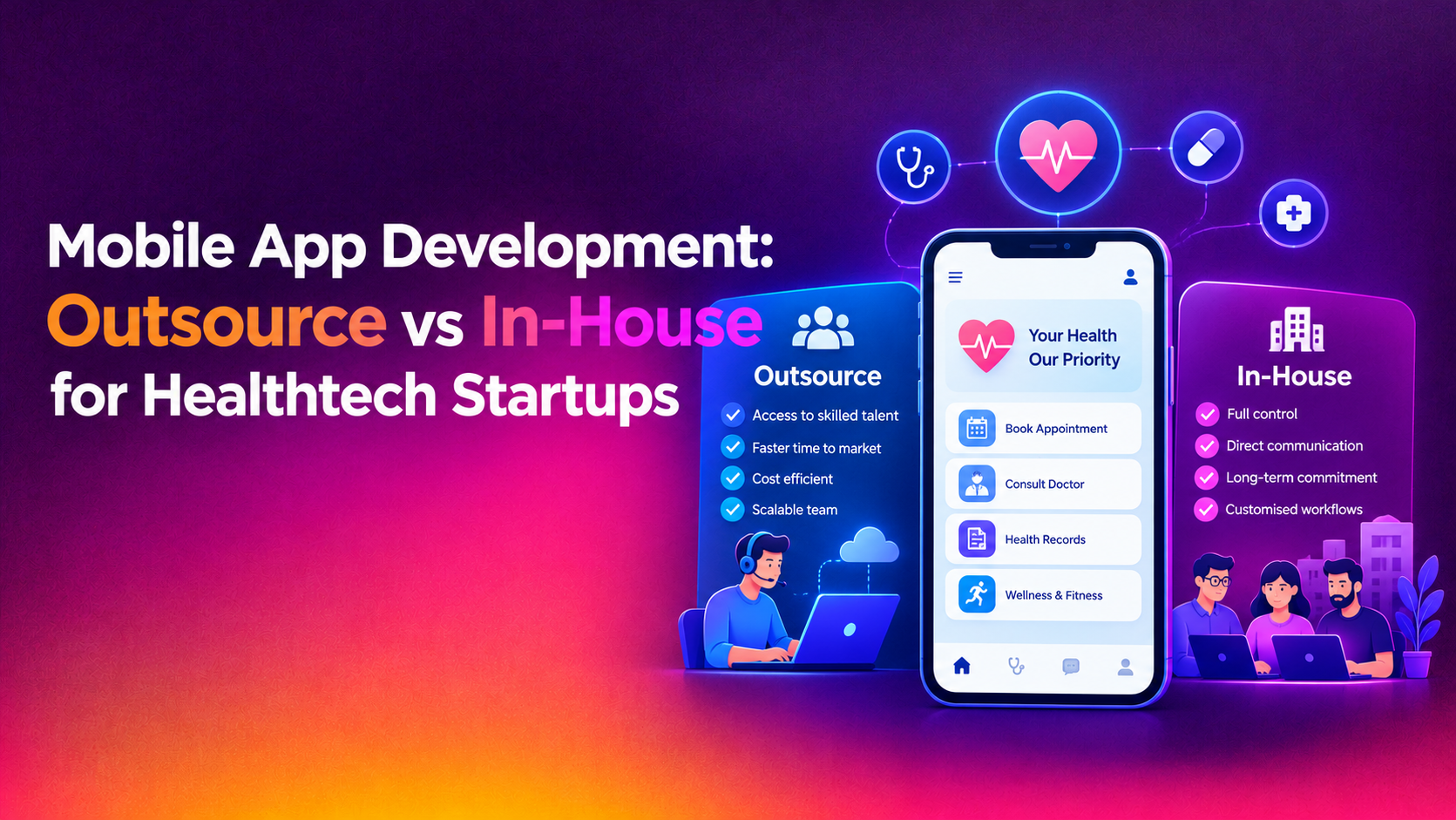
For a multi-outlet restaurant brand, the question of mobile app development vs in-house team for restaurant chains usually arrives right after the first customer complaint about slow online ordering or a loyalty scheme that lives on paper cards. Hiring your own developers sounds like control. Hiring an agency sounds like speed. Both have real merits, and both can fail if you pick them for the wrong reasons. This guide compares the two routes on the things a restaurant operator actually feels: hiring, delivery speed, integrations with the kitchen, upkeep and ownership.
It is written for founders, operations heads and marketing leads at chains with several outlets, who are deciding how to build or rebuild an ordering and loyalty app. Costs and timelines vary widely, so we describe drivers rather than quote figures. Always ask for an itemised proposal before you compare options.
What a restaurant chain app really has to do
A chain app is not a menu with a checkout button. It is a front end to several operational systems, and each one adds work.
- Ordering and menu management: outlet-specific menus, modifiers, availability that changes by the hour, and pickup, dine-in and delivery flows.
- Loyalty and wallet: points, tiers, stamps or credits that must stay consistent across every outlet and the app.
- Offers engine: coupons, time-limited deals, first-order incentives and outlet-level campaigns, with rules that stop abuse.
- POS integration: orders must land in the till system without staff retyping them, and item or price changes should flow back to the app.
- Kitchen display integration: tickets routed to the right station, with status updates the customer can see.
- Delivery tracking: rider assignment, live status and notifications, whether you use your own fleet or partners.
- App store upkeep: OS updates, store policy changes, crash fixes and payment-provider changes, indefinitely.
Notice that most of this list is integration and operations, not screen design. That is the lens to use when weighing the two models.
The in-house route: what you gain and what you take on
An in-house team gives you people who sit in your office, learn your business deeply and answer only to you. For a chain with a long product roadmap, that is attractive. It also means you become a software employer.
Hiring and retention
A credible app team needs more than one developer. You typically need mobile engineers for each platform or a cross-platform specialist, a backend developer, someone who understands testing and release, and design input. Hiring all of that takes time, and a single resignation can stall the project if knowledge sits in one head. Restaurant chains also compete for the same engineers as product companies, which affects both recruitment time and salary expectations.
Management overhead
Someone in your leadership has to run sprints, review code quality, handle security and decide priorities. If your operations director is also acting as product owner, the app competes with outlet openings for attention.
Where in-house shines
- Deep, continuous knowledge of your menu, promotions calendar and outlet quirks.
- Immediate availability for small changes and urgent fixes.
- Full internal ownership of the knowledge, not just the code.
The outsourced route: what you gain and what you must manage
An outsourced restaurant app development company brings a team that has already solved ordering flows, payment edge cases and store submissions. You are buying a ready-made capability rather than building one from scratch.
Speed to launch
A specialist team can usually start sooner than you can recruit, because the designers, engineers and testers already work together. That matters when a competitor has launched a loyalty app, or when you want the app live before a seasonal campaign.
Breadth of skills
Restaurant apps touch payments, maps, push notifications and third-party APIs. An agency spreads those skills across a team instead of asking two hires to cover everything.
What you must manage
- Clear requirements, because vague briefs produce vague quotes and change requests.
- Contract terms on source code, accounts and documentation, so that you are never locked in.
- A named contact who understands your outlets, not just a ticketing system.
If you want to see how a planned build is scoped, our custom mobile app development service page outlines the approach.
Mobile app development vs in-house: side-by-side comparison
The table below is a general comparison, not a verdict. Individual agencies and individual hiring plans vary a great deal.
| Factor | In-house team | Outsourced development partner |
|---|---|---|
| Time to start | Slower, because recruitment and onboarding come first | Faster, because a team is already assembled |
| Skill coverage | Limited to the people you hire | Broader mix of design, mobile, backend and testing |
| POS and kitchen display integration | Depends on whether your hires have done it before | Often repeatable if the partner has integrated similar systems |
| Knowledge of your business | Very high over time | Builds up through discovery and a good contact |
| Cost structure | Salaries, tools and management time, whether or not work is flowing | Project fee plus a support arrangement, tied to scope |
| Key-person risk | High if a lead developer leaves | Lower, since the knowledge sits across a team and documentation |
| Ownership and control | Naturally yours | Must be secured in the contract (code, accounts, documents) |
| App store upkeep | Your responsibility, all year | Covered by a support plan if you agree one |
| Flexibility to scale up or down | Hard; hiring and exits are slow | Easier to adjust scope between phases |
Integrations are where the decision is really made
Screens are the easy part. The harder work is making the app talk to the systems your outlets already run. Ask both an internal candidate and an agency the same questions.
- Which POS systems have you integrated with, and was it through an official API, a middleware layer or a custom connector?
- How do orders reach the kitchen display, and what happens if the connection drops during the lunch rush?
- How are menu, price and stock changes synchronised across outlets?
- Who owns the rider and delivery-tracking logic, and how are third-party delivery partners handled?
- How will the offers engine apply discounts consistently in the app and at the till?
Many POS vendors limit or charge for API access, so check this with your POS provider early. It can shape the timeline more than any design decision. If your in-house hires have never done a POS integration, that learning is paid for with your launch date.
Maintenance and app store upkeep
Launch is the beginning of the cost, not the end. Apple and Google update operating systems and policies regularly, payment providers change their requirements, and phone models multiply. A chain app that is not maintained will eventually crash on a new phone during a weekend rush.
With an in-house team, upkeep is part of everyone's job and competes with new features. With an outsourced team, it should be written into a support agreement that defines response times, what counts as a bug versus a new request, and who handles store submissions. Whichever route you choose, budget for it from day one and ask what happens when the original developer is no longer available.
Ownership, lock-in and who holds the keys
Ownership is the most common worry with outsourcing, and it is manageable if you handle it upfront. Insist on the following in writing.
- The app store developer accounts are registered in your company's name.
- Source code is delivered to a repository you control, with build instructions.
- Backend hosting, domains and third-party accounts are under your control.
- Documentation covers architecture, integrations and release steps, so another team could take over.
- Licensing of any third-party components is disclosed.
In-house ownership is not automatic either. If one engineer holds all the knowledge and leaves, you own code that nobody understands. Documentation matters in both models.
A hybrid approach many chains end up choosing
The choice is not always either-or. A common pattern is to have an agency build and launch the first version, then add one or two internal people, such as a product owner and a technical lead, to guide priorities and handle small changes while the partner continues to cover larger releases and store upkeep. This keeps business knowledge inside the company without carrying a full engineering department from day one. A good partner will support this structure by documenting the work and training your team.
Which route fits which chain
- Lean toward in-house when the app is central to your brand, you plan continuous heavy development, and you can attract and retain engineers in your location.
- Lean toward outsourcing when you need to launch soon, your integrations are standard, and you want predictable scope and support without building a department.
- Consider a hybrid when you want fast delivery now and more internal control later.
If you are still unsure, ask two or three agencies to propose and compare them with an honest estimate of your own hiring timeline. You can start by reading how our mobile app development company in Kerala scopes and delivers projects.
Red flags when choosing an outsourcing partner
- A fixed price quoted before anyone has asked about your POS, kitchen display or outlets.
- No clear answer on who owns the code and developer accounts.
- No plan for post-launch support or store updates.
- Case studies with impressive numbers but no reference you can call.
- A single-line quote with no assumptions or exclusions.
Why Companies Choose CloudHouse for Custom Mobile App Development
CloudHouse Technologies plans each build in phases, so your ordering, loyalty and integration work is scoped before development begins. Quotes are itemised, which lets you see what drives the cost and compare it fairly with an in-house hiring plan. Support continues after launch, including updates for new operating system versions and store requirements.
Conclusion
The right answer depends on how central the app is to your business, how fast you need it, and how much management capacity you have. In-house gives depth and control at the price of hiring and retention risk. Outsourcing gives speed and breadth if you secure ownership and support in the contract. Many chains do best with a hybrid. When you are ready to compare, request a custom mobile app development quote from CloudHouse and put real scope and timelines next to your hiring plan before your next menu launch or campaign season.