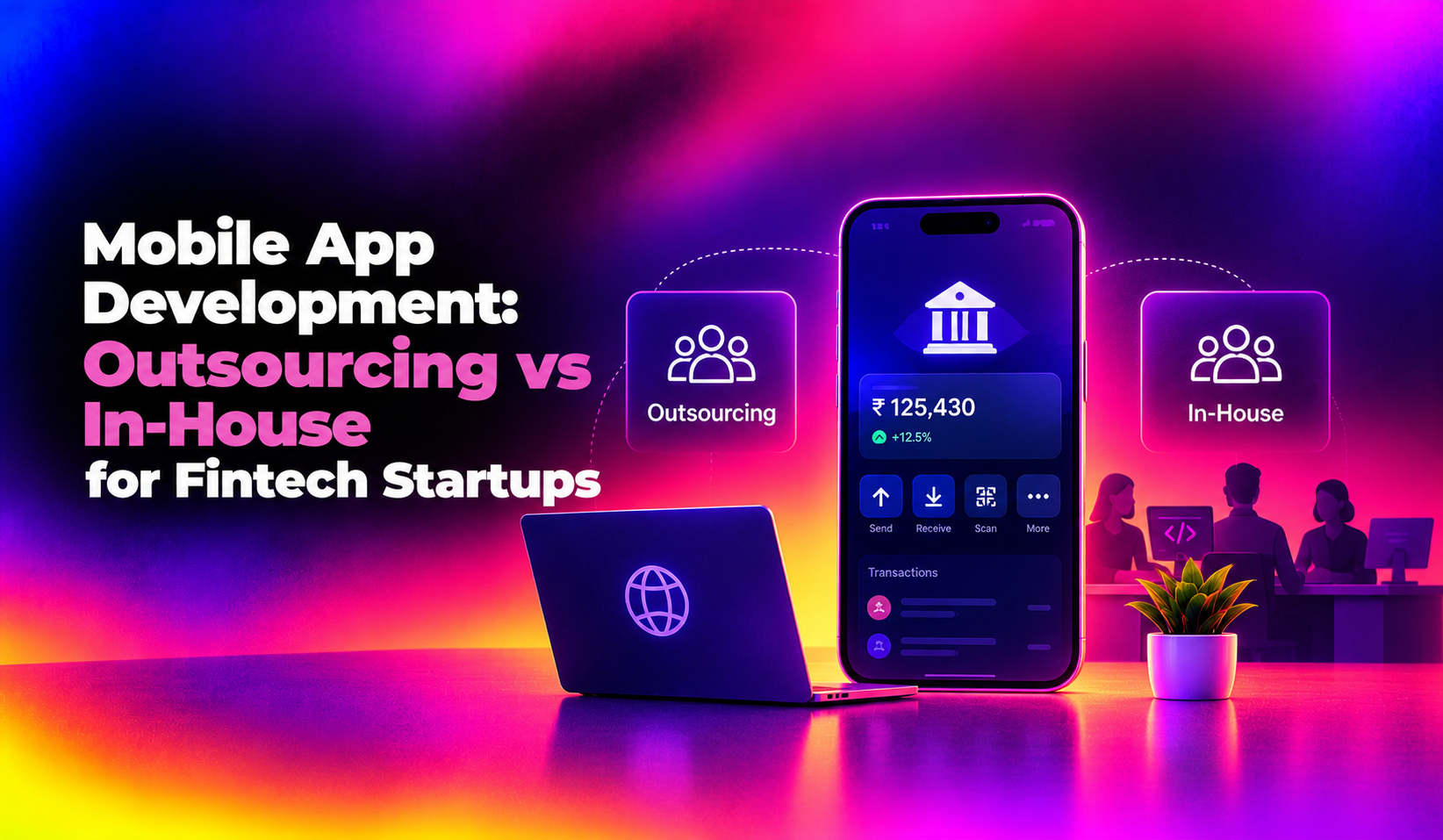
For a fintech startup, the decision between building an in-house mobile development team and outsourcing to a specialized partner is rarely made once — it resurfaces at every funding round, every new feature, and every compliance audit. Mobile app development outsourcing vs in-house fintech decisions are especially high-stakes because a fintech app touches money, personal data, and regulatory obligations from day one. Get the model wrong and you either burn 40% of your seed round on salaries before writing a line of production code, or you hand sensitive financial logic to a vendor you can't fully vet. This guide breaks down real costs, real timelines, and the fintech-specific risks that generic "in-house vs outsourcing" articles almost always skip.
Why Fintech Startups Face This Build Decision Early
Most SaaS startups can delay the build-vs-buy-vs-outsource conversation until after product-market fit. Fintech founders don't get that luxury. A lending, payments, or wallet app needs PCI DSS alignment, KYC/AML workflows, and often a banking-as-a-service integration before the first beta user ever opens the app. That means your mobile team — whoever they are — needs security and compliance literacy from sprint one, not "eventually."
This is exactly where the in-house vs outsourced calculus gets harder for fintech than for, say, a food-delivery app. You're not just asking "can this team ship features fast?" You're asking "can this team ship features fast without creating a compliance liability that blows up during your Series A due diligence?" That single constraint is why generic comparison articles fall short — they compare cost and speed but rarely address fintech mobile app security or regulatory exposure in any depth.
Founders and CTOs typically hit this decision point at one of three moments: pre-seed (deciding how to build the MVP at all), post-seed (scaling past a single founding engineer), or post-Series A (realizing the "quick and dirty" build needs a rebuild before a bank partner will touch it). Each stage changes the math, but the underlying trade-off — control and in-house cost vs speed and outsourced risk — stays the same.
There's also a talent-scarcity dimension unique to fintech. Mobile engineers who understand secure token storage, biometric authentication flows, and how to build against a core banking or payments API are a much smaller pool than general iOS/Android developers. A generic "in-house mobile dev team cost" estimate based on average developer salaries will understate what you actually need to pay to hire someone who won't need months of ramp-up time on compliance basics. That scarcity is exactly what pushes many founders toward outsourcing in the first place — not because they don't want control, but because the specialized talent they need is easier to access through an established partner's existing bench than through a from-scratch hiring pipeline.
In-House Mobile App Development: Pros, Cons, and Real Costs
Building in-house means hiring mobile engineers, a backend team, QA, and eventually a security/compliance specialist, all as direct employees or long-term contractors.
Pros
- Full control over architecture and roadmap — no vendor dependency for day-to-day decisions
- Institutional knowledge stays in-house — critical when your core product IS the mobile app
- Easier to iterate on sensitive logic (fraud rules, ledger reconciliation) without external sign-off cycles
- Culture and communication tend to be tighter when everyone reports to the same leadership
Cons
- Hiring timelines of 60-90 days for standard mobile roles, stretching to 4-6 months for developers with genuine fintech/payments experience
- Senior fintech mobile engineers in the US cost $150,000-$250,000 per year in salary alone, before equity, benefits, payroll tax, and equipment
- A functional mobile team needs 5-8 people (iOS, Android or cross-platform, backend, QA, DevOps) — meaning a fully loaded in-house team can run $800,000-$1.5M annually before you've shipped v1
- No guarantee of fit — a bad senior hire can cost 6+ months of lost runway to discover and replace
- Idle capacity between major releases, since fintech apps don't need constant full-team throughput year-round
For an early-stage fintech with 12-18 months of runway, committing $1M+ a year to salaries before validating the product is often the single biggest threat to survival — bigger than any security risk from outsourcing.
There's also an opportunity cost that rarely shows up in a spreadsheet: the months your founding team spends interviewing, negotiating offers, and onboarding new hires are months not spent talking to customers or banking partners. Fintech founders who go fully in-house from day one often report that their actual product timeline slips by a full quarter simply because engineering leadership got pulled into recruiting instead of building. That's a real cost, even if it never appears on a payroll line item.
None of this means in-house is the wrong choice — for a well-funded, post-Series A fintech that has already proven its core product and needs deep, long-term ownership of a complex ledger or fraud engine, the control and institutional memory an in-house team provides can be worth the premium. The mistake is defaulting to in-house purely out of instinct or a belief that outsourcing is inherently less trustworthy, without running the actual numbers for your stage.
Outsourced Mobile App Development: Pros, Cons, and Real Costs
Outsourcing means partnering with an external custom mobile app development company that provides a dedicated team, typically billed hourly, monthly retainer, or fixed-scope.
Pros
- 40-60% lower cost than equivalent US-based in-house hires, since experienced offshore/nearshore teams bill $50-$150/hour versus $150-$250/hour for US-based senior talent
- Faster start — a vetted outsourced team can typically begin sprint work in 1-3 weeks versus 2-6 months to hire in-house
- Access to teams who've already solved PCI DSS, KYC/AML, and banking API integration for other clients — you're buying pattern-matched experience, not starting from zero
- Elastic capacity — scale the team up for a major release, scale down after launch, without severance or idle payroll
Cons
- Trust and IP concerns — sensitive financial logic and user data pass through a third party, so vendor security posture matters enormously
- Communication overhead, especially across time zones, if not managed with clear async processes
- Variable quality across vendors — the outsourcing market includes both highly compliant, security-audited teams and low-cost shops with no fintech experience
- Requires clear contracts around IP ownership, data handling, and code escrow to avoid disputes later
The real differentiator for fintech isn't "outsourcing is risky" — it's "unvetted outsourcing is risky." A partner with documented experience in fintech mobile app security (encrypted local storage, certificate pinning, secure key management, SOC 2-aligned processes) closes most of the trust gap that founders worry about.
When you evaluate a potential outsourcing partner, ask direct questions: How do they handle access to production data during development and testing? Do they sign a data processing agreement and, where relevant, a BAA-equivalent for financial data? What's their process for code review and static security analysis before a release ships? A partner who can answer these clearly, with named processes and past fintech client examples, is a fundamentally different risk profile than a generalist agency that has never touched a payments API. This is also where the "outsource mobile app development" search intent often goes wrong — founders compare hourly rates without comparing security maturity, and end up choosing the cheapest option rather than the safest one for their specific risk profile.
Side-by-Side Comparison Table
| Factor | In-House Team | Outsourced Team |
|---|---|---|
| Typical annual cost | $800,000 - $1.5M+ (5-8 person team, US salaries) | $150,000 - $400,000 (equivalent dedicated team, offshore/nearshore rates) |
| Time to start building | 2-6 months (hiring + onboarding) | 1-3 weeks (vetted partner) |
| Hiring risk | High — bad hires cost months to detect and replace | Lower — swap individual roles within existing vendor bench |
| Security & compliance depth | Depends entirely on who you hire; built from scratch | Often pre-built if vendor has fintech track record; verify via audit/SOC 2 |
| Scalability | Slow to scale up or down; fixed payroll commitment | Elastic — scale team size to sprint needs |
| Best fit | Well-funded, post-PMF fintechs needing tight in-house IP control | Pre-seed to Series A fintechs needing speed and cost efficiency |
Why Fintech Startups Choose CloudHouse for Mobile App Development
CloudHouse Technologies works with early-stage fintech founders who need a dedicated, security-conscious mobile team without the 6-month hiring cycle or seven-figure annual burn of building in-house. Our teams bring hands-on experience with PCI DSS-aware architecture, secure authentication flows, and banking API integrations, so compliance isn't bolted on after launch — it's part of the sprint plan from day one. Clients get transparent hourly or retainer billing, direct access to the engineers writing their code, and the flexibility to scale the team as the product and funding stage evolve.
If you're weighing whether to hire an in-house mobile team or bring in a partner, our custom mobile app development team can scope your build, flag the compliance requirements specific to your product, and give you a realistic cost and timeline before you commit a single salary.
Frequently Asked Questions
How much does it cost to build a fintech mobile app?
A basic fintech MVP typically runs $50,000-$110,000, while a production-ready app with full PCI DSS and KYC/AML compliance runs $150,000-$300,000. Complex products with multi-currency support or advanced fraud detection can exceed $300,000-$500,000. Outsourced teams generally deliver these builds at 40-60% less than the fully loaded cost of an equivalent in-house team.
How long does it take to launch a fintech app with an outsourced team?
A vetted outsourced partner can typically start sprint work within 1-3 weeks of contract signing, versus 2-6 months to hire an equivalent in-house team. A fintech MVP with core compliance features usually takes 4-6 months to reach a launchable beta, depending on integration complexity with banking partners.
Is outsourcing mobile app development safe for a fintech product handling sensitive financial data?
It's safe when the vendor has documented fintech experience, clear data-handling contracts, and security practices like certificate pinning, encrypted storage, and SOC 2-aligned processes. Ask any potential partner for references from other fintech clients and a written breakdown of how they handle PCI DSS and KYC data before signing.
Do we need an in-house mobile team at all, or can we outsource permanently?
Many fintechs succeed with a hybrid model: keeping core ledger, compliance, and architecture decisions in-house while outsourcing front-end mobile development to a specialized partner. This preserves control over the most sensitive logic while still gaining outsourcing's speed and cost advantages for day-to-day feature work.
What happens if we outsource and later want to bring development in-house?
A well-structured outsourcing contract includes full IP ownership, clean code documentation, and knowledge transfer clauses, making a future transition to an in-house team straightforward. Ask prospective vendors about their code handover process and whether they offer month-to-month engagement so you're never locked into a long-term contract you've outgrown.
Whether your fintech startup builds in-house, outsources, or lands on a hybrid model, the decision should be driven by your runway, your compliance requirements, and how quickly you need to reach market — not by a generic rule of thumb. Talk to CloudHouse Technologies for a free scoping call and a realistic cost estimate for your specific fintech mobile app.