Deciding between mobile app development in-house vs outsourcing is one of the highest-stakes calls a startup founder or product manager will make before writing a single line of code. Get it wrong and you either burn six figures on a team you can't keep busy after launch, or you hand your product roadmap to a vendor who disappears after the first release. This guide breaks down real 2026 numbers for both paths so you can make the call with confidence.
If you've been quietly worried about the sunk cost of hiring an in-house mobile team only to have your roadmap slow down three months after launch, you're not alone — it's the single most common regret founders report when they choose the wrong staffing model too early.
In-House vs Outsourced Mobile App Development: The Real Difference
Search results for this topic typically compare native development against cross-platform frameworks like Flutter or React Native — a technical decision your development partner should be helping you make, not the strategic staffing question you're actually trying to answer. The framework choice affects your codebase; the in-house-vs-outsourced choice affects your runway, your hiring risk, and how fast you can adapt when user feedback changes the roadmap.
Most comparison articles online focus on native vs cross-platform frameworks. That's the wrong question at this stage. The decision that actually determines your burn rate, your time-to-launch, and your ability to pivot is whether you build a full-time internal team or outsource mobile app development to a specialist partner.
An in-house team means hiring salaried developers, designers, and a QA engineer who work exclusively on your product, all year round — whether there's a sprint's worth of work for them or not. Outsourcing means paying a dedicated external team only for the phases you actually need, with the ability to scale the engagement up during a big release and down during quieter maintenance months.
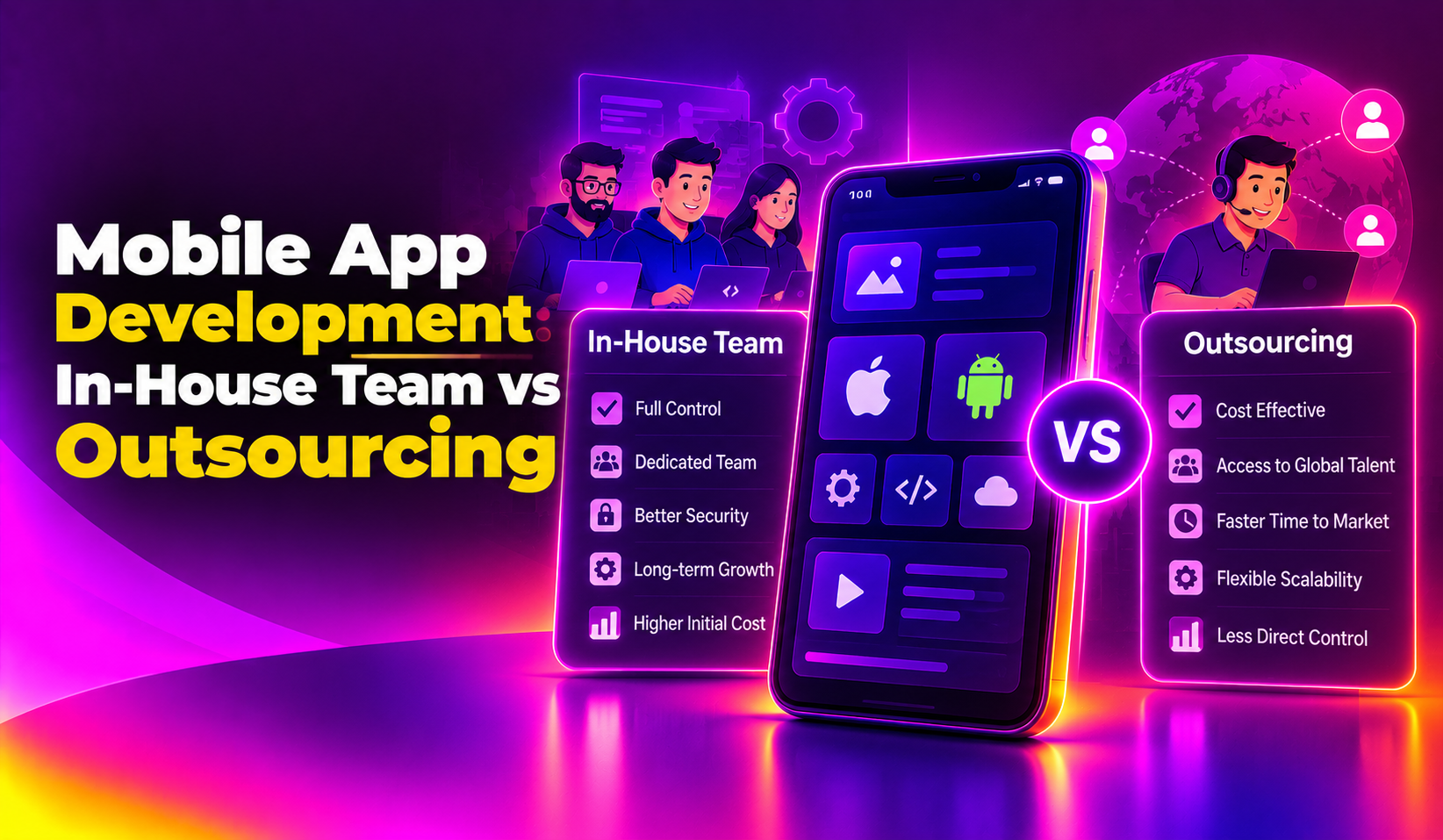
- In-house: full control, deep product knowledge, but fixed monthly cost regardless of workload
- Outsourced: variable cost tied to actual work, faster ramp-up, but requires a trustworthy partner with strong communication practices
In-House Mobile App Development Cost in 2026
Hiring an in-house mobile app development team in 2026 is expensive well beyond the base salary line. A single mid-level mobile developer in the US now costs $100,000–$180,000 in base salary, but the real number after benefits, payroll tax, and recruiting fees lands closer to 1.4–2.5x base salary — so a $140,000/year hire often costs $175,000–$210,000 fully loaded.
To build and ship a mid-complexity app you typically need at least an iOS developer, an Android (or cross-platform) developer, a backend engineer, and part-time QA and design support. For a full MVP-to-V1 build, that's 1,500–2,500 development hours, which at in-house rates translates to $150,000 to $300,000+ for engineering labor alone — before infrastructure, tooling, and ongoing support are even counted.
The hidden costs are what catch founders off guard:
- Recruiting fees of $5,000–$15,000 per hire
- Benefits adding 25–35% on top of salary
- 3–6 months of hiring and onboarding time before a single feature ships
- Idle payroll during slow post-launch maintenance months
There's also a retention risk that rarely makes it into cost calculators: senior mobile engineers are in high demand, and losing even one developer mid-build can add 6–10 weeks of delay while you recruit and onboard a replacement who has to get up to speed on your codebase. That risk compounds every year you keep the team on payroll, especially for a first-time founder without an in-house technical hiring manager to vet candidates properly.
Outsourced Mobile App Development Cost in 2026
When you outsource mobile app development, you pay for output, not headcount. A functional MVP built by an experienced offshore or nearshore team typically costs $30,000–$90,000, depending on complexity and platform coverage. Full product builds — with backend, admin dashboards, and analytics — run $100,000–$150,000, which is still commonly 50–70% cheaper than the equivalent in-house build.
Hourly rates vary significantly by region: developers in India run roughly $20–$40/hr, Eastern Europe $25–$55/hr, and North America $150–$250/hr. A well-run hybrid or nearshore engagement can save 35–42% over a fully onshore in-house build while still delivering senior-level code quality.
Outsourced pricing also scales cleanly with scope. A simple utility or content app with a handful of screens can launch for well under $30,000, while a marketplace or fintech app with real-time features, payment integration, and complex backend logic sits at the higher end of the range. The key advantage is that you're paying for a defined scope of work rather than committing to a fixed monthly headcount cost regardless of how much of the roadmap is actually in active development that month.
The table below compares the two models directly across the factors that matter most to a founder making this call.
| Factor | In-House Team | Outsourced Team |
|---|---|---|
| Typical cost (MVP to V1) | $150,000–$300,000+ | $30,000–$150,000 |
| Time to launch | 5–9 months (incl. hiring) | 3–5 months |
| Ongoing maintenance risk | Fixed payroll even during slow periods; talent attrition risk | Scales with actual workload; contract can flex or pause |
| Hiring lead time | 2–4 months to build the team | 1–2 weeks to start |
| Best fit | Long-term product with stable, large roadmap | MVP, seasonal features, or teams without in-house tech leadership |
💡 None of these worked? Skip the guesswork.
Get Expert Help →Which Model Fits Your Product Stage?
Early-stage startups validating a product idea rarely need a full in-house team on day one. If you're still testing product-market fit, outsourcing lets you launch an MVP in months rather than waiting out a hiring cycle, and you avoid carrying salaried developers through a pivot. Once your roadmap stabilizes and you have 12+ months of confirmed feature work, an in-house team (or a hybrid model with a core internal lead plus an outsourced build team) starts to make more financial sense.
A useful rule of thumb: if you can't commit to at least 18 months of continuous full-time work for every hire, outsourcing protects you from the exact sunk-cost scenario most founders fear — a fully staffed team with a thinning backlog three months after launch.
This is also where a build app in house vs agency decision often gets revisited mid-project. Many founders start in-house, hit a hiring wall or a budget crunch, and bring in an outsourced partner to keep momentum — which works, but costs time in the handover. Deciding the model upfront avoids that friction.
Consider mapping your decision against three questions before committing to either model:
If you have a validated backlog stretching 12+ months with confirmed budget, an in-house team starts paying off because you avoid ramp-up costs on every new feature. If your roadmap could pivot after user testing, outsourcing keeps you from carrying idle salaries through a strategy change.
Managing a mobile team well requires a CTO or senior engineering lead who can review architecture decisions and code quality. Without that, an outsourced partner with its own project management and QA process reduces the risk of shipping a poorly architected app.
Recruiting a full in-house team realistically takes 2–4 months before development even starts. An outsourced partner with developers already on staff can begin discovery and sprint planning within one to two weeks, which matters enormously if you're racing a competitor or a funding milestone.
Many growth-stage companies land on a hybrid model: a small in-house product owner or CTO paired with an outsourced development team that handles the bulk of the engineering. This combines the roadmap continuity of in-house ownership with the cost flexibility of outsourcing, and it's increasingly the default choice for startups scaling past their first release.
Why Startups Choose CloudHouse for Mobile App Development
CloudHouse Technologies works as an embedded outsourced team for startups that need senior mobile engineering without the fixed overhead of full-time hires — you get dedicated iOS, Android, and backend developers, transparent hourly billing, and no long-term lock-in contract. Our mobile app development company in Kerala team has shipped production apps for founders who needed to launch fast without gambling on a six-figure in-house hire.
Unlike a purely offshore staffing vendor, CloudHouse assigns a dedicated project lead who works in your timezone-overlap hours, runs weekly sprint demos, and hands over full source code ownership at every milestone — so there's no dependency lock-in if you later decide to bring development in-house. This is particularly valuable for the exact worry most founders raise: the fear of being stuck paying for a team that no longer matches the pace of the roadmap. With CloudHouse, you can scale the engagement down to a maintenance retainer the moment your feature velocity slows, instead of carrying full-time salaries through a quiet quarter.
Frequently Asked Questions
How much does mobile app development cost in 2026, in-house vs outsourced?
An in-house build typically costs $150,000–$300,000+ once salaries, benefits, and recruiting are included, while an outsourced MVP build ranges from $30,000–$150,000 depending on complexity. Outsourcing is usually 50–70% cheaper for a first release.
How long does it take to build and launch a mobile app?
An outsourced team can typically launch an MVP in 3–5 months since there's no hiring delay. Building in-house usually takes 5–9 months once you include the 2–4 months needed to recruit and onboard a full team.
Do you offer a trial or month-to-month engagement instead of a long-term contract?
Yes. CloudHouse works on flexible, hourly-billed engagements with no long-term lock-in, so you can start with a defined MVP scope and scale the team up or down as your roadmap changes.
What is the average cost to hire in-house app developers?
A single in-house mobile developer costs $100,000–$180,000 in base salary in the US, or $175,000–$210,000 fully loaded with benefits and overhead — and that's before you add a second platform developer, backend engineer, or QA support.
Is outsourcing mobile app development safe for a startup's core product?
Yes, when you choose a partner with a track record, clear communication cadence, and code ownership terms in the contract. Reputable outsourcing partners like CloudHouse hand over full source code and documentation, so there's no vendor lock-in risk to your core product.
Whether you choose an in-house team or an outsourced partner, the right decision comes down to your product stage, your roadmap certainty, and how much budget flexibility you need in the first year. For most startups moving from idea to MVP, outsourcing removes the hiring bottleneck and the sunk-cost risk — letting you validate the product before committing to permanent headcount.