Why Network Marketing Companies Need Custom MLM Software
Every network marketing company eventually hits the same wall: the spreadsheet-and-plugin combo that worked at 200 distributors starts breaking at 2,000. Commissions run late. Genealogy trees load slowly. Compliance officers start asking questions the back office can't answer. At that point, founders start Googling "mlm software development checklist for network marketing companies" — and most of what they find is a generic feature list written by a vendor trying to sell one specific product.
That's the problem with off-the-shelf MLM platforms: they're built for the average compensation plan, not yours. If your company runs a hybrid binary-unilevel structure, has multi-currency payouts across three countries, or needs FTC-compliant income disclosure statements baked into the dashboard, a generic SaaS tool will fight you every step of the way. Custom MLM software development exists precisely because compensation logic, compliance rules, and distributor experience are not one-size-fits-all.
The real risk isn't spending money on development — it's spending money on the wrong vendor. A broken commission engine doesn't just cost you rework fees; it costs you distributor trust, and in this industry, trust is the entire business model. This checklist is built for founders and ops leads who are about to sign a contract and want to know exactly what to demand before money changes hands. If you're ready to move forward, CloudHouse's MLM software development company in Kerala team can walk through this checklist with you on a scoping call.
The Complete MLM Software Development Checklist
Print this. Bring it to every vendor call. If a vendor can't answer these questions with specifics — not marketing language — that's a red flag.
- Compensation engine flexibility: Can it handle binary, unilevel, matrix, board, and hybrid plans without custom re-coding for each?
- Commission calculation transparency: Does the back office show distributors a line-by-line breakdown of how their commission was calculated?
- Genealogy tree performance: Does the tree render in under 2 seconds for organizations with 10,000+ downlines?
- Real-time volume tracking: Are personal volume (PV), group volume (GV), and business volume (BV) updated instantly, not overnight batch jobs?
- Multi-currency and multi-country payout support: Can it settle commissions in local currency with correct tax withholding per jurisdiction?
- Payment gateway and e-wallet integrations: Stripe, Razorpay, PayPal, and regional payout rails (bank transfer, mobile money)?
- KYC and distributor verification: Built-in identity verification before first payout, required in most regulated markets.
- Compliance and income disclosure tools: Automated FTC-style income disclosure statements and anti-pyramid-scheme safeguards (revenue must trace to product sales, not just recruitment).
- E-commerce and inventory integration: Native shopping cart, autoship/subscription orders, and stock sync with your warehouse or 3PL.
- Mobile app for distributors: A dedicated app (not just mobile web) for tree viewing, order placement, and commission tracking — companies with dedicated apps see meaningfully higher daily engagement.
- Rank advancement automation: Automatic rank calculation and qualification tracking, with alerts before a distributor loses rank.
- Replicated distributor websites: Auto-generated personal websites/landing pages for each distributor with their referral link baked in.
- Reporting and analytics dashboard: Admin-side visibility into churn risk, top performers, and volume trends without exporting to Excel.
- Data security and hosting: Where is data hosted, is it encrypted at rest, and who owns the database if you switch vendors later?
- Scalability under load: Load-tested for concurrent logins during payout days (traditionally the highest-traffic moment for any MLM platform).
- Source code ownership: Do you own the code outright, or are you licensing a white-label product you can never fully leave?
If even three or four of these are missing from a vendor's proposal, expect commission disputes, compliance exposure, or a costly re-platforming project within 18 months.
Compensation Plan Types: Binary, Unilevel, Matrix, and More
Choosing the right mlm compensation plan software starts with understanding what your compensation structure actually needs to compute — because the plan type dictates a huge portion of your development cost and complexity.
Binary plans restrict each distributor to exactly two frontline positions (a left leg and a right leg), with commission typically calculated as a percentage of the weaker leg's volume. Binary structures grow fast due to spillover, and reward teamwork — but the software has to handle constant leg-balancing logic, which is computationally heavier than it looks.
Unilevel plans allow unlimited direct recruits, with commissions paid across a set number of levels (usually 5–8), each level earning a smaller percentage. Unilevel software is simpler to build and audit, which is why many startups choose it first — the tradeoff is it rewards direct recruitment more than deep team-building.
Matrix plans cap both width and depth (e.g., a 3x9 or 5x7 matrix), forcing structured, controlled growth and simpler forecasting — good for companies that want predictable payout ceilings.
Hybrid and board plans combine elements of the above, or use a "board" model where distributors advance by filling out a board of positions before cycling into a new one. These require the most custom engineering, since off-the-shelf platforms rarely support true hybrid logic without heavy customization.
The takeaway for network marketing software requirements: don't pick a compensation plan because a vendor's template makes it easy to build. Pick the plan that fits your product margins and recruitment strategy, then find a development partner who can build the engine around it — not the other way around.
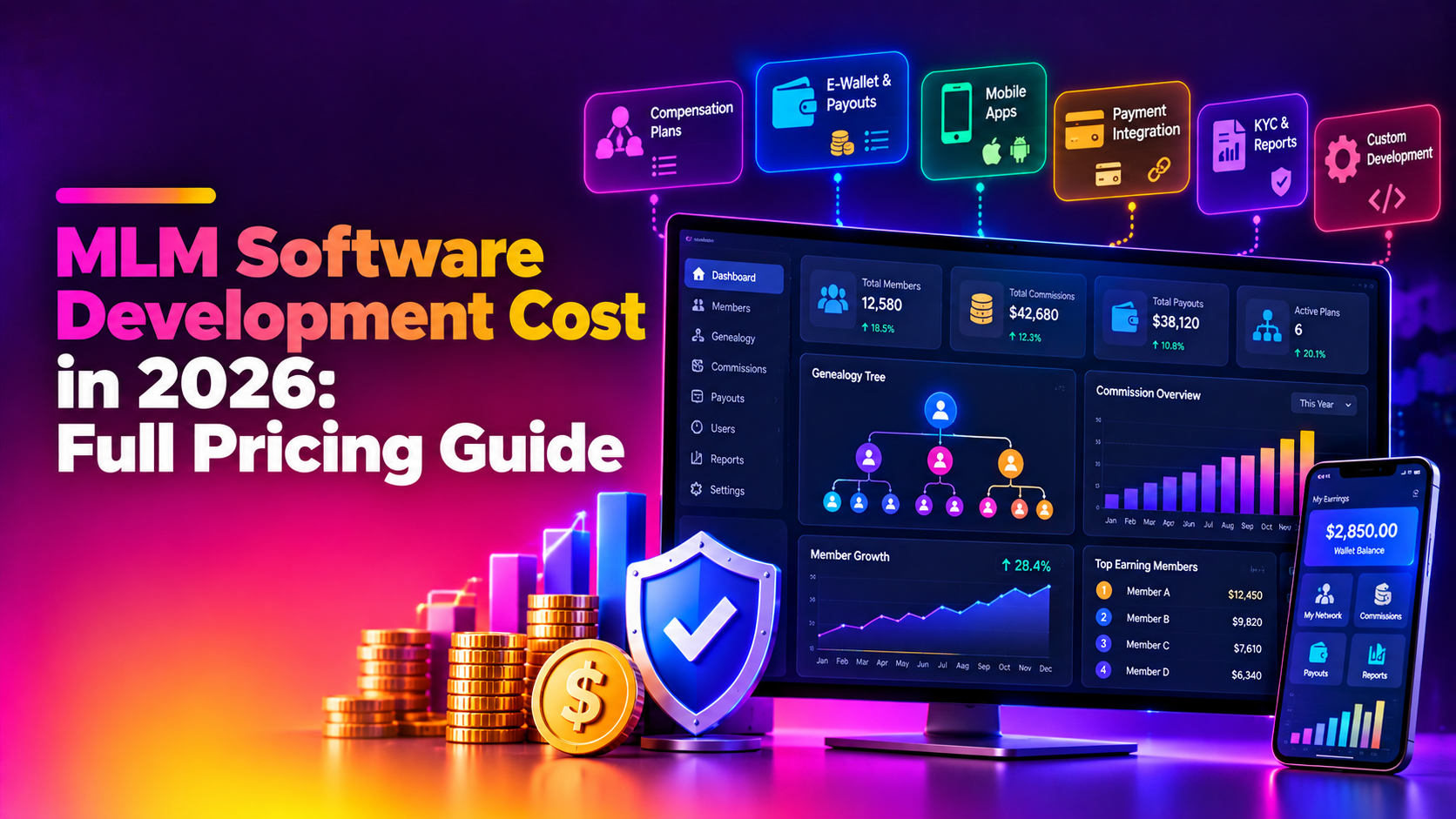
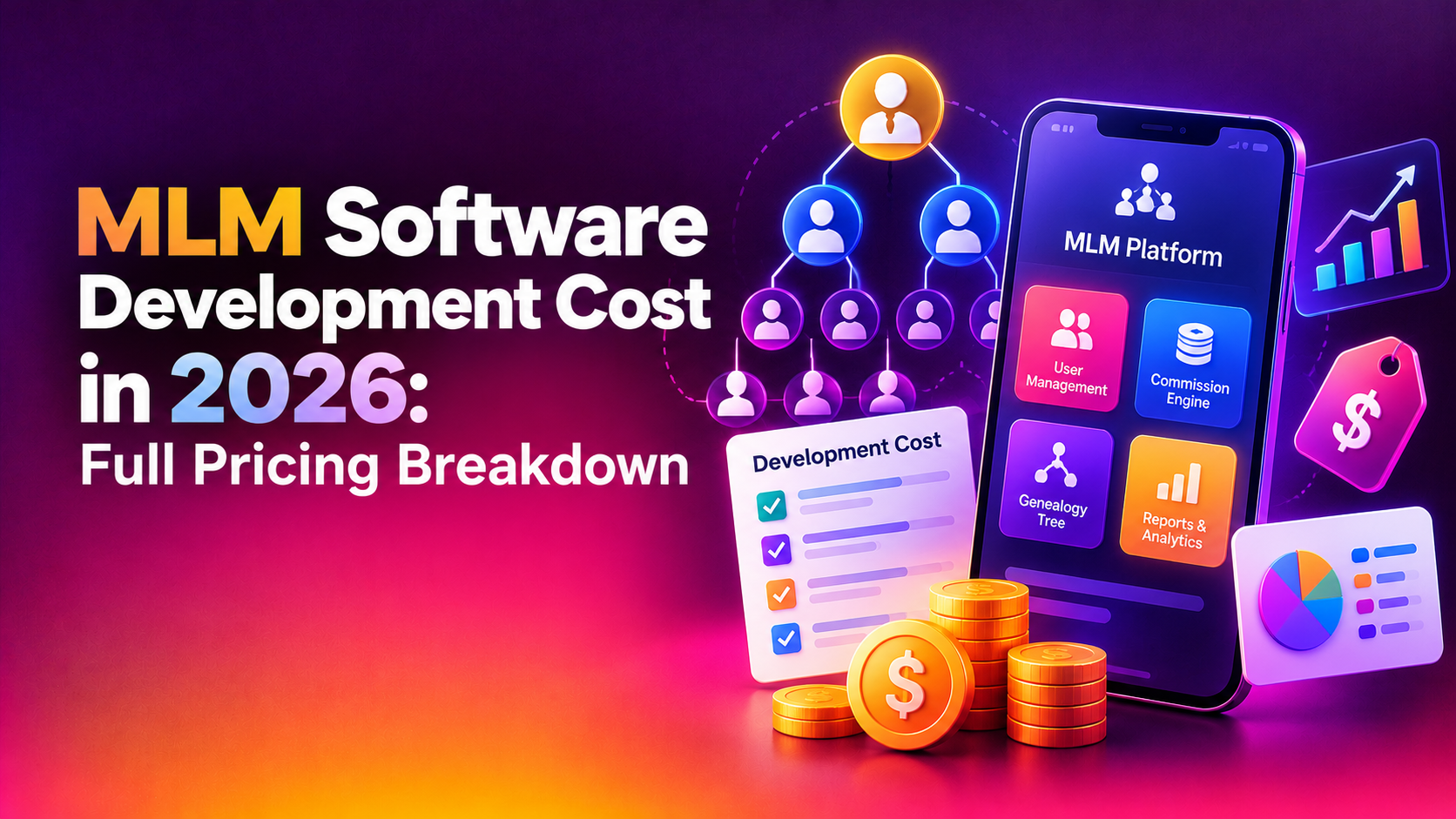
How Much Does MLM Software Development Cost in 2026?
MLM software development cost varies widely because the compensation engine complexity, integrations, and mobile app scope all move the number. As a working range for 2026:
- Basic unilevel or binary platform (web back office + core comp engine, no mobile app): roughly $8,000–$18,000.
- Mid-tier platform with e-commerce integration, replicated websites, and a single mobile app (iOS or Android): roughly $18,000–$40,000.
- Enterprise-grade platform with hybrid compensation plans, multi-currency payouts, KYC/compliance automation, native iOS + Android apps, and dedicated infrastructure: $40,000–$90,000+.
Ongoing costs matter as much as the build price: budget for hosting, security patching, compensation plan rule changes (these happen more often than founders expect), and support. A vendor quoting a suspiciously low flat fee with no mention of post-launch maintenance is often the one that disappears after go-live — leaving you to find a new team when the commission engine breaks during a payout cycle.
Ready to get an accurate quote based on your actual compensation plan, not a generic package? Talk to CloudHouse's MLM development team for a scoped estimate.
Why Network Marketing Companies Choose CloudHouse for MLM Development
CloudHouse Technologies builds MLM software as custom engineering, not template configuration. That distinction matters because it's exactly where most MLM software projects go wrong — a templated back office can't flex when your compensation plan needs a rule that the template didn't anticipate.
Here's what network marketing companies get working with CloudHouse:
- Compensation-plan-first architecture: the comp engine is built around your exact plan (binary, unilevel, matrix, or hybrid), not retrofitted from a generic template.
- Full source code ownership: no white-label lock-in — you own the codebase and can switch hosting or maintenance providers anytime.
- Compliance-aware development: income disclosure tooling and anti-pyramid safeguards built in from day one, reducing regulatory exposure.
- Load-tested for payout days: architecture designed to handle the traffic spike every MLM platform sees when commissions post.
- Transparent, milestone-based pricing: no flat-fee surprises — you see exactly what you're paying for at each build phase.
See the full scope of services at cloudhousetechnologies.com/services/mlm-software-development-company-kerala.
Vendor Red Flags: What Goes Wrong When Founders Choose the Wrong MLM Software Partner
Most horror stories in this industry trace back to the same handful of vendor mistakes, and they're worth naming directly because founders rarely spot them during the sales process.
The demo looks great, but the comp engine is hardcoded. A polished demo with sample data tells you nothing about whether the underlying compensation engine can actually be reconfigured. Ask the vendor to walk through changing a single commission percentage live, in front of you, without a developer touching code. If they can't, your "customization" was cosmetic.
No load testing before payout day. MLM platforms see their heaviest traffic in short bursts — the hour commissions post, or the day a new promotion opens. Vendors who never mention load testing are the ones whose dashboards crash on the 1st of the month, right when distributors are trying to check what they earned.
Vague answers about data ownership. If a vendor hesitates when you ask "if we leave, do we take our database and source code with us," that hesitation is the answer. White-label platforms are notorious for holding distributor data hostage behind a subscription.
Compliance treated as an afterthought. Anti-pyramid-scheme regulations require that a meaningful share of revenue trace back to actual product sales rather than recruitment fees. Software that doesn't track this distinction natively makes it very hard to produce the reports regulators (or auditors) eventually ask for.
No clear post-launch support plan. Compensation plans change — new bonus pools, adjusted percentages, new ranks. If the contract doesn't spell out how those changes get made and what they cost, expect a fight every time your business evolves.
Vetting against this list before signing a contract is the single highest-leverage thing a founder can do to avoid a costly re-platforming project 12–18 months after launch.
Frequently Asked Questions
1. How long does custom MLM software development take?
Most projects run 12–18 weeks from requirements gathering to soft launch, depending on compensation plan complexity and how many integrations (payment gateways, e-commerce, mobile apps) are in scope.
2. We already have a white-label MLM platform — can we migrate to custom software without losing distributor data?
Yes. A proper migration plan exports your existing genealogy trees, volume history, and distributor records, then runs parallel testing against the new system before cutover, so no commission history is lost.
3. Is a cheaper white-label MLM software a safer starting point than custom development?
It can be, for very early-stage companies still validating their compensation plan. But white-label products limit how much you can customize the comp engine, and you rarely own the source code — meaning switching later means starting over rather than upgrading.
4. Can custom MLM software handle compliance requirements like FTC income disclosure rules?
Yes, when built correctly. This needs to be scoped explicitly with your development partner up front — it's not a feature most generic platforms include by default, and retrofitting it later is expensive.
5. What happens if our compensation plan changes after the software is built?
Well-architected MLM software separates the compensation rules engine from the core platform, so plan changes (adjusting percentages, adding a rank, introducing a new bonus pool) can be configured without a full rebuild — this is one of the biggest advantages of custom development over rigid templates.