Choosing the wrong technology partner for your network marketing platform is one of the most expensive mistakes a direct-selling company can make. If you are searching for an mlm software development checklist, it usually means you have already been burned once — by a vendor who couldn't handle your compensation plan, disappeared after go-live, or shipped a system that broke the moment your distributor count crossed a few thousand. This guide gives you a concrete, no-fluff checklist to verify before you sign a contract with any MLM software vendor in 2026.
We built this checklist from real vendor-evaluation conversations with direct-selling companies migrating off legacy platforms, and from working directly with founders who came to us after a failed first attempt. Use it as a literal, line-by-line audit before you hire.
Why Most MLM Software Projects Fail Before They Launch
The majority of failed MLM software projects don't fail because of bad code — they fail because the buyer never verified the vendor's actual capability before signing. A polished demo with sample data proves almost nothing about whether a vendor can replicate your exact compensation logic, survive an FTC-style compliance audit, or scale past your first big promotion. The gap between "the demo worked" and "our production system works" is where most companies lose six figures and a year of runway.
This is why a structured mlm software development checklist matters more than a features brochure. You need proof, not promises, across five categories: compensation plan accuracy, compliance readiness, scalability, security, and vendor accountability.
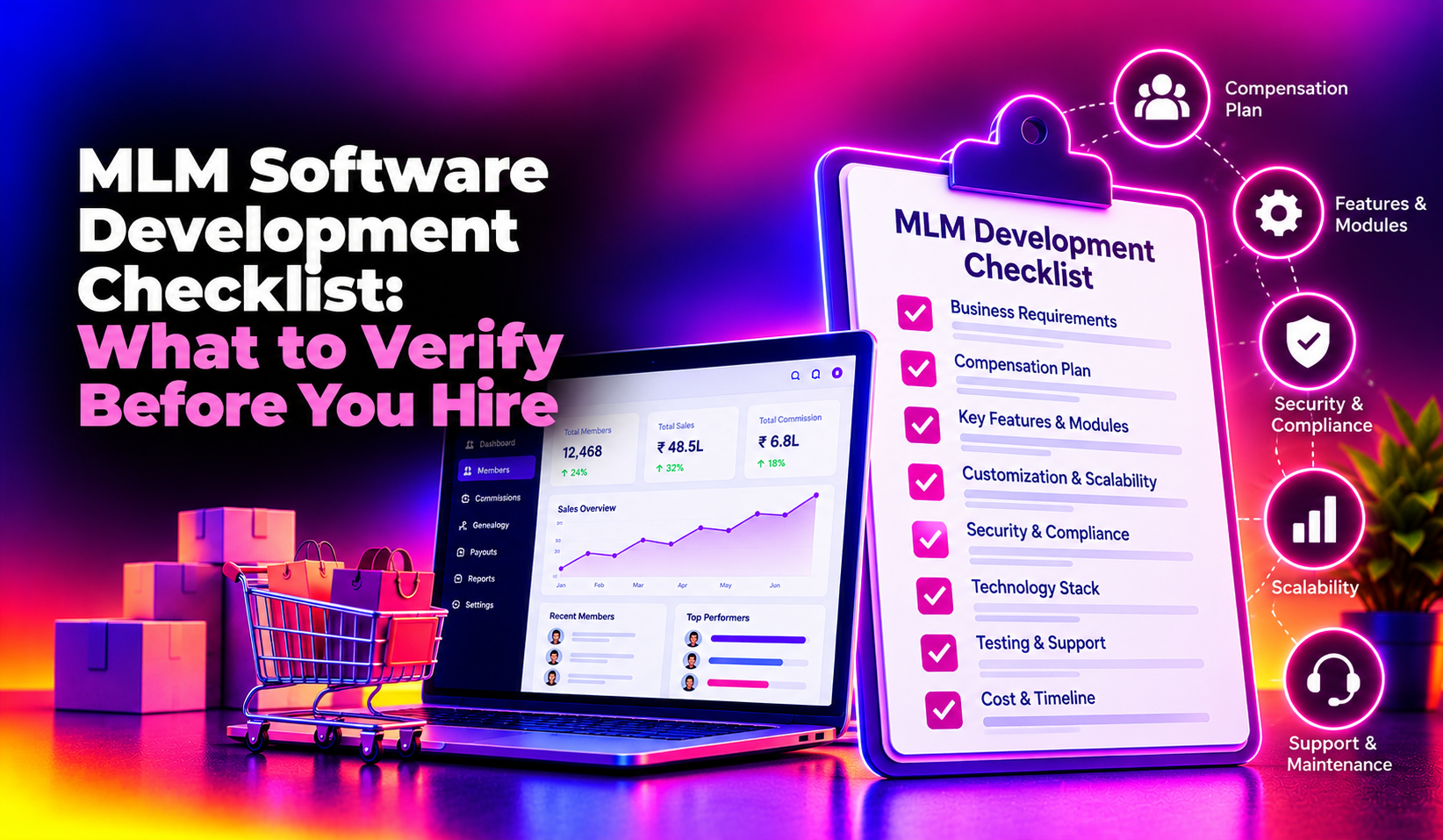
The Complete MLM Software Vendor Requirements Checklist
Work through each item below with every vendor on your shortlist. Do not accept a verbal "yes" — ask for a demonstration, a document, or a signed commitment for each point.
- Exact compensation plan replication — the vendor must load your real plan (binary, unilevel, matrix, board, hybrid, breakaway, or generation) and run it against a sample of your actual historical orders, not a generic demo dataset.
- Edge-case handling — ask them to process your awkward edge cases: split orders, returns after commission runs, compressed legs, and rank rollbacks. If they can't show you this working, they haven't built it yet.
- Compliance and regulatory tooling — the platform must support region-specific rules on income disclosure statements, earnings claims, tax withholding, and distributor agreements, with configurable compliance policies per jurisdiction.
- Data ownership and export rights — confirm in writing that you retain full ownership of distributor, order, and commission data, and can export it in a usable format at any time without vendor lock-in.
- Real-time commission engine performance — request a load test or documented benchmark showing commission runs complete without downtime at your projected peak order volume, not just your current volume.
- Payment gateway and e-commerce integrations — verify native or documented API support for your specific payment processors, tax engines, and e-commerce or CRM stack.
- API and webhook access — the platform should expose a documented REST API and webhooks so you are not dependent on the vendor for every future integration.
- Security posture — ask for their most recent penetration test results, encryption-at-rest and in-transit policies, and role-based access control model for admin and distributor accounts.
- Scalability architecture — confirm whether the system is built on infrastructure that can scale horizontally during enrollment spikes and product launches, and ask what happens operationally when it doesn't.
- Reference clients at your scale — request at least two live client references running a similar compensation plan and distributor count, and actually call them.
- Support SLA in writing — get response-time and resolution-time commitments in the contract, not just a sales promise, including what happens during a commission-run outage.
- Source code and escrow terms — clarify whether you own the source code outright, or whether a code escrow arrangement protects you if the vendor shuts down.
- Post-launch maintenance scope — get a written definition of what is included after go-live versus billed separately, so "maintenance" doesn't become an open-ended invoice.
If a vendor cannot satisfy every item above with evidence rather than assurances, treat that as a disqualifying red flag — not a negotiation point.
💡 None of these worked? Skip the guesswork.
Get Expert Help →Compensation Plan Support: The First Thing to Verify
Before any conversation with a vendor, document your compensation plan in full detail — every rank, every bonus type, every qualification rule. Vague descriptions like "it's basically a binary plan" lead to vendors underestimating complexity and underquoting the project.
Ask the vendor to configure your actual plan rules in a sandbox environment and run them against a batch of your real (anonymized) order data. Compare the output commission amounts against your own manual calculations. Discrepancies here are the single biggest predictor of post-launch disputes with distributors.
Every mature MLM business has exceptions — compressed downlines, retroactive rank adjustments, split shipments. Feed these specifically to the vendor during evaluation. A vendor who has genuinely built flexible compensation logic will handle them without a change order; one who hasn't will ask for "additional scope."
A vendor confident in their engineering will happily put you on a call with the actual developers or architects who will build your system — not only the sales team. If they resist this, treat it as a warning sign.
Generic "MLM experience" is not enough. Ask specifically for case studies or references involving your compensation plan type, your distributor scale, and your industry (health and wellness, cosmetics, financial services, etc., often have different compliance requirements).
Before signing, confirm who owns the source code, what happens to your data if you switch vendors later, and whether there is a defined off-boarding process. Companies that skip this step are the ones who get held hostage by a vendor two years later.
Ask what happens if a commission run fails at 2 a.m. on payout day. A vendor with a real support SLA will have a documented escalation path; a vendor without one will improvise.
Why Hosting Companies and Direct-Selling Businesses Choose CloudHouse for MLM Software
CloudHouse Technologies builds custom MLM platforms with configurable compensation engines that are tested against your real order data before launch, not generic demo data. We provide transparent, hourly-billed engineering with no vendor lock-in, documented API access from day one, and a support model with clear response-time commitments — because we have seen firsthand what happens to companies who skipped this checklist with a previous vendor.
Get Your MLM Software Requirements Reviewed Before You Sign Anything
If you are currently evaluating vendors, don't sign a contract until you've run this checklist against every shortlisted provider. Our MLM software development company team can review your compensation plan, your current vendor's proposal, or your existing platform's architecture, and tell you plainly where the risks are before you commit budget and time.
Frequently Asked Questions
How much does custom MLM software development cost?
Custom MLM software costs vary widely based on compensation plan complexity, integrations, and expected distributor volume, typically ranging from a focused MVP build to a multi-phase enterprise platform. The only reliable way to get an accurate number is to have a vendor quote against your actual compensation plan and integration list, not a generic package price.
How long does it take to build MLM software from scratch?
A well-scoped MLM platform with one or two compensation plan types typically takes several months from discovery to launch, with more complex hybrid plans or heavy legacy-data migrations taking longer. Vendors who promise a fully custom platform in a few weeks are usually reusing a rigid template rather than building to your actual requirements.
What compensation plan types should MLM software support?
At minimum, a serious MLM software vendor should be able to configure binary, unilevel, matrix, board, and hybrid plans, along with breakaway and generation-based structures if relevant to your business. The critical test isn't whether they list these plan types on their website — it's whether they can load your specific rules and reproduce accurate commission output against real order data.
Do MLM software vendors offer a trial or phased engagement before a full commitment?
Reputable vendors will usually agree to a paid discovery or proof-of-concept phase where they configure a sandbox version of your compensation plan before you commit to the full build. Be cautious of any vendor who insists on a full upfront contract with no intermediate milestone to validate their work against your requirements.
What happens if my MLM software vendor shuts down or underperforms after launch?
This is exactly why source code ownership, data export rights, and support SLAs need to be settled in the contract before you sign, not after a problem occurs. If you retain full code and data ownership and have documented API access, you can migrate to a new development partner without starting from zero, which is why this sits near the top of any serious mlm software development checklist.
Should I choose off-the-shelf MLM software or a custom-built platform?
Off-the-shelf MLM software can work for simple, single-plan businesses that need to launch quickly and cheaply, but it usually becomes a constraint the moment your compensation plan needs a rule the template wasn't designed for. Custom-built MLM software costs more upfront but gives you full control over compensation logic, integrations, and data ownership — which matters most once your distributor base and plan complexity grow past what a template can flex to support.
Red Flags That Should Stop a Deal Immediately
Beyond the checklist items above, watch for behavioral warning signs during the sales process itself. A vendor who avoids technical questions by redirecting you back to sales, who cannot produce a single reference client running your compensation plan type, or who is vague about who actually owns the source code after the contract ends, is telling you something important about how the engagement will go after you've paid the deposit.
Equally telling is how a vendor responds when you ask for their compliance documentation. A vendor with genuine experience in the direct-selling space will have ready answers about income disclosure statement handling, distributor agreement versioning, and jurisdiction-specific tax rules — because they've been asked before by companies who got burned skipping this step. A vendor who treats compliance as an afterthought during the sales process will treat it as an afterthought in production, and that risk lands squarely on you, not them.
Pricing structure is another signal worth reading carefully. Vendors who quote a single flat number without first reviewing your compensation plan documentation in detail are usually pricing a generic template, not your actual requirements. Ask for a breakdown by module — compensation engine, compliance tooling, integrations, and support — so you can see exactly what you are paying for and negotiate scope where it doesn't match your priorities.
Vetting an MLM software vendor properly takes more effort up front, but it is dramatically cheaper than rebuilding a broken platform after your distributor network has already grown around it. Run every vendor on your shortlist through this checklist, insist on evidence over assurances, and you'll avoid the most common and most expensive mistakes companies make when choosing MLM software development partners.