When a client's WordPress site gets hacked at 11pm on a Friday, the hosting company or agency that finds out first has two choices: scramble to fix it themselves, or lose the account. A reliable malware removal service for hosting companies exists precisely for this moment — a white-label partner who can clean the infection, restore trust, and let the agency keep its focus on selling and building, not on decoding obfuscated PHP at midnight.
For hosting companies and web agencies managing dozens or hundreds of client sites, malware isn't a rare emergency — it's a recurring operational risk. Outdated plugins, shared hosting cross-contamination, brute-forced admin panels, and supply-chain attacks through nulled themes all funnel into the same support queue. The question isn't whether a client site will get infected, it's how fast — and how professionally — the response happens when it does.
Why Hosting Companies and Agencies Need a Malware Removal Partner
Most hosting companies and digital agencies are not staffed for security incident response. Their teams are excellent at provisioning servers, building websites, and managing client relationships — but manually reverse-engineering a malware injection, tracing a backdoor shell, and hardening a compromised server against reinfection is a specialized skill set that few in-house teams maintain at scale.
When a client discovers their site is flagged by Google Safe Browsing, blacklisted by an email provider, or redirecting visitors to spam pharmacy pages, the clock starts ticking immediately. Every hour the site stays infected is an hour of lost traffic, lost sales, and eroding trust. If the agency's response is "we'll look into it next week," that client is already shopping for a new provider.
This is exactly where a dedicated agency malware cleanup service earns its keep. Instead of building an internal security team from scratch, hosting companies and agencies partner with a specialist who can be looped in within minutes of a report coming through, clean the site under the agency's own branding, and hand back a clean, hardened, documented result — all without the client ever needing to know a third party was involved.
💡 None of these worked? Skip the guesswork.
Get Expert Help →What's Included in a Professional Malware Removal Service
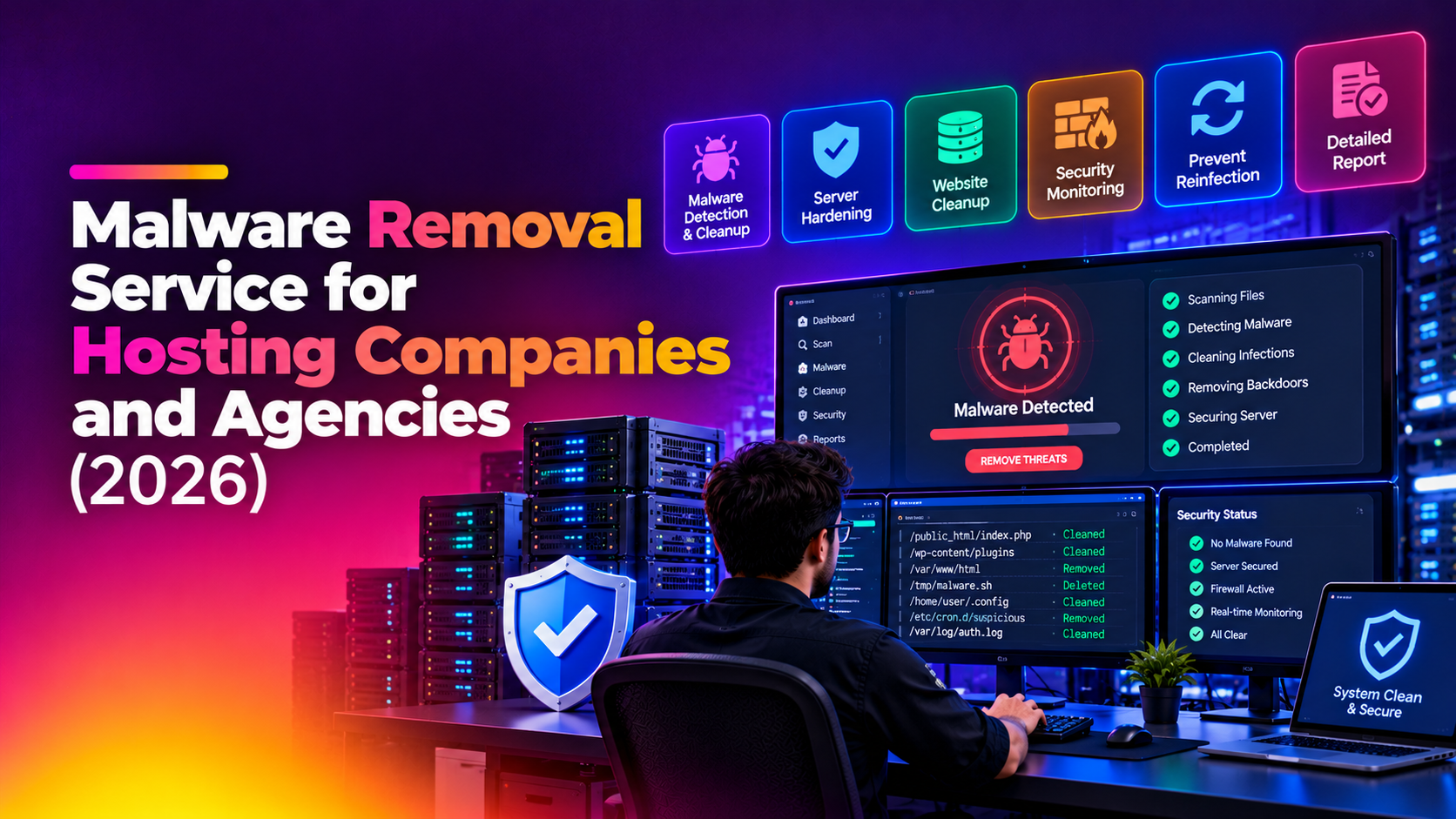
Not all "malware removal" offers are equal. A professional, agency-grade service should include far more than deleting a suspicious file and calling it done. Here is what a genuine white label malware removal engagement covers:
A complete file-system and database scan to identify every injected script, backdoor, obfuscated payload, and modified core file — not just the symptom the client noticed (a defaced homepage or a blacklist warning), but the root cause.
Automated scanners catch known signatures, but sophisticated attackers hide backdoors in image files, .htaccess rules, cron jobs, and wp-config includes. A proper cleanup pairs automated tooling with a security engineer manually reviewing suspicious code before removal, so nothing is missed and nothing legitimate is broken.
Once the site is clean, submitting delisting requests to Google Safe Browsing, Norton Safe Web, McAfee SiteAdvisor, and relevant email/spam blacklists — because a technically clean site that's still flagged as dangerous is still losing the client traffic and sales.
Patching the entry point that let the attacker in — updating vulnerable plugins/themes, rotating all credentials and API keys, tightening file permissions, disabling unused PHP execution in upload directories, and adding a web application firewall rule set to block repeat attempts.
A short monitoring window (typically 7-30 days) after cleanup to confirm reinfection hasn't occurred, since a poorly hardened site frequently gets reinfected within days through the same original vulnerability.
A clean incident report the agency can hand to its own client under its own branding — what happened, what was fixed, and what was done to prevent recurrence. This is often the single biggest value-add for agencies: it turns a crisis into evidence of competent partnership.
Malware Removal Pricing for Hosting Companies in 2026
Pricing for malware removal for client websites varies significantly depending on whether it's a one-off cleanup or a standing partner relationship. Below is a realistic 2026 market range for agencies evaluating providers:
| Engagement Type | Typical Price Range (2026) | Best For |
|---|---|---|
| Single-site emergency cleanup | $99 – $299 per site | Occasional incidents, one-off clients |
| Ongoing monitoring + cleanup retainer | $15 – $40 per site / month | Agencies managing 10+ client sites |
| White-label bulk cleanup (per-incident, volume discount) | $40 – $120 per site | Hosting companies with recurring infections across shared servers |
| Hourly security engineer support | $25 – $60 per hour | Complex server-level compromises, custom investigations |
Agencies and hosting companies that partner on an hourly or retainer basis, rather than paying per emergency, typically save 30-50% over time and — more importantly — get guaranteed response-time SLAs instead of being queued behind other customers during a mass-infection event. This is a critical part of any serious hosting company security partner relationship: predictable pricing that scales with client count rather than surprise invoices after every incident.
In-House Cleanup vs Outsourced Malware Removal
Many agencies start out trying to handle malware cleanup in-house, usually with a developer manually deleting suspicious files. This works occasionally, but it doesn't scale and it introduces real risk. Here's how the two approaches actually compare:
| Factor | In-House Cleanup | Outsourced Malware Removal Partner |
|---|---|---|
| Response time | Hours to days, depends on developer availability | Typically 1-4 hours with a dedicated SLA |
| Thoroughness | Often misses hidden backdoors, reinfection common | Full scan, manual review, hardening included |
| Cost predictability | Unbudgeted developer hours pulled from other projects | Fixed per-site or retainer pricing |
| Blacklist removal | Frequently overlooked or delayed | Included as standard |
| Scalability across many client sites | Breaks down past a handful of incidents per month | Built for volume, white-label ready |
| Client-facing reputation | Risk of visible delays and repeat incidents | Fast, professional resolution under agency branding |
The core issue with in-house cleanup isn't competence — it's opportunity cost. Every hour a developer spends stripping malware out of a client's WordPress malware removal for agencies case is an hour not spent on billable project work. For a hosting company managing infections across multiple client accounts, that opportunity cost compounds quickly and eats directly into margin. There's also a compliance angle many agencies overlook: if a developer misses a backdoor and the site is reinfected within a week, the client sees that as the agency's failure, regardless of who technically did the cleanup.
The right choice usually depends on volume. An agency dealing with one infection every few months might get away with in-house handling. A hosting company running dozens of client instances on shared or reseller infrastructure, where one compromised account can spread laterally to neighboring sites, needs a partner with the tooling and staffing to respond immediately and at scale.
Why Hosting Companies Choose CloudHouse for Malware Removal
CloudHouse Technologies works as a behind-the-scenes hosting company security partner for agencies and hosting providers who need dependable, white-label incident response without hiring a full-time security team. Engagements run on hourly, per-incident, or retainer billing with no long-term lock-in, so agencies scale support up or down as their client base changes. Response typically begins within 1-4 hours of a ticket being raised, and every cleanup includes hardening and a short monitoring window so the same vulnerability doesn't reopen the same ticket next month. Learn more about the full scope of our malware removal service, built specifically to support hosting companies and agencies managing infections across multiple client sites.
Frequently Asked Questions
How much does malware removal cost for hosting companies managing multiple client sites?
Bulk or retainer-based white-label malware removal typically runs $15-$40 per site per month for ongoing monitoring, or $40-$120 per incident for one-off cleanups at volume discounts. Hourly engineer support runs $25-$60/hour for complex server-level cases. Costs are usually lower per site than paying for one-off emergency cleanups repeatedly.
How long does it take to remove malware from a client's WordPress site?
Most single-site WordPress infections are fully cleaned within 4-24 hours once the engagement starts, depending on the depth of the compromise. Server-level or multi-site infections on shared hosting can take longer since every account on the server needs to be checked for cross-contamination.
Do you offer white-label malware removal that clients never know about?
Yes. A core reason agencies and hosting companies use a third-party malware removal partner is to keep the relationship invisible to the end client — the agency remains the single point of contact, and all reporting can be delivered under the agency's own branding.
Can a malware removal partner work on a monthly retainer instead of per-incident billing?
Yes, and for agencies managing more than a handful of client sites this is usually the more cost-effective option. A monthly retainer typically bundles ongoing monitoring, faster SLAs, and discounted cleanup rates compared to paying full price for each individual incident.
What causes most WordPress malware infections on client sites?
The majority of infections trace back to outdated plugins or themes with known vulnerabilities, weak or reused admin passwords, nulled/pirated premium themes bundled with backdoors, and shared hosting environments where one compromised account infects neighboring sites on the same server.
For hosting companies and agencies, the real cost of a malware incident isn't the cleanup itself — it's the client relationship on the line while the site stays down. A dependable malware removal service for hosting companies turns a potential churn event into a demonstration of exactly the kind of reliability that keeps clients renewing year after year.