Why NVIDIA Driver Setup Matters for Linux Mint Gaming
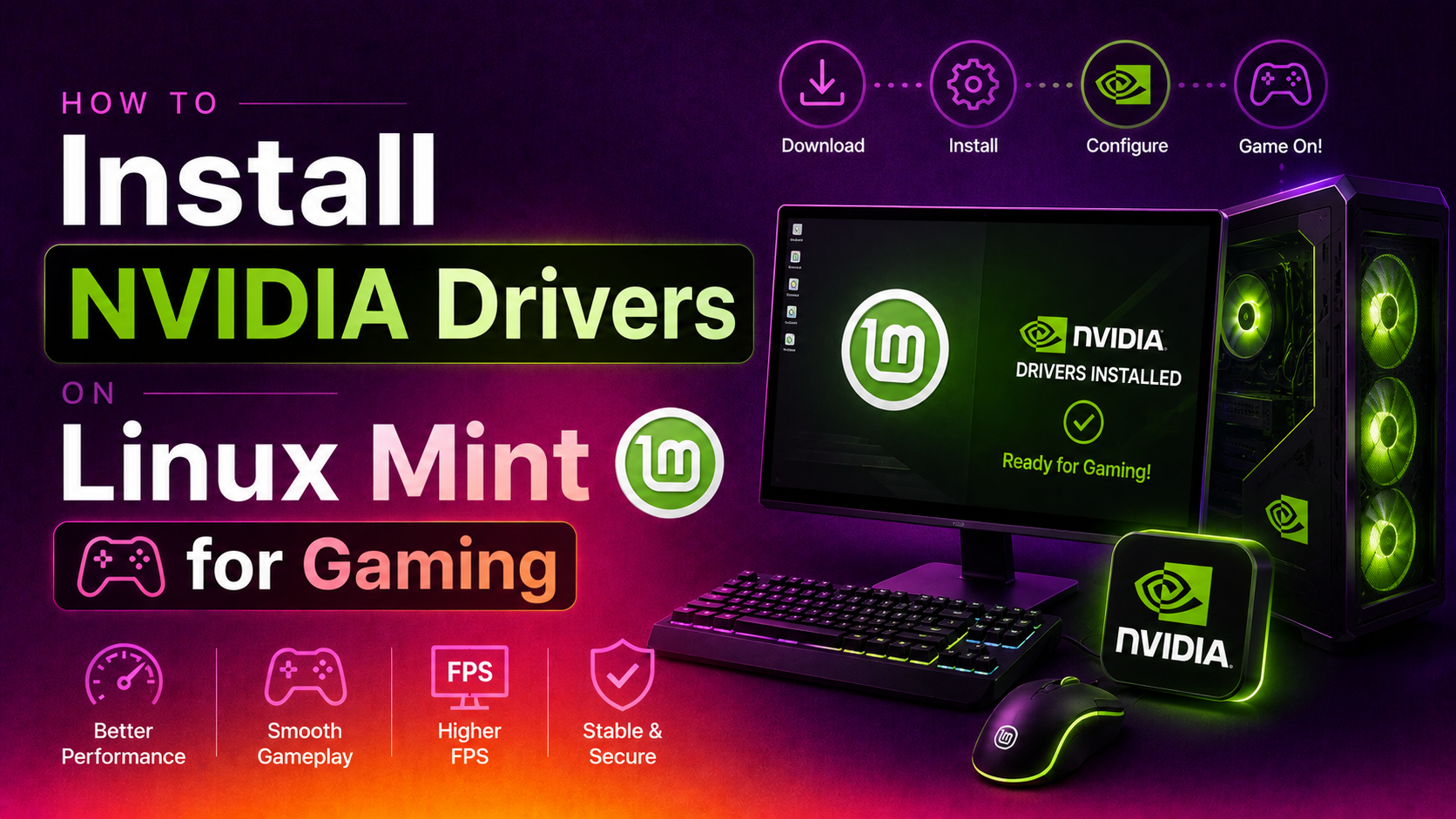
Linux Mint ships with the open-source Nouveau driver by default — it provides basic display output but is severely limited for gaming: no hardware acceleration, poor frame rates, and no support for NVIDIA's DLSS or ray tracing features. Installing the proprietary NVIDIA driver unlocks full GPU performance and Steam compatibility for gaming in 2026.
This guide covers three installation methods — Driver Manager (recommended for beginners), command line (for advanced users), and troubleshooting when drivers fail to load.
Before You Start: Check Your GPU and Kernel
First identify your NVIDIA GPU model and the recommended driver version:
lspci | grep -i nvidiaAlso check your kernel version — NVIDIA driver compatibility depends on it:
uname -rFor NVIDIA Turing (RTX 20xx), Ampere (RTX 30xx), Ada Lovelace (RTX 40xx), and Blackwell (RTX 50xx) GPUs, NVIDIA recommends the open-source kernel modules (driver 560+). For Maxwell, Pascal, and Volta GPUs, use the closed-source proprietary driver.
Method 1: Install via Driver Manager (Recommended)
Linux Mint's Driver Manager automatically detects your GPU and lists compatible driver versions:
- Open the Start Menu → Administration → Driver Manager
- Wait for the tool to scan your hardware (requires internet connection)
- Under your NVIDIA GPU, select the driver marked "recommended" — typically the highest nvidia-driver-XXX version listed
- Click Apply Changes
- Enter your password and wait for the installation to complete
- Restart your computer
After rebooting, verify the driver loaded correctly:
nvidia-smiYou should see your GPU model, driver version, and CUDA version in the output. If nvidia-smi shows an error, continue to the troubleshooting section.
Method 2: Install via Command Line (Advanced)
For specific driver versions or when Driver Manager fails, use the terminal:
sudo apt update
sudo apt install nvidia-driver-570
Replace 570 with the version number appropriate for your GPU. To see all available versions:
apt-cache search nvidia-driverImportant: Never mix installation methods. If you previously installed a driver via Driver Manager, don't also run the NVIDIA .run installer from their website — you'll end up with two conflicting drivers.
After installation:
sudo rebootMethod 3: Enable Open-Source Kernel Modules (RTX 20xx and Newer)
For Turing-generation GPUs and newer, NVIDIA's open kernel modules deliver better performance and stability on Linux kernel 6.x:
sudo apt install nvidia-driver-570-openThe -open suffix installs the open-source kernel module variant. After reboot, verify with nvidia-smi. If you experience instability with -open, fall back to the standard proprietary version.
Troubleshooting: Driver Not Loading After Reboot
Check if Secure Boot is blocking the driver
Secure Boot is the most common reason NVIDIA drivers install successfully but fail to load. Check its status:
mokutil --sb-stateIf output shows "SecureBoot enabled", either disable Secure Boot in your BIOS settings, or sign the NVIDIA kernel module (an advanced process). Disabling Secure Boot is the quickest fix for gaming systems.
Check for kernel module loading errors
dmesg | grep -i nvidia
journalctl -b | grep nvidia
Look for lines containing "error" or "failed". Common errors include missing firmware or blacklisted modules.
Remove and reinstall the driver cleanly
sudo apt purge nvidia-*
sudo apt autoremove
sudo apt update
sudo apt install nvidia-driver-570
sudo reboot
Configure Steam to Use NVIDIA GPU
After installing the driver, configure Steam's Proton for best gaming performance:
- Open Steam → Settings → Compatibility
- Enable "Enable Steam Play for all other titles"
- Select Proton Experimental or the latest stable Proton version
- For each game: right-click → Properties → Compatibility → check "Force the use of a specific Steam Play compatibility tool"
To confirm Steam is using your NVIDIA GPU rather than the integrated Intel/AMD GPU:
nvidia-smiWith a game running, you'll see the game's process appear under the Processes section in nvidia-smi output.
Verify Gaming Performance After Installation
Test that your NVIDIA GPU is functioning properly with a quick benchmark:
sudo apt install glmark2
glmark2
A score above 2000 indicates the proprietary driver is working correctly. If you get a score below 500, the system may still be using Nouveau — recheck with nvidia-smi.
If your NVIDIA driver installation fails, causes a black screen, or Steam still won't use the GPU, CloudHouse Technologies provides expert Linux gaming and driver support on a pay-per-ticket basis — no subscription required.
Frequently Asked Questions
What NVIDIA driver version should I install on Linux Mint in 2026?
For RTX 20xx and newer GPUs, install nvidia-driver-570 or the latest version shown as "recommended" in Driver Manager. For older Pascal/Maxwell GPUs, nvidia-driver-470 is the last supported version — check Driver Manager for what's available for your specific GPU.
Will installing NVIDIA drivers break my Linux Mint installation?
Not if you use Driver Manager or apt — these install tested package versions. Problems typically occur when using the .run file from NVIDIA's website alongside package manager drivers. Stick to one method.
How do I switch back to Nouveau if NVIDIA drivers cause problems?
Remove the proprietary driver: sudo apt purge nvidia-* && sudo apt autoremove && sudo reboot. Linux Mint will automatically fall back to Nouveau.
Can I game on Linux Mint without NVIDIA proprietary drivers?
Yes, but performance will be severely limited. Nouveau doesn't support hardware acceleration, DLSS, or NVENC encoding. Most modern games will run at unplayable framerates without the proprietary driver.
Why does nvidia-smi show no driver after installation?
The most likely cause is Secure Boot blocking the unsigned kernel module. Run mokutil --sb-state to check. If Secure Boot is enabled, disable it in your BIOS/UEFI settings and reboot.