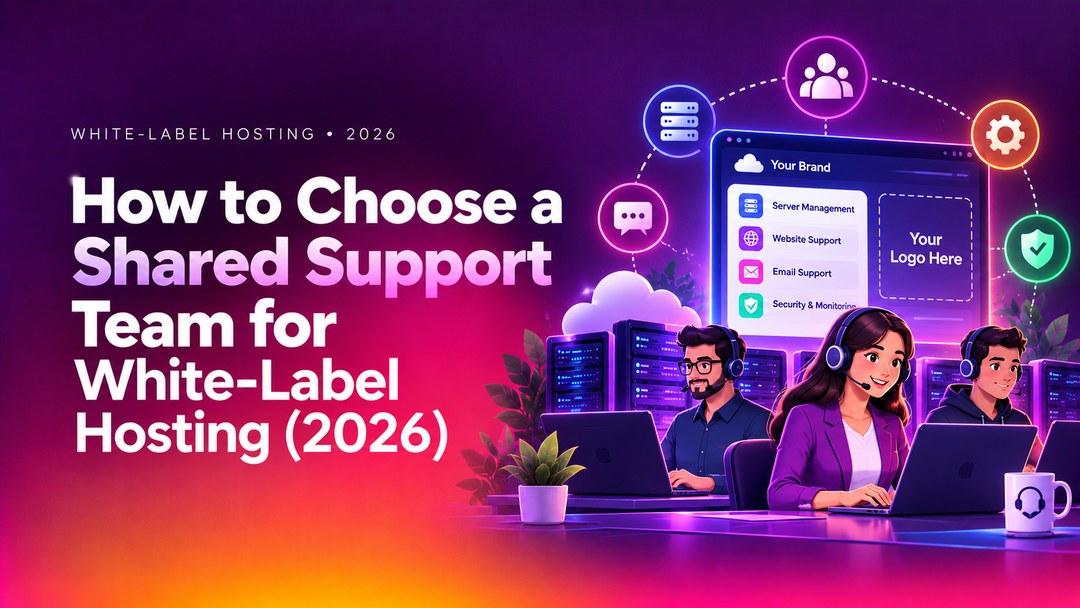
If you run a white-label hosting brand, your support desk is your brand — every ticket reply either reinforces trust or quietly erodes it. Knowing how to choose a shared support team for white label hosting is the difference between a vendor who becomes invisible extension of your team and one whose branding slip-ups or missed SLAs end up in your customers' inboxes. This guide breaks down exactly what to evaluate before you sign a contract.
Why White-Label Support Vendor Selection Is Different
Generic "shared support team" advice assumes you're comfortable with the vendor's name appearing somewhere in the process. White-label hosting resellers don't have that luxury. Every email footer, ticket signature, live chat greeting, and phone script has to carry your brand, not the vendor's. That single requirement changes almost everything about how you should evaluate a shared support plan — from onboarding depth to the tooling the agents use day to day.
A generic outsourced helpdesk that's perfectly fine for an in-house IT department can be a disaster for a hosting reseller, because a single mis-branded reply — "Thanks, this is [Vendor Name] support" instead of your company name — can trigger a support ticket of its own, or worse, a churned customer who now suspects your entire operation is a reseller shell.
The Core Risk: Losing Control of Your Own Brand Voice
When you evaluate white label support team hosting options, the central question isn't "can they answer tickets correctly" — most competent shared-support vendors can do that. The real question is: will they answer tickets exactly the way your customers expect from you, every single time, across every shift and every agent?
This is where pooled/shared support models introduce risk that dedicated in-house teams don't have. A shared pool of agents serving multiple hosting brands has to context-switch between brand voices, escalation paths, and even ticketing systems throughout a single shift. If the vendor hasn't built rigorous brand-isolation processes, mistakes bleed through — an agent forgets which brand's macros to use, or references the wrong company name in a canned reply.
Vendor Evaluation Checklist for White-Label Shared Support
Use this checklist when comparing shared support plans for hosting companies that claim to offer white-label service:
- Brand consistency enforcement — Ask how they prevent cross-brand bleed. Do agents work from brand-specific macros, signatures, and knowledge bases? Is there a technical guardrail (not just training) that stops an agent from sending the wrong brand's email template?
- NDA and confidentiality terms — A written mutual NDA should be non-negotiable, not an add-on. Confirm it explicitly covers your customer data, your infrastructure details, and the fact that the support is outsourced at all.
- SLA transparency — Get the exact first-response time, resolution time by ticket priority, and what happens (credits, escalation, penalty) if the SLA is missed. Vague language like "prompt response" is a red flag.
- Escalation process clarity — Ask for the actual escalation path in writing: who owns a ticket that isn't resolved in L1, how fast it reaches L2/L3, and whether you (the brand owner) get visibility into escalations in real time.
- Agent continuity and training — High agent turnover means your brand voice keeps getting re-taught to new people. Ask about average agent tenure and how new agents are onboarded to your specific brand guide.
- White-label tooling proof — Request a live demo of their helpdesk under your branding — custom domain, your logo, your email sender name — before you sign anything.
- Reporting and audit access — You should be able to pull ticket-level QA reports and CSAT scores tied specifically to your brand's tickets, not blended into the vendor's overall metrics.
- Trial or month-to-month flexibility — A vendor confident in their white-label execution should be willing to prove it over a trial period before locking you into a long-term contract.
Red Flags to Walk Away From
If a vendor can't show you a sample white-labeled ticket thread, hesitates on a written NDA, or describes their SLA only in vague marketing language, treat that as a serious warning sign. The same applies if pricing is opaque about per-agent vs. per-ticket costs — you need to know the true unit economics of outsourced shared support hosting before you commit.
How Pooled Support Actually Works (and Where It Can Go Wrong)
A shared support model pools trained agents across multiple hosting brands so no single reseller has to carry full-time headcount. Done well, this gives you 24/7 coverage at a fraction of in-house cost. Done poorly, it means your customers are served by agents who are simultaneously juggling three other brands' tickets with inconsistent quality.
The safest structure is a hybrid: a dedicated, brand-trained pool of agents assigned specifically to your account, backed by a larger shared bench for overflow and after-hours coverage. Ask any white label technical support provider you're evaluating whether they use this structure or a fully commingled pool — the difference materially affects consistency.
Technical Depth Matters as Much as Brand Voice
Brand consistency is only half the evaluation. The agents still need to actually resolve cPanel/WHM, Plesk, DirectAdmin, email, and server-level issues correctly. During a shared server support team evaluation, ask for anonymized examples of past ticket resolutions covering common hosting issues — DNS propagation delays, SSL renewal failures, mailbox quota errors — so you can judge technical competence alongside branding fit.
Questions to Ask Before You Sign
- Can we see a sample of white-labeled email templates and live chat scripts under our brand?
- What is the maximum number of other brands an individual agent serves per shift?
- How quickly can new product/service changes on our end be reflected in your knowledge base?
- What happens to open tickets if we choose to leave the contract?
- Is there a dedicated account manager who understands our brand specifically, or a rotating point of contact?
Why White-Label Hosting Providers Choose CloudHouse for Shared Support
CloudHouse structures every shared support engagement around brand isolation from day one — agents work from brand-specific macros, signatures, and escalation trees rather than a single generic script shared across clients. Hosting resellers also get transparent, written SLAs with real response-time commitments instead of vague marketing language, plus month-to-month flexibility so you can validate quality before locking into a long-term agreement. Our shared support plans are built specifically for hosting companies that need to protect their brand while scaling support coverage.
Pricing Models for White-Label Shared Support
Before comparing quotes, understand how shared support plans for hosting companies are typically priced, because the structure affects your margins as much as the headline rate:
- Per-ticket pricing — You pay per resolved ticket. Predictable for lower ticket volumes, but costs can spike during incidents or migrations.
- Per-agent-hour pricing — You pay for dedicated agent hours regardless of ticket volume. Better for high, steady ticket volume where you want guaranteed capacity.
- Tiered monthly plans — A flat monthly fee covering a ticket-volume band, with overage rates beyond that. Easiest to budget around and the most common model for growing resellers.
Whichever model a vendor proposes, ask them to walk through a worst-case month (a mass outage, a bulk migration, a security incident) so you know exactly what it will cost you when ticket volume spikes rather than discovering it on an invoice.
💡 None of these worked? Skip the guesswork.
Get Expert Help →Onboarding: What a Proper White-Label Handover Looks Like
A rushed onboarding is one of the most common reasons white-label support relationships fail in the first 90 days. A vendor that takes white-labeling seriously will typically run onboarding in stages:
You provide a brand voice guide, canned response library, and escalation contacts. The vendor should ask detailed questions here, not just accept a one-page brief.
Before going live, agents handle simulated tickets in a sandbox so you can review tone, technical accuracy, and branding compliance without risking real customers.
For the first one to two weeks, a senior agent or QA reviewer double-checks tickets before they go out, catching brand or technical errors early.
Once quality stabilizes, the team takes over fully, but regular QA sampling and monthly reporting should continue indefinitely — not just during onboarding.
If a vendor proposes skipping straight to full handover without any shadow period, treat that as a sign they haven't done many true white-label engagements before.
How to Measure Success After Launch
Once your white label technical support provider is live, track these metrics monthly rather than assuming things are fine because complaints haven't surfaced:
- First response time against the contracted SLA, broken out by priority level
- Resolution time for common categories (billing, DNS, email, server access)
- CSAT scores specific to your brand's tickets, not the vendor's blended average
- Branding compliance audits — periodic manual review of a sample of tickets for tone and template accuracy
- Escalation rate — what percentage of tickets require escalation beyond L1, and whether that rate is trending up or down
A vendor confident in their shared server support team evaluation process will offer to share these metrics proactively in a monthly or quarterly review call, rather than making you request them each time.
Common Mistakes Hosting Resellers Make When Choosing a Support Vendor
Even experienced hosting resellers fall into predictable traps when selecting a white label support team hosting partner:
- Choosing on price alone — the cheapest per-ticket rate often correlates with the least brand-isolation infrastructure, since dedicated macros, QA, and training all cost the vendor money that gets passed through in pricing.
- Skipping the trial period — committing to an annual contract before seeing how the vendor actually handles a real ticket queue under your brand is one of the fastest ways to end up locked into a poor fit.
- Not defining escalation ownership in writing — verbal assurances about "we'll escalate anything urgent" mean nothing without a documented SLA tied to ticket priority.
- Assuming technical competence equals brand competence — a team that resolves server issues quickly can still damage your brand if they're inconsistent about tone, signatures, or disclosure of the outsourcing relationship.
- Ignoring agent turnover data — a vendor with high attrition will constantly be re-training new agents on your brand voice, which shows up as inconsistent quality even if individual tickets look fine in isolation.
Avoiding these mistakes usually comes down to slowing down the vendor selection process just enough to ask for proof — sample tickets, written SLAs, and a trial period — rather than relying on a sales call alone.
Making the Final Decision
Once you've run a vendor through the checklist above, the decision usually comes down to trust signals: did they willingly show you a white-labeled ticket sample, put SLAs in writing, and sign an NDA without friction? A vendor that treats these as standard practice, rather than special requests, is far more likely to protect your brand consistently over the long run than one that seems to be assembling white-label capability on the fly just to win your business.
Conclusion
Choosing a shared support team for white-label hosting comes down to one core principle: your customers should never know support is outsourced at all. By evaluating brand consistency safeguards, confidentiality terms, SLA transparency, and escalation clarity — and insisting on proof rather than promises — you can find a partner who protects your brand while freeing you from the cost of building an in-house team.