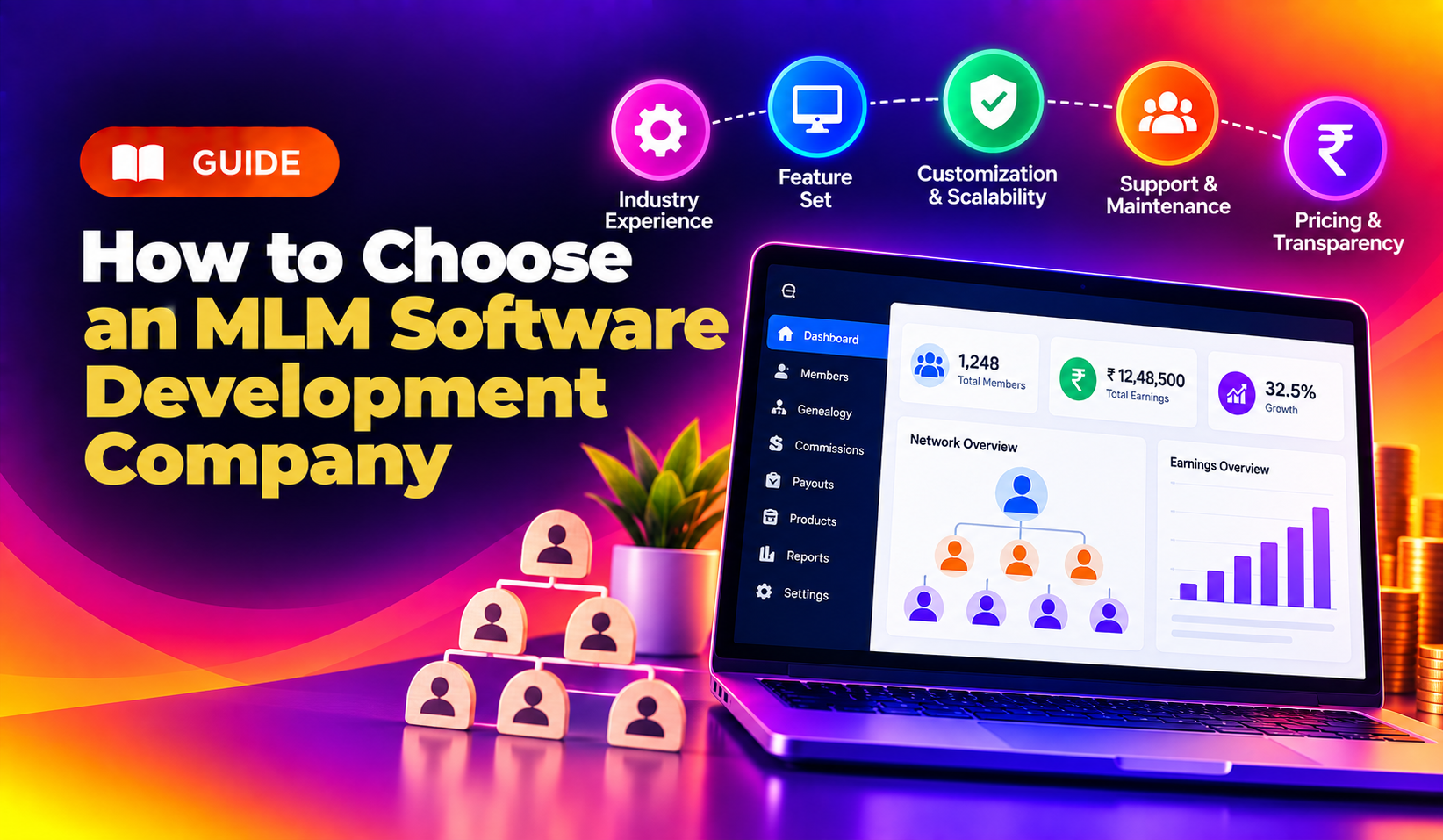
Choosing the wrong MLM software vendor doesn't just cost you money — it can stall your launch for months, expose your network to compliance risk, or leave you locked into a platform that collapses the moment you scale past a few thousand distributors. If you're researching how to choose an MLM software development company, you've likely already been burned once, or you've heard enough horror stories to know that "they built an app before" isn't a real qualification. This guide gives you a concrete, usable framework — not another generic feature list — for evaluating MLM software vendors before you sign a contract.
What Makes MLM Software Development Different From Regular App Development
Most software agencies can build a CRUD app, a dashboard, or an e-commerce store. MLM software is a different animal entirely. It has to calculate multi-level commissions in real time, enforce compensation plan rules that change as your business grows, handle payout compliance across regions, and stay accurate down to the last cent when thousands of distributors are earning from overlapping downlines simultaneously.
A generic web development shop that has never built a binary or matrix compensation engine will underestimate the complexity of genealogy trees, rank advancement logic, and re-entry or spillover rules. This is exactly why so many MLM software projects run over budget and over timeline — the vendor didn't know what they didn't know going in. When you're evaluating a partner for MLM software development, you're not hiring a coding shop; you're hiring a team that understands direct-selling business logic as deeply as they understand software architecture.
There's also a data-integrity dimension that regular app development rarely deals with. Your genealogy tree, commission ledger, and rank history need to remain fully auditable for years, because distributors will dispute payouts and regulators may ask for historical records. A vendor without direct-selling experience often treats this as an afterthought, bolting on reporting after the core system is built rather than designing the database schema around auditability from day one.
Why This Matters for Your Bottom Line
A miscalculated commission run isn't a minor bug — it's a trust-breaking event for your distributor network. Founders report that inaccurate payouts, even for a single cycle, cause visible drops in distributor confidence and re-engagement. That's why compensation plan expertise has to be a first-order evaluation criterion, not an afterthought you assume any competent developer can pick up mid-project.
The Real Cost of Getting This Wrong
Industry data suggests the majority of MLM platform failures trace back to a single root cause: the original vendor could not handle scale or compliance changes after launch. That means the mistake isn't always visible on day one — it shows up eight or twelve months later, when your distributor count has grown and the architecture that looked fine at launch starts buckling under real commission-run volume. Evaluating a vendor's scalability story before you sign is far cheaper than migrating to a new platform mid-growth.
Vendor Evaluation Checklist: What to Verify Before You Sign
Before you sign any contract, walk through this checklist with every vendor you're considering. Treat any vague or evasive answer as a warning sign.
- Compensation plan experience — Ask for two or three live examples of binary, matrix, or unilevel plans they've built and shipped, not just mockups or slide decks.
- Source code ownership — Confirm in writing that you own 100% of the source code after final payment, not a licensed or "white-label" version you can never fully control.
- Security and audit history — Ask whether the platform has undergone a third-party security audit, and how they handle PCI-DSS or data-privacy compliance for payment and personal data.
- Scalability proof — Ask directly: can this architecture handle growth from a few thousand to several hundred thousand distributors without a rebuild? Get a technical answer, not a sales answer.
- Post-launch support terms — Get the SLA in writing: response times, bug-fix windows, and what happens if the compensation plan needs to change six months after launch.
- Payment gateway and e-wallet integrations — Confirm they've integrated the specific payment rails and e-wallets you need, in the regions where you actually operate.
- Reference clients — Ask for at least one reference client who has been live on the platform for over a year, not just recent launches still in their honeymoon phase.
- Technical specification process — A serious vendor will insist on a detailed technical specification of your compensation plan before writing code. If they skip this and just ask for your plan PDF, that's a red flag on its own.
If a vendor can't give you clear, specific answers to every item above, that's a signal to keep looking. Treat this checklist as a filter, not a formality — a vendor who welcomes tough questions is telling you something different from one who gets defensive or vague. This is also where partnering with an experienced provider of MLM software development services pays off — you get straight answers to every one of these questions upfront, rather than discovering the gaps after go-live when they're far more expensive to fix.
💡 None of these worked? Skip the guesswork.
Get Expert Help →Compensation Plan Types a Vendor Should Support (Binary, Matrix, Unilevel)
Your vendor doesn't need to support every compensation model in existence, but they do need deep, provable experience in the model your business actually runs on. Here's what to verify for each of the three most common plan types.
A binary compensation plan places each distributor with exactly two legs (left and right), and commissions are calculated on the weaker leg's volume. A vendor building binary MLM software needs to correctly handle flush cycles, capping limits, and spillover logic — get this wrong and payouts either underpay distributors or blow past your commission budget. Ask the vendor to walk you through how their system handles carry-forward volume and capping, and ask for a live walkthrough of an existing binary MLM software company deployment rather than a theoretical explanation.
Matrix plans restrict each distributor's downline width (for example, a 3x9 or 5x7 matrix), with unplaced recruits spilling over to other positions. Matrix MLM software development requires careful handling of forced-matrix placement algorithms and re-entry positions. Ask specifically how the vendor's system decides where overflow recruits land — this logic is where most matrix bugs originate, and it's rarely visible until your distributor count grows past a few hundred active recruiters.
Unilevel plans allow unlimited width in the front line, with commissions paid across a fixed number of depth levels. This sounds simpler than binary or matrix, but depth-based bonus calculations and rank-qualification logic can still get complicated quickly, especially when businesses layer stairstep or breakaway bonuses on top. Confirm the vendor has actually shipped unilevel systems with the specific bonus types your plan requires, not just the base depth-commission structure.
Whichever model you use, the vendor should be able to demo a live, working example of that exact plan type — not a generic admin panel with commission fields grayed out. If you're planning to combine models, such as a hybrid binary-unilevel structure, be even more direct about asking for a working example of that specific hybrid, since this is where many custom MLM software provider teams start improvising.
Red Flags to Avoid When Hiring an MLM Software Company
Some warning signs are obvious once you know to look for them. Others only surface after you've already paid a deposit. Watch for these patterns during vendor evaluation:
- No written scope or technical specification — If a vendor is willing to start coding based on a verbal conversation or your compensation plan PDF alone, they're guessing, not engineering.
- Reused "white-label" platforms sold as custom — Some vendors resell the same base platform to every client with a new coat of paint. This limits your ability to customize later and often means you don't actually own the source code.
- Vague answers about security and compliance — If a vendor can't clearly explain how they protect distributor data, payment details, and payout accuracy, move on.
- No safety controls on payouts — Budget platforms often skip capping limits and audit trails because they're harder to build. That liability lands on you, the business owner, not the vendor.
- Unrealistically low quotes — Custom MLM software development is a specialized discipline; quotes far below market rate usually mean corners are being cut on compensation logic, security, or support.
- No post-launch support plan — If the conversation stops at "go-live" with no mention of ongoing support, you'll be on your own the first time your compensation plan needs to change.
- Reluctance to provide reference clients — A vendor confident in their work will happily connect you with an existing client who has been live for a year or more.
Any one of these red flags alone might not be disqualifying, but two or more together should make you walk away. The pattern to watch for is a vendor optimizing for a quick close rather than a durable partnership — and MLM software, more than most software categories, is a long-term relationship, not a one-time delivery.
Why Businesses Choose CloudHouse for MLM Software Development
CloudHouse Technologies builds MLM software with binary, matrix, and unilevel compensation logic engineered from a detailed technical specification of your actual plan, not a generic template. Clients retain full ownership of their source code, get documented post-launch support terms, and can request a security review of their platform before go-live. Rather than selling a one-size-fits-all system, our MLM software development services team works from your compensation plan first and builds the software around it, which is why businesses that have been burned by a previous vendor tend to stay with us long after launch. Whether you need a binary MLM software company partner in Kerala, India, or a fully custom matrix build for a global launch, the evaluation process above is exactly what we expect you to run us through.