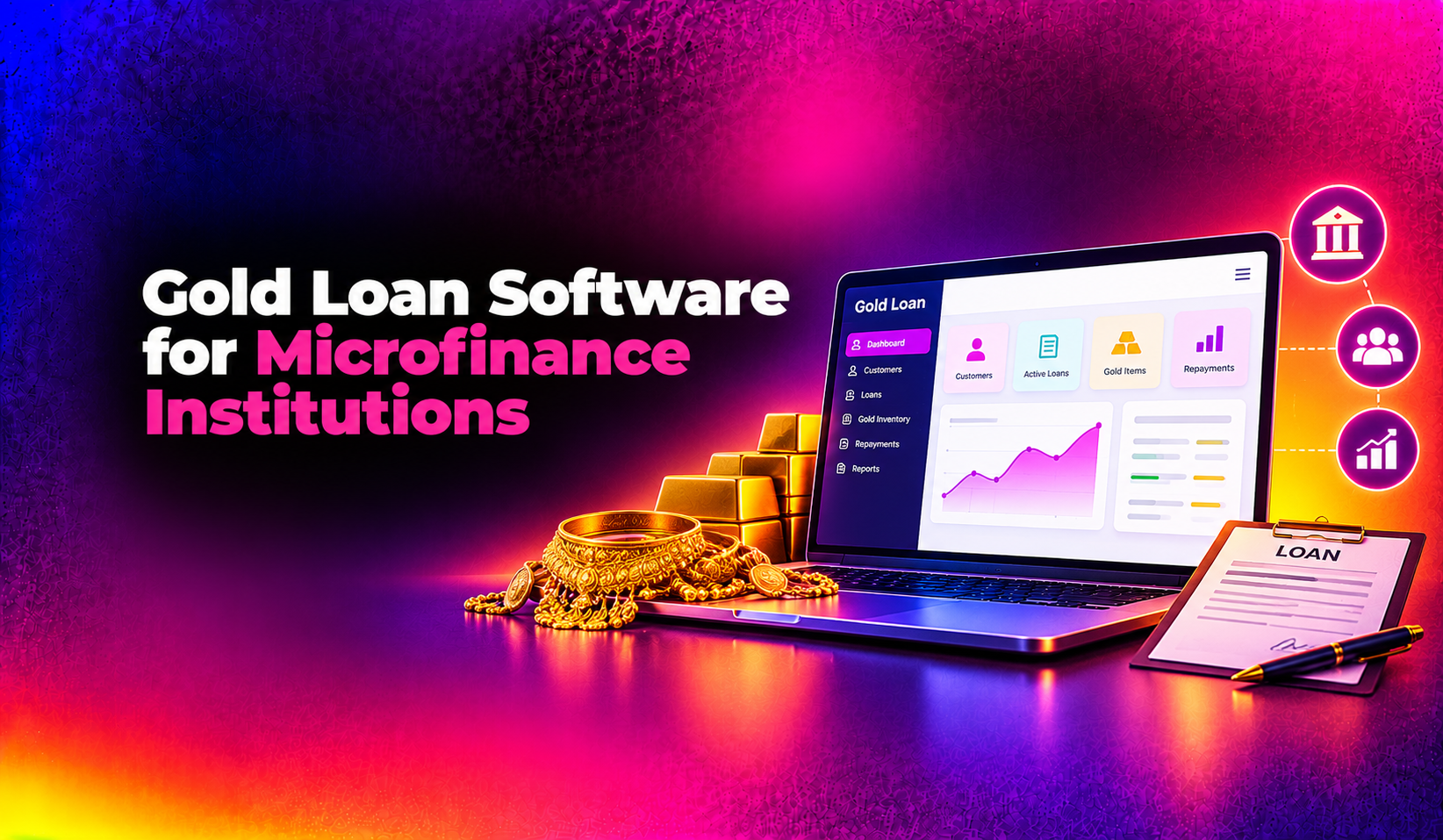
If you are opening your first gold loan business, the software you pick will shape almost every day of operations. It decides how a pledged ornament is recorded, how interest is calculated, how a defaulted loan moves toward auction and how clearly you can see your own book at the end of the day. This guide explains how to choose a gold loan software vendor when you are a new lender with no legacy system to compare against. It covers the features that matter, the questions to ask, a vendor evaluation checklist and a comparison table you can fill in during demos.
It is written for founders, branch owners and operations heads who are launching a gold loan company, a pawn-style lending branch or a new gold loan division inside an existing finance business. Nothing here is legal or regulatory advice. Lending rules, permitted loan-to-value limits, auction procedures and record-keeping duties differ by country and by licence type, so confirm your obligations with your regulator, auditor or counsel before you configure anything.
Why first-time lenders need to be more careful
An established lender already knows its own process and can judge whether a vendor fits it. A new lender is in a different position. You are defining the process and buying the tool at the same time, which makes it easy to be impressed by a long feature list and miss the basics. A few risks are specific to new gold loan businesses.
- You may not know what you will need in year two. A second branch, a vault audit or a regulator inspection can arrive sooner than planned.
- Mistakes in the first records are hard to fix later. If weights, purity and customer details are captured loosely in the first months, every report built on them inherits the problem.
- The software becomes your control system. With physical gold held on your premises, weak audit trails are a security issue as well as an accounting one.
- Switching later is painful. Moving live pledged loans from one system to another is possible but disruptive, so it pays to choose with some care now.
What gold loan software actually has to do
Strip away the marketing and a gold loan system has to handle a small set of jobs reliably. Judge every vendor against these core workflows before you look at extras.
- Customer onboarding and identity verification, with documents stored against the borrower.
- Appraisal and pledge entry, capturing item details, gross and net weight, purity and the assessed value.
- Loan creation using your own scheme rules, including loan-to-value, tenure and interest structure.
- Collections, part-payments, renewals, top-ups and closure with release of the pledged items.
- Overdue tracking, notices and the auction or recovery process.
- Reporting, accounting hand-off and a complete audit history.
A purpose-built gold loan application should cover these without forcing you to bolt on spreadsheets. If a vendor's product is a generic lending tool with a gold module added later, ask to see exactly how a pledge is recorded and released.
Appraisal and valuation controls
Appraisal is where a gold lender either protects or loses money, so look closely at how the software supports it.
- Item-level records: each ornament or item is listed with description, gross weight, stone or impurity deduction, net weight and purity, rather than a single lump entry.
- Rate management: the gold rate used for valuation should be set by an authorised user, dated and logged, not typed freely by whoever is at the counter.
- Photographs and packet details: the ability to attach images and a packet or seal number helps resolve disputes at release.
- Appraiser accountability: every valuation should record who performed it, so you can review the work of an individual appraiser over time.
Ask the vendor what happens if the gold rate is changed during the day and how previously issued loans are affected. The answer should be that old loans keep the values they were issued with.
Loan-to-value and scheme configuration
Loan-to-value, or LTV, is the ratio between the amount you lend and the assessed value of the gold. Your permitted LTV is set by your regulator and your own risk policy, and it may change. The software should let you configure it, not hard-code it.
- Can you define multiple schemes with different tenures, interest rates, processing fees and LTV caps?
- Does the system block a loan that exceeds the configured LTV, or only warn the user?
- Who is allowed to override a limit, and is every override recorded with a reason?
- Can you change a scheme for new loans without altering loans already issued?
A new lender often starts with one or two schemes and adds more once the market responds. Choose a system where adding a scheme is a configuration task, not a paid customisation each time.
Interest calculation and collections
Interest logic is a common source of customer complaints and audit findings. Ask for a live demonstration using your own scheme rules rather than a prepared example.
- Support for the interest methods you plan to use, such as simple or compounding, daily or monthly, slab-based or flat.
- Handling of part-payments, interest-only payments, early closure and renewals.
- Penalty or overdue interest rules that can be switched on and explained clearly to the customer.
Test an edge case yourself. Ask the vendor to close a loan on a date mid-period, with a prior part-payment, and show the statement. If the numbers are hard to explain, they will be hard to explain to a customer, too.
Auction and recovery workflow
Nobody wants to auction pledged gold, but you need a system that handles it correctly if it happens. Auction is where legal exposure is highest, so the software should enforce process rather than leave it to memory.
- Automatic flagging of overdue loans at configurable stages.
- Notice generation, with a record of what was sent, when and to which address.
- A hold that stops an item from entering auction until the required notice steps are complete.
- Recording of the auction itself, including reserve value, bidder, sale amount and settlement of the customer's account.
Ask which steps are configurable, because notice periods and procedures are set by the rules that apply to you. Confirm those rules with your counsel and ask the vendor to set the workflow to match, not the other way round.
Reports, accounting and audit trail
For a new lender, reporting is how you discover problems before they grow. It is also what an auditor or inspector will ask for first.
- Daily cash and collection reports by branch and by user.
- Portfolio reports covering outstanding principal, interest accrued, overdue ageing and LTV exposure.
- Vault and stock reports that reconcile the physical gold in the safe with the loans marked as active.
- An immutable audit log showing who created, edited, approved or deleted any record.
- Export to your accounting package or a clean hand-off for your accountant.
Ask whether a record can be deleted. In a well-designed system, loans are reversed or cancelled with a trail, never silently erased. Ask also about role-based access, so a counter clerk cannot change a scheme and a branch manager cannot alter another branch's data.
Vendor evaluation checklist
Use this checklist during each demo. Mark each line yes, partly or no, and write down what you were shown rather than what you were told.
- The software records individual items with gross weight, net weight and purity for each pledge.
- Gold rates are controlled by authorised users and logged.
- LTV limits are configurable and can be enforced, with logged overrides.
- Multiple schemes can be created without custom development.
- Interest methods match your plan and the vendor showed a live calculation on your own sample loan.
- Part-payments, renewals and closures produce clear statements.
- The auction workflow includes notices, holds and a recorded sale.
- Reports cover collections, portfolio, overdue ageing and vault reconciliation.
- There is a full audit log and records cannot be silently deleted.
- Roles and permissions can be set by user and by branch.
- Data is backed up, and the vendor can explain restore steps and data location.
- You can export your data in a usable format if you ever leave.
- Training, onboarding and post-launch support are described in writing.
- The quote is itemised and separates licence, setup, customisation, hosting and support.
- The vendor can provide references you can actually call.
Comparison table for your shortlist
Most new lenders end up choosing between a few kinds of solution. The table below is a general comparison, not a ranking, and individual products vary a great deal.
| Factor | Generic lending software | Off-the-shelf gold loan product | Custom-built gold loan system |
|---|---|---|---|
| Gold-specific appraisal and vault tracking | Often limited or an add-on | Usually built in | Built to your exact process |
| LTV and scheme flexibility | Varies; may need customisation | Configurable within product limits | Fully tailored |
| Auction and recovery workflow | Rarely complete for pledged assets | Commonly included | Designed around your local rules |
| Time to launch | Moderate; setup work is common | Usually the shortest | Longest, because it is built first |
| Upfront effort and cost | Varies with customisation | Generally lower than custom | Highest upfront, with ownership benefits |
| Fit for a first-time lender | Acceptable if gold is a minor line | Often the most practical start | Suits lenders with a unique model |
For many first-time lenders, a gold-specific product that can be configured, and extended later if needed, is a sensible middle path. A fully custom build makes more sense when your scheme structure, branch model or compliance needs are genuinely unusual.
Cost drivers and how to compare quotes
Gold loan software pricing varies widely, and you should be cautious of any vendor who quotes a firm number before understanding your business. The main cost drivers are the number of branches and users, the amount of customisation to your schemes, whether the system is hosted by the vendor or on your own servers, integrations with accounting, SMS or payment tools, data migration if you have existing records, and the level of training and support. Ask every vendor for an itemised quote that separates one-time setup from recurring charges, and ask what would change the price after you sign. That makes it possible to compare proposals fairly, rather than on a headline figure.
Why Companies Choose CloudHouse for Gold Loan Software
CloudHouse Technologies plans each gold loan project around your schemes, branches and compliance needs, so delivery follows an agreed scope rather than a generic template. Support continues after launch, which matters when your first live loans and first audit arrive. Quotes are itemised so you can see what you are paying for and compare it with other vendors. You can read more on our gold loan software product page.
Conclusion
The best gold loan software vendor for a new lender is the one who can show, with your own sample data, how appraisal, LTV, interest, auction, reporting and audit work in practice, and who is clear about cost and support. Use the checklist and table above in every demo, insist on evidence rather than promises, and confirm your regulatory duties with your own advisers. When you are ready to talk through your launch plan, request a gold loan application quote from CloudHouse and set up your system before your first customer walks in.