Choosing the wrong technology partner for a crypto trading platform is one of the most expensive mistakes a fintech founder can make — not just in money, but in regulatory exposure and lost market timing. If you are researching how to choose a crypto trading software development company, you already know the stakes: a security flaw, a compliance gap, or an unscalable architecture can sink an exchange before it earns its first fee. This guide gives you a concrete, usable framework — not generic crypto trend commentary — to evaluate vendors on security, compliance, track record, and real 2026 pricing.
What Does a Crypto Trading Software Vendor Need to Get Right?
A crypto exchange or trading platform is not a typical web application. It is a real-time financial system that must handle order matching, custody, liquidity, and compliance simultaneously, under constant attack surface pressure. Most vendor-comparison articles online list company names and generic "years of experience" claims, but few explain what actually separates a competent crypto exchange development company from one that will leave you exposed.
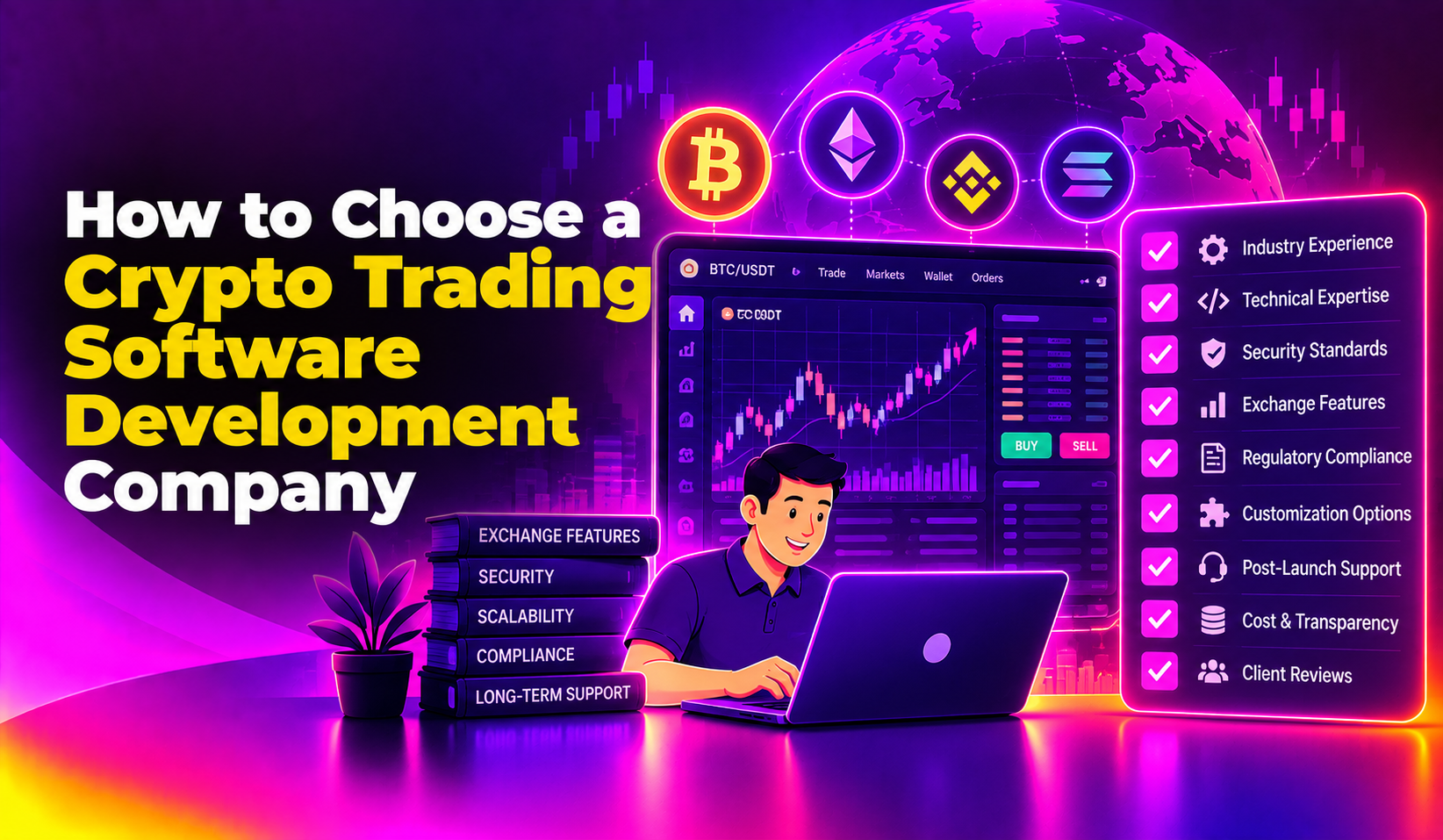
At minimum, a serious vendor must demonstrate command over seven interlocking subsystems:
- Order matching engine — capable of handling volume spikes without latency degradation
- Custody infrastructure — hot/cold wallet architecture with multi-signature and MPC support
- KYC/AML and compliance tooling — built to adapt to shifting regional frameworks (MiCA, FinCEN MSB, FIU-IND, etc.)
- Liquidity integration — API connectivity to market makers and liquidity providers so order books aren't empty on day one
- Payment and fiat on/off-ramp rails — banking partnerships and payment gateway integrations
- Risk and fraud controls — withdrawal limits, anomaly detection, circuit breakers
- User-facing trading interface — web and mobile apps with real-time charting and order types
If a vendor cannot speak fluently to each of these seven areas with specifics — not just marketing language — they are not ready to build a platform meant to launch in 2026's regulatory and security climate.
A useful way to think about this stage: every unanswered "how" in a vendor pitch becomes a risk you inherit after launch. If a sales team cannot explain how their matching engine handles a sudden 50x spike in order volume during a market crash, or how their custody model isolates a compromised hot wallet from cold reserves, assume the gap exists in the code, not just in the conversation. The founders who get burned in crypto trading software development are rarely the ones who asked too many hard questions during vendor selection — they're the ones who accepted vague reassurance instead of specifics.
Vendor Evaluation Checklist: Security, Compliance, and Track Record
Use this checklist literally during vendor calls. Score each vendor against every item — the goal is to eliminate anyone who cannot give a direct, specific answer.
- Security audits: Has the vendor's code been through independent third-party penetration testing or smart contract audits (e.g., CertiK, Hacken, Quantstamp)? Ask for a redacted audit report.
- Wallet architecture: Do they support multi-signature or MPC (multi-party computation) custody, cold storage segregation, and withdrawal whitelisting?
- Regulatory awareness: Can they name the specific licensing regime relevant to your target jurisdiction (MiCA in the EU, VASP registration, FIU-IND, MSB/FinCEN in the US) and how their KYC/AML module maps to it?
- Track record: Have they shipped a live, still-operating exchange or trading platform — not just a demo? Ask for a reference client you can actually contact.
- Source code ownership: Will you own 100% of the source code and IP after delivery, or are you locked into their proprietary core?
- Incident response history: Ask directly whether any platform they built has ever been breached, and how they responded. A vendor with zero real answer here is a red flag.
- Scalability testing: Has their matching engine been load-tested at realistic order-per-second volumes, not just demoed on low traffic?
- Post-launch support model: Is ongoing security patching, monitoring, and compliance updates included, or a separate costly add-on?
- Team composition: Do they have in-house blockchain security engineers and compliance specialists, or is this outsourced to unnamed subcontractors?
- Contract clarity: Is there a clear SLA, defined milestones, and an exit clause that avoids vendor lock-in?
Founders evaluating a crypto exchange development company often focus purely on price and timeline, but crypto trading software security failures are what actually end companies — FTX, Mt. Gox, and dozens of smaller exchanges collapsed from custody and control failures, not slow delivery. Weight security and compliance items in this checklist far higher than cost or speed.
How Much Does Crypto Trading Software Development Cost in 2026?
Real crypto trading platform development cost figures in 2026 vary enormously depending on whether you choose white-label or fully custom development:
- White-label MVP: roughly $8,000–$30,000, live in 2–3 months, suitable for a basic spot-trading exchange with limited customization.
- Advanced white-label (futures-ready): $60,000–$150,000, with additional $10,000–$50,000 for security hardening, compliance modules, and third-party integrations.
- Enterprise white-label: up to $250,000+, with monthly licensing fees often ranging $899–$5,000.
- Fully custom-built platform: typically $150,000 and up for a scoped build, and $1,000,000+ for a full-scale exchange with proprietary matching engine, custody, and compliance stack — usually taking 6–24 months.
The biggest cost levers are trading modules (spot vs. margin vs. futures vs. OTC desk), wallet depth (hot/cold split, MPC custody), KYC/AML integration depth, and the number of supported jurisdictions. Any vendor quoting a single flat number without asking about these variables is not scoping the project seriously.
It's worth running this checklist against at least three vendors side by side before making a decision, rather than evaluating each in isolation. Founders who compare only one vendor at a time tend to anchor on that vendor's framing of "industry standard" security and compliance — which is sometimes just their own limitations dressed up as normal practice. A genuine market comparison across three shortlisted vendors will quickly expose which one is underselling audit depth, glossing over jurisdictional compliance, or padding the timeline to hide scope they haven't actually planned for.
Custom-Built vs White-Label Platforms
This is the decision most founders get wrong by defaulting to whichever a salesperson pushes first.
When a White-Label Crypto Trading Platform Makes Sense
A white label crypto trading platform is the right call when speed-to-market matters more than deep customization — for example, launching in a single jurisdiction with standard spot/margin trading and no unusual compliance requirements. You inherit a proven codebase, reducing security risk from unproven custom code, but you also inherit licensing dependency on the white-label vendor and limits on how deeply you can customize matching logic or fee structures.
When Custom Development Is Worth the Investment
Custom development is justified when you need proprietary trading logic (algorithmic market-making, unique order types), multi-jurisdiction compliance flexibility, full IP ownership for fundraising or acquisition purposes, or integration with existing internal systems (internal ledgers, existing KYC providers, proprietary risk engines). It costs more and takes longer, but it removes long-term dependency on a third-party's roadmap and licensing terms.
Most serious fintech founders land on a hybrid: a custom-built core (matching engine, custody, compliance) combined with selectively licensed components (KYC vendor APIs, liquidity aggregation) rather than reinventing every layer from scratch.
Before signing with either type of vendor, insist on a written breakdown of exactly which components are proprietary to the vendor versus owned outright by you. It is common for white-label contracts to bury a clause granting the vendor perpetual rights to reuse core modules across other clients — which is fine for a generic UI template, but unacceptable for your matching engine configuration, compliance rule set, or liquidity routing logic if those represent your competitive edge. Read the IP assignment clause as carefully as the security section; the two are equally capable of derailing a fundraising round or acquisition later.
Red Flags to Walk Away From During Vendor Calls
A few warning signs consistently correlate with troubled crypto trading software projects down the line:
- "We'll figure out compliance later": Regulatory requirements shape architecture decisions from day one — custody structure, data residency, and reporting hooks all need to be designed in, not retrofitted after a regulator flags a gap.
- Refusal to share a reference client: Every vendor with real delivery history has at least one client willing to take a short call. If none exists, treat the vendor's "years of experience" claim as unverified.
- No mention of load testing: A matching engine that has never been stress-tested at realistic order volumes is a liability waiting for your first traffic spike — often your worst possible moment for downtime.
- Vague answers on wallet segregation: If a vendor can't clearly describe how hot and cold wallets are isolated and who holds custody keys, assume the custody model is underdeveloped.
- Pressure to sign before a technical scoping call: Legitimate vendors want to understand your compliance jurisdiction and trading volume expectations before quoting a final price — anyone skipping this step is guessing, not scoping.
Why Fintech Companies Choose CloudHouse for Crypto Trading Software Development
Fintech founders choose CloudHouse's crypto trading software development team because we build with security and compliance as the starting point, not an afterthought bolted on before launch. Our engineers scope custody architecture, KYC/AML integration, and jurisdiction-specific compliance requirements before writing a line of matching-engine code, and every build includes documented source-code ownership with no vendor lock-in. We also offer transparent, milestone-based pricing so founders know exactly what they're paying for at every stage — not a black-box quote.
Frequently Asked Questions
How much does it cost to build a crypto trading platform?
Costs range from roughly $8,000 for a basic white-label MVP to $1,000,000+ for a fully custom, enterprise-grade exchange. Most mid-market fintech founders building a compliant custom platform with real security architecture should budget $150,000–$400,000 depending on jurisdiction and feature scope.
How long does crypto trading software development take?
A white-label platform can launch in 2–3 months. A custom-built platform with proper security audits, compliance integration, and load testing typically takes 6–12 months, and a full-scale exchange with proprietary infrastructure can take 12–24 months.
What crypto trading software features are essential at launch?
At minimum: a tested order-matching engine, multi-signature or MPC wallet custody, KYC/AML onboarding, real-time trading UI with charting, withdrawal/fraud controls, and an admin dashboard for compliance reporting. Advanced features like margin trading, staking, and API trading can follow post-launch.
Is a white-label crypto exchange safe to launch with?
It can be, provided the underlying codebase has been independently audited and the vendor offers dedicated custody security. Ask for the audit report before signing — a white-label platform is only as safe as the code it's built on, regardless of how polished the sales demo looks.
Do you offer a fixed-price or milestone-based engagement for crypto platform development?
Yes. CloudHouse structures crypto trading software engagements around clear milestones — architecture and compliance scoping, core engine development, security audit, and launch — so founders can approve budget in stages rather than committing to a single opaque lump sum upfront.
Picking the right partner for a crypto trading platform is a security and compliance decision as much as a technical one. Run every vendor through the checklist above before signing anything, and weight track record and audit history above price and delivery speed — the cheapest quote is rarely the cheapest outcome once a security incident or regulatory gap forces a rebuild.