If you are about to sign a contract with a DevOps support provider, the details in the fine print matter more than the pitch deck. This devops support checklist gives engineering managers and startup CTOs a concrete, pre-hire framework to verify CI/CD ownership, incident response, and on-call coverage before money changes hands — not after your first outage.
What DevOps Support Should Actually Cover in 2026
Most vendor websites describe DevOps support in vague terms: "automation," "cloud expertise," "24/7 monitoring." In practice, a real DevOps support engagement in 2026 covers five concrete responsibility areas: CI/CD pipeline ownership, infrastructure-as-code maintenance, incident response and on-call rotation, security and secrets management, and cost/performance optimization. A provider that cannot map their service to these five areas with specifics — not marketing language — is not ready to run production infrastructure for you.
This matters because outsourced DevOps has become the default for startups and mid-market engineering teams that cannot justify a full in-house SRE function. CloudHouse's DevOps support service is built around exactly this model: a right-sized team that plugs into your existing stack rather than forcing a rebuild.
Why a Checklist Beats a Sales Call
A sales call is optimized to get you to sign. A checklist is optimized to protect you after you sign. The difference shows up three months in, when an incident happens at 2 a.m. and you find out the "24/7 support" in the deck actually means a ticket queue with a next-business-day response. Verifying claims against a written checklist — before the contract, not during renewal — is the only reliable way to avoid that gap.
💡 None of these worked? Skip the guesswork.
Get Expert Help →CI/CD & Infrastructure Checklist to Verify
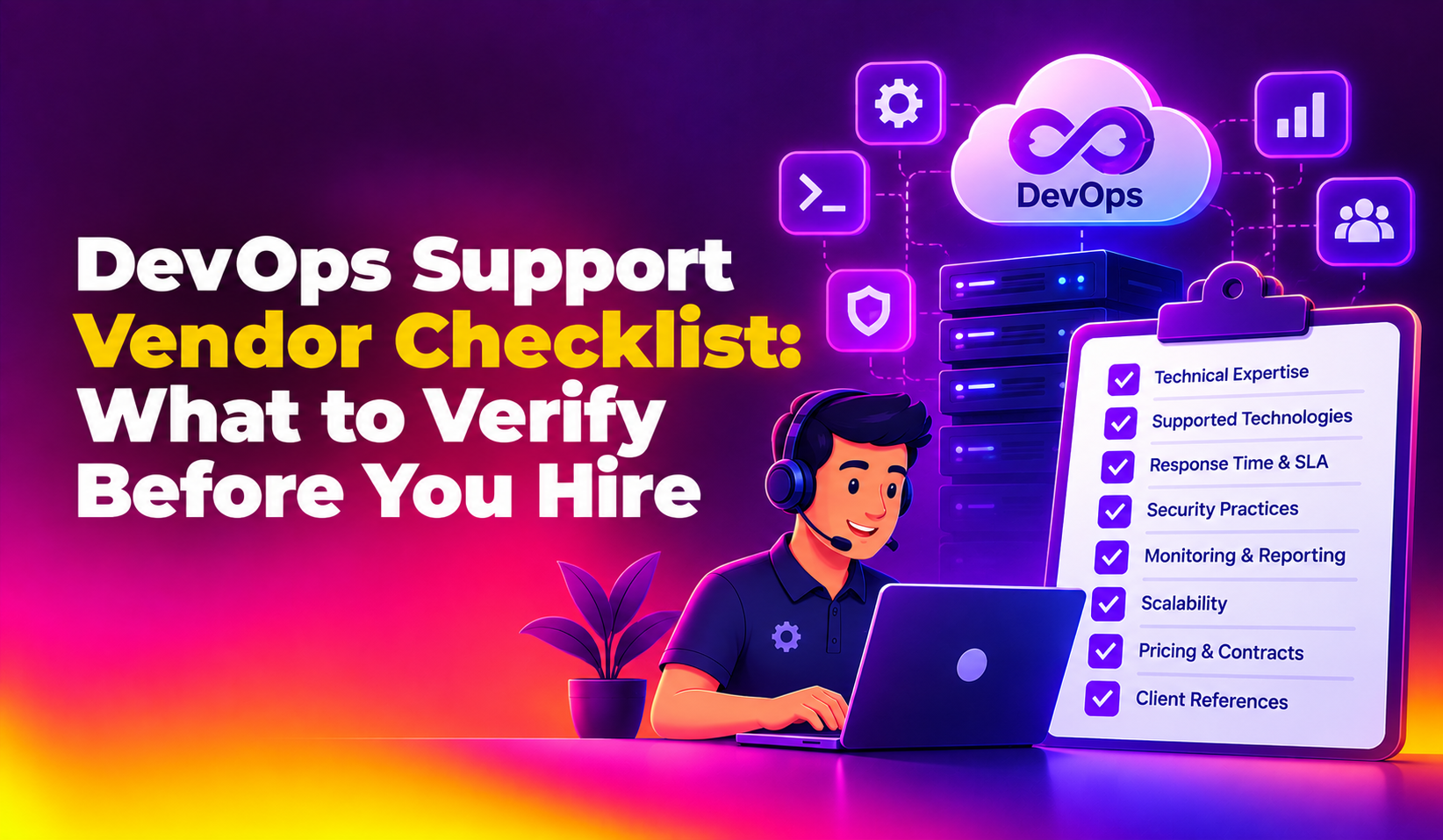
CI/CD is the backbone of any DevOps engagement, and it's also the area where vendors most often oversell. Before signing, verify the following with concrete evidence — screenshots, sample pipeline configs, or a live walkthrough, not just a verbal yes.
- Do they support your existing CI/CD tooling (GitHub Actions, GitLab CI, Jenkins, CircleCI) without forcing a migration?
- Can they show a sample pipeline with build, test, security scan, and deploy stages for a stack similar to yours?
- Is infrastructure managed as code (Terraform, Pulumi, CloudFormation) with version-controlled state, or are changes made manually in cloud consoles?
- What is their rollback process when a deployment fails mid-release, and how fast can they execute it?
- Do they support blue-green or canary deployments, or is every release a full-cutover risk?
- How do they handle secrets management — dedicated vault tooling (HashiCorp Vault, AWS Secrets Manager) versus environment variables in plaintext?
- Will they provide read access to your own pipeline definitions and infrastructure code, or is the configuration locked inside their tooling only?
Ask the vendor to share their screen and walk through an actual pipeline run — ideally for a client with a comparable tech stack. Vague answers about "supporting all major cloud platforms" without specifics on tooling versions are a signal to keep asking questions, not to relax.
You should retain access to and ownership of your Terraform/IaC repos regardless of which vendor manages them. If a vendor is reluctant to grant this, treat it as a lock-in risk.
Ask how staging and production environments are kept in sync, and whether infrastructure drift is detected automatically or discovered manually after something breaks.
A credible vendor can produce (with client details redacted) an actual incident timeline showing detection, acknowledgment, escalation, resolution, and postmortem. If they can only describe process in the abstract, the on-call coverage is likely aspirational rather than operational.
"An engineer will be notified" is not an answer. You want a named escalation path: primary on-call, secondary on-call, and an engineering lead who gets paged automatically if an incident breaches its SLA clock.
Questions to Ask Before Signing a DevOps Support Contract
Beyond CI/CD and on-call, a handful of contract-level questions determine whether the engagement will actually flex with your business as it grows or changes.
- What is the minimum contract term, and what does an early exit or downgrade look like?
- How is pricing structured — flat retainer, per-incident, or hybrid — and what triggers overage charges?
- How long does onboarding take before the vendor is fully accountable for on-call coverage?
- Who owns the relationship if the primary engineer assigned to your account leaves the vendor?
- Can the engagement scale up (additional on-call coverage, more environments) without a full contract renegotiation?
- Is there a trial period or pilot engagement before a long-term commitment?
- What reporting cadence do you get — weekly, monthly — and does it include concrete metrics (uptime, MTTR, deployment frequency) rather than a narrative summary?
Getting these answers in writing before signing is the single highest-leverage thing you can do to de-risk a DevOps support hire. A vendor that hesitates to commit any of this to a contract clause is telling you, indirectly, how the engagement will actually run.
Why Businesses Choose CloudHouse for DevOps Support
CloudHouse structures its DevOps support service around the exact gaps this checklist is built to catch: named on-call engineers with documented escalation paths, infrastructure-as-code you retain ownership of, and incident postmortems delivered on a fixed schedule rather than "when we get to it." Clients get a pilot-friendly onboarding process and monthly reporting tied to real metrics — deployment frequency, MTTR, uptime — instead of a narrative update. The result is a support relationship engineering leaders can actually audit, not just trust.
Frequently Asked Questions
How much does DevOps support typically cost?
Pricing varies by scope, but most vendors offer either a flat monthly retainer covering a defined set of environments and on-call hours, or a hybrid model with a base retainer plus per-incident charges beyond an included threshold. Ask for a breakdown of what's included in the base fee — especially on-call coverage hours — before comparing quotes across vendors.
What SLA should I expect for on-call incident response?
For critical (P0) incidents, a credible SLA targets acknowledgment within 5-15 minutes and a clearly defined resolution target, often under an hour for service-restoring action even if full root-cause resolution takes longer. Get these numbers in the contract, not just in a sales conversation, and confirm what happens if the SLA is missed.
How long does onboarding take before a vendor can take over on-call coverage?
A realistic onboarding window is two to four weeks for a vendor to review your infrastructure, document runbooks, and shadow your team before assuming full on-call responsibility. Be cautious of vendors promising same-week full ownership — that usually means they skip the runbook and system-familiarity phase entirely.
Can I switch DevOps vendors without disrupting operations?
Yes, if the outgoing and incoming vendors both maintain infrastructure as code and documented runbooks that you own. This is exactly why contract clauses about IaC ownership and documentation handoff matter — they determine whether a vendor switch takes days or becomes a multi-month re-discovery project.
What contract flexibility should I look for?
Look for a pilot or short initial term (one to three months) before a longer commitment, plus clear terms for scaling coverage up or down without a full renegotiation. Avoid multi-year lock-ins with no exit clause, especially with a new vendor relationship you haven't yet stress-tested during a real incident.