If you have been searching for a straight answer on what DevOps support actually costs in 2026, you have probably noticed a pattern: most vendor pages talk about "scalability" and "24/7 monitoring" but avoid publishing real numbers. That vagueness makes budgeting difficult, especially when you are comparing an in-house hire against an outsourced DevOps support service.
This guide breaks down actual DevOps support pricing models, what drives cost up or down, and how to choose a model that fits your infrastructure without overpaying for coverage you don't need.
Why DevOps Support Pricing Varies So Much
DevOps support cost is not a single number because it depends on several variables that change from one business to the next:
- Infrastructure complexity — a single-region app on managed services costs far less to support than a multi-cloud, multi-region setup with Kubernetes clusters.
- Coverage window — business-hours support is cheaper than true 24/7/365 on-call coverage with guaranteed response SLAs.
- Team size and seniority — junior engineers handling routine tickets cost less than senior DevOps/SRE engineers who redesign pipelines and handle incident response.
- Cloud spend — some providers price partly as a percentage of your monthly AWS, Azure, or GCP bill, since larger environments need more active management.
- Tooling stack — CI/CD pipelines, IaC (Terraform/Pulumi), observability stacks, and security tooling all add setup and maintenance overhead.
DevOps Support Pricing Models Compared
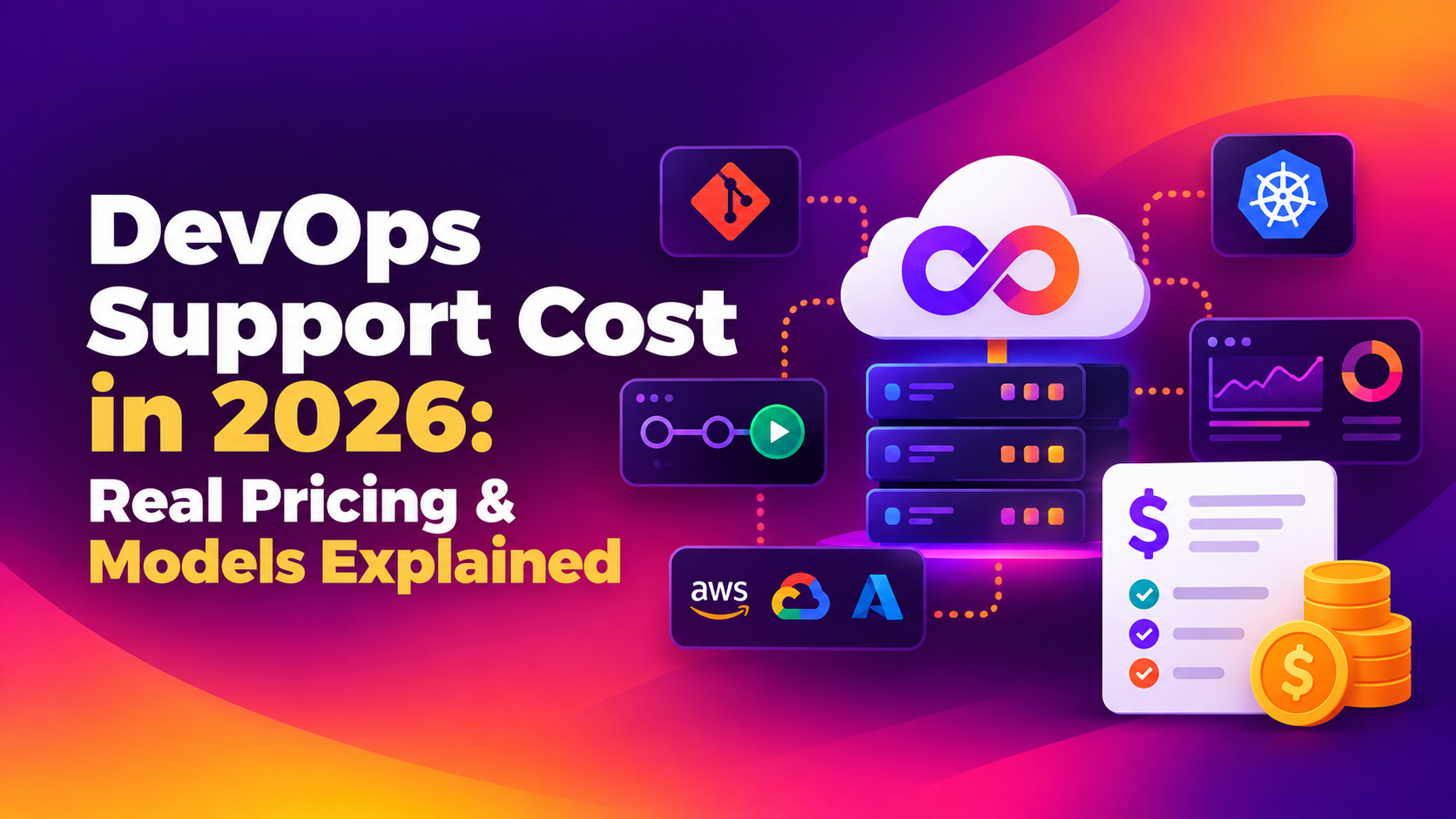
In 2026, most providers price DevOps support using one of three models: hourly consulting, monthly retainer, or project-based fixed pricing. Each has trade-offs depending on whether you need ongoing operational support or a one-time infrastructure overhaul.
| Pricing Model | Typical Range (2026) | Best For | Watch Out For |
|---|---|---|---|
| Hourly Consulting | $35–$75/hr (offshore) to $150–$220/hr (onshore senior) | Short-term fixes, audits, one-off migrations | Costs can balloon on open-ended incidents without a cap |
| Monthly Retainer (Managed DevOps) | $3,500–$8,000/month (small/mid environments), $10,000–$18,000/month (larger, multi-service stacks) | Ongoing monitoring, CI/CD maintenance, on-call coverage | Check what's actually included — some retainers exclude major incident response or after-hours escalation |
| Project-Based (Fixed Scope) | $8,000–$40,000+ depending on scope | Kubernetes migration, CI/CD pipeline build-out, cloud cost optimization projects | Scope creep — get deliverables and acceptance criteria in writing |
| Hybrid (Retainer + % of Cloud Spend) | Base retainer ($8,000–$10,000/month) + 5–10% of monthly cloud bill | Fast-growing infra where cloud spend scales month to month | Can get expensive quickly once cloud spend grows — model it against a fixed retainer |
For comparison, a single senior in-house DevOps engineer in the US typically costs $180,000–$250,000/year fully loaded (roughly $15,000–$21,000/month) — before accounting for recruiting time, benefits, and the risk of losing that one person mid-incident. A managed DevOps support service with a small team often costs less than one full-time senior hire while providing redundancy across multiple engineers.
What Most DevOps Providers Don't Tell You
Most competitor content in this space stops at "it depends" without giving usable numbers, and rarely publishes clear vendor-selection criteria. A few things worth checking before signing anything:
- What counts as an "incident"? Some retainers only cover monitoring alerts, not active incident response or root-cause fixes.
- Response time SLAs — ask for numbers in writing (e.g., 15-minute response for P1 incidents), not just "fast response."
- Onboarding time — a provider that needs 6-8 weeks just to understand your infra before delivering value is a hidden cost.
- Exit terms — can you leave with 30 days' notice, or are you locked into a 12-month contract regardless of performance?
How to Choose the Right Model for Your Business
As a rough rule of thumb:
- If you need a one-time migration or audit, hourly or project-based pricing is more cost-efficient.
- If you run production systems that need ongoing monitoring, patching, and on-call coverage, a monthly retainer gives predictable budgeting.
- If your cloud spend is growing fast and infrastructure changes monthly, a hybrid model can align provider incentives with your growth — but model the cost at 2x your current cloud spend before committing.
Why Businesses Choose CloudHouse for DevOps Support
CloudHouse runs DevOps support on transparent monthly retainers with published response-time SLAs, so you know exactly what you're paying for before you sign anything. Our engineers handle everything from CI/CD pipeline maintenance to incident response and cloud cost optimization, with month-to-month flexibility instead of long lock-in contracts.
Frequently Asked Questions
How much does DevOps support cost per month in 2026?
Most managed DevOps retainers range from $3,500 to $18,000 per month depending on infrastructure size, coverage hours, and team seniority. Small to mid-size environments typically fall in the $3,500–$8,000/month range.
Is hourly or retainer pricing better for DevOps support?
Hourly pricing works well for short, well-defined projects like audits or one-time migrations. Retainers are better for ongoing production support because they provide predictable monthly costs and guaranteed availability rather than per-incident billing.
How long does it take to onboard a DevOps support provider?
A well-run onboarding should take 1-3 weeks for small to mid-size environments — enough time to review infrastructure, set up monitoring access, and agree on escalation paths. If a provider quotes 6+ weeks before delivering any value, treat that as a red flag.
Can I try DevOps support on a month-to-month basis before committing long-term?
Yes — many providers, including CloudHouse, offer month-to-month terms rather than forcing a 12-month contract upfront. This lets you validate response times and service quality before committing to a longer retainer.
Does DevOps support pricing include cloud cost optimization?
Not always — some providers bill cloud cost optimization as a separate project. Confirm whether ongoing cost reviews and right-sizing recommendations are included in your retainer or billed additionally.