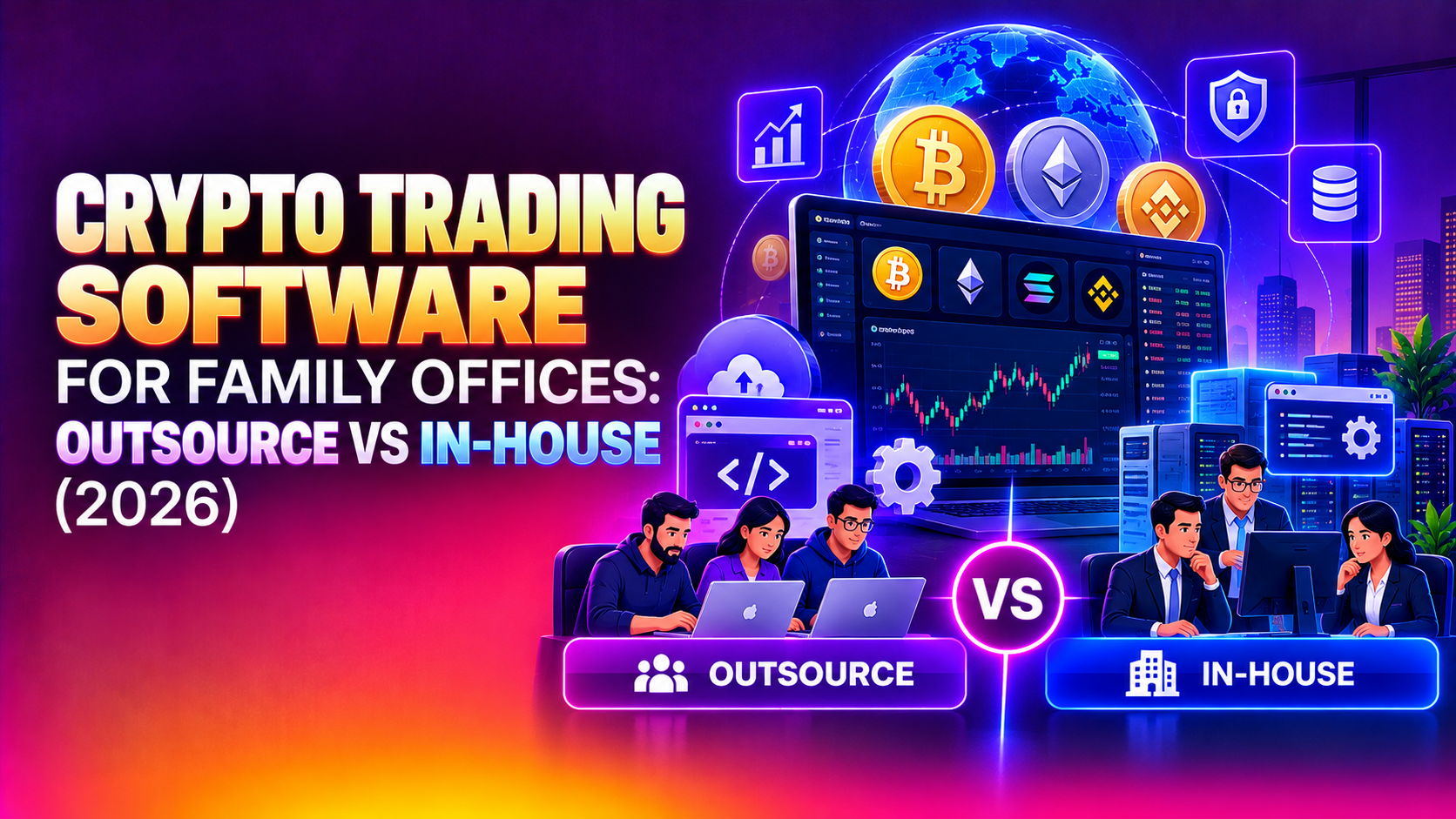
A family office that wants to trade digital assets eventually faces the same question: do we build the execution and control tooling ourselves, or hand it to a specialist? This article compares crypto trading software outsourced vs in-house family office setups, so CIOs and operations heads can decide who should own the build. It covers custody and key management, exchange connectivity, risk limits, reporting and audit trail, which are the areas where family offices usually feel the most pressure.
Nothing here is a guarantee of any outcome, and every office is different. Use it as a framework, then ask any provider for an itemised quote against your own requirements. If you want to see what an outside build looks like, our crypto trading software development service page outlines how we scope this work.
Why family offices have a different requirement
A trading firm optimises for speed and volume. A family office usually optimises for control, privacy and accountability to a small group of principals. That changes what good software looks like.
- Few operators, high consequence: a small team may be responsible for large allocations, so one mistaken order or one leaked credential matters a great deal.
- Principal-level reporting: family members, trustees and external advisers expect clear statements, not raw exchange exports.
- Mixed mandates: holdings may sit across several entities, trusts or wallets, each with its own approval rules.
- Discretion: the office often does not want strategy details, balances or counterparties visible to a large outside vendor team.
- Long horizon: tooling has to be maintainable for years, even when the people who commissioned it have moved on.
What you are actually building
"Trading software" is shorthand for several separate components. Seeing them individually makes the in-house versus outsourced decision much clearer.
Custody and key management
This is the part where mistakes are least forgiving. The software has to decide where keys live, who can approve a transfer and how recovery works if a person leaves. Typical designs involve hardware security modules or institutional custodians, multi-party approval, withdrawal allow-lists and clear separation between the people who initiate and the people who approve. Whoever builds it must understand that the safest design is often the one that removes the software from direct control of funds.
Exchange and venue connectivity
Each exchange, broker or over-the-counter desk has its own API behaviour, rate limits, order types and failure modes. A connectivity layer normalises these so a trader sees one view. It also has to handle disconnects, partial fills, duplicate order protection and maintenance windows without leaving positions in an unknown state.
Pre-trade risk limits
Risk controls should sit between the trader and the venue, not inside a spreadsheet. Examples include per-order size caps, daily loss thresholds, concentration limits per asset or venue, restricted asset lists and a kill switch that cancels open orders. For a family office, these limits usually reflect the investment policy statement, so they need to be configurable by the office and not buried in code.
Reporting and reconciliation
Positions, cost basis, realised and unrealised gains, fees and transfers between wallets must reconcile with what exchanges and custodians report. Accountants and tax advisers need exports they can trust, and principals need summaries they can read.
Audit trail
Every order, approval, limit change and login should be recorded in a tamper-evident log with who, what and when. This is what lets you answer an auditor, a trustee or a regulator without reconstructing events from memory.
Building in-house: where it fits
An in-house build can make sense when the office already employs engineers with exchange and security experience, when the strategy is proprietary and must never leave the building, or when the scope is narrow, for example one venue and a simple reporting feed.
The honest costs are less obvious. Family offices often underestimate that the first version is only the start. APIs change, venues add or remove features, and security practices evolve. Someone must be on call when an order router misbehaves at night. Key-person risk is also real: if the one engineer who understands the approval workflow leaves, the office is left with software nobody can safely change. Hiring, retaining and managing a specialised team is a substantial and ongoing commitment, and it competes with the office's core job of managing wealth.
Outsourcing: where it fits
Outsourcing suits offices that want production-grade tooling without building a permanent engineering function. A specialist team has usually seen common failure modes in connectivity, order handling and reconciliation, and can bring tested patterns instead of learning on your capital.
The risks are different but real. You must trust a third party with sensitive design details, you depend on their availability after launch, and poor contract terms can leave you with code you cannot maintain. These risks are manageable when you insist on the right terms, which we cover below. Our outsourced crypto trading software team works this way: planned delivery, documented handover and an itemised quote.
Outsourced vs in-house: side-by-side comparison
| Factor | In-house build | Outsourced build |
|---|---|---|
| Upfront cost | Moderate to high: recruiting, salaries, tooling and security reviews before any value is delivered | Project-based and more predictable when scoped and itemised, though still significant |
| Ongoing cost | Permanent headcount, on-call cover and training | Optional support or maintenance retainer, scaled to need |
| Time to first working version | Slower, because hiring and design come first | Usually faster, with an experienced team starting on a defined plan |
| Custody and key management | Full internal control, but depends on a few individuals | Strong when the vendor has security experience; design must be reviewed by you |
| Exchange connectivity upkeep | Your team tracks every API change | Can be covered by a support agreement |
| Confidentiality of strategy | Highest, as knowledge stays inside | Depends on contracts, access limits and what you choose to share |
| Key-person risk | High when one or two engineers hold the knowledge | Lower if documentation and handover are contractual |
| Audit trail and reporting | Built to your exact needs, but often deprioritised | Can be specified up front as a deliverable |
| Flexibility to change later | High | High if you own the code and documentation |
The table shows that neither route is always better. In-house wins on secrecy and control. Outsourcing wins on speed, breadth of experience and reduced dependence on individuals.
What drives cost either way
We will not quote figures in an article, because they depend on your scope. Instead, these are the factors that move the price, whichever route you choose.
- The number of venues, custodians and asset types to connect.
- Whether execution is manual with approvals or partly automated.
- The depth of risk controls and the number of approval tiers.
- Reporting complexity, including multiple entities and tax-ready exports.
- Security reviews, penetration testing and independent code review.
- Support expectations after launch, including response commitments.
When comparing routes, put a realistic estimate of internal salary, management time and replacement risk next to an itemised vendor quote. Compare like with like.
A middle path many offices consider
The choice is not strictly binary. A common arrangement keeps strategy, risk policy and final approval inside the office, while an outside team builds and maintains connectivity, reporting and the audit log. That keeps confidential decisions private while avoiding the burden of maintaining every integration. If you take this route, define precisely which components are yours and which are the vendor's, so responsibility is never ambiguous.
Terms to insist on if you outsource
- Code and documentation ownership: you should receive the source, architecture notes and deployment instructions.
- Access discipline: the vendor should never hold production keys or withdrawal authority. Approvals stay with your people.
- Staged environments: testing against sandbox or low-value accounts before live use.
- Independent security review: a review of key handling and approval flows before real funds are involved.
- Confidentiality and data handling: written terms covering who sees strategy details and where data is stored.
- Exit plan: a defined handover process so you can move maintenance in-house or to another firm.
- Support commitments: written response expectations for incidents, especially around venue outages.
Questions to ask before you decide
- Who inside the office will own the system after launch?
- What happens if the lead engineer or vendor contact leaves?
- Can we describe our investment policy in rules a system can enforce?
- Which components must remain strictly confidential?
- How would an auditor reconstruct a disputed trade from our logs?
If these answers are unclear, a short scoping engagement with an outside team can clarify requirements before you commit to either route.
Why Companies Choose CloudHouse for Crypto Trading Software Development
Clients come to CloudHouse because we plan delivery in stages, stay available for support after launch and provide transparent, itemised quotes so you can see what each component costs. We design with your approval and custody policies in mind instead of asking you to adapt to ours. You can read more about the approach on our crypto trading software development company page.
Conclusion
For a family office, the in-house versus outsourced decision comes down to control, continuity and the real cost of owning specialised software over time. Build in-house if you have the people, the appetite for ongoing maintenance and a strong reason to keep everything internal. Outsource, or split the work, if you want tested engineering, documented handover and less dependence on a few individuals. Either way, insist on clear ownership of code, strict separation of custody and software, and a durable audit trail. To discuss your requirements and receive an itemised proposal, visit our crypto trading software development company in Kochi page and request a quote.