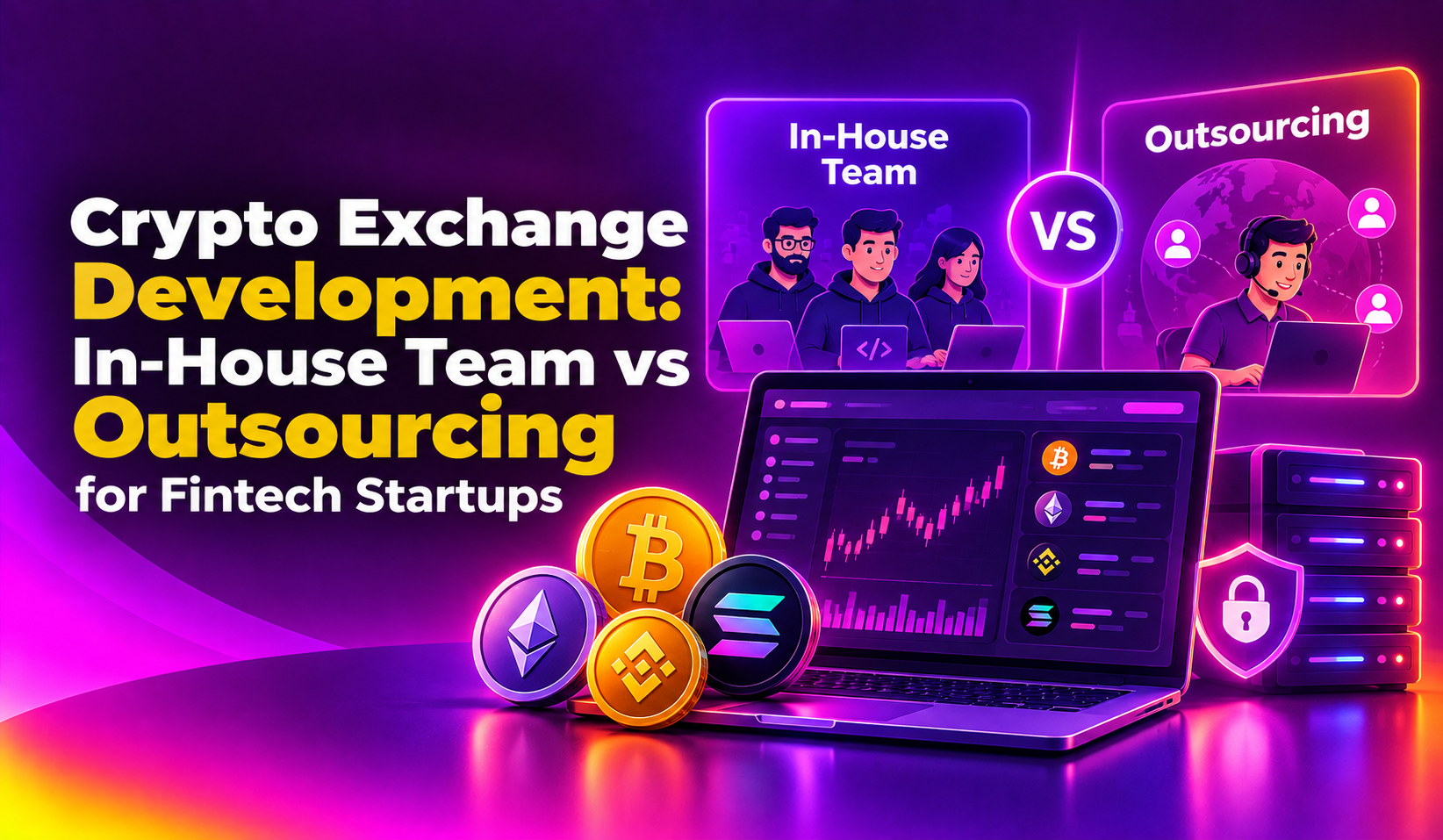
Every fintech founder building a crypto exchange eventually hits the same fork in the road: hire an internal engineering team, or bring in an outsourced development partner. The decision behind crypto exchange development in-house vs outsourcing isn't just about cost — it's about compliance risk, time-to-market, and whether your first product ships before your funding runway runs out. This guide breaks down the real tradeoffs so you can make the call with confidence.
Unlike generic software projects, a crypto exchange sits at the intersection of financial regulation, security engineering, and 24/7 trading infrastructure. Get the team wrong and you're not just late to market — you're exposed to licensing delays, failed audits, and security gaps that can sink a fintech startup before it earns its first dollar of revenue.
Why This Decision Is Different for Crypto Exchanges
Most "build vs outsource" advice was written for SaaS dashboards and e-commerce apps. Crypto exchange development carries three pressures that don't exist in ordinary software projects:
- Regulatory exposure — KYC/AML workflows, transaction monitoring, and jurisdiction-specific licensing (MiCA in the EU, FinCEN MSB registration in the US, VARA in Dubai) must be baked into the architecture from day one, not bolted on later.
- Security-critical code — a bug in a wallet module or matching engine isn't a support ticket, it's a headline. Exchanges are the single most-attacked category of fintech software.
- Time-to-market pressure — crypto market cycles move fast. A six-month hiring delay while you build an internal team can mean missing the window entirely.
These three factors are why the standard "hire slowly, build a permanent team" playbook often fails fintech startups specifically — and why so many founders are re-evaluating hire crypto developers vs agency decisions before writing their first job description.
In-House vs Outsourced: The Full Comparison
Here's how the two paths compare across the four factors that matter most to a fintech startup crypto development team: cost, time-to-market, compliance risk, and talent scarcity.
| Factor | In-House Team | Outsourced Development Partner |
|---|---|---|
| Cost | High fixed cost: senior blockchain engineer salaries ($130k–$220k+ in the US/EU), recruiter fees, benefits, equipment, and management overhead — payable whether or not the product ships on time. | Milestone or project-based pricing. Lower upfront burn, cost scales with actual delivery. No recruiting fees, no idle bench time between sprints. |
| Time-to-Market | 3–6 months typical just to hire 4–6 qualified blockchain/security engineers, before writing a line of exchange code. Onboarding and internal process-building adds more delay. | A specialized partner starts from an existing, battle-tested exchange codebase and compliance playbook — MVP exchanges can launch in 8–14 weeks. |
| Compliance Risk | Requires hiring or training staff on KYC/AML frameworks, sanctions screening, and multi-jurisdiction licensing — a steep learning curve most first-time fintech teams underestimate. | Experienced partners have already implemented KYC/AML, transaction monitoring, and audit-ready reporting on prior exchanges — those "hard lessons" transfer directly to your build. |
| Talent Scarcity | Engineers who understand order-book architecture, custody/key management, and regulatory constraints are rare and expensive; most are already employed at exchanges or Web3 firms. | An established development partner already has this bench built — you access senior expertise without competing in the same tight hiring market. |
| Long-Term Control | Full ownership of IP, roadmap, and institutional knowledge stays in-house permanently. | IP can be fully transferred contractually; many startups outsource the initial build, then hire a smaller internal team to maintain and extend it post-launch. |
💡 None of these worked? Skip the guesswork.
Get Expert Help →When In-House Actually Makes Sense
In-house isn't wrong for every startup — it's the right call when:
With 18+ months of runway and a validated product, you can afford the hiring timeline and want to own every layer of the stack long-term.
If your competitive edge is a proprietary matching engine or a novel custody model, keeping that expertise in-house protects it from walking out the door with a contractor.
A founder who has shipped exchange infrastructure before can recruit and vet the right specialists faster than a non-technical founder can.
When Outsourcing Wins for Fintech Startups
For most early-stage fintech startups, outsourcing is the more defensible choice because:
- You need to validate demand and secure regulatory approval before committing to a permanent engineering payroll
- Your runway is measured in months, not years, and a 4–6 month hiring delay is not survivable
- You lack an in-house compliance function and need a partner who already understands KYC/AML implementation, not just the business requirement
- You want to launch an MVP exchange, gather real trading volume data, and only then decide whether to build a permanent internal team
This is precisely the gap that specialized partners like CloudHouse Technologies' crypto trading software development team are built to close — combining exchange-specific engineering with the compliance and security experience that most first-time in-house hires simply haven't accumulated yet.
The Hidden Costs Founders Miss
When founders run the numbers on crypto exchange development in-house vs outsourcing, they often compare only salary versus invoice — and miss the costs that actually move the needle:
- Recruiting cost — agency or in-house recruiter fees for hard-to-fill blockchain roles often run 20–30% of first-year salary per hire.
- Security audit rework — an internal team building its first exchange typically needs 2–3 rounds of external security audits before launch, each adding weeks and five-figure costs. Experienced partners reduce this because their code has already passed prior audits.
- Compliance re-architecture — bolting KYC/AML onto an exchange that wasn't designed for it from day one frequently means rebuilding core transaction flows, not just adding a form.
- Opportunity cost of delay — every month spent hiring instead of shipping is a month competitors can use to capture your target users.
A Practical Decision Framework
Ask these four questions before deciding:
1. How much runway do you have? Under 12 months — lean outsourced. Over 18 months with a validated model — in-house becomes viable.
2. Do you have compliance expertise on the founding team? If not, an outsourced partner with existing KYC/AML implementation experience closes that gap immediately.
3. Is your differentiator the technology itself, or the market you serve? If it's the market (a regional exchange, a niche asset class), outsourcing the underlying engineering is low-risk. If it's proprietary trading technology, in-house protects that IP.
4. Can you realistically hire 4–6 specialized engineers in the next quarter? In most cities, the honest answer is no — which is exactly why hybrid models (outsourced build, smaller in-house team for maintenance) have become the default path for fintech startups entering crypto exchange development in 2026.
Why Fintech Startups Choose CloudHouse for Crypto Exchange Development
CloudHouse Technologies works specifically with fintech startups that need to move fast without cutting corners on compliance or security. Our teams bring existing KYC/AML implementation patterns, audited matching-engine architecture, and multi-jurisdiction licensing experience to every engagement — so you're not paying to relearn lessons other exchanges already paid for. We also offer flexible engagement models, letting you start with an outsourced MVP build and transition to a hybrid or in-house model once you've validated your market, without a rebuild.
Get a Free Quote for Crypto Exchange Development
If you're weighing in-house hiring against outsourcing for your crypto exchange, don't guess — get a clear, project-specific cost and timeline estimate before you commit either way. CloudHouse Technologies' crypto trading software development team can scope your MVP, map the compliance requirements for your target jurisdictions, and give you a realistic launch timeline within days, not months. Book a free consultation today and find out which path actually gets you to market faster.
Red Flags to Watch for With Either Path
Whichever direction you lean, certain warning signs should make you pause before committing budget or headcount:
- In-house red flag: a candidate who claims blockchain experience but can't speak concretely about order-book design, cold/hot wallet separation, or double-spend prevention. Surface-level Web3 familiarity is not the same as exchange engineering experience.
- Outsourcing red flag: a development agency that quotes a fixed price without asking which jurisdictions you plan to operate in. Compliance scope changes the architecture, and any partner who skips that conversation is likely reusing a generic template rather than building for your regulatory reality.
- Either path red flag: no clear answer on who owns the source code and IP after launch. Get this in writing before development starts, not after.
- Security red flag: any team, internal or outsourced, that treats a third-party smart contract or wallet security audit as optional rather than a mandatory pre-launch gate.
A Hybrid Model Is Often the Real Answer
In practice, the choice isn't always binary. Many successful fintech startups blend both approaches: they outsource the initial exchange build — matching engine, wallet infrastructure, KYC/AML integration — to move fast and de-risk the regulatory groundwork, then hire a lean internal team (often just 2–3 engineers) to own ongoing feature development, customer-facing support, and day-to-day operations once the exchange is live and generating revenue.
This hybrid path captures the speed and compliance experience of an outsourced partner during the highest-risk phase of the business — pre-launch, pre-revenue — while still building internal ownership over time as the company matures. It also avoids the worst outcome in this decision: spending six months hiring an in-house team, only to discover mid-build that nobody on the team has actually implemented KYC/AML transaction monitoring at exchange scale before.
Frequently Asked Questions
Is it cheaper to build a crypto exchange in-house or outsource it?
Outsourcing is almost always cheaper in the first 12–18 months because you avoid recruiting fees, full-time salaries, benefits, and idle engineering time between milestones. In-house can become more cost-efficient long-term only once your product is validated and you're scaling a mature platform with predictable ongoing engineering needs.
How much does crypto exchange development cost with an outsourced team?
An MVP crypto exchange with core trading, wallet, and basic KYC/AML functionality typically ranges from the low-to-mid six figures depending on features, blockchain networks supported, and compliance scope. Costs scale up with advanced order types, multi-asset support, and additional jurisdictional compliance modules. Get a project-specific quote rather than relying on generic estimates, since scope varies significantly.
How long does it take to launch a crypto exchange with an outsourced partner vs an in-house team?
An experienced outsourced partner can typically deliver an MVP exchange in 8–14 weeks because they start from proven architecture and compliance playbooks. An in-house team usually needs 3–6 months just to hire and onboard before development even begins, pushing total time-to-market out to 6–9 months or longer.
Do outsourced crypto development teams handle regulatory compliance?
Reputable crypto exchange development partners build KYC/AML workflows, transaction monitoring, and audit-ready reporting directly into the platform architecture, based on experience across prior exchange builds. That said, you should always confirm which specific jurisdictions and regulatory frameworks (MiCA, FinCEN, VARA, etc.) a partner has direct implementation experience with before signing a contract.
What if we outsource now and want to bring development in-house later?
This is one of the most common paths for fintech startups: outsource the initial MVP build to validate the market and secure funding, then hire a smaller internal team to maintain and extend the platform once you have traction. To make this transition smooth, ensure your outsourcing contract includes full IP transfer and clean, well-documented code — CloudHouse structures every engagement this way by default.