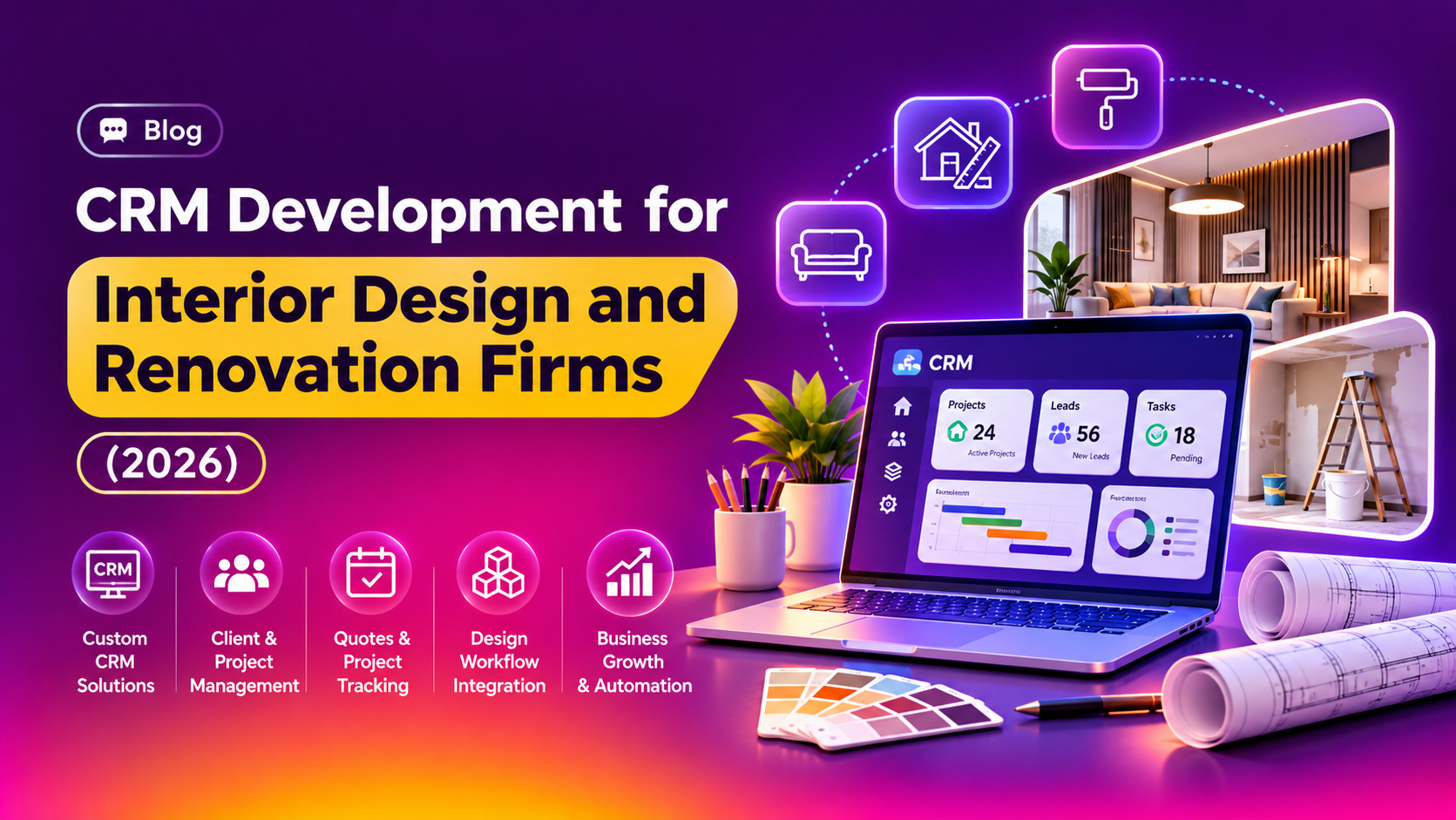
Interior design and renovation businesses run on a long chain of small commitments: an enquiry, a site visit, a first quotation, three revisions, a material selection, a vendor booking and a stage payment. Most firms track this in WhatsApp chats, spreadsheets and a founder's memory. This guide explains what CRM development for interior design and home renovation firms should actually cover, which options exist, and how to judge them against your own workflow.
Nothing here promises a particular result, and every studio works differently. Use it as a framework, then request an itemised quote against your real process. If you want to see how a custom build is scoped, our CRM development service page explains the approach.
Why generic CRMs struggle with interior projects
A standard sales CRM assumes a simple path: lead, deal, won or lost. An interior or renovation project does not end when the client says yes. That is when the most expensive and error-prone work begins. The sales record needs to flow into design, procurement, site execution and collections without anyone retyping it.
- Long, branching cycles: a client may pause for months, return with a new scope, or ask for a second quotation for another room.
- Many versions of one document: quotations change repeatedly, and the team must know which version the client approved.
- Physical work on site: measurements, photos and snag lists belong with the client record, not on someone's phone.
- Third parties everywhere: carpenters, electricians, tile suppliers and fabricators all affect the timeline.
- Money tied to progress: payments depend on stages being completed and approved, not on calendar dates.
Enquiry capture: stop losing leads at the first step
Enquiries arrive from your website form, social media, WhatsApp, phone calls, architects, builders and referrals from past clients. The first requirement of a good CRM is that every one of these lands in one place with the source recorded.
Useful capture fields for this niche include property type, location, carpet area, whether the property is new or being renovated, rooms in scope, target move-in timeline and a rough budget band the client is comfortable sharing. Automatic assignment to a designer, plus a reminder if nobody responds within a set time, prevents the common problem of a promising lead going cold over a weekend.
Site-visit scheduling and measurement records
Site visits are costly in time and travel, so they should be planned, not improvised. A CRM can offer a booking calendar per designer, route-friendly grouping of visits on the same day, and automatic confirmations to the client. After the visit, the designer should be able to attach measurements, photographs, notes on existing electrical and plumbing points and any client preferences straight to the record from a phone.
This matters later. When a dispute arises about what was agreed on day one, a dated record with photos is far more reliable than recollection.
Quotation versions and BOQ management
The quotation is the heart of the sales process, and also its biggest source of confusion. A purpose-built CRM treats the quotation as a structured bill of quantities rather than a loose document.
- Maintain line items by room, work type and material grade, so a revision changes one line and not the whole file.
- Keep every version, with a clear label for which one the client accepted and when.
- Show a comparison between versions so the client sees what changed and why.
- Convert the approved quotation into the project BOQ with one action, instead of rebuilding it.
- Link standard items to a rate library your team maintains, so pricing stays consistent between designers.
Project stage tracking after the sale
Once a quotation is approved, the CRM should turn the deal into a project with stages that match how you work. A typical flow runs from design finalisation to material ordering, civil and carpentry work, electrical and plumbing, finishing, installation, handover and snagging. Each stage should have an owner, a planned date and a status the whole team can see.
The real value comes from dependencies. If the modular kitchen shutters are delayed, the system should flag that the countertop fitting and final painting are now at risk, so the project manager can speak to the client early instead of explaining a delay after the fact.
Vendor and material follow-up
In many renovation firms, the biggest hidden cost is time spent chasing suppliers. A CRM that includes vendor tracking can store each vendor's category, rates, past orders and reliability notes. It can then raise purchase requests from the BOQ, record promised delivery dates and send reminders when a delivery is due.
- Link each material order to the project and the BOQ line it supports.
- Record what was ordered, what arrived and what was rejected or damaged.
- Prompt a follow-up call automatically when a promised date passes.
- Keep a simple history so you can see which vendors deliver on time across projects.
Client approvals that leave a record
Interior projects are full of decisions: laminate shades, tile layouts, lighting positions, hardware finishes. When these are approved verbally, the firm carries the risk of a later claim that something was never agreed. A CRM can send the client a design or material selection for approval by link, capture an explicit yes with a timestamp, and store it against the project. Change requests can follow the same path, with any cost or time impact noted before work begins.
Payment milestones and collections
Cash flow is a serious pressure point in this business. Because payments are usually staged, the CRM should store the payment schedule against project stages: an advance on booking, further instalments on design approval, material delivery and completion, and a final payment on handover. When a stage is marked complete, the system can prompt an invoice and send a reminder to the client.
Finance staff benefit from a clear view of what has been invoiced, what has been received and what is overdue per project. Integration with your accounting software is worth discussing early, so figures are not entered twice.
WhatsApp and email follow-up
For most clients in this niche, WhatsApp is the main channel, and a CRM that ignores it will be bypassed. Look for the ability to send template messages for visit confirmations, quotation reminders, payment due notices and project updates through the official WhatsApp Business API, with replies logged on the client record. Email remains important for formal quotations and contracts, and both should live in the same timeline so a new team member can see the entire conversation.
Set follow-up cadences by lead stage, for example a gentle reminder after a quotation is sent and another if the client has not responded. Always include an easy way for the client to opt out, and follow the messaging rules of the channel you use.
CRM options compared for interior and renovation firms
There is no single correct choice. The table below compares the common routes against the criteria that matter most in this trade. Cost is described in relative terms, because the real figure depends on your team size and scope.
| Criteria | Spreadsheets and chat groups | Generic off-the-shelf CRM | Industry template or add-on | Custom-built CRM |
|---|---|---|---|---|
| Upfront cost | Lowest | Low to moderate | Moderate | Highest, scoped to your needs |
| Ongoing cost | Hidden in staff time | Per-user subscription that grows with the team | Subscription plus add-on fees | Optional support retainer |
| Enquiry capture from all channels | Manual | Good for forms and email, weaker for WhatsApp | Usually good | Built around your sources |
| Quotation versions and BOQ | Messy file copies | Basic products and quotes only | Partial | Structured by room and work type |
| Stage tracking and dependencies | Not practical | Limited, often needs a separate tool | Fixed stages | Matches your own project flow |
| Vendor and material follow-up | Phone calls and memory | Rarely included | Sometimes | Linked to BOQ lines and projects |
| Payment milestones | Separate sheet | Needs add-ons | Partial | Tied to project stages |
| WhatsApp integration | Personal phones | Often paid extra | Varies | Designed in from the start |
| Flexibility to change later | High but chaotic | Limited by vendor roadmap | Limited | High if you own the code |
Read the table as a decision aid, not a ranking. A solo designer with a handful of projects may be fine with a well-organised sheet. A growing firm running many sites at once usually outgrows it. A custom build makes most sense when your process is distinctive and the time lost to workarounds is larger than the cost of building it properly.
What drives the cost of a custom CRM
We do not publish figures in an article because they depend on scope. These are the factors that move the price up or down.
- The number of user roles, such as sales, designers, site supervisors, accounts and vendors.
- Depth of the quotation and BOQ module, including rate libraries and version comparison.
- Whether vendors and clients get their own login or portal.
- WhatsApp Business API setup and message template volume.
- Integrations with accounting, e-signature and website forms.
- Data migration from existing spreadsheets and chat history.
- Mobile access for site teams, including offline photo upload.
Ask every provider for an itemised quote that lists these separately so you can compare like with like, and consider a phased release that starts with enquiries and quotations before adding procurement and payments. You can see how we structure this on our CRM development company page.
A practical checklist before you commit
- Can your team capture an enquiry from every channel without retyping?
- Does the quotation keep every version and show what the client approved?
- Can the BOQ become a project plan without rebuilding it?
- Will site staff use it comfortably on a phone?
- Can you export all your data at any time?
- Who owns the source code and documentation?
- What support is available after launch, and in writing?
Why Companies Choose CloudHouse for CRM Development
Clients choose CloudHouse because we plan delivery in clear phases, remain available for support after launch and provide transparent, itemised quotes so each module has a visible cost. We start from how your studio actually works rather than forcing a template onto it. More detail is on our CRM development in Kerala page.
Conclusion
For an interior design or renovation firm, a CRM earns its place when it follows a project from first enquiry through quotation versions, vendor deliveries, client approvals and final payment, while keeping WhatsApp and email in the same record. Start by mapping your own process, compare the options against the criteria above and insist on clear ownership of data and code. To discuss your workflow and receive an itemised proposal, visit our CRM development company in Kerala page and request a quote.