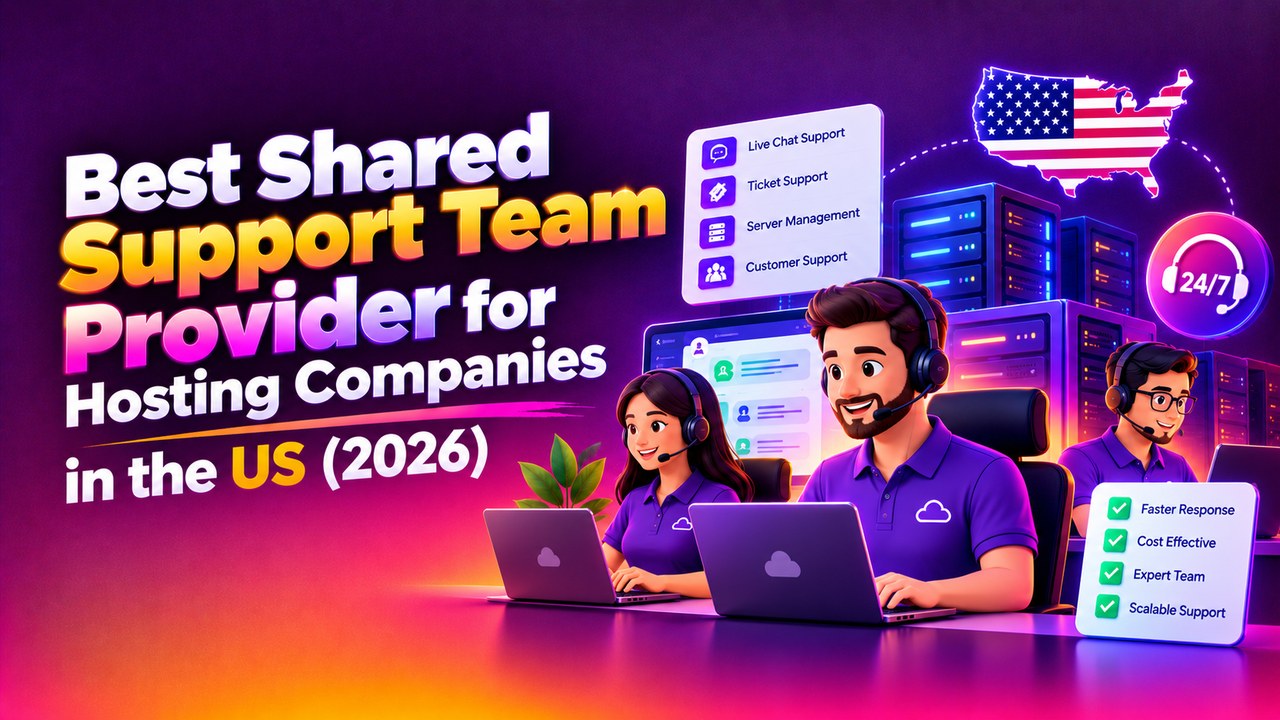
Hosting companies in the US live and die by response time. When a customer's site goes down at 2am, the difference between renewing a contract and churning to a competitor is often measured in minutes, not days. That's why more hosting providers are asking the same commercial question: what is the best shared support team provider for hosting companies in 2026, and how do you actually tell the good ones from the ones that just look good on a sales call?
This guide breaks down real pricing, the criteria that separate a genuinely reliable shared support vendor from a risky one, and a side-by-side comparison you can use today to shortlist providers for your own hosting business.
What Is a Shared Support Team, and Who Needs It?
A shared (or "pooled") support team is a group of trained technical agents who handle tickets, live chat, and NOC-level tasks for multiple hosting companies at once, rather than being dedicated to a single client. Because the agent pool is shared across several clients, the hourly cost per hosting company is significantly lower than hiring full-time, dedicated staff — while still delivering 24/7 coverage.
Shared support teams are the right fit for:
- Hosting companies with 200-5,000 active customers who can't yet justify a full in-house team
- Resellers and white-label hosting brands who need support to look and feel "in-house" to their end customers
- Growing hosting businesses that see seasonal ticket spikes (renewal periods, migrations, DDoS events) and need elastic capacity
- Founders who want to focus on sales and infrastructure while a specialist team owns the support queue
If you're evaluating whether a shared model or a fully dedicated shared team support plan is the right fit, the honest answer depends on ticket volume — which we cover in the pricing section below.
How Much Does Shared Support Team Pricing Cost in the US in 2026?
Pricing for outsourced/shared hosting support in the US market typically falls into three bands, depending on where the agents are based and how deep the technical escalation goes:
- Offshore-delivered shared teams (India, Philippines): roughly $8–$18 per agent hour, or bundled into flat monthly plans starting around $400–$900/month for shared-tier coverage
- Nearshore teams (Mexico, LatAm): roughly $20–$30 per agent hour — a middle ground for US companies wanting closer time-zone overlap
- Onshore US/UK/Canada-based teams: roughly $35–$60 per agent hour — the most expensive, usually reserved for premium or compliance-sensitive accounts
Some providers price per resolved ticket instead of per hour, typically landing between $1 and $7 per ticket depending on complexity (a routine password reset costs far less to resolve than a server-level incident). Dedicated hosting-support agents assigned full-time to one brand tend to run $1,200–$3,500/month, which is where the "shared" model earns its value — you get a trained hosting support agent without paying for a dedicated headcount.
Most US hosting companies report 40-60% cost savings moving from an in-house support hire to a shared support team, mainly because you're not carrying the overhead of benefits, training time, shift coverage, or recruitment churn for a role that experiences high turnover industry-wide.
What to Look for in a Shared Support Team Provider
Not all shared support vendors are built the same. Before signing a contract, run every candidate through this comparison table — it reflects the criteria that actually separate reliable vendors from ones that will cost you customers.
| Criteria | What "good" looks like | Red flag |
|---|---|---|
| SLA / first-response time | 30 minutes or less, guaranteed in writing | Vague "fast response" with no number attached |
| Platform expertise | Proven cPanel/WHM, Plesk, DirectAdmin, and WHMCS experience with references | "We can learn your stack" — i.e., you're the training ground |
| Coverage hours | True 24/7/365, including holidays and weekends | Business-hours only, with "on-call" as an afterthought |
| Escalation depth | L1 helpdesk through L3 server admin, all under one contract | L1 only, with server issues bounced back to you |
| Pricing transparency | Clear per-agent, per-ticket, or tiered plan pricing published upfront | "Contact us for a custom quote" with no ballpark given |
| Data security | NDA, role-based access, encrypted credential vaults, documented data-handling policy | Shared logins, no access controls, no written security policy |
| Scalability | Contractual ability to flex agent headcount for renewal season or traffic spikes | Fixed headcount regardless of your ticket volume |
| White-label quality | Tickets and chat branded under your domain and tone guidelines, invisible to end customers | Agents mention the vendor's name or use generic scripts |
Ask any provider you're evaluating to walk you through a live ticket queue and show you real average response times — not marketing claims. A provider confident in its numbers will show you the dashboard.
In-House vs Outsourced: Which Is Right for You?
The honest trade-off comes down to ticket volume and growth stage:
- Under roughly 500 active hosting customers: a shared support team almost always wins on cost — you get 24/7 coverage without the overhead of full-time salaries, benefits, and shift scheduling for a team that would otherwise sit idle during low-ticket hours.
- 500-5,000 customers, unpredictable ticket spikes: shared or semi-dedicated support gives you the flexibility to scale agent hours up during renewal season without a hiring cycle.
- 5,000+ customers with consistent, high ticket volume: a dedicated (fully allocated) team from the same provider often makes more sense — but you can usually transition from shared to dedicated with the same vendor rather than starting over.
The biggest objection founders raise is trust: "will my customers know this isn't my own team?" With a properly run white-label shared support provider, the answer is no — agents work under your brand name, your macros, your tone of voice, and your ticketing system, so the transition is invisible to the person submitting the ticket.
💡 None of these worked? Skip the guesswork.
Get Expert Help →Vendor Evaluation Checklist Before You Sign a Contract
Beyond the comparison table above, run every shortlisted provider through this checklist before you commit budget. Skipping any one of these steps is how hosting companies end up locked into a support vendor that quietly damages their customer relationships.
Ask the provider to screen-share a real, active ticket queue — not a demo environment. Look at actual first-response timestamps, not the SLA promised in the sales deck. A provider with nothing to hide will show you this in the first call.
Ask for named references from other hosting companies running the same control panel stack (cPanel/WHM, Plesk, DirectAdmin) and WHMCS billing setup you use. A generalist helpdesk vendor without hosting-specific experience will cost you more in escalations than it saves in hourly rate.
Find out exactly what happens when a ticket is beyond L1 scope — does it go to an in-house L2/L3 engineer at the same company, or does it bounce back to you? Providers that only offer helpdesk-level support look cheaper on paper but shift the hardest (and most costly) tickets back onto your own team.
Before moving your entire queue, run a 2-4 week pilot with a subset of tickets — password resets, basic DNS questions, low-risk billing queries. Measure resolution quality and customer satisfaction before scaling to your full support volume.
Confirm the contract allows you to scale agent hours up or down monthly, and that there's no punitive exit clause if the fit isn't right after 60-90 days. Hosting is seasonal — your support vendor's contract terms should reflect that.
How to Switch Support Vendors Without Disrupting Customers
Many hosting companies delay switching to a better shared support provider simply because they're worried about downtime or dropped tickets during the transition. In practice, a well-run migration follows a predictable pattern:
- Weeks 1-2 — Documentation handoff: transfer your existing SOPs, macros, canned responses, and known issue playbooks to the new provider so agents aren't starting from zero.
- Weeks 2-3 — Shadow/parallel support: the new team works alongside your current support (in-house or outgoing vendor), handling a portion of tickets under supervision while quality is verified.
- Week 4 — Staggered cutover: ticket routing and live-chat is switched fully to the new provider, typically timed outside your peak renewal window to minimize risk.
This phased approach means your customers never notice a service dip — tickets keep getting answered under your brand throughout the transition, and you retain a documented fallback plan if the new vendor underperforms during the trial weeks.
Common Mistakes Hosting Companies Make When Choosing a Shared Support Provider
After evaluating dozens of vendor relationships, a few recurring mistakes show up again and again among US hosting companies shopping for shared support:
- Choosing on price alone. The cheapest per-hour rate often comes from a generalist call-center vendor with no hosting-specific training — resulting in longer resolution times and more tickets bounced back to you, which erases the cost savings.
- Skipping the security review. Handing over server credentials and customer data without a documented access-control policy is one of the fastest ways to create a compliance or breach liability.
- Ignoring time-zone overlap. A fully offshore team with zero overlap with your business hours can create a communication gap for escalations that need your input in real time.
- Not testing before scaling. Committing your entire ticket volume to a new vendor on day one, instead of piloting with a smaller allocation first, removes your ability to course-correct early.
- No exit plan. Signing a long-term contract without a documented offboarding or contract-flexibility clause leaves you stuck if the relationship doesn't work out.
Why Hosting Companies Choose CloudHouse for Shared Team Support
CloudHouse Technologies runs shared support teams specifically trained on cPanel, WHM, Plesk, DirectAdmin, and WHMCS — the exact stack most US hosting companies run on. Plans are hourly and month-to-month with no long-term lock-in, agent capacity scales up automatically during renewal periods or incident spikes, and every ticket is handled fully under your brand. There's no forced annual contract and no minimum headcount commitment, which means you only pay for the support hours your customers actually need.
Frequently Asked Questions
How much does a shared support team for hosting companies cost?
Shared support plans typically run $400-$900/month for entry-level 24/7 coverage, or $8-$30 per agent hour depending on whether the team is offshore or nearshore. Per-ticket pricing usually falls between $1 and $7 per resolved ticket. Get an exact quote based on your ticket volume through CloudHouse's shared support plans.
Is outsourced shared support secure for handling my hosting customers' data?
Reputable providers use signed NDAs, role-based access controls, encrypted credential vaults, and documented data-handling policies before any agent touches your systems. Always ask a prospective vendor to show you their access-control setup in writing before onboarding — if they can't, that's a disqualifying red flag.
How long does it take to onboard a shared support team?
Most hosting companies can go live within 1-2 weeks. The first week is typically spent documenting your SOPs, macros, and escalation paths; the second week runs a shadow/parallel support period where the new team works alongside your existing process before taking over tickets fully.
Will my customers know the support team isn't in-house?
No — a properly run white-label shared support team operates entirely under your brand name, email domain, and support macros. Agents are trained to represent your company's tone and never disclose that support is outsourced.
Do shared support providers offer a trial or month-to-month plan?
Yes, most credible providers — including CloudHouse — offer hourly, month-to-month billing rather than locking you into a long-term annual contract. This lets you test response quality and ticket resolution before committing to a larger plan.
Choosing the right shared support partner is one of the highest-leverage decisions a growing hosting company can make — it directly affects churn, reviews, and renewal rates. Use the comparison table above to shortlist vendors, ask for real SLA numbers in writing, and start with a small trial period before scaling up your support hours.